NPR This is The Indicator from Planet Money.
I'm Darian Woods. And I'm Paddy Hirsch. Right now, following US strikes against Iran, perhaps the most watched corner of the world is a strip of water about 100 miles long and just 24 miles wide at its narrowest point.
It's called the Strait of Hormuz, and it's the gateway to the otherwise landlocked Persian Gulf.
It is important because roughly a quarter of the oil shipped in the world and a fifth of all the liquefied natural gas passes through this choke point the northern bank of which is part of the Republic of Iran.
Part of Iran's response to the bombing of its nuclear facilities was a vote in the Iranian parliament over the weekend to close the Strait of Hormuz though a final decision would lie with Iran's National Security Council.
Iran has threatened to shut the Strait down in the past. And while it has never actually done so, a lot of people are worried that this time could be different.
On today's show, we'll learn why the Strait of Hormuz has become such an important pressure point in geopolitics and whether Iran could indeed close it off and throttle the supply of oil to the rest of the world.
We'll also find out how the most important indicator of what might happen in the Strait could be the insurance industry.
That's coming up after the break.
This message comes from MetaAI.
MetaAI is the personal AI to help you with whatever you need.
Not only is MetaAI now an app, but it's also on the apps you already love, Facebook, Instagram, WhatsApp, and Messenger, plus the Ray -Ban Metaglasses.
It's easy to access wherever you are throughout the day.
Experience Meta's newest AI that's tailored to you by downloading the Meta AI app.
Try the Meta AI app today on the Apple App Store and Google Play.
This message comes from the Hartford. Every day, they make business insurance easy.
Or easier, anyway. And when it comes to business insurance for midsize and large businesses, they know just how complex it can be.
And businesses rely on them to make the complex challenges less so.
That's why at each step, from quotes to claims to everything in between, the Hartford is devoted to making it easier.
Connect with your underwriter at the Hartford or visit thehartford .com.
The Strait of Hormuz has been pivotal to trade in the Middle East for millennia, but it took on global importance after the Second World War.
That's when companies began drilling and extracting oil from the region in earnest and shipping it around the world.
And back then, pretty much every drop of the black stuff went through the Strait of Hormuz.
That is a route you have to take to transport oil from a number of Middle Eastern countries to their global destinations.
Elizabeth Braw leads the Maritime Threats Initiative at the Atlantic Council, a think tank.
If you can't go through the Strait of Hormuz, you cannot choose another route.
You either sail through there or you don't conduct your business.
Iran, Iraq, Kuwait, Saudi Arabia, Qatar, Bahrain and the United Emirates all ship oil and gas through the strait.
Some have tried to get around this choke point.
Both Saudi Arabia and the UAE have built pipelines that allow them to get some oil out of the region by land.
But pipelines are expensive to build and maintain.
And most of the oil and gas produced in the Persian Gulf still goes out by sea.
As we mentioned, that is a quarter of the global supply of shipped oil and a fifth of the world's supply of liquefied natural gas.
And this has put Iran, which owns the coastline to the north of the Strait of Hormuz, in a position of great potential influence.
It could, if it chose, throttle trade in the world's key energy sources.
Rachel Ziemba is an economist and strategist at the Center for New American Security.
This has been a well -known choke point for many, many decades.
And Iran has definitely threatened to block the straits.
They've never done it, but there have been times where it was much harder for vessels to get in and out.
For example, during the Iran -Iraq war in the 1980s, Iraq attacked Iran's oil tankers.
Iran responded by attacking shipping operated by Iraq's trading partners, as well as countries that loaned Iraq money to support its war effort.
it. Commercial shipping volume through the Strait of Hormuz dropped by 25 percent and oil prices spiked.
The Strait never actually closed, but this new conflict between Israel and Iran and now the United States is making some people worry that Iran might decide to flex its maritime muscle again.
It's far from a new thing to think about choke points, but with the escalation of conflict, exchange of fire, and just even the potential for accident, this is very much in focus right now.
Rachel says that if Iran did decide to act, it would probably not try to literally blockade the Strait of Hormuz.
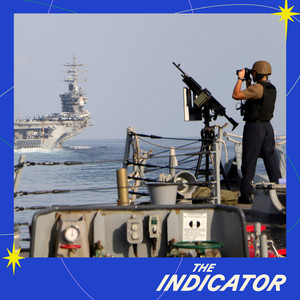
It's 21 miles wide, after all, and the U .S. Navy patrols the strait frequently.
But that doesn't mean that Iran couldn't inhibit traffic in other ways.
The issue is not only the territory, but also what could be done with vessels and drones to potentially make it harder to go in and out of the strait.
Also, Rachel says, Middle East watchers worry about missile attacks on energy infrastructure by Iran or one of its proxies in the region.
We're also maybe more worried about whether individual tankers might face attacks and damage There's a lot of scenarios out there which I think the market is struggling to price right now.
Even before the US bombed Iran and the Iranian parliament voted to close the strait, Rachel says that concerns about a deterioration of security in the region were already affecting shipping.
What is happening right now is that a number of fuel producers are encouraging tankers to wait outside the straits and only come in, say, the night before they're going to be refilled.
I would call it just -in -time gas or oil refilling.
What's more, Rachel says, insurance companies were beginning to boost premiums for ships that wanted to navigate the strait, but enough to make them want to keep their time in the channel to a minimum.
The result is now there's a bit of a traffic jam in the Arabian Sea on the other side of the strait from the Persian Gulf, and that implies complications in an already complex area.
There are risks in this kind of traffic jam.
There was, for example, a collision of two vessels.
It hasn't been confirmed that it has anything to do with the escalation of regional tensions, but in this time where there's a lot of attempts to avoid financial sanctions and the like, this is just a time of greater uncertainty.
That uncertainty, compounded by the American bombing, has rattled the oil market.
Prices for oil rose as much as 10 % after Israel first struck Iran on June the 13th.
But as of Monday, prices retreated, falling 7%.
That volatility affects everyone, whether or not they buy oil directly from the Gulf states.
The US, for example, buys hardly any oil from the Gulf.
But oil is priced in a global market, of course, so a shortage in supply resulting from a blockade of the Strait of Hormuz would still affect Americans.
Closing the strait, then, is a way for Iran to retaliate and strike at the U .S. economy.
But Rachel Ziemba and Elizabeth Braw say that a blockade or an attempt to slow shipping would anger most of the rest of the world and alienate potential supporters.
It would also inhibit Iran's ability to supply oil to one of its most important customers, China.
All of this means that a blockade, even a partial one, just doesn't look likely, even after the bombing campaign by the US.
Elizabeth Braw says her key indicator for tensions in the Strait of Hormuz is the maritime insurance market.
Maritime insurance is indispensable for anybody trying to understand maritime threats.
That is where the best knowledge resides, simply because if you as the insurer or as the insurance industry, if you get it wrong, you will be paying a lot of money when one of the ships that you have insured is harmed in some way.
Yeah, they have skin in the game, not just pontificating on the couch like you or me.
Like real money involved.
Yes. And Elizabeth says to monitor the insurance world, she keeps a close eye on risk assessment reports issued by something called the Joint War Committee.
The Joint War Committee.
That sounds like a fairly belligerent title for an insurance organization.
These insurance companies can get punchy, right?
The Joint War Committee is a group of representatives of maritime insurance companies that monitor seaways and issue threat warnings.
And they've got a pretty good record. They predicted Russia's invasion of Ukraine in 2022, for example, when most analysts thought Russia wouldn't invade.
And despite the attacks by Israel and the U .S. on Iran, the Joint War Committee seems relatively sanguine about the risk to shipping in the Strait of Hormuz right now.
The Joint War Committee has not told its members that they should stop sailing through the Strait of Hormuz.
The international shipping community is pretty calm about the situation in the Strait of Hormuz simply because they know that even though tensions are indisputably high and even though there is violence, it is unlikely that that violence will spill into attacks on shipping in the Strait of Hormuz.
A blockade on international shipping by Iran would inflame tensions and alienate allies and trading partners, Elizabeth says.
The reaction from the world's nations would be so severe, she says, that it would be a price not worth paying.
This episode was produced by Cooper Casper Kim with engineering by Patrick Murray.
It was fact -checked by Tyler Jones.
Julia Ritchie edited this episode, and Kate Kincannon is the show's editor.
The Indicator is a production of NPR.
is reaching the right audience.
That's why you need LinkedIn ads.
You can target your buyers by job title, company, role, seniority, and skills.
All the professionals you need to reach in one place.
To get a $100 credit on your next campaign so you can try it yourself, just go to linkedin .com slash results.
That's linkedin .com slash results.
Terms and conditions apply only on LinkedIn ads.
This message comes from Mint Mobile.
If you're tired of spending hundreds on big wireless bills, bogus fees, and free perks, Mint Mobile might be right for you with plans starting from $15 a month.
Shop plans today at mintmobile .com slash switch. Upfront payment of $45 for three -month, five -gigabyte plan required.
New customer offer for first three months only.
Then full -price plan options available.
Taxes and fees extra.
See Mint Mobile for details.
This message comes from Capella University.
At Capella, you'll learn relevant in -demand skills you can apply in the workplace right away.
A different future is closer than you think with Capella University.
Learn more at capella .edu.