We are living in interesting times, a turning point in history.
Are we entering a dark authoritarian era or are we on the brink of a technological golden age or the apocalypse?
No one really knows, but I'm trying to find out.
From New York Times Opinion, I'm Ross Douthat.
And on my show, Interesting Times, I'm exploring this strange new world order with the thinkers and leaders giving its shape.
Follow it wherever you get your podcasts.
From The New York Times, I'm Rachel Abrams, and this is The Daily.
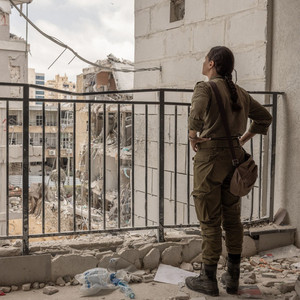
After President Trump's announcement of a ceasefire between Israel and Iran, all sides are claiming victory.
But perhaps no country has emerged as a bigger winner than Israel.
home. Today, my colleague Patrick Kingsley explains how Prime Minister Benjamin Netanyahu helped to steer events to this moment and what might come next if a ceasefire holds.
It's Wednesday, June 25th.
So Patrick, early this morning, President Trump was furious that Iran and Israel had continued to attack each other in the hours before the ceasefire that Trump very proudly announced was supposed to take effect.
The president even said, they don't know what the blank they're doing, but he used a word that rhymes with schmuck.
And what he was really angry about, it seemed, was Israel.
Specifically, he did not want Israel to continue dropping more bombs.
He basically said or demanded that they were going to turn their fighter jets around.
And so I think the question on everybody's mind right now is, will the ceasefire actually hold?
You never know with the ceasefire, particularly in its opening stages.
These arrangements can always break down and they can sometimes result in short spasms of violence before returning to calm.
But as we're talking on Tuesday night here in Jerusalem and 2 p .m. Eastern time over where you are, it does seem to be holding.
The Israeli military issued an announcement a short while ago in which they said life could return to normal in Israel.
And that's a sign that the Israeli security establishment no longer think that Iran is on the verge of firing missiles into Israeli civilian areas.
Can you tell us a little bit about how this deal came about?
Our colleague Maggie Haberman reported that even some of Trump's closest advisors were caught off guard by his announcement last night.
Well, everything happened in fast forward from roundabout Sunday morning onward. President Trump ordered U .S. planes to bomb three key nuclear sites that Israel had not been able to destroy.
Then on Monday, Iran essentially decided to de -escalate.
Instead of firing lots of missiles at lots of different American air bases and interests across the Middle East, they fired simply at one U .S. military base in Qatar, which was seen as a kind of signal that Iran wanted to respond in a somewhat token way.
And then President Trump suddenly announced that he had brokered a deal between Israel and Iran.
The deal is a little bit murky.
We're not quite sure how it came about.
But we do know from from other reporting by my colleague here, Adam Raskon, that the leadership of Qatar was essential to communicating between Israel and Iran.
And within hours, the Iranians said that they were on board with this plan.
Israel was still silent, and both sides continued to strike each other.
But then, as the morning wore on, not much more than 12 hours after Iran had struck the American airbase, the fighting seemed to subside.
And by mid -morning, the Israeli government had announced that they too were party to this deal.
And barring another attack or two from either side, the ceasefire has since held.
And it's all happened in surprisingly quick time.
We've gone from being in a situation on Saturday night where we were braced for the outbreak of a much broader conflict involving the U .S. across the Middle East to a situation where the Israel -Iran war of 2025 has been contained to just 12 days.
Now, it was still very deadly.
In Iran, more than 600 people were reported dead.
In Israel, up to 30.
But the bloodshed still came came to an end much more quickly than some had feared.
That 180 -degree turn that you described really is just so stark.
The fact that we went from the possibility of this wider war to a ceasefire in just a couple days, it does make me wonder about Israel in all of this, because they were the ones who were lobbying for U .S. involvement for months.
What have they gained in all of this?
In truth, Israel is the biggest winner.
it. For years, Israel perceived Iran as the biggest threat to its long -term future.
And Netanyahu had made it his life's goal to launch a military attack on Iran big enough to set back its military capabilities and its nuclear program, and in particular, its missile program.
Now, we've just seen an early report from several of our colleagues that an initial assessment by the U .S. government says that the Israeli and American strikes may have only set back Iran's nuclear program by less than six months.
But nevertheless, Iran's program is in a worse state than it was two weeks ago.
go clearly some nuclear sites have been damaged iran no longer seems to have the ability to fire huge barrages of ballistic missiles at israel so the optics of this remain that this is a big win for israel even if we're uncertain about the exact nature of the details of that win and in particular it's a big win for Netanyahu, who, if we remember at the start of the war with Hamas back in October 2023, was facing political oblivion.
He was seen in Israel as a man who had presided over the worst military catastrophe in Israeli history.
And yet now he can claim, following the Iran campaign, to be the architect of one of Israel's greatest military victories.
So how did Netanyahu, in fact, pull all of this off?
It's a combination of his long -held ambition, a sequence of unforeseen events, and then, as time went on, a series of decisions by both Netanyahu and his military leaders that allowed him to get to this point.
The timeline arguably starts on October 7th, when Hamas, which is an ally of Iran, surprised Israel with the deadliest attack in Israel's history.
Netanyahu was at the helm on that day, and that ruined his credentials in the eyes of many Israelis.
He and his party plummeted in the opinion polls and he was at a kind of political nadir.
Because people blamed him for this attack.
At least in part. He was blamed along with the leaders of Israel's security establishment.
And it seemed like this was close to the end of his political career.
But then as time goes on, the war against Hamas evolves into a slightly wider war against Hamas and its regional allies.
And that leads to a series of decisive confrontations in the second half of last year, 2024, that essentially allowed Israel, if not to entirely defeat Hamas's ally in Lebanon, Hezbollah, to assassinate its top leadership, severely weaken its military capabilities and force it back from the Israeli border.
And that also had a knock -on effect in Syria.
It meant the Syrian government, which was a key ally of Iran, collapsed under pressure from rebel groups in Syria.
And it did so in part because Iran and Hezbollah could no longer come to its aid because they were substantially weakened by this growing conflict.
And that in turn sucked Israel and Iran into a more direct confrontation.
They had been fighting what we call a shadow war, where mostly they were attacking each other through secret and unannounced attacks, sometimes cyber attacks, sometimes assassinations.
And that all broke out into the open as a result of this war with Hamas developing into a more intense regional conflict throughout the course of 2024.
And so we enter 2025 in a situation that Israelis, by and large, could not have imagined at the start of this war.
Instead of being humiliated by Hamas, suddenly Israel was increasingly dominant.
And that created what many Israeli leaders, including Netanyahu, thought was a window of opportunity in which Iran was historically weakened and unable to likely rely on its network of regional proxies and allies to come to its rescue in the event of a massive Israeli attack.
And Netanyahu and the Israeli military leadership began planning for such a massive attack.
Okay, Patrick, just to make sure I have this right, it sounds like this is the story of Israel having this ambition for a very long time to take out Iran and its allies.
But it has not been in a position to do this because of this risk of a wider war that certainly the United States has been worried about.
But that risk of a wider war now does not look as great as it has been all these years because of all the different conditions that you described.
Is that right? Yes.
And if we want to add an extra factor into what made all this come together, it was the effect of October 7th on the Israeli psyche.
To critics of Israel, October 7th was caused in part because Israel did not end its occupation of the West Bank or its blockade of Gaza.
And there was an eruption in response to that.
For many Israelis, they've concluded the opposite, that October 7th happened because Israel allowed a threat, Hamas, to grow in strength along its borders.
And Israel did not do anything about it soon enough.
And so the lesson that many Israelis have learned from that is that they need to act preemptively and decisively in order to take out such a threat.
And we've seen that, first of all, with Hamas in Gaza, but also with Hezbollah in Lebanon.
And now with Iran. Exactly.
And what made all of this also come together was the arrival in the White House of President Trump, who, despite making contradictory statements over the last weeks and months has become a crucial partner in Netanyahu's and Israel's campaign in Iran over the last 12 days.
And to be clear, Trump's support in this war was never actually a given until literally the bombs were dropping.
Their relationship has blown hot and cold, but he set about from very early on in Trump's presidency, even as Trump was signaling that he wanted to negotiate with Iran in order to get Iran to limit its nuclear ambitions.
Netanyahu was trying to get Trump to back his military ambitions against Iran and back his vision of destroying Iran's nuclear program, not through diplomacy, but by military force.
Our colleague Jonathan Swan told us this whole backstory of Netanyahu coming to the White House.
He insists that Iran is very, very close to getting a weapon closer than they've been in recent times.
And Trump is still not convinced that force is the answer.
He still wants to try diplomacy.
And Netanyahu argues that the only way that diplomacy is going to work is if Trump shows some force.
And Trump is still not buying it.
He says diplomacy first, but gets increasingly frustrated when Iran seems like it's not actually very serious about making a deal.
And as we know, Israel just attacks anyway.
They let the United States know they're going to go it alone with her without U .S. help.
But Netanyahu seems to have made a very strategic bet that Trump would eventually give Israel the support that it would need, which, of course, is what happens.
Yes, exactly. So to drag in President Trump and the United States Air Force into its attack was an incredible coup for Netanyahu.
When Israel did attack on June 13th, They didn't know whether Trump or the American Air Force would join them.
They did eventually some eight or nine days later.
And that was, in hindsight, what allowed the war to end.
It allowed Israel to feel that it had achieved its main objective, the strike on Fordow.
It then brought about an endgame where Iran fired back against the American airbase in Qatar.
And that then created a situation in which all sides could de -escalate.
So this feels like a huge victory for Israel and a huge moment, even if we don't quite know the scale of that victory, or what exactly will happen next.
We'll be right back.
why journalism matters.
Our job is to bring home facts, help our readers understand what's happening, regardless of what the consequences may be to us.
And if they punish us, so be it.
We will still go out there and report as honestly and aggressively and fairly and truthfully as we can.
I mean, if the New York Times were not at the White House asking the hard questions, looking for stories behind the stories, trying to understand what's going on, it's possible these questions don't get asked.
Independent reporting requires resources.
You can support it by subscribing to The New York Times at nytimes .com slash subscribe.
So Patrick, I want to talk to you about what happens next here, because it seems like both President Trump and Benjamin Netanyahu are assuming that these attacks go a long way to set Iran's nuclear program back, which has been the stated ambition of Israel for a very long time.
Do we think here, though, that the point for the United States and maybe also Israel is to get Iran to make a nuclear deal?
Because my impression has been that that's what the United States wants, but that's not what Israel has been wanting out of this.
I think there's a lot of nuance here.
Maybe the best place to start is to remember that when an American president, Barack Obama, last tried to negotiate a nuclear deal with Iran that limited Iran's nuclear program, Israel was fundamentally opposed to it because, in essence, they said it did too little to limit that nuclear program and did too little to limit its regional ambitions.
Now, there's a world in which Israel is less resistant to a new deal brokered by President Trump.
So just hypothetically, a deal between the United States and Iran would be easier if Israel wasn't objecting to it, right?
And we don't actually know whether Iran is going to come to the table and negotiate with the United States, but there is a scenario in which they do.
And if those talks did lead to a deal that would seem to make it true what Netanyahu had told Trump when he met with him months ago, which is that diplomacy is only going to work with a show of force.
I think you can argue it both ways, depending on your perspective.
On the one hand, it could be that having been reduced to a position of greater weakness by this 12 -day war, Iran feels too scared to continue its nuclear program, Or in fact, galvanized to accelerate even faster towards a nuclear weapon, precisely because it feels it has not got very much time to do so before perhaps a future Israeli attack.
And it wants to create an insurance policy against future aggression by creating the very thing that Israel had wanted to prevent it from getting its hands on in the first place.
It sounds like what you're saying is that two possible scenarios are diametrically opposed to one another.
We don't know what's going to happen, but it is possible that what has transpired over the past week and a half or so has brought the U .S. closer to a deal with Iran.
And another scenario is that it is possible that what's happened has made it much, much harder to get a deal.
Both those things are possible.
Time will tell. Patrick, can we just talk about one of these scenarios, this idea that none of this leads to a deal.
In that situation, could Israel even call this whole operation a victory?
Well, fundamentally, Israel fears a nuclear Iran.
And if it sees that Iran actually has not been set back hugely by this 12 -day war, the possibility arises that they will attack again and again and again, if necessary.
What they've done in these last 12 days is to break Israel's fear barrier about attacking Iran.
The challenge for Israel in resuming such attacks on Iran is that they are immensely costly for the Israeli economy and an immense strain on Israel's air defense system.
Israel has only a finite amount of missile interceptors, and the longer a conflict with Iran goes on, the more missiles Iran fires, the more interceptors Israel must fire in response and the greater the risk that a missile is going to slip through and cause a mass casualty event.
And these are all factors that may limit Israel's future ambitions of striking Iran's nuclear program, even if it does turn out that those nuclear sites have sustained less damage than Israel and the U .S. previously said.
I'm a little bit surprised, Patrick, that when you were talking about the limitations of Israel's military capabilities to attack Iran, you didn't mention the other front of this conflict, which, of course, is happening in Gaza, where Israel has been waging this war against Hamas for the past 20 months or so.
I'm just wondering how what happened in Iran over the past 12 days affects the war in Gaza.
There's now growing expectation that actually there could be a knock -on effect in Gaza as a result of all that's been going on in Iran in recent days.
Whatever the final assessment of the Israeli strikes on Iran's nuclear program, it is still perceived as a big victory in Israel for Prime Minister Netanyahu.
He is now seen as the prime minister that dared to take the fight to Israel's biggest enemy, Iran.
And that seems to have boosted his confidence.
Some polling suggests it has put him in one of his strongest positions since the start of the war in Gaza in October 2023.
23. And analysts and allies of Netanyahu are saying that this now gives him a bit more room for political maneuver to potentially make a deal that ends the war in Gaza.
We're still several steps away from that.
But if he has increased his popularity, it could allow him to to be more flexible in the negotiations over the future of the Gaza war, because he is now less beholden to hardliners in his coalition who have threatened to collapse his government and send it to early elections that previously Netanyahu risked losing.
Now he stands a fighting chance chance of winning a future election, which means that he's potentially less worried about making a move in Gaza that leads to the collapse of his coalition government.
And that's why people think that in the coming weeks, we could be moving towards an endgame in Gaza, just as we've reached an endgame in Iran.
Okay, so because the war with Iran makes him more popular, Netanyahu is not as reliant on this hard right group that he has needed up until now and had insisted on him continuing the war in Gaza and been very reluctant for a deal.
And what you are saying is that now he has more ability to kind of ignore the far right because he has other constituencies that like him now that he might be able to build off of.
Yes, because he's taken a big step that many Israelis, even his critics, have applauded, that may mean that he stands a better chance of winning a snap election if his government does collapse.
Of course, all of this is still in the realms of the hypothetical, and we don't quite know how things are going to play out.
But certainly the mood in Israel on Tuesday Day was one of greater optimism about the sense that there could be a truce that would release the dozens of hostages, both dead and alive, who are still held in Gaza.
You know, in a way, it sounds like regardless of the outcome in Gaza, Netanyahu has actually managed to turn the tide of at least a significant portion of domestic public opinion in favor of him and what he's doing with Iran.
And he's been able to rally a certain amount of support behind him at a time when maybe that support was kind of waning because of what was happening in Gaza.
And that kind of political machination, it makes me understand sort of how he's held onto power for so long.
I think what we've seen in the last few weeks is Netanyahu at his peak as a mover and shaker, as a politician.
And he's ended up, at this point, in an infinitely stronger position than he was at the start of this long 20 -month crisis in October 2023.
So we see a prime minister who has perhaps achieved one of the greatest political comebacks in the history of Israel, if not the wider region.
this came about not through intricate and well thought out planning over the past 20 months it it came about because of incremental and in some cases fortunate developments that were beyond netanyahu's control and that he simply took best advantage of as time went on and the sum total of of both those unforeseen events and Netanyahu's ability to take advantage of those events has led us to where we are today.
Patrick, thank you so much. Thank you.
We'll be right back Here's what else you need to know today In the closely watched Democratic primary For mayor of New York City Zoran Mamdani A 33 -year -old Democratic socialist has taken a major lead over former Governor Andrew Cuomo, who conceded that he had lost the race.
Tonight was not our night.
Tonight was Assemblyman Mandani's night, and he put together a great campaign, and he touched young people.
The winner of the race may not be official for days.
But what's clear is that at a time when national Democrats are struggling to find a message, Momdani's unabashedly left -wing agenda has found a large audience among Democrats in New York City Today's episode was produced by Mary Wilson, Shannon Lin, and Rob Zipko It was edited by Paige Cowett and Patricia Willans Contains original music by Dan Powell, Leah Shaw -Demeron and was engineered by Alyssa Moxley.
Our theme music is by Jim Brunberg and Ben Landsberg of Wunderli.
That's it for The Daily.
I'm Rachel Abrams. See you tomorrow.