Hi, I'm Lindsay. And I'm Marshall.
Welcome to Tumble, the show where we explore stories of science discovery.
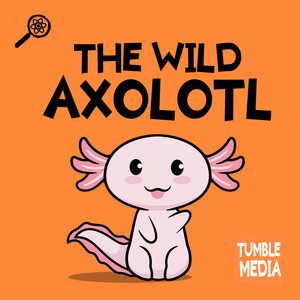
Today, we're talking about axolotls.
Have we got axolotl facts about them?
Yes, we do. Maybe you already know about axolotls from Minecraft, but in real life, they're from Mexico.
We're going to find out how axolotls spread around the world and what scientists are doing to save them in the wild.
Today's question comes from Maximiliano from Mexico City.
He sent his question in Spanish.
Hola, soy Maxi y tengo 10 años.
Vivas ciudad de Mexico.
Me gustaría saber porque viviel más agolote son peseras que los ríos y lagos.
In English, Maxie is 10 and he wants to know why are there more axolotls in fish tanks than there are in lakes or rivers, and wait, are there more axolotls in fish tanks?
Is it just like one fish tank?
There are a lot of axolotls in aquariums and fish tanks all over the world and Maxie must kind of be an axolotl expert for knowing that.
I also didn't know that the word for axolotl in Spanish was aholote, which really does roll off the tongue a lot better.
I agree. So let's ask our listeners at home, because maybe they're axolotl experts too.
Why do you think there are more axolotls today living in fish tanks than in the wild?
And how do you think scientists would find out?
Think about it, because we'll be back with an axolotl veterinarian!
Someone who just like, just an axolotl doctor.
Yes! And we'll meet him soon.
So, we found the perfect person to help answer Maxi's question.
My name is Horacio Mena.
I'm a medical veterinarian.
Horacio is a veterinarian who cares for and studies axolotls in the wild.
So he's like a vet scientist like like a superhero kind of When we think of veterinarians we immediately think of animals and the wonderful work that goes into understanding them I work at a biology Institute at a university and I'm currently working on a project with axolotls Rasia grew up near the place where axolotls are originally from and the only place where you can find them in the wild Oh, wait, there's just one place?
Where's that? It's an area of Mexico City called Xochimilco.
Okay, so Xochimilco, is that like the neighborhood where axolotls are hanging out in little coffee shops?
No! But it is a really special place.
It's full of lakes and little islands separated by canals.
And when Horacio was a kid, he and his mom would go there to buy flowers.
I see. Xochimilco is a place where you can buy lots of plants.
There are important dates like Christmas where you can buy the poinsettia or Dia de los Muertos where you can buy those little yellow flowers.
Oh, so it's like a flower market.
Well, there's way more to it than just flowers.
There's also music, food, and these really colorful boats called trajineras that people can rent to tour the canals.
Lots of tourists go there.
Sounds amazing! So I guess, just like… There's flower shops, there's these beautiful canals, and there's just like axolotls jumping around everywhere.
So like, was that what Orássio's experience was as a child?
You'd think so, but actually, no. The first time he saw an axolotl in Xochimilco, it was in a fish tank.
So we're coming right back to Maxi.
When I was a kid, I saw an axolotl in a fish tank.
It was a surprising sight sort of strange looking because it was standing on four legs about as long as a fork and a half very attentive very Observant I mean it's one of those first impressions you have and it stays in your mind, right?
So it sounds like it really made an impression on him.
It's a fork and a half with little legs We should use Forks as units of measurement more Yeah, or as you thought that the axolotl was super cute They are!
It's totally true. They're little aquatic salamanders with funny gills that look like feathers.
And it's true that the axolotl has a really distinctive face.
It always looks like it's smiling.
Little cutie little guys.
If you look at its little face, it looks like it's always laughing, right?
So it has resting happy face.
Yes, resting happy face.
And they're not just cute, they're also an important part of Mexican culture and mythology.
Early Mexicans, the Aztecs, thought that they were the aquatic form of one of their gods.
So, the aquatic form, like, were they transforming gods and stuff?
Like, what's the story there?
The story is about one of two brother gods that Arrasio compares to two other brothers who Marvel fans might be familiar with.
I always give the example, for those who like comics, I tell them imagine it's like Thor and Loki.
Ones tall, blonde, strong, standing there with his hammer, and then there's Loki who's smarter, quicker, has more spark, more everything.
The Aztec version of Loki was called Xolotl, and as the story goes Xolotl morphed into a salamander in order to avoid being sacrificed.
That's the origin of the axolotl.
Wow. So that's where the name axolotl even came from.
Yeah, and like a god axolotls have a special power.
Can you guess what it is?
I mean, I think it's super strength.
Like I know you see axolotls walking down the street like lifting cars and stuff.
So that's not something you see.
And that's not what it is.
That's right. They don't walk down the street.
Yeah, no, axolotls can grow back body parts if they lose a finger, an arm or a bit of their tail, they'll grow it right back really quickly.
If it loses a hand, it can grow it back.
Another one will grow back in just 15 days.
I guess I've heard that's what axolotls in Minecraft do, like giving players regeneration powers.
Yes. It's an awesome superpower that works well in Minecraft, just like real life.
Sure. But that goes all the way back to when European explorers discovered the axolotls and its amazing limb -regrowing properties for themselves when they traveled to Mexico in the 19th century.
They brought axolotls back to Europe to study them.
Oh my gosh, so many amazing things came from Mexico like tomatoes, corn, chocolate and lots of really good music, like really good music, but also axolotls!
Axolotls are surprisingly easy to breed in captivity.
So now, scientists estimate that there are over 1 million axolotls under human care.
Wow, so that's how we ended up with so many axolotls in aquariums and labs around the world.
But why are there so few in the wild?
We'll get to that soon.
For now, let's get back to after he saw the axolotl in the fish tank he kind of forgot all about them.
wait how could you forget about little cutie axolotl smiley faces?
well amphibians weren't really his thing at the time but he loved all types of other animals so he became a vet.
in those years we all wanted to be veterinarians taking care of jaguars, of wolves or dogs or birds or hawks.
In fact, amphibian medicine wasn't even a class you could take.
Eracio got a dream job working in Mexico City's biggest zoo with tons of cool animals, but one day he got an unexpected call from a team of biologists who wanted to implant small transmitters in axolotls.
Oh no, so they want to make like axolotl walkie -talkies or something?
Not at all. They wanted to look for a way to track where axolotls were and what they were doing.
The transmitters could help them do that.
The problem was, no one knew how to implant those little devices and little axolotls without injuring them.
They asked me, Hey Horacio, do you like experimental surgery?
Do you want to do this project?
And I said yes, I'll give it a try.
I didn't know what I was getting into.
And that was the moment when I started to develop a special surgery to be able to put a transmitter on an axolotl and follow it everywhere.
Horacio's job was to develop a surgery that wouldn't be harmful to the axolotls.
And to do this, he had to learn everything about the axolotl.
I had to read, I had to learn about the axolotl how its heart, its lungs, its kidney, its brain works, what things I could use to be able to perform the procedure.
It even allowed me to develop surgical techniques aimed at the conservation of animals.
So was Horacio able to do the tiny transmitter surgery?
He did! And along the way, Rosio became obsessed with axolotls!
Who wouldn't? You fall in love with the animal, you get to know it!
We became great friends because there came a time when I said, I don't want to work at the zoo anymore, I only want to be with axolotls!
Yeah, I mean, not surprising, he really fell hard for the little guys.
I can't say that I blame him, they are very cool.
Yeah, but a hard part of learning to love axolotls is knowing that they're actually an endangered species in their own home, the lakes and canals of Xochimilco.
I don't know. Erasio says that if axolotls disappear from Xochimilco entirely, it would be a huge loss.
We'd lose, oh my gosh, we'd lose so much. We'd lose part of our identity Because the axolotl has always been a species that historically played a really important part in our country, like, for example, the bald eagle in the United States.
Oh, no! But how can we stop axolotls from disappearing in their home country?
To find out, we're going to take a journey to Xochimilco with Aracio right after this quick break.
Tumble is brought to you with support from IXL Learning.
IXL is an online learning platform that enriches your home school curriculum and enhances your kids' learning goals no matter where they go to school.
It offers practice in math, English language arts, science, and social studies while adapting to each child meeting them exactly where they are.
Plus, IXL encourages kids to be curious and empowers them to take control of their own learning.
My son has been using IXL to keep up on topics that aren't being covered in school right now.
And I really love the way that IXL's dynamic platform tracks his performance, gives him immediate feedback and corrections and really helps him stay on top of things.
IXL lets him choose which topic to study, gives him real time feedback and helps him take charge.
Make an impact on your child's learning.
Get IXL now in Tumble Science podcast for kids listeners can get an exclusive 20 % off IXL membership when they up today at ixl .com slash tumble.
Visit www .ixl .com slash tumble to get the most effective learning program out there at the best price.
calling all kids in the car, Brittany and Meredith here from the chart topping family road trip trivia podcast. Are you dreading another silent car ride with the We've got The Cure three rounds of fresh trivia every single week.
Movies, music, even science and Disney.
We've got something for every trivia buff in the car.
No more crickets chirping on those long journeys.
The Family Road Trip trivia podcast is your secret weapon for connecting and laughing with kids of all ages.
Teens, toddlers, adults, it doesn't matter.
Spark their curiosity and challenge their brains with every episode.
New episodes drop weekly wherever you get your podcasts.
Search for the Family Road Trip Trivia podcast and turn those car rides into epic adventures.
We're back and we're going to explore the axolotls' native habitat, the waters of Xochimilco near Mexico City.
Remember how I said earlier that Xochimilco is a a big tourist draw with music, and food, and colorful boats?
Well, Kerasio gets to see a part of it that most people don't.
It's not the touristy part, it's the axolotl part.
And it's super different.
Sochimalco is an idea of what ancient Mexico was.
Pre -Hispanic Mexico.
Which was all water.
So, imagine the sensation that you start to get into your boat and you go into the water the air starts to change.
You breathe fresh air.
You're on your boat listening to the water.
Little by little the noise of people goes away.
That sounds really peaceful.
Yeah let's imagine that we're in that colorful boat with Horacio exploring the canals.
You see a heron flying, you see pelicans, you see trees you've never seen before because it's your first time there.
In the distance you can see a fisherman throwing his net into the lake.
You can also see as you go along in your boat farmers who are toiling the land, they're planting flowers, they're planting food or corn, or vegetables.
And it's so relaxing where you no longer feel time.
Time passes! But you're not like you were a few minutes ago in the city.
So more or less that's like an idea of entering Xochimilco.
Well, Horacio really seems to love the place.
He really does, and he knows a ton about it.
He's going to explain the three main reasons why axolotls aren't doing well in Xochimilco anymore and what scientists are trying to do to save the species.
Okay, what's the first?
There was a boom in urban growth.
The water that supplied Xochimilco some natural springs was piped in to bring water to the city.
And then Xochimilco began to dry up.
There were only small places left in Xochimilco where axolotls can survive.
So, a lot of the canals just dried up.
Yes, only a tiny portion of the original wetlands are left and axolotls need those to survive.
And here's the second problem.
Sometime in the 1970s, the government had the idea of encouraging locals to introduce carp into lapya into the water for people to go fishing and have food, but that turned out to be a terrible idea for the axolotl.
The carp and tilapia arrived and began to compete with the axolotl.
I see. So on the one hand, the wetlands are disappearing and on the other, there's also new kinds of fish in the wetlands that exist that are preying on animals like axolotls.
Yeah. And the last problem is that the quality of the water has gotten much worse due to so much pollution from the growing city.
And water quality matters a lot to axolotls.
The axolotl is one with water.
I'll tell you what I mean.
If there is any change in the water, any variation of temperature, humidity, whatever...
its body instantly feels it.
So if the water quality is bad, it's bad for the axolotl that gets sick.
Oh man, so there's like a lot of things the axolotls up against. Poor little guy.
Yeah. With all of these changes, biologists in Mexico started to worry.
They wanted to know how many wild axolotls live in Xochimilco's waterways.
So, starting in the late 1990s, they decided to measure the number of axolotls that were there.
What'd they find? Well, their numbers have gone down a lot.
But the first ever count found about 6000 axolotls per square kilometer.
That's a little less than a square mile.
But 16 years later, there were just 35 per square kilometer.
Wow, from 6000 to just 35, that's a really steep drop!
Yeah, that's why axolotls officially became an endangered species.
And, Orazio told us about three things that scientist have been trying in order to save them.
Okay, let's hear them.
Well, first they tried removing the carp and tilapia from the waters of Xochimilco.
But the problem is, carp and tilapia reproduce really quickly, and their numbers would just shoot back up no matter how many times they were removed.
Scientists could tell that wasn't going to work.
Well, that's a bummer.
Yeah. So they came up with a different idea that involves working with the local farmers of Xochimilco called chinamperos.
They farm on these little floating parcels of land called chinampas.
Chinampas. Got it. The head biologist in Oracio's lab noticed that some chinampas in Xochimilco had been abandoned for many years, so he had the idea to turn them into refuges.
We call them refuges because they're designed specifically for the axolotls to live in.
They're not in direct contact with the areas where there are carp and tilapia.
So, together with the farmers, Horacio and his team are taking some of those abandoned chinampas and digging ditches in them.
Like the Chinampas, in general, where the water is very permeable.
The soil of the Chinampas is very permeable.
So the water gets in as if it were a sponge.
So the ditches that we dug begin to fill with water, creating new little canals and what's the advantage?
You're not going to have carp.
You're not going to have tilapia.
And you can recreate an ecosystem that's very similar to the axolotl's original habitat.
That's interesting.
So they're, like, recreating mini -versions of the axolotl's original habitat?
Exactly. And to make sure they stay free of carp and tilapia, they've designed these cool barriers made of plants and other organic matter.
They're placed around the edges of the chinampas, and they serve two purposes.
First, to improve the quality of the water for the axolotls' protected refuges, and to keep the carp and tilapia out.
Okay, so it's not like plastic, it's just all natural stuff.
Yeah, and on the chinampas, they've planted lots of the plants that axolotls like to eat, and also the kind that grow underwater roots that axolotls use as shelter.
And when these new habitats are, we call it mature, When enough time has passed when you see insect communities and little fish establishing themselves Now you can introduce your axolotls in small underwater cages to confirm that your refuge is working It sounds like a great idea.
So is it all working?
Well, it's too early to know for sure Rocio's team just conducted a new survey of axolotls this year, but they're still finding out what the results will be So, I guess this is a little bit of a to -be continued.
Exactly. But they're trying another idea at the same time to boost up the number of axolotls in the wild.
They're taking axolotls who have lived their whole lives in fish tanks and labs back to Xochimilco and putting them into the canal.
Wow, I wonder what that feels like for the axolotl.
Is it like when we go camping?
What does that feel like for you?
I don't know, not good.
Well, Oracio thinks it would feel incredible for an axolotl.
Imagine that your can make incredible velocities, but… Imagine that at some point you're brought to a place where your body feels so grateful to be there, when it enters water that feels perfect.
Like a hug. Or like a hug, a happy little axolotl getting hugged by the water.
Yeah, I love that too.
And, Horacio says that if axolotls were to go extinct, an important part of Mexican heritage would disappear.
So, yes, this would really break one of our country's important roots.
That is to say, the environmental part, the identity part, the historical part, the cultural part, right?
As a Mexican it would be a disgrace if this were to happen.
Well, I really hope that that doesn't happen.
Me too, and fortunately there's people like Horacio making sure they're doing everything possible to keep the axolotls alive and giving them a reason to have a smile on their happy little faces.
Now that you've learned all about how scientists are helping axolotls survive in Xochimilco, think about animals in your part of the world.
What are their habitats like?
Think about all the animals living nearby.
What did they need to survive in their environment?
And how could you help them do better?
You can send us an email about your local animal habitats by going to our website, sciencepodcast4kids .com.
We'd love to hear about it.
Thanks today to Dr. Horacio Mena, wildlife veterinarian at the Biology Institute at the National Autonomous University of Mexico.
Well, you can watch part of our interview with Orácio in a bonus interview video available to patrons when you support our show on Patreon at the $1 level or higher.
That's just $1. That's at patreon .com slash tumble podcast. Then you can head to our website to learn more about axolotls and Xochimilco on the blog at Science Podcast for kids.
Comm. This material is based upon work supported by the National Science Foundation under grant number 2415575 culturally situated STEM podcasts for kids.
Special thanks to Dr Remy Doe at Florida International University and Yasmine Cachachejo at AUI.
Our cultural editorial review group is led by Nuria Net and includes Jasmine Romero, Maria Luisa di Stefano, Federico Subervi, and Ideikis Rodriguez.
Lorena Galeot wrote this episode.
Sarah Roberson Lentz is our managing editor and designed the episode art.
Nuria Net is our editorial consultant for this series.
Chad Janai is our production assistant.
Gary Calhoun -James engineered and mixed this episode.
Chris Ferry provided the voice for the scientists English translation.
I'm Lindsay Patterson and I'm the executive producer of this show.
I'm Marshall Escamilla.
And I made all the music and sound design for this episode.
Tumble is a production of Tumble Media.
Thanks for listening and stay tuned for more stories of science discovery.
Hey everybody, here we are at the end of the episode.
And that means it's time to wish some happy birthdays to our supporters on Patreon.
I also want to give a shout -out to some of our new Patreon subscribers from this past week, Kaitlyn Grace and Arthur.
Welcome aboard y 'all.
And I wanted to give a warm welcome and a happy birthday on January 20 to Mollye.
Happy birthday Mollye!
Stay curious and keep asking questions!
And we only have one other one this week, a happy birthday to Oliver with love from Mom, Dad and Maggie.
Thanks to all of you and to everyone who supports Tumble on Patreon.
If you want to get a birthday shout out of your own, like these fine folks, simply support Tumble on Patreon at the $5 level or higher by going to patreon .com slash Tumble podcast. Once again, that's patreon .com slash Tumble podcast.