Hello, lovely, I'm Maria.
And my name is Rory, and we are the hosts of the IELTS Speaking for Success podcast, the podcast that aims to help you improve your speaking skills, as well as your listening skills.
We started this podcast to give you gorgeous grammar, fabulous vocabulary for your high IELTS schoolbook.
Ben, let's go.
Rory, you look like a wild animal.
A Scottish wild animal.
What's wrong with you?
What's your problem, Rory?
I don't have a problem.
I have a topic.
Shall we talk about wild animals?
Wild animals, dear listener, it's a comeback.
We used to have this topic, but now it's a comeback.
Now they can ask questions about wild animals.
What's your favorite wild animal?
Oh, there are so many to choose from.
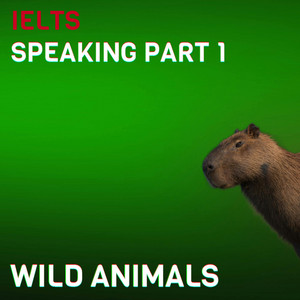
But if you force my hand, then I would say capybaras are... Well, I like capybaras the best.
I just think they're...
A perfect representation of inner peace and calm that I would really like to have in my life.
And I do, but I would like to have more of it, like a capybara.
Are there many wild animals in your country?
Well, not unless you include the people, especially those people from Glasgow.
Seriously, though, yeah, we do.
We have foxes and badgers and there are deer roaming around in the forests.
And closer to the coast, we have things like otters.
I think there are lynxes somewhere as well, although I haven't seen those last two anywhere.
Have you ever seen wild animals?
In Scotland, yeah.
You can see deer in the meadows and the forests all the time, although particularly in the morning when it's quiet, because they're a bit skittish, I suppose.
And...
Near the coastal areas there are birds like seagulls and in between parts of like in the rivers and in the coastal areas you've also got herons, which are big I suppose you would call them big birds that feed on aquatic life like fish.
So you see them fishing there all the time.
Where can you see wild animals in your area?
Well, other than where I said already, I'm sure if you wandered deep into the forest and the mountain ranges they would probably see lots of wild animals wandering, pretty much unfettered by humans.
Unless they're near the roads, really.
And there aren't many going through the mountains, to be honest.
Do you like watching animals in the zoo?
I used to, but the more I think about it, the more I find myself actually being against zoos, to be honest.
I think they're sort of almost like a species-wide excuse for destroying the natural habitats of other animals.
And we think it's, oh, it's perfectly fine because we have them there in the zoo and they're safe and we can research from them.
But what a lot of people don't know is that these animals suffer from something called zookosis, which means that they repeat behaviors or engage in strange behaviors that they wouldn't normally in the wild.
So you can't actually study them effectively.
And also, it's cruel if that's happening to them anyway.
So it's all a bit pathetic, really, in my opinion.
Thank you, Rory, for your answers.
Thank you.
Dear listener, we have our premium episodes for you.
This week on premium, Rory is gonna describe a piece of clothing he often wears, speaking part two.
And in speaking part three, we're gonna discuss clothes and fashion in general.
The links are in the description, so if you want quality preparation, super grammar, fabulous vocabulary for your high IELTS score, do check them out.
Wild animals, dear listeners.
So cheetahs wolves, wild animals, freedom for the wild animals giraffes, baboons what's your favorite wild animal?
Could you write in the comments?
All right, what's your favorite wild animal, and why is the answer?
Capybaras Capybaras capybaras, capybaras are so cute.
A capybara, dear listener, is a huge animal.
It's the largest rodent which lives in South America.
But now I've heard that in the States it's legal to keep capybaras as pets.
Oh, come on!
Don't keep the capybaras as pets.
Let them be free.
Yeah, it looks like a huge guinea pig, alright?
Please, if you have no idea what a capybara is, could you please google it now?
Capybara.
C-A-P-Y-B-A-R-A-S.
If you don't know what a capybara looks like, just look at my Instagram, because half of my posts have capybaras in them.
I love capybaras.
You can say there are many animals that I enjoy, but if you force my hand, so if you force my hand, force it like to make this choice I'd go with capybaras or giraffes or pandas.
I'd go with pandas, to be honest.
But mostly capybaras.
My favorite animals are pandas and capybaras.
Why do you like pandas?
Pandas are so cute and they're at ease.
They do whatever they want and they're funny as well.
They do these things and baby pandas are adorable.
They're really cute.
Okay, okay, fine.
But baby capybaras are also cute.
Oh, yes, they are.
But like pandas are, you know, they're big and fluffy.
And so this is...
That's why.
Capybaras are a perfect representation of inner peace and calm.
Inner peace.
And if you look at capybaras, they are usually in this lake, surrounded by oranges and water going down their heads, and they're kind of like Zen.
You can see them when they've got birds like resting on their heads and noses, and the birds are sitting there doing their thing and the capybara is just like yeah, it's fine.
Capybaras.
Capybaras don't mind being alone, but they live in groups up to 40 capybaras so they kind of flock together.
How chill is that?
The capybara can just be by itself and still totally fine.
They're strong swimmers.
Is there anything that they cannot do?
No.
Yes, they're capable of everything.
Maybe take IELTS.
Oh no, I think the capybara could take IELTS and get band 9 for sure.
Rory does know certain things about the wildlife in his country.
So, dear listener, you should also know what wild animals can be seen in your country.
So, Rory mentioned foxes, badgers.
What are badgers?
Who are they?
Well, they're mammals.
They're black and white mammals.
And they live in... Well, they live underground in things called sets.
But they're really, like, predatory.
They're quite vicious.
And apparently a lot of them have tuberculosis.
Oh, so now badges have colors the same as pandas.
They are black and white.
Very cute.
Badges.
They look cute, but dear God, they're terrifying if you meet one.
Also deer.
Deer, you know, maybe deer roam around the forest.
So when they roam, you can imagine like a field, a forest and then deer roaming there.
You haven't mentioned squirrels wildcats, Scottish wildcats and Rory, the classic Highland cow which could be seen in the Scottish Highlands.
I don't know if the highland cow counts as a wild animal.
Oh, yes, they're really wild.
How are they wild?
They live on farms.
No, in the highlands.
They're all this, you know, this Scottish... They have farms in the highlands?
I don't think the Highland Cow counts as a wild animal.
Okay, okay.
But wild cat.
Scottish wild cat.
It's by the definition.
It's wild and it's a cat.
Wild cat.
One word.
Also, Scotland has this coastal area and the sea, the ocean.
I think we have both, but most of the time we're talking about the sea, because there's the North Sea on one side and the Irish Sea on the other.
But way up in the far north, there's the Arctic Ocean, which is quite close.
And, dear listener, in Scotland we have humpback whales.
Do we?
Oh, yeah.
I see you still should learn about Scottish wildlife.
Listen, you need no other wild animals apart from capybaras, all right?
So... Yeah.
So, dear listener, please mention some specific animals.
Even if they don't live in your area.
Just throw in some names, some nice names like wild cats, humpback whales.
Capybaras.
Capybaras.
Tell the examiner you like capybaras and watch as your score goes from band five to band nine. otter o double t e r please google it uh look at this animal so yeah and also lynx uh rory there aren't any lynxes in scotland sorry darling darling they just they i'm sure maybe i was mistaking them for the wildcats then no because there is some sort of animal that's like that I've just checked.
Are there no Linksys?
No, they want to kind of reintroduce Linksys to Scotland.
And there are some websites with people saying why they will be kind of useful.
Yeah, so the rural areas... They'll keep the tourists away.
They said the same thing, for They were gonna reintroduce wolves to Scotland, and I cannot think of a worse idea.
I mean... Okay, yes, wolves used to be a natural part of the ecosystem here, but...
Could you imagine if we have wolves just running around Scotland and there are tourists who go into the Highlands?
I think that's just a recipe for disaster.
Yep.
So, dear listener, wild boars, gorillas, monkeys, hippos, deer, what else, cheetahs, wolves, so go ahead, okay?
But to be super cool and full of awesome, choose some strange names of rare animals, just to show off your super vocabulary.
You can prepare for this now.
In the comments, could you write your favorite wild animal, but don't go like monkey...
Or like a wildcat.
Be something, you know, be creative.
Like otters or I don't know what else.
Capybaras.
Capybaras.
Have you ever seen wild animals?
Well, okay, maybe in the zoo, maybe on television.
If you've never seen any wild animals, you can just imagine, yeah, dear listener.
So, maybe you see a deer in the meadows.
Meadows are what?
Kind of like fields?
Meadows.
I guess so, yeah.
They have a couple of sparse trees in them.
And you can also say a couple of things about birds.
Well, they are also wild animals, birds.
Seagulls, for example.
Or you mentioned a specific bird, these herons.
Yes, herons are magnificent birds if you ever see them.
They have very long necks and very long, sharp beaks, which they use for fishing.
And they have a wingspan of about a meter, but they're really big and they're cool.
They look like storks, but I think storks are white usually, whereas herons are grey and black and white.
You said some word like skittish?
Oh, yeah.
They're skittish.
But that just describes the kind of personality.
But you know what I mean.
The kind of traits that they have in their behavior.
So if they see people, then they immediately fly away.
Much like me, to be honest with you.
But unlike the capybara.
Skittish could be used about animals or people.
For example, like nervous or easily frightened.
So my horse, my horse, horse, yeah, I have a horse.
My horse is very skittish.
Do you have a horse?
No, no, no horses.
It gets frightened when there are many people.
We watch animals usually in the zoos or in a circus.
And do you say like we watch animals?
We what?
What do you do?
We watch films, but we watch animals.
We can watch animals in the zoo or on TV.
You can say that, yes, I enjoy going to the zoo, or I used to do it in the past, but not anymore.
Yeah, because people are destroying the habitats of animals.
Because zoos are immoral.
I'm sorry if you like the zoo, but it's not cool to go to the zoo.
Oh, Rory is so emotional about it.
Yeah, we can say that people are destroying the habitat.
So the place where wild animals live is called the habitat of animals.
And animals in zoos, they suffer from zookosis.
It's like psychosis for people.
I'm showing it myself for other people.
Duh or zookosis for animals, for example.
Or this panda is suffering from zookosis, and actually i googled it, i thought like rory made it up this word.
No, it's real, it's crazy.
So zookosis zookosis okay, is a form of psychosis that develops in animals.
Can you imagine?
Held in captive in zoos, so animals are held captive.
To be held captive, to be in captivity in a zoo, not in the wild.
You can say oh, I prefer watching animals in the wild, on a safari trips, for example in Africa, not in captivity.
Yeah, not in zoos.
Okay.
Yeah, and if animals have strange behaviors, they're obsessive, they have repetitive actions.
So these are signs of zookosis.
It is unacceptable.
Rory, I have a couple of wild animals and, dear listener, you can use these wild animals and these words in these questions about wild animals just to avoid talking about, like monkeys, pandas yeah, everybody knows things about them.
So, Rory, a babirusa.
What is a babirusa?
What do you think?
What kind of animal it is?
It's a mammal or a bird.
But what is it?
Describe a babirusa.
A babirusa is a wild animal.
I'm going to guess it's like a small monkey.
A baby russa.
Dear listener, you should Google it now.
A baby russa.
So it's a baby, B-I-R-U-S-A.
A baby russa is a kind of a pig.
It looks like a deer pig.
Oh, okay.
A baby russa.
So not even remotely close.
Then oh, baby rusa oh oh, another one.
Ai ai is the name of the animal.
Jelly sna ai ai.
I've heard of this before.
Is that the thing with the?
I don't want to say it's the thing with the big eyes, but it's not, is it?
Yeah yeah, it has big eyes.
Yes correct yeah, they're like, they're the tiny monkey things, More like a lemur.
What do you call it?
Lemur?
A lemur.
Lemur, lemur, yeah.
So with the eye, eye has a long fingered lemur.
Native to Madagascar. is the largest nocturnal primate.
Nocturnal meaning lives at night, yeah?
Yes.
Well, no, I mean, all animals live, but yes, they're active at night.
It's the strangest primate in the world.
Aye-aye.
The name is aye-aye.
I don't know about that.
I think people are the strangest primates in the world.
The last one.
Dear listener, also think what is it.
Shoebill.
Shoebills.
Yes, like shoes and bills.
Shoebills.
That's a bird.
That's a bird, yes, correct.
And it has a beak like a shoe, a Dutch wooden shoe, you know, like in... Oh, the clogs?
The clogs, yeah, yeah, the clogs.
In the Netherlands they have these nice shoes clogs, and the bird which is called a shoebill has the beak in the shape of this, like a clog.
Oh, dear listener, could you check out our premium episodes speaking part 2 and 3, for your super quality IELTS preparation.
There is more vocabulary, even more grammar.
Not so many jokes, okay?
No dead jokes for me.
It's more serious.
The links are in the description.
And also our phrasal verb course is there for you to kind of boost your vocabulary for bands 8 and above.
Thank you so much.
Hugs and loves.
Loves and hugs.
Loves and hugs.
Loves and hugs.
Bye.
Bye.
What's your favorite wild animal?
Oh, there are so many to choose from.
But if you force my hand, then I would say capybaras are, well, I like capybaras the best.
I just think they're a perfect representation of inner peace and calm that i would really like to have in my life and i do, but i would like to have more of it like a capybara.
Are there many wild animals in your country?
Well, not unless you include the people, especially those people from Glasgow.
Seriously, though.
Yeah, we do.
We have foxes and badgers and there are deer roaming around in the forests.
And closer to the coast, we have things like otters.
I think there are lynxes somewhere as well, although I haven't seen those last two anywhere.
Have you ever seen wild animals?
In Scotland, yeah.
You can see deer in the meadows and the forests all the time, although particularly in the morning when it's quiet, because they're a bit skittish, I suppose.
And...
Near the coastal areas there are birds like seagulls and in between parts of like in the rivers and in the coastal areas you've also got herons, which are big I suppose you would call them big birds that feed on aquatic life like fish.
So you see them fishing there all the time.
Where can you see wild animals in your area?
Well, other than where I said already, I'm sure if you wandered deep into the forest and the mountain ranges they would probably see lots of wild animals wandering, pretty much unfettered by humans.
Unless they're near the roads, really.
And there aren't many going through the mountains, to be honest.
Do you like watching animals in the zoo?
I used to, but the more I think about it, the more I find myself actually being against zoos, to be honest.
I think they're sort of almost like a species-wide excuse for destroying the natural habitats of other animals.
And we think it's, oh, it's perfectly fine because we have them there in the zoo and they're safe and we can research from them.
But what a lot of people don't know is that these animals suffer from something called zookosis, which means that they repeat behaviors or engage in strange behaviors that they wouldn't normally in the wild.
So you can't actually study them effectively.
And also, it's cruel if that's happening to them anyway.
So it's all a bit pathetic, really, in my opinion.