The world you see is not real.
You're not living in this very moment that you're experiencing and nothing is like it seems.
It turns out your brain constructs your reality as you're experiencing it.
It edits your memories as they happen.
It lives in totally different time spheres and tells you a story about the world that feels real.
What's going on and who's really in control of your life?
The gap between reality and you.
Vision is maybe our main source of information about the world, but in reality we don't really see that much.
Only a thumbnail-sized area of your visual field is in high resolution, while the rest is out of focus.
If it doesn't feel like this, That's because it's made up by your brain, using a pretty neat trick.
Each second, your eyes make three to four sudden jerky movements, saccades of 50 milliseconds, focusing from one point to another, scanning your environment to get different sharp images that your brain then edits together.
During a saccade, your brain shuts down your vision so you don't see a wild motion blur.
This means that each day for around two hours, you're completely blind.
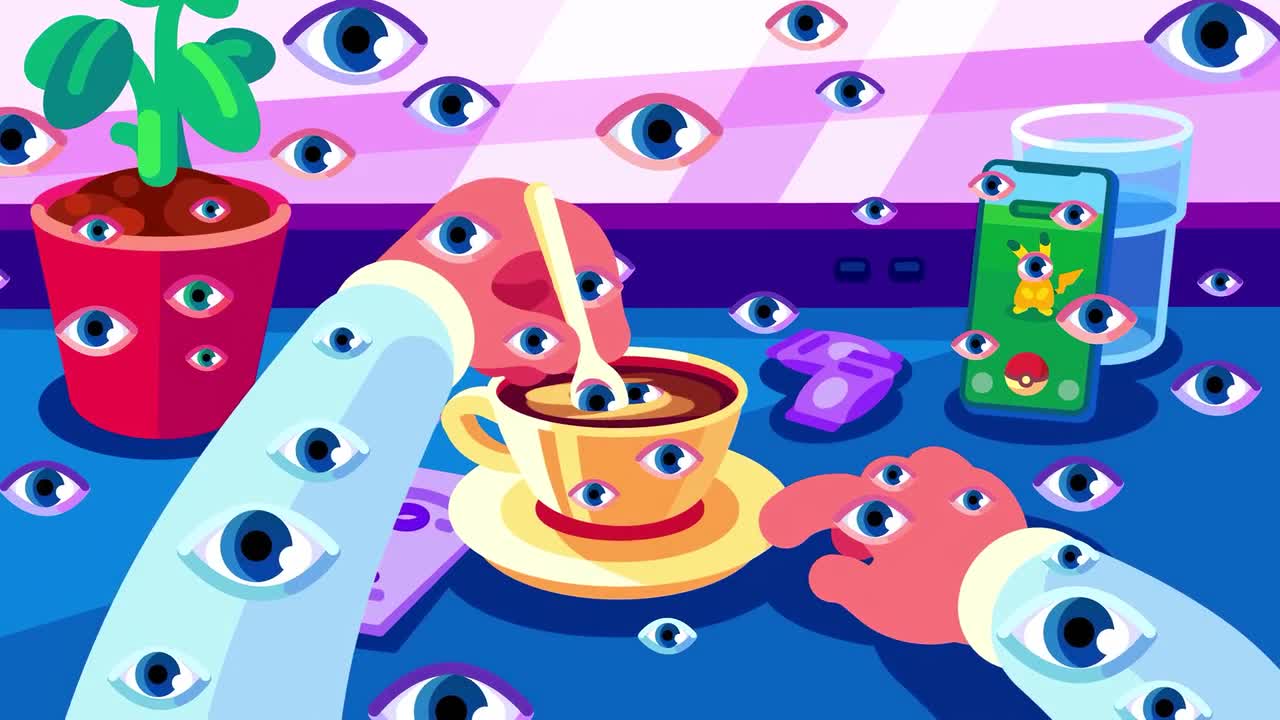
If you could actually see what your eyes see, it would look something like this.
Instead, your brain fills this time with its best guesses of what happened during the blackness.
But it does way more.
It turns out that you're not really experiencing time correctly.
What's really happening when you're stirring milk into a cup of coffee?
As the spoon hits the ceramic, light reflects off it and hits your eyes after 1.3 nanoseconds.
The ceramic vibrates and creates a shockwave of air molecules that travels to your ear in 12 milliseconds.
Heat is picked up by fibers in your fingers that send a signal to your brain in 50 milliseconds.
Three very different inputs, all processed in your brain at different times.
You don't experience them separately, but as one smooth, simultaneous and connected moment.
Your brain takes a moment to process and then invents a reality, a present moment that's not real.
What you feel is now is in fact a selectively edited version of the past.
You really only consciously experience the world 0.3 to 0.5 seconds after things happened.
Except this is also not really true.
Because your brain is editing time and space way more than that.
And it makes decisions completely out of your conscious control.
You're living in the past.
No, future.
No, a made-up future.
Your present, what you experience right now, is kind of the future.
Imagine for a second that you're a table tennis pro.
In pro table tennis, balls whoosh around at 25 meters per second, which is pretty fast.
So let's slow down time.
Light passes from the ball to your eye in nanoseconds.
It's converted into electrical impulses that reach your brain to be processed after 100 milliseconds.
Meanwhile, the ball travels 2.5 meters through the air, the length of the table.
If your brain showed you the past, where the ball was 100 milliseconds ago, it would hit you before you could react.
So instead, your brain takes its location, speed and direction and calculates where the ball should be in the future.
By the time the information reaches you,
And then it creates a fictional version of it.
This is what you see in your fake present, a fake ball that's somewhere else.
But you don't need to just see the ball, you want to smash it back hard.
If you acted now and started swinging your arm, you'd miss by a mile.
Things are just too fast.
So before the ball even touches your opponent's bat, your brain starts predicting where it will likely be in space after they hit, based on the other player's posture and your table tennis experience.
But as it can't be sure if it will be correct, it prepares multiple different responses.
Maybe the ball will be here, or here, or even here.
To be ready for all of these scenarios, your brain sends pre-programmed orders to the muscles.
You need to jump left, right or up, telling them to be ready for any of them at a moment's notice.
For a short moment, multiple ghost versions of you exist, all equally real inside your brain.
And then, as your opponent is about to lay into the swing, your brain decides on a single future that it thinks is most likely.
All but one of the ghosts are deleted.
You only ever experience the ghosts that won, never the potential ones.
The order to the muscles to act out.
The winning movement is triggered even before the ball is hit.
Back to you.
You are totally oblivious to this.
By the time you consciously see the ball coming at you and decide to hit it in a particular way, your body has already hit it back.
In reality, your brain already made all the decisions.
Your conscious experience is nothing more than an invented future, a prediction based on the information your brain received a fraction of a second ago.
This is not just true for extreme sports like table tennis, but also for walking.
Walking is time travel.
After your game, you're walking back home, seemingly choosing your path and reacting to things.
Meanwhile, your brain is operating in three different time spheres at once.
It processes the sensory feedback of the past, it calculates the current state of your body and it predicts your future.
Because walking is intense.
Before the signal from your foot touching the ground has even reached the brain, it's already sent the order to your foot to make the next step and it's already calculated the muscle patterns for the next two.
But what if something truly catastrophic happens?
There's a banana peel, and you step on it and slip.
How did it get here?
Listen, don't worry about it.
It turns out your brain is ready for this.
So far, we spoke of your brain making decisions for you, but this is not really true.
You don't have a central control room where the world comes together.
In reality, different parts of your body are aware of different things at different times.
Your spinal cord usually knows stuff before your brain.
And even within your brain.
Different regions process the same event at different speeds and make independent decisions.
As your foot catches the peel, the gyroscope inside your ears notices a sudden change of your position in space.
It submits this information to your brain, stem and spinal cord, the things-must-happen-quickly section of your body.
They immediately trigger emergency recovery patterns and send orders to different muscle groups.
Within 200 milliseconds, pre-programmed sequences activate to catch your fall.
Your arms shoot out.
Your other leg stiffens to support your weight.
Your core muscles contract to stabilize you.
100 milliseconds later, when you become aware that you're tripping, your body is already recovering.
You are only just now catching up.
Okay, so we've learned that your brain is constantly predicting reality around you, makes decisions about the best way to act, and then shows you an edited version.
Which totally makes sense.
Would you really want to be in charge of all that?
But your brain is not just predicting the external world.
Right now, it's predicting a way more complex thing.
You.
Are you just a prediction of your brain?
Why do you feel about the world the way you do?
Your sense of hunger, your energy level and especially your emotions are not just objective reactions to what state you're in, but predictions.
Your brain's prediction of what you'll need soon or need to be ready for.
You're probably used to getting food or going to bed roughly around the same time.
And as the time approaches, your brain releases hormones to prepare you.
A self-fulfilling prophecy.
You get hungry or tired because your brain assumes this is the time when this is needed.
This is the most striking thing about your emotions.
They aren't just reactions to the outside world, they're predictions.
When you go to a party, your brain isn't waiting to see how you feel once you get there, based on how the party actually is.
It analyzes your experiences of past parties and who it expects to be there.
Maybe close friends you feel safe around.
Maybe people you don't know who are a less socially secure bet.
Maybe your brain remembers a party where you felt anxious and that experience stuck.
This can be pretty annoying.
If your brain predicts anxiousness, it adjusts your heart rate, hormone levels and muscle tensions before you even enter the room.
It prepares your body for anxiety, making you actually feel anxious, which then confirms the brain's prediction and gets saved for future reference.
Does this make you feel like you're just along for the ride, forced to experience whatever predictions your brain feeds you?
Thankfully, it's not quite like that.
Your conscious self is obviously not the decider of most things as you go through your day.
But that is not what it's good at anyway.
Your brain and all of these different organ systems decide a lot of things, but they're more like butlers, taking care of all the busy work.
You may not be in the driver's seat, but you are the passenger that decides where to go.
What your conscious self is good at is long-term planning and abstract thinking.
It's a storyteller that tells the story of your life to your brain and to yourself, wherever the edges of these overlapping entities melt into each other.
You are able to see the big picture that your internal prediction machine could never begin to grasp.
You are the part of you that can edit and write new predictions into the system.
Sometimes you and your brain disagree on what's correct, but in the end you are the person in power who tells the story about who you are in this world, a story so convincing that you experience it as undeniable reality and as a happy accident.
Your conscious self is great at being happy about ice cream, fascinated by internet videos and thinking deeply about pokemon types.
What if you could train your brain to be more than just a regular butler?
Transforming it into a lean, mean problem-solving machine with supercharged critical thinking skills and next level intuition, to help make your reality even more interesting and fun.
Thanks to our friends at Brilliant, you can.
Brilliant helps you get smarter every day, with thousands of bite-sized interactive lessons on just about anything you may be curious about.
Explore the big ideas powering technology like AI or learn the fundamentals of programming.
Delve into the physics behind everything from a game of pool to black holes.
Understand core concepts in maths, logic, data analysis and beyond.
On Brilliant, you'll learn through discovery by trying things yourself.
You'll not only get hands-on with key concepts, you'll learn to apply them in the real world, giving extra fuel to your consciousness journey.
The best part of Brilliant is that there's always something new to spark your imagination, with new lessons added every month.
Want a shockingly fun way to learn the physics of electricity?
Plug into their latest course on circuits.
Or want to learn how language models like ChatGPT choose their next words?
Their latest course on generative AI will help boost your human intelligence.
Whatever you choose to learn on Brilliant, it only takes a few minutes each day to change your reality, helping you see the world in new ways, build powerful problem-solving skills and end every day a little smarter.
To explore everything Brilliant has to offer for free for a full 30 days.
Visit brilliantorg slash nutshell or click on the link in the description.
You'll also get 20% off an annual premium subscription.
We're finally making a PC game.
Starbirds is a cheerful, cozy resource management game set in space.
You help a brave flock of intergalactic birds, mine asteroids, build thriving production networks and discover new technologies to advance across the galaxy.
We've been working on this for almost two years now with the amazing team at Tucana Interactive the minds behind dwarf romantic and can't wait for you to play the early access version later this year.
But here's the thing wishlisting is incredibly important for indie games like ours.
It helps us get noticed, reach more players and keeps you updated as we develop the game.
So if you want to be part of this adventure, please wishlist starbirds on steam using the link in the description.
Thank you so much for watching and your support.
It means the world to us, or in this case, the universe.