Ted Audio Collective You're listening to Ted Talks Daily, where we bring you new ideas to spark your curiosity every day.
I'm your host, Elise Hugh.
I'm one of those people who doesn't like seeing photos of myself, and it's also hard for me to hear my recorded voice, even given what I do for a living.
It turns out I'm not alone.
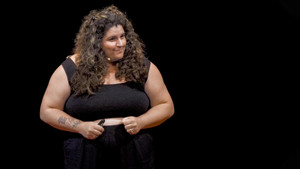
In her 2024 talk, portrait photographer Terry Hofford unpacks why we cringe when we see photos of ourselves and how to overcome that cringe factor to better appreciate those moments captured on camera after the break.
Like Ted Talks? You should check out the TED Radio Hour with NPR.
Stay tuned after this talk to hear a sneak peek of this week's episode.
And now our TED Talk of the Day.
Hands up if you've said, I hate having my photo taken.
Or, I'm just not photogenic.
Or, I look bad in photos.
Alright, now standardly my usual response would be that you just haven't had me as your photographer yet.
But today I want to let you know that you are not alone.
As a boudoir and portrait photographer for the past 10 years, I've had the immense privilege of photographing thousands of humans and thus thousands of bodies and they've all said something similar before their photo shoots.
And this got me thinking, if everybody thinks they look bad in photos, regardless of their size, shape, age, gender, then maybe it has nothing to do with photos at all.
So I started to collect some data on the images that people struggle with the most and I was able to come up with a handful of reasons why people think they look bad in photos and I'm going to share five of those with you today.
Now, have you ever heard your voice on a recording or on tape as we used to say back in the day?
Right. The same thing that makes you cringe when you hear your voice on a recording is the same thing that makes you cringe when you see yourself in a photograph.
Essentially, your brain is being presented with a reality different to the reality it has come to know the most.
Reason number one why you look bad in photos is that you've been looking at a reflection of yourself your whole life.
Whether that's looking in the mirror as you brush your teeth in the morning, checking yourself out in the shop window when you walk by, or plucking that rogue chin hair in the rear view mirror of your car.
The ladies know what I'm talking about.
Your brain gets a pretty clear idea of what you look like.
When you see a photograph of yourself, however, you're seeing the reverse or the flip of that and it can be a little uncomfortable.
But uncomfortable doesn't mean bad.
It just means that it's different than what we expected because the majority of us are not symmetrical in our facial attributes.
Just a few weeks ago, I had a client that I showed this beautiful portrait to and immediately she said, Oh my God, I look just like my uncle.
So I explained to her what I just explained to you and I asked her, Would it be okay for me to flip the photo so you can see what I'm talking about?
As soon as I flipped the photo, you can see your whole body relaxed, her face relaxed.
And she said, Oh yeah, that definitely looks more like me.
To which I responded, that's also probably what your uncle sees when he looks in the mirror.
Contrary to what you want to do when you think you look bad in a photo, the way to overcome this is to actually look at yourself in photos more because this helps your brain understand that both realities are true.
Now, the second reason why you think you look bad in photos is that you may not resonate with how you're being portrayed.
For example, those of us that are socialized as women, we learn pretty early on that our value and confidence is found in our appearance and ultimately our sex appeal.
So I figured as a Boudoir photographer, I would help women find their confidence through sexy photos.
And it worked for many, but it didn't take me long to realize that not everyone feels confident the same way and not everyone wants to feel sexy at all.
Imagine my surprise when I realized I was asexual, meaning I find sex to be kind of boring and like doing the dishes.
I would never find my confidence in photos where I'm looking sexy.
Sure, I can understand that these photos are technically beautiful, but I don't see myself in them, so they're uncomfortable because it feels like I'm playing pretend.
Once I was able to lean into my identity, however, I was able to start to ask for and create photos that resonated with how I wanted to be seen and more importantly, how I wanted to feel.
This allowed me to relearn what I look like when I'm confident.
So the next time you find yourself thinking you look bad in photos, I want you to get curious and ask yourself the question, what specifically am I struggling to accept about this image and does it have anything to do with how I'm being portrayed?
If you can switch from judgment to curiosity, not only are you going to release the shame of looking bad in photos, but you're going to be able to explore your photos and ultimately yourself from a new perspective.
So by now, you can probably start to see that looking bad in photos has less to do with how you look and more to do with how you think.
And reason number three is no different.
And this is that you've taught yourself to hyperfixate on your insecurities.
Anytime a client would come in and tell me she hated her stomach or didn't like her arms or her chin, I could predict which photos she would struggle with the most.
Whenever you look at photos of yourself, you might find yourself hyper focusing on whatever your current insecurity is.
We all do this, even as body image educators.
A few years ago, I was returning home from a trip to Vegas with my creative friends and I was scrolling through the photos when one photo just stopped me in my tracks.
All I saw was my stomach.
Suddenly, everything that I had heard about what it means to be a woman with a stomach came rising up to the surface.
Some of the most negative things I hadn't heard in a really long time were just telling me this was horrible.
In fact, I almost deleted the image.
However, because of the work that I do and have done as a body image educator, I was able to collect myself in realizing what I was doing.
I took a deep breath, centered myself, and once again got curious, realizing that my brain just needed me to help fill in the context.
I asked questions like, who was I with?
What was I doing? And more importantly, how did I feel the moment this photo was taken?
Suddenly, I could see the photo for what it was, this absolutely beautiful memory of myself and my friends hanging out in the desert.
Dr. Wayne Dyer has said that when we change the way we look at things, the things we look at change.
This applies to our photos, but also our bodies.
When you find yourself hyperfocusing on whatever your insecurity is in your photo, it may look bigger or smaller, good or bad, because at the end of the day, I don't actually know how you see yourself.
But what I do know is that whatever you tell yourself you're going to see will be exactly what you do.
So if you tell yourself, I'm going to look bad in this photo, yeah, you probably will, no matter how good the photo actually is.
And now back to the episode.
Now, all of the reasons why we look bad in photos have to do with reason number four.
And this is that we've put some pretty unrealistic expectations on photography and our bodies.
One of my favorite quotes comes from John C.
Maxwell, who says that disappointment is the gap that exists between expectation and reality.
And if you've ever done any traveling, you know this to be true.
But the thing is, bodies and photography don't care about beauty standards, but we expect them to.
Bodies are just biological organisms responding to a series of inputs, outputs and genetics.
Their whole job is to basically get you from point A to point B, keep you alive as long as possible, and they don't care what you look like doing it.
Photography, on the other hand, was created to simply document a moment in time.
But somewhere along the way, we determined that every single photo of us has to be absolutely amazing.
But the truth is, photography's only job is to capture a fraction of a second.
Like I'm talking one eight thousandth of a second, guys.
But we've made these fractions of a second create some really big narratives, like I look bad in photos that prevent us from showing up and being present in our lives.
So today I want to reassure you that sometimes a fraction of a second is just a fraction of a second.
Sometimes a body's just being a body.
As a self -portrait artist, I've seen my body in a lot of different seconds and in a lot of different ways.
And sometimes I look like this.
You can laugh, it's okay.
And in other times, I look like this.
But the thing is, they're just different photos of me.
They're not good or bad or right or wrong, they're just different documentations.
I've just been taught that one series of these images should make me feel less confident simply because it does not live up to the expectation of what makes a photo or body good.
Now, that brings us to our last and final point.
Read the number five.
As you can see from these photos, we have unlimited angles.
Yet somewhere along the way, we've decided that certain angles are better than others.
And for this one, I actually need some audience participation.
So if you do have your phone with you, pull it out.
Pull out your phone, you can turn it on.
All right, we're going to open the camera and I'm going to get you to take a selfie.
So we got some good studio lights, I do anyways.
Anyways, find your angles.
Look good. Beautiful.
If you came with someone, feel free to be in the photo together.
You're documenting a moment in time.
Beautiful. Once you're done with your selfie, don't put your phone away because we're going to do a second photo.
This time you're going to take your phone and put it right to your chest.
And you're going to look down.
We're still smiling because we're having a good time.
Down here. Not out here.
Over here. And we're smiling.
Beautiful. You look amazing.
Now, between picture one and picture two, if we're being radically honest, which picture do we like the most?
One. Between picture one and picture two, if you had to post one to your social media today, which one are you realistically choosing?
One. One. No. Now, between picture one and picture two, did all of your accomplishments and achievements disappear?
No. Between picture one and picture two, did all of your love, passion, creativity and brilliance just vanish?
No. And between picture one and picture two, what angle do you think your babies, your children, your grandchildren, and your pets see you at the most?
And do they love you any less because you have a double chin or shadows under your eyes?
No. The truth is, nobody that loves us unconditionally actually cares.
All angles of you are worthy of being photographed simply because you are worthy of being photographed.
Beauty standards have done such a good job of conditioning us to believe that there is a right and wrong way to have a body.
So it's no wonder we put all this pressure on how we're going to show up in photographs.
But this pressure is preventing a lot of us from showing up in photographs with and for the people we love the most.
This past weekend was the 17th anniversary of my dad's passing.
And when I look at photos, do you think I see his double chin or his receding hairline or wrinkles or whatever his insecurity was?
No. I see my dad being my dad.
Your people just want to see you being you.
So I want this to encourage you to take all the photos of all the moments and just recognize that they're simply different documentations of this one wild, magic, amazing life of yours.
And maybe, just maybe, you don't actually look bad in photos.
Thank you. That was Terry Hofford at TEDx Winnipeg in 2024.
If you're curious about Ted's curation, find out more at ted .com slash curation guidelines.
And that's it for today.
Ted Talks Daily is part of the Ted Audio Collective.
This episode was produced and edited by our team, Martha Estefanos, Oliver Friedman, Brian Green, Autumn Thompson, and Alejandra Salazar.
It was mixed by Christopher Faizy -Bogan.
Additional support from Emma Tobner and Daniela Valarezo.
I'm Elise Hugh. I'll be back tomorrow with a fresh idea for your feed.
Thanks for listening.
On the Ted Radio Hour, computer scientist Frances Chance studies how the graceful dragonfly manages to be such a deadly hunter.
We know that they fly to intercept their prey.
They fly really fast and they're very successful.
What AI developers are learning from natural intelligence.
That's next time on the Ted Radio Hour from NPR.
Subscribe or listen to the Ted Radio Hour wherever you get your podcasts.
PRX.