NPR.
Paying for health care isn't just a problem for people.
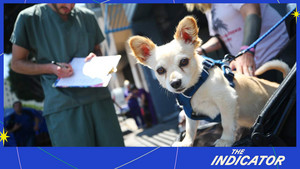
In the past few years, the cost of health care for pets has actually been surging.
For a point of comparison, get a load of this stat.
According to the Consumer Price Index, which tracks the price of goods and services, overall prices in the economy are about 25 higher today than they were five years ago.
But over that same period, the cost of veterinary services increased by about 41%.
Yeah, that is a steep increase.
And according to a recent Gallup survey, most pet owners say they have skipped necessary vet care because of the cost.
So what is going on here?
This is The Indicator for Planet Money.
I'm Adrian Ma.
And I'm Darian Woods.
Today on the show.
What is behind the rising cost of care for our furry or feathered or scaly friends?
And we have an economic theory that helps explain what's going on.
This message comes from NPR sponsor Capella University.
Sometimes it takes a different approach to pursue your goals.
Capella is an online university accredited by the Higher Learning Commission.
That means you can earn your degree from wherever you are and be confident your education is relevant, recognized and respected.
A different future is closer than you think with Capella University.
Learn more about earning a relevant degree at capella.edu.
This message comes from the Hartford.
Every day, they make business insurance easy.
Or easier, anyway.
And when it comes to business insurance for midsize and large businesses, they know just how complex it can be.
And businesses rely on them to make the complex challenges less so.
That's why, at each step, from quotes to claims, to everything in between, the Hartford is devoted to making it easier.
Connect with your underwriter at the Hartford or visit thehartford.com.
Compared to veterinarians, you could argue that human doctors have it kind of easy.
I mean, after all, they only have to take care of one species.
While vets they might have to treat a dog and a cat, a snake and a flying squirrel all in one afternoon.
And this sort of unpredictability is what Adam Hetchko loves about veterinary medicine.
I do everything, but surgery is my thing.
We helped a pet this week that had a foreign body and an obstruction, had eaten a toy.
Adam runs an independent veterinary practice in Cleveland, Ohio.
Can I ask what kind of pet and what kind of toy, or is this like a HIPAA violation?
This one was a squeaker toy.
So the little squeaky thing that comes out of a stuffed animal, those little discs.
Yeah, they go, hee-hee.
Uh-huh.
So the dog had pulled out that, swallowed it whole, and it had gotten stuck.
It was a lab.
And labs are known for being silly and eating things sometimes.
The dog's name is Kelly, by the way, and Adam says she's doing great now.
Even though Adam loves his job, he knows the rising price of veterinary services is a problem.
My sleepless nights are because I want to deliver the best service I can for the best value that I can.
Sometimes some of that is out of my control.
So we asked Adam straight up, what's up with the soaring cost of vet care?
And here's the headline.
Adam says the costs of operating a practice have just gone up a lot.
Medication is more expensive, thanks in part to tariffs.
For the same reason, medical supplies like bandages, gowns and syringes are more expensive.
Adam says a box of exam gloves costs more than twice what it did just a year or so ago.
But maybe the biggest cost pressure Adam says has been the cost of labor wages for veterinarians and support staff like nurses and office managers.
Our labor costs have gone up significantly over the last few years.
And in veterinary medicine, many practices, that labor cost exceeds 50% of our overall costs.
In a way, what Adam is describing here is a perfect example of a classic economic idea called Baumol's cost disease.
This is one of my favorite economic theories.
Yes.
This is like a econ nerd deep cut.
Baumol's cost disease is a theory devised in the 1960s by two economists, William Baumol and William Bowen.
Okay.
Bill Baumol and Bill Bowen?
That's right.
We got BB and BB.
They're two BB kings.
Sounds like a vaudeville act.
According to the two BBs, there are certain industries that get a lot more productive each year thanks to advances in technology, things like manufacturing.
And then there are industries where productivity is really hard to increase because the jobs are just so inherently dependent on human labor.
Yeah, and this explains why, over time, we've seen big screen TVs and computer software become cheaper, but certain services that require human labor have gotten more expensive.
There isn't yet a robot or an AI in the world that can watch your kid or administer an IV or unclog your toilet.
Or remove a plastic squeaker disc from a dog's insides.
Yeah, I don't think I would trust that to a robot.
Not yet.
And if we as a society want people to become caretakers and nurses, plumbers and animal surgeons, wages for those jobs have to rise over time.
Otherwise, a lot of people that might have chosen to do those jobs will choose to do something else.
And that is Baumol's cost disease in a nutshell.
So Bournemouth's cost disease helps explain the rising cost of pet care, but it doesn't give the full picture.
There are a couple more factors we haven't yet talked about.
One is the influence of corporate ownership.
In recent years, veterinary care has been increasingly taken over by private equity firms, and Vets who work at corporate-owned practices are under significantly more pressure to generate profits than those who work at independent ones.
That's according to a 2023 study.
If you're interested, we did a whole episode on private equity and pet care which we'll link to in the show notes.
Finally, one more reason people are spending more on pet care is that many pet owners are just willing to spend more on pet care.
Adam Henchko says he's noticed a shift in the culture of pet ownership compared to a few years ago, and he chalks it up to pandemic lockdowns.
When people were isolated, some of the only social interactions that people had or companionship was their pets in their house.
And leaning on them to get through some of those challenges, I think, only strengthened the bond.
And once you strengthen that bond, there's definitely a change in how you look at the care of your pet.
The shift to remote work meant many people were, for the first time, spending all day with their pets.
So they became more attuned to their fur baby's every hiccup or odd behavior.
And Adam believes that's made many people more willing to pay for the very best care they can afford to keep their pet healthy.
So I think pet owners are driving some of that up because they're looking for more options and more services relatively expensive services like annual blood testing or sonograms or procedures that can cost thousands of dollars.
So let's recap.
Vets are facing higher costs for supplies, medicines, and employees.
Some are under pressure from their bosses to be more profitable and some pet owners are just willing to pay a premium for a premium level of care.
But for those who can't.
There are still a lot of people who are being priced out of veterinary services.
It's stressful because I want to be able to do everything I can for the pet and my team wants to be able to do everything they can for that pet.
And it's hard sometimes when we can't.
And I think what's even harder is when we get the comment well, you're just in it for the money, or you don't care about my pet.
That cuts me deeply when I hear that.
That's Not when I was seven years old, that's not why I chose to do this.
I chose to do this to help animals, to support the human animal bond.
Adam did have some advice.
He says get to know your vet and take your pet for regular checkups to help spot health issues before they become serious and more expensive to treat.
And he says you could consider buying pet health insurance.
But we should say those policies are not cheap.
Often they can run several hundred dollars a year.
And like pet care in general, the trend is that they're only getting more expensive.
Special thanks to the dogs and cats of Indicator Land for their support.
In no particular order, they are Jolene Widget, Bocephus Texas, Juarez Juno, Juarez Tigger Rue and Richard Katz McKim, which is a cat, if you hadn't guessed.
This episode was produced by Angel Carreras and engineered by Maggie Luthar.
It was fact-checked by Sierra Juarez.
Kagan Cannon edits the show, and The Indicator is a production of NPR.
This message comes from Mint Mobile.
Starting at $15 a month, make the switch at mintmobile.com slash switch.
$45 upfront payment for three months.
Five gigabyte plan equivalent to $15 a month.
Taxes and fees extra.
First three months only.
See terms.
This message comes from BetterHelp.
As a dad.
BetterHelp president Fernando Madeira, relates to needing flexibility when it comes to scheduling therapy.
I have kids under 18, so like time is very limited.
That's why, at BetterHelp, our therapists try to have sessions, sometimes at night, depending on the therapist, or during the weekend.
So I think that's what we need to tell the parents.
You're not alone.
We can help you out.
If a flexible schedule would help you visit BetterHelpcom for 10 off your first month of online therapy.