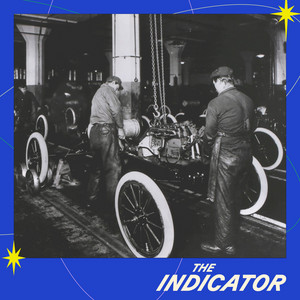
NPR. This is The Indicator from Planet Money.
I'm Adrian Ma. And I'm Whelan Wong.
It is Jobs Friday. We've got the latest numbers from the Bureau of Labor Statistics.
In May, the economy added 139 ,000 jobs.
And the unemployment rate was unchanged at 4 .2%.
If you're a faithful indicator listener, you know that we like to look at the BLS's, ah, what they call the Employment Situation Report every month, because it's a snapshot of how everyday people are doing in the economy.
But there are other ways that the BLS measures how working people are doing, and that is what we're looking at today.
A data series that gets one economist particularly excited.
It's the greatest unsung series that if you say, what should we be watching.
That's what you should be watching.
I would recognize that economist voice anywhere.
Oh, yes. Welcome back to the chat, Austin Goolsbee.
President of the Federal Reserve Bank of Chicago.
Yes, he is back. And this unsung data series he's obsessed with is labor productivity growth.
It's a measure of worker output.
For the last couple of years, this number for the most part has been increasing in a significant way.
And the thing is, economists don't know exactly why.
So today on the show, Austin Goolsbee takes us on an economic mystery hunt of sorts.
He walks us through some of the different theories about why this number has been going up.
It's the case of the perplexing productivity growth.
The basic measure of labor productivity is output per hour.
Economists use data from gross domestic product reports to calculate this number.
Oh, so there are not literally Bureau of Labor statistics employees just fanning across the country counting how many widgets every factory is making?
Yeah, they're not like, oh, five zipper teeth today!
Yeah. It's actually tallying up the value of those widgets.
Or for a restaurant, it would measure sales per worker.
That is how the BLS calculates productivity.
Now, when we talked to Chicago Fed President Austin Goolsbee in April, he told us that patterns in the productivity data can be hard to spot.
It's like when your kids are growing, you can look back at markers of pencil on the door frame, but in the moment, they just look the same as they always looked.
When Austin studied those pencil marks on the door frame of the economy, he noticed productivity took a hit at the start of the pandemic, which is not surprising.
And then it started rebounding in late 2022, which is maybe also not surprising.
But then - It kept looking really quite good, better than pre -COVID.
And now we've got two solid years where productivity growth has been well above the previous decade or two trend line.
And that's really where the mystery began.
If you look at data from the 2010s, labor productivity grew around 1 % a year, but compare that with rates that we've seen more recently, which are more like 2 % a year.
But aren't there always twists and turns in a mystery?
BLS data released yesterday showed that productivity growth actually fell 1 .5 % in the first quarter of 2025.
So we called him Austin to see what he made of this drop.
Productivity's a really noisy number, so you've got to be careful.
Austin said if you look at first -quarter GDP, that number was a little weird. It showed a decrease because of a surge in imports ahead of tariffs.
And remember, GDP numbers feed into the productivity number.
Just recognize stuff like that goes up and down a lot over a year, a decade.
It's of course much smoother, and for productivity, that's the timeframe you want to be thinking about.
And bottom line, Adrian, as Austin told us in April, economists like to root for more productivity.
There is a very real sense in which if productivity growth is higher, even modestly higher for a sustained period, everything is wonderful.
Our wages can grow faster without inflation.
The interest rate doesn't have to go up in the short run.
At the end of the day, it is productivity.
That made us the richest major economy in the world.
Yeah. I mean the U .S. is still a global leader in terms of productivity.
So you can see why economists like Austin are so fascinated with it.
So Austin walked us through four possible explanations.
Theory number one. More people working from home.
You've got a couple of researchers going out and making the case that people can be more productive per work or per hour, if they can have that flexibility.
When you're kind of kicking the tires on this idea, do you look at, you know, which industries are showing productivity growth?
Because that seems like it is a largely people type in at their desks kind of story.
Yes. And look, you're channeling your inner economic researcher.
That's exactly the style.
Oh my gosh, that's so nice of you to say.
That's the style. I'm glad you took that as a compliment.
That's exactly... it was not intended as a compliment, but not everyone would take it as such. If that is the main cause, that's just a one -off.
That would increase the level of productivity, but that's not a reason why the growth rate would continue.
So in Austin's view, flexibility does not explain the sustained productivity growth.
So let's look at Theory Number 2, what economists call labor reallocation.
That they call it that is exactly why you never want to hire a person with a Ph .D. in economics to work on your marketing.
Okay? This is just the idea of the great resignation.
Maybe it allowed people to leave jobs that they were sick of, go into something that motivates them more, that they're more suited to, and they had an explosion of productivity.
But sort of like the flexibility theory, this reshuffling is also a one -off event in Austin's view.
A lot of workers moved to new jobs they liked better, and they stayed.
They didn't keep moving around.
So onto theory number three, new business creation.
There's been a surge in new business applications in the US starting during the pandemic.
And historically new businesses often have faster productivity growth or higher productivity.
So there has been some argument, maybe the economy's productivity went up Because we have all these new firms, again, I'm a little nervous that that sounds like a one -time.
So we're down to our last theory, and that is… artificial intelligence.
Austin says most economists think it's still too early for the effects of AI to show up in the data.
Still, he finds AI to be an intriguing lead in this economic mystery.
That's because there are historical examples of new technology leading to longer -term productivity So electricity comes in, it is electricity production where there's a massive increase in productivity.
Then after a little bit of time it kind of filters its way through the economy and you see a boom in productivity in the most electricity intensive industries, so aluminum gets more productive and then And then, with another lag of a lot of years, people start building businesses around the presence of electricity, and then you see the productivity continue.
These technological ripple effects show up throughout history, like in the Gilded Age, which we talked about in yesterday's episode and which we'll link in the show notes.
Another place you can see these ripple effects are with the introduction of computers in the 20th century.
So, if AI proves to be as transformative, that could boost productivity in a lasting way.
Is it tricky to tease out, then, if it could be AI, or if it's something that maybe started earlier than what we think of as AI?
Could you still attribute this to the computer boom that you were talking about earlier?
Now, you're, there's an old, he was, he was my teacher, and he was a famous economist, Bob Solow, and he used to have this phrase.
He said when economists talk about the sources of growth, they always end up going down in a blaze of amateur sociology.
And there is a sense in which it might be many things.
So, Austan Goolsbee, economic detective, remains on the case.
Sounds like economists are going to be super productive trying to figure this out.
See what I did there?
Does that mean we have to be more productive doing stories about it?
I hope not. This episode was produced by Cooper Katzmann Kim with Engineering by Neil Rauch. It was fact checked by Ciera Juarez.
Kicking Cannon is our show's editor and the indicator is a production of NPR.
This message comes from Inspiraty.
Providing HR services and technology, from payroll, benefits, and HR compliance, to talent development.
Learn more at Insparity .com slash HR Matters.