Quick note before we start today's show.
You might have heard that President Trump has issued an executive order seeking to block all federal funding to NPR.
This is the latest in a series of threats to media organizations across the country.
And meanwhile, millions of people, people like you, depend on the NPR network as a vital source for news and entertainment and on the indicator as a source to explain our economy.
And listen, we're proud to be here for you.
And now more than ever, we need you to be here for us.
Visit donate .npr .org now to give and if you already support us via NPR Plus or other means, thank you.
Americans love shrimp.
In fact, we eat shrimp more than any other seafood.
I guess I am the exception here because I don't love shrimp.
Oh, come on, Adrian.
I mean like what, no shrimp scampi?
No shrimp fried rice?
Not even a shrimp taco?
Yeah, not so much. I think it's a textural thing.
Like it has a bounciness that doesn't quite jive with me.
Oh, bouncy. That's on something I heard on Top Chef before.
Yeah. But it is true that Americans eat a lot of shrimp.
about six pounds per person each year.
That is literally hundreds of shrimp a person.
All that shrimp love makes it all the more surprising that the Americans who actually catch shrimp are disappearing.
There were less than 1 ,500 shrimpers in Louisiana last year.
A quarter of a century earlier, there were nearly 7 ,000 according to state records.
And a large reason for this drop is cheap imported shrimp.
US shrimpers say they just can't afford to compete, which is why a lot of those shrimpers are huge fans of tariffs.
This is The Indicator from Planet Money.
I'm Adrian Mar. And today we're on another road trip with friend of the show, Stephen Basaja from the Gulf States newsroom.
Always happy to play tour guide.
And today we are off to the Louisiana bayou.
We'll meet a shrimper who will tell us why this industry is the rare one celebrating tariffs.
And we asked a seafood economist if this is the kind of tariff they can support.
So, let's get sizzling.
Or bouncing. Yeah, bounce along down!
This message comes from U .S. Bank.
As a small business owner, you're used to doing it all, but U .S. Bank Business Essentials is here to help.
It's a powerful combination of checking and card payment processing that gets you fast access to the money you've earned with no monthly maintenance fee checking and unlimited digital transactions.
They even have small business specialists that work together with you to help your business reach its full potential.
That's the power of us.
Deposit products are offered by US Bank National Association, member FDIC.
This message comes from NPR sponsor Acura.
The all new Acura ADX is a compact SUV built for versatility.
Available all wheel drive for weekend escapes, Google built in for seamless connectivity, as well as a Bang & Olufsen premium sound system for high quality audio.
The all new Acura ADX is crafted to match your energy.
Visit Acura .com to learn more.
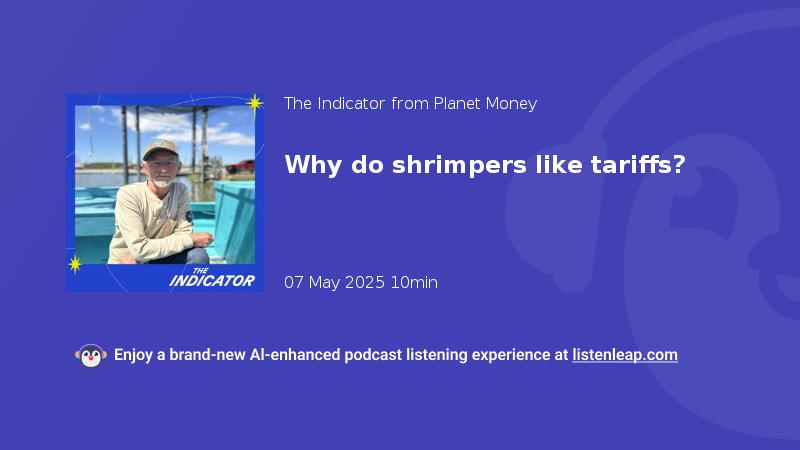
Google is a trademark of Google LLC Shrimping is one of these jobs that you're kind of born into.
Yeah, it's in your blood is how A .C.
Cooper described it.
A .C. can count back four generations of shrimping in his family and actually raised his own kids on his baby blue boat, the Lacy K.
My wife was my deckhand and would bring the kids on the boat from them little plastic swimming pools.
and they would swim in the daytime, and at night, my wife would dry it out and put all three of them in it and they would sleep in the little swimming pool under the bow.
That way, they wouldn't get wet while we worked.
So, you could see for AC, shrimping is a family affair.
He even named his boat the Lacey Cay after his wife and daughter.
Now, his boat is docked at a harbor in Louisiana Bayou and he says he can remember a time when there were about 20 boats around, but today.
We're on the end of the pier right where it starts at. — These thaws used to be full.
And if you looked at them now, there's two boats that's tied up on the other side.
I mean, there's nobody else behind us.
Nobody. — AC blames its decline on shrimp imported from countries like Ecuador, India and Vietnam.
And in fact, an investigation by the US International Trade Commission found those countries subsidize their shrimp exports that pushed down the price of shrimp and harmed US shrimpers.
Now, towards the end of the Biden administration, they put targeted tariffs on shrimp from those countries.
And when President Donald Trump announced his additional global tariffs, shrimpers like A .C.
celebrated. Ah, we're jumping, you know, we definitely support it.
There's no doubt we support him 100 % on this issue.
Now, we have done a lot of stories talking to economists about how tariffs can harm workers and businesses, but we wanted to see if this was a case of an exception — a case where economists could say that this is actually a correct way to use tariffs.
So Steven, you actually called up a seafood economist. How do you like your shrimp?
Sadly, I'm allergic to shrimp.
Oh no! I know, it's devastating.
Sounds like a professional hazard. That is Martin Smith, and despite his allergy, he is in fact a seafood economist at Duke University.
Now, Martin does agree with the shrimpers that the main thing harming their industry is foreign imports.
The real price, so when in economics, when we talk about real prices, we're inflation -adjusting, the real price of shrimp is dramatically lower today than it was 40 years ago.
We checked and, yeah, the real price of shrimp today is about 40 percent lower than it was at the start of the 90s.
But while Martin and AC might agree on the cause of the problem, they don't agree on the solution.
Because along with shellfish, Martin has another allergy.
This one, the tariffs.
Tariffs are just the wrong way to go about it.
We often talk about the toll of tariffs on the American wallet.
Martin says we should also be considering their toll on the American diet.
And he says that's because seafood is a rich source of protein that can reduce the risk of heart disease and Americans should be eating more of it.
Our vegetarian friends, you all get to pass on this one.
But in general, Americans aren't getting their two weekly servings of seafood the USDA recommends.
We love our shrimp.
We love our salmon. We eat a lot of it.
We still fall short of the USDA dietary guidelines on seafood consumption.
So Adrian, I know you're skipping the shrimp, but are you getting your, you know, two weekly servings of seafood in another way?
I don't think so. But on the upside, I guess that means I'm like not getting my daily dose of microplastics, either.
I'm sure they're finding their other ways into the system.
It's probably true.
Yeah. Well, I have been working on getting better at eating more seafood, and honestly, the cheap price of shrimp has helped.
Yeah, I read that one shrimper actually called this trend the chickenization of shrimp.
Yeah, shrimp has really gone from this luxury purchase to a common buy, which is why Martin says raising the price of shrimp with tariffs would be bad for Americans' health, even if a price hike would help shrimpers.
You're going to drive up prices and you're going to drive down seafood consumption and that's going to be bad for cardiovascular health and overall the health of Americans.
And if it sounds like at this point that we are straying away from economics, what we're really talking about here are the trade -offs between free trade and protectionism.
The trade -off between cheaper products for the American consumer versus shielding the American worker.
American shrimpers say this goes beyond free trade.
They say for the last 50 years, international development groups like the World Bank funded and propped up international shrimp farming.
The goal was to create jobs and boost the economies of countries in Asia and South America.
The U .S. is the largest shareholder for the World Bank, so American shrimpers say their own country is supporting the very foreign competition they're struggling against. Yeah, Martin says this competition is actually just another trade -off when trying to develop the economies of other countries.
I mean, this is a little bit of a philosophical question.
Is there no case to be made that we should share some of what we have with people who are so desperately poor that we can barely even imagine it?
Does it make sense for the world to collectively work on developing new technologies that can help to feed people?
My answer to that is yes.
I'm an economist. I'm looking at the big picture.
Are there winners and losers when you do these sorts of things?
Absolutely. This is also the phrase that economists often use to describe the consequences of free trade.
There are winners and losers.
Gulf Coast shrimpers have been on the losing end of that equation for a long while.
AC Cooper has fought for more than 20 years to change that and now believes there is the right man in the White House to make it happen.
Hopefully, Trump does it.
You know, I voted for him.
I voted for him the first time.
I was a Democrat. I changed my party.
I went to Republican.
I can't sit here and watch what's going on in this country and think it's gonna be okay because it's not.
— What ACU really wants as a long -term fix is a cap on shrimp imports.
— Don't let them bring you into where they overwhelm us.
And look, everybody needs to make money, I understand that.
But you can't just take and kick us aside and say you're not worthy enough of having your job to make a living.
and you gotta find something else.
We're gonna stand up for what we believe in and we doing that.
But a lot of shrimpers have not been able to stick it out.
For example, AC says one of his sons, you know, one of the boys he raised on his shrimping boat that was playing in a little kiddie pool, that son had to leave the business because AC says he could no longer support his family financially shrimping.
This episode was produced by Lily Quiroz, with help from Drew Hawkins.
It was engineered by Maggie Luthar and fact checked by Sierra Juarez.
Cake and Canon edits the show and the indicators of production of NPR.