But Why is brought to you by Vermont Public.
As a nonprofit public media organization, listener support makes up the lion's share of how we fund this podcast.
There are lots of ways to support future episodes of But Why.
If you're able, you can purchase something from our merch store, join the But Why fan club, or make a donation in any amount.
And we always love it when you share our show with others.
Learn more at butwhykids.org. Thanks for your support.
Now on to the episode. This is But Why, a podcast for curious kids from Vermont Public.
I'm Jane Lindholm, and today I'm somewhere very special.
I'm in southern Iceland. Now, if you don't know Iceland, it's a big island country in the North Atlantic Ocean.
And we're on the Westman Islands, which is home to the world's largest colony of Atlantic puffins.
And many of them are actually right behind me now.
They're nesting right now. They've burrowed into the hillside.
And their eggs have actually hatched. Puffins mate for life, and so each pair has laid one egg earlier in the spring. and these eggs are just hatching or have hatched now, and the little puffin babies called pufflings are deep in their burrows so they don't get eaten by gulls.
Later in the summer, they'll fly out kind of sling themselves off this cliffside and go out to sea.
Puffins spend most of the time each year out to sea, and they only come back and get their feet on land when it's time to nest.
So these puffins are here for a couple of months and they're very cute.
But they're also really fascinating birds.
Their beaks. are so beautiful and dynamic, although not all the time.
And they have this really sort of charismatic way about them that people love.
So we're going to learn all about puffins and answer all of your puffin questions in today's episode.
Hey, it's me, back in Vermont now. We recorded that introduction back in June when we were on one of the most exciting field trips But Why has ever gone on. a trip to Iceland.
We decided to go to Iceland because it's a remarkable country. where we could answer a lot of questions you've sent us over the years on a lot of different topics.
Iceland is known for having really remarkable geological features. a landscape that is fascinating and always changing.
So we have upcoming episodes about glaciers and volcanoes that we recorded in Iceland.
We're also doing a horse episode featuring the Icelandic horse. a breed known for its friendliness and ability to survive in harsh conditions.
And we made a lot of videos while we were there that we've started publishing on our YouTube channel, But Why Kids?
And I hope you and your adults can check those out.
They include questions like, why does Iceland have so many volcanoes?
What is a glacier? How does a geyser explode?
And why is Iceland green and Greenland icy?
We're also making a video all about puffins from our visit to the world's largest colony of Atlantic puffins.
And that's what our episode is about today, these remarkable birds.
But here's the thing. We were hoping to be able to record an interview while we were in Iceland. with a researcher who has spent his career studying puffins.
But he was too busy. with the puffins. The puffin babies had just hatched when we arrived, and he was out looking in burrows, tagging birds and collecting data.
So we missed him by a day or two. That's frustrating.
But sometimes flexibility is the name of the game, and we pivoted to interview a different researcher. who knows all about these fascinating creatures.
And he was much closer to where we are now.
I am Don Lyons. I'm Director of Conservation Science for the National Audubon Society's Siebert Institute.
The Seabird Institute is based in Maine, the state farthest north and east in the United States.
Maine has a lot of coastline. Here's some trivia for you.
If you could drive up the main coastline in a straight line, Well, maybe not even drive.
Like let's say you were flying like a bird from bottom to top. keeping the line between the ocean and the land right below you. you would travel about 228 miles.
But if you were to get in a boat and motor in and out of every cove and around all the cliffs and peninsulas that jut out and the inlets that stretch into the land. and made a loop around every island that counts as part of Maine.
Do you know how far you'd have to travel?
3,478 miles. That's more than the coastline of California.
That also means there are a lot of places to observe seabirds and to see how they behave. and a lot of potential locations for seabirds to rest, nest, and find food.
So it's a great place for Don Lyons to do his job.
My job is super fun. I get to work with birds all day year round.
I'm a scientist. I'm what I call myself an avian ecologist.
Avian meaning birds. An ecologist, meaning I'm mostly interested in how birds interact with their environment, with other species. like the species they eat or the species that eat them. or other aspects of weather, climate, other aspects of the environment that they encounter.
But it sounds really quiet where you are right now.
You're not with the birds. That's right.
I'm in an office today, sadly. But I get to spend a lot of time out on islands, ocean islands. where the group of birds that I like to work with, seabirds typically nest and they nest in colonies in in big groups all together.
They're very social. They like to nest together.
And those can be very noisy places. Birds do a lot of talking to one another. and also smelly places.
Birds, when they're all concentrated in one place can produce a lot of bird poop.
So you've had to get used to the smell of bird poop in your workplace.
That is right. But most of the time, those islands are out in the ocean, far from the the coast, and so there's usually a pretty good breeze, which helps carry that smell away.
So the specific seabird we want to talk with you about today is a bird called the puffin.
Hello, my name is Ace. I am eight years old.
I live in Denver, Colorado, and my question is, What are puffins?
What are puffins? Well, that's a good question.
Coming from someone in Colorado, you've probably never seen a puffin before.
So puffins, they are seabirds, so they spend most of their time out in the sea, in the ocean.
They eat fish, they dive underwater, they can swim underwater with their wings. and they catch small fish, maybe two or three inches long or maybe five centimeters long with their bill, which is their beak.
They catch those while they're underwater and they can eat them right then underwater even. or they can bring them to the surface and swallow them there.
And they only come to land. when they're going to nest.
So They may nest for three months out of the year, maybe middle of summer.
And that's the only time they ever set foot on land.
The rest of the time, they're out flying around the ocean or swimming on the surface of the ocean. diving underwater to catch fish.
Don told us there are actually four different species of puffins. and they all live in the northern half of the world, the northern hemisphere.
By the way, penguins, by contrast, all live in the southern hemisphere.
Three types of puffins live in the northern Pacific Ocean. the horned puffin, the tufted puffin, and something called the rhinoceros auklet, which I had never heard of.
That's a type of puffin with a little horn like a rhinoceros's horn on the top of its beak, right where its beak comes out of its face.
But the most famous puffin is the one that lives in the North Atlantic Ocean.
The Atlantic puffin, which nests in the North Atlantic Ocean, from here in Maine in the US, all the way across the North Atlantic in Canada and Iceland and the United Kingdom, even into Norway.
And so they're an Atlantic puffin species.
Atlantic puffins are what we are mostly going to talk about today.
These are small seabirds a little heavier but about the same length as a pigeon.
But puffins don't walk like pigeons. When they're on land, they sort of stand up and waddle, kind of similar to the way a penguin walks.
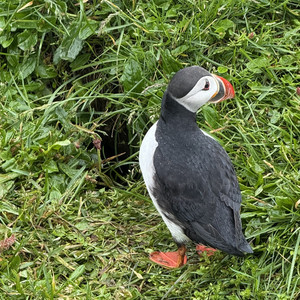
They have black backs and white fronts. The top of their heads are black and they have big white cheek patches.
And then they have these really bright orange feet. an orange and black triangle over their eyes, and beautiful black, orange, and white beaks.
Sometimes these birds are called the parrots or the clowns of the sea.
My name is Hazel. I live in Gilbert, Arizona.
I'm eight years old. Why are puffins' beaks so colorful?
That's a great question, Hazel. So a lot of times when animals are colorful, They're trying to convey information or communicate information.
With puffins, that's true. And often what they're communicating is how old they are. and whether they're old enough to nest.
So when a puffin is a chick, or just fledges and takes off into the world on its own, their bill is dark.
Kind of black, grayish black. And it stays that color for a while.
They often wait until... They're five or six years old before they nest, which is pretty unusual for birds.
And so they spend their second, third, fourth, fifth year of life, not nesting, but they start to look a little more like an adult puffin each year. that bill becomes more colorful, it becomes thicker top to bottom, and it has ridges that run vertically from top to bottom.
Um, so that, that colorful bill that we were also impressed with and catches our eye really well.
It develops over time and really communicates that an individual puffin is old enough to nest.
And when you say old enough to nest, you mean old enough to mate and have babies.
That's right. Yeah. So puffins will find a mate and and often they mate for a long time, if not for life.
The female puffin will lay just one egg per year.
But none of that starts until they're five, six, seven years old.
When they are too young to nest? Do they still come onto land for those summer months, or are they out to sea for four or five years?
Yeah, nice follow-up question. Most of the time, these young birds are out in the ocean.
They will come to colonies sometimes late in the summer.
They may just swim around the island or they may get up and land on the island a little bit.
And they spend some of that time socializing, getting to know other young puffins and But also studying the colony was interesting.
That colony, a place where lots of baby puffins were raised that year, And if so, maybe that's a good place for that puffin to think about nesting themselves when they're old enough.
Wow, that's fascinating. Can you imagine you're out by yourself in the ocean for 12 months unless you come in to say hey to everybody else who's there.
And otherwise, puffins are pretty solitary, right?
They're just by themselves bobbing out in the ocean and catching fish.
Yeah, they really don't socialize much that we know of away from the colony.
They probably see other puffins and they go to similar places or the same places to find food.
But we think they're mainly going there to find food, not really. to make friends or possibly find a mate.
And we know that birds that are already old enough to be nesting, the male and female, Even though they spend every summer together working to raise a check, during the winter they split up.
And they're not anywhere particularly close to one another during the winter.
So they're not meeting up in the middle of the wintertime to ask each other Ruben's questions.
I'm nine years old. I'm from Savannah, Georgia.
Where do birds go in a lightning storm? They're not like, hey, did you see that lightning?
How'd you live through that? They don't get to consult their partners on kind of get some advice or some thoughts or brainstorm how to solve problems.
Most of the time they do that on their own.
So how do they survive and where do they go in a lightning storm?
Puffins are lucky they don't stick up out of the water much, so they're not a very high target for a lightning bolt.
Oftentimes, the waves are higher than a puffin will stick out of the water.
That's one way they avoid the risk of getting struck by lightning.
They probably also see storms coming. they're probably pretty good at predicting the weather based on just what they see around them.
Not what's going to happen tomorrow, But when they see a dark cloud, in the afternoon, they probably can fly away from that or around it and avoid a bad storm. to kind of reduce the chance that they get exposed to a lightning storm.
Birds can get hit by lightning. It's not common, and there hasn't been much research done on it.
But there have been accounts of people seeing birds get struck by lightning.
And sometimes a bird might be taking shelter in a tree that gets hit by lightning.
Unfortunately, that's usually not good for the bird.
But again, it seems to be pretty rare. Let's talk a little bit about what puffins do when they're on land.
Hi, my name's Ellie. I'm four years old.
And I live in Hopkington, Massachusetts.
Why do puffins live underground? Hi, my name is Bernie.
I am six years old. I live in Woodinville, Washington.
Why do puffins... within little holes in hills that I kind of whittle. and that I kind of, a medium sized hole, Yeah, so great questions.
You guys already know a lot about puffins.
Yeah, so puffins are kind of an unusual bird in that they... nest underground.
And so they don't spend all their lives underground.
They're out on the ocean for most of the year, but when they come to an island to nest, they will look for a spot where they can either dig a hole in dirt which we call a burrow. or if an island is really rocky but has some broken up rocks, boulder-sized rocks, maybe a meter on a side or two or three feet on a side. they will look for crevices in those rocks where they can kind of drop down below the surface And again, find a kind of safe little hidden burrow-like space.
They really only put their nests in these underground places Because that protects the egg and chick and the adults while they're in there. from predators, like here in North America, bald eagles. really big predatory birds that are certainly capable of eating the eggs. or eating a young chick,
Or some of those birds, like the eagles, are capable of eating adult puffins too.
Some gulls also like to eat puffin babies and puffin eggs.
That's right. Puffins are generally safe from these species, these predators. if they find a good burrow and a pretty deep burrow.
Some birds, Ravens are an example. We'll try and dig out birds from earthen burrows.
But if the puffin has dug a burrow really deep, then the raven will probably give up before it gets there.
Our team was really lucky. In June, we got to go to Iceland do some reporting in Iceland.
And one of the places that we went to was the world's largest colony of Atlantic puffins.
And it was amazing to see all of these burrows, which are pretty well hidden.
It just sort of looks like a grassy hillside.
The day that we were there, the pufflings, the baby puffins, had just recently hatched.
So the adults were outside of the burrows, but we couldn't see the pufflings, but we most of the adults were sort of outside keeping guard.
They seemed to be on alert and there were a lot of gulls and other bigger birds flying around in great big circles, I guess maybe just hoping that they could catch sight of a really tasty little puffin baby, maybe.
Yeah, it sounds like you had a cool trip to see a really cool puffin colony.
So gulls can have a couple other sneaky impacts on puffins.
When puffins have chicks, once that egg hatches into a chick, Puffins feed the chicks fish and they carry fish back to the burrow. kind of crossways in their bill, in their beak.
And so Those fish are out there for anybody to see.
We scientists, we take pictures of them and we identify the fish that puffins are eating that way.
So it's really neat for a research study question we can understand what puffin diet is like, what fish are important to puffins, but It also means that gulls and other species can see those fish. and a certain number of goals, figure out, hey, I could maybe steal some of those fish I caught an adult puffin kind of not really paying attention.
I could swoop in there and maybe bump the adult puffing around, get it to drop those fish or maybe scare the adult puffin into dropping those fish.
And so a lot of the interactions you see there are goals trying to steal fish, not actually expecting to get a look at a check or a chance at a The chicks are, they're pretty smart, even though they're very young.
And they can, very rarely come out of the burrow.
And when they do, it's often at night. when the gulls are sleeping, not very active.
So they generally stay safe. in their little burrow until they're ready to fledge or leave the island and kind of become independent and kind of go out in the world on their own.
Well, that brings us to Sawyer's good question about how baby puffins learn to fly.
My name is Sawyer and I am 10 years old.
I'm from Marietta, Georgia. Why do puffins live on such high cliffs?
Don't the adult puffins carry the baby puffins instead of letting them jump off the cliffs themselves?
To get to your question, Sawyer, we first have to understand a little bit about the body structure of a puffin.
Since puffins spend almost all of their lives in the water, diving for fish, They need really strong wings for swimming.
Don says most seabirds that spend a lot of time swimming have short wings.
Penguins are kind of the extreme example of this.
Their wings have become so specialized for swimming that they can't even fly at all anymore.
Puffins are actually really fast flyers, but they do have relatively short wings that help propel them underwater. so they can't soar around like the gulls we saw patrolling the skies near the Puffin Burrows when we visited Iceland. like those goals.
That's exactly right. Or if people know, albatross or vultures or eagles, a lot of really big birds. have really long wings and can soar or glide. through the air.
Puffins can't do that. They have to beat their wings really fast.
I've heard people have tried to Measure how fast they beat their wings.
It might be 400 times a minute Wow Which is amazing.
It's a little like hummingbirds, even, how hard they have to beat their wings. just to say airborne.
They nest on high cliffs, or kind of hills on islands. so that they have a lot of space between them and the water.
So when they take off, from their nesting spot just outside their burrow.
They have a lot of time to get up speed, to flat their wings really hard and get up speed so that they are flying. so that they don't just drop and land in the ocean.
The chicks, start out... So one reason the adults can't carry them, the chicks, when they fledge...
They're almost as big as adults. So it'd be kind of like. one of our parents carrying us around when we finished high school.
It would just be really difficult for the parent to help in that process.
And so those young puffins, the first time they leave the burrow and leave the island, They have not flown before.
They don't have a lot of muscles built up to fly well, so they often are jumping off cliffs and ending up in the water. which is okay.
They're good swimmers. They can kind of paddle away. from the island and get their start in life and start looking for fish to eat. right off the bat.
But it does mean that almost all puffins like to take off when they start flying from a high spot.
Imagine being that baby puffin, a puffling, and the first time you have to try flying, it's in the middle of the night.
And you're not just expected to flap your wings a few times and see how it goes. you're going to have to jump off a high cliff and hope you figure it out before you hit the water.
Dawn says it's not always graceful, but the pufflings figure it out pretty quickly.
In the place that we visited in Iceland, the Westman Islands, there are a lot of baby puffins every year.
After all, it's the biggest colony of Atlantic puffins in the world.
And sometimes these pufflings get a little disoriented and turned around when they first try to fly. so they wind up back on land.
People who live on the main island often scoop up those little babies and take them back to the cliffs at night and kind of throw them or toss them off the cliff.
It sounds a little alarming, but it's actually helpful.
That's how the babies... get off to sea.
I wish we had been there to see that part of the tradition.
Coming up, What are puffins doing right now in the middle of August?
And we'll learn a little bit about puffin conservation in Maine.
About 50 years ago, there were almost no puffins there at all because they'd been hunted so much and even used in feathered hats.
Now there's a thriving population, the one that Dawn has been studying.
So stay with us to learn more. This is But Why, a podcast for curious kids.
I'm Jane Lindholm, and today we're learning all about puffins.
These cute little seabirds are sometimes called the parrots of the sea.
But it turns out they're more than just silly looking.
They're fascinating. We're learning about them from Don Lyons, the Director of Conservation Science for an Audubon Society program called the Seabird Institute in Maine.
Don has been answering all of your questions about puffins.
We interviewed him on August 14th. right around the time when all those pufflings were making their way out to sea.
Puffins are amazing in that those pufflings, those fledglings, When they leave the island, they don't get any more help from their parents the rest of their lives.
They're on their own. which is incredible.
They somehow know they figure out how to find fish. and catch fish without the parent ever showing them how that's done.
And they'll figure out how to make it back to their nesting grounds when they are mature and it's time to start having babies.
Puffins don't just hang around near the island where they were born their whole lives, you know.
They often go really far away. They go where the food is.
And that can be relatively close by or it can be quite a ways away.
The puffins here in Maine, They often, kind of late summer, they go north up into the ocean off of Canada. because the food's really good up there.
And so they'll find herring and sand lance and other forage fish, we call them.
And then as the fall gets colder and we get closer to winter, they start moving south again.
And they may be... just a few 100 miles or maybe 500 kilometers from the colony. where they were raised during the winter here.
A few puffins go further south, but it's just a few birds that go that far.
But other puffins, other Atlantic puffins from elsewhere and other of the Pacific puffins, the puffins that nest out in the Pacific Ocean.
They may go hundreds or thousands of kilometers or miles southward usually during the winter.
So it really all depends on where they're going to find food.
They're really just out there chasing food.
And then, when they're adults and it's time to find a mate and a nesting ground, they can find their way back.
Year after year, they go to the same colony, they find the same mate, and sometimes even the same burrow.
That's pretty impressive, considering they might head out to sea 500 or 1000 miles away for most of the year. and then they can find their way back to the same tiny island.
Yeah, it is amazing. It's not something we understand that well. that part of this process is a bit of a mystery.
Dawn says they probably have a lot of complex ways of knowing how to do that. including an internal sense of direction that's kind of like a compass. an ability to recognize their island by sight and familiar landmarks, and possibly a sense of smell that helps them sniff out their colony from any others.
But there are still a lot of unknowns about how puffins actually do it.
It's hard for us humans to understand it when we can't even tell one puffin from another.
Hi, my name is Michaela. I'm from Barrie, Ontario.
I am eight years old, and my question is, how do you tell... them apart from male and female.
All puffins look alike. It's kind of amazing.
I can have a puffin in my hand. I can have two puffins in my hand, one in each hand.
And I cannot tell them apart. Even you. I cannot tell if one's a male, one's a female.
I can measure them and I can say, well, this one's a little bigger than that one, but that's all I got.
That's all I know. The way we do eventually figure that out is we take a blood sample. or pluck a few feathers that have blood in them. and we take that blood to a laboratory and extract the genes out of the blood, the DNA out of the blood,
And with that DNA, we can tell whether it's a male or female.
So it's amazing. that they can sort that out, but they do.
And I'm sure some of that is how that bill looks.
The bill is pretty unique from one bird to the next. and they can make vocalizations or calls.
They can do a little talking. to identify themselves.
And I'm sure the puffins themselves know other traits to tell each other apart.
All right. I have a couple of rapid fire questions for you.
I'm five years old and I'm from New York.
How long can puffins hold their breath? And do they eat fish?
Sam is wondering how long can puffins hold their breath and do they eat fish?
We know they eat fish. How long can they hold their breath? puffins, they dive underwater, swim underwater. that can last even two or three minutes.
And I bet somebody's curious about how deep they can dive.
Most of their dives are just in the top 50 feet or 15 meters of water.
But there are puffins that we've documented diving as much as 50 meters or 200 feet, which is amazing for a bird that weigh about as much as a full can of soda.
Hello my name is Juliet. I am four-year-old, and I live in Denver, Colorado.
How do... Birds have red feet. How do birds like puffins have red feet, wonders Juliette.
That foot color is probably there because it's another way to signal that a bird is an adult.
Puffin chicks don't have red feet. They're just kind of dark and black or gray.
Most of that foot color is just pigments that the puffins produce. much like our skin color varies a lot or we produce pigments for our skin.
It's not always the same color in all of us, but that same process produces pigment in the skin of their legs and But the purpose of that is probably primarily to let other puffins know that, hey, I'm an adult.
I could be a potential mate. Michaela, who asked a question earlier about how we tell female and male puffins apart, has another question.
Why do puffins have that little triangle around their eye?
Don says it's similar to both the colorful feet and the colorful beak or bill.
It signifies that the puffin is an adult and old enough to mate or have babies.
And he says that triangle also helps identify a puffin as a puffin because it's unique to their species.
We got another puffin question from Logan.
I'm 11 years old. I live in McMaster on the Mornington Peninsula in Victoria, Australia.
Do puffins have any blubber? And if so, how much of it do they have?
Blubber is a specialized type of body fat that many marine animals like whales and seals have.
It not only helps keep their bodies warm in cold water, but it also helps with buoyancy, keeping them afloat.
While it's usually associated with marine mammals, penguins have blubber, and they are, of course, birds.
Puffins also have a layer of fat that helps insulate them from the cold sea and cold winds. but it's not called Blubber.
I asked Dawn if there was anything else we should know about puffins.
Well, fun fact, puffins carry fish back to their chicks in their bill, crossways in the bill, they can catch multiple fish and hold them and catch another fish and hold that and So they're often delivering five to 10 fish to their chicks at a time.
But kind of the record that we've heard about or that I've heard about of how many fish can a puffin carry? is 62.
No way. That's what I'm told. I have not seen the photograph, but... you know, that bill is really designed well to hold lots of fish.
Inside their mouth, they have some ridges and kind of barbed surfaces. that help hold fish.
And so they really are designed, you could say, to hold fish, to carry fish.
I can barely carry one fish in my mouth, let alone 62, although I'm tempted to try it tonight.
Before we let Don go back to his puffin research, I wanted to know just a little bit about the work he and his colleagues have been doing in Maine.
Because, you see, puffins were pretty much gone there for a long time.
We didn't lose... all the puffins, but we were down to just a handful of puffins on just one island.
It may have been as few as two puffins. We don't know, but really, really low number.
And that happened mostly because people hunted them for their eggs, for their meat. or their feathers at one time.
It was high fashion for women to wear feathers on their hats or or even hold birds on their hats, dead birds.
About 125 years ago, puffins were nearly gone from the coast of Maine.
But in 1973, just over 50 years ago, researchers decided they were going to see if they could bring them back.
So they went to puffin colonies along the Canadian coastline in Newfoundland, and took some puffin babies from nests there.
And they took chicks that were about 10 days old, They stuffed them into a suitcase. put them on a plane, flew them to Maine, got them on a boat.
The boat took them out to one of these islands where puffins had nested 100 years earlier.
And people had built burrows, had dug burrows out of sod and the The pufflings were put in those burrows.
And that all happened really fast, like within 24 hours, within a day.
All of that was all coordinated ahead of time.
So that when a puffling was grabbed, it got to a new burrow in Maine in 24 hours or so. kind of an amazing bit of travel logistics.
Personally, I can't help but think about what a confusing process that might have been for both the Pufflings and the adult parents.
But anyway. Pufflings were brought down for over five years to that island.
And in some years that was around 200 pufflings a year.
They were hand-fed. So there wasn't adult puffins to feed them.
So people got the small fish, and dropped those fish into the burrows.
And the pufflings would pick them up and eat them.
And then the pufflings fledged from the island.
They left the island. They don't normally get help from their parents after they leave the island.
So this strategy could work. And they swam away.
Remember that puffins don't mature for several years, so it was unclear if this plan to recolonize eastern egg rock in Maine was going to work. the scientists decided to put out decoys, fake puffins. to make it look like the island was a good place to mate and raise chicks.
And they even played the sounds of seabirds, so any puffins who were scoping the island out would think it was a rockin' place to be.
And you know what? It worked. Within a couple days of those first decoys going out. real puffins, landed on the island and started checking them out.
It still took two or three more years before they started nesting.
But that did happen. It actually happened on those first fish. being carried into a burrow were seen on July 4th, 1981.
And today, Dawn says there are about 3,000 puffins nesting on two restored island colonies.
But just as importantly, kind of the techniques, the use of moving tools, the pufflings, the chicks, which we call translocation. that movement of birds and the use of decoys, have now been used for around a third of all seabird species in the world, including some species that were critically endangered.
So I kind of puffins have been a situation where some really good conservation work for puffins has happened, but also work that has benefited many more species of seabirds around the world.
What a great place to end on a conservation success story.
Thanks to Don Lyons, Director of Conservation Science for the National Audubon Society's Seabird Institute.
And thanks to all of you for sending us your Puffin questions.
You can always send us questions about anything that makes you feel curious and you want to know more about.
Have an adult help you record you asking your question.
Tell us your first name where you live and how old you are.
And then have your adult email the sound file to questions at butwhykids.org.
If your adults don't already know how to do this, you can remind them that most smartphones come with a free audio note-taking app. like voice memos or recorder.
Our show is produced by Vermont Public and distributed by PRX.
It's made by Melody Beaudet, Sarah Baik, and me, Jane Lindholm.
Joey Palumbo is our video producer. Jory Raphael made our logo, and Luke Reynolds wrote our theme music.
If you like our show, please write us a review or ask your adults to do it on whatever app you're using to listen to us.
It helps other kids around the world find us.
We'll be back in two weeks with an all new episode until then.
Stay curious. From PRX.