NPR.
This is The Indicator from Planet Money.
I'm Waylon Wong.
And I'm Adrian Ma.
A few years ago, Taylor Iogo's family relocated from Washington, D.C. to Atlanta, Georgia.
Taylor wanted to find a home near a good school for her daughter.
And Taylor took this research really seriously.
I'm one of those people.
I comb the data.
I look at school performance, particularly for Black children.
Taylor found a public school she really liked, West Manor Elementary School in southwest Atlanta.
Her daughter started going there in kindergarten, and it's been great.
West Manor is a place where the teachers and the staff, they know the kids by name, every single one.
They know the parents, the grandparents, the aunties and uncles that come to pick them up.
Whenever there's a holiday celebration, the auditorium is packed with families.
But Taylor heard a disturbing rumor at her daughter's kindergarten graduation in the spring.
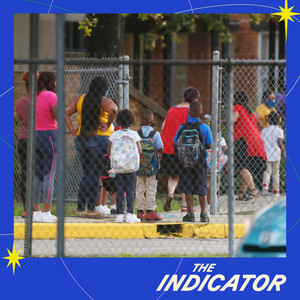
West Manor might be closed as part of a broader effort by Atlanta public schools to address declining enrollment.
And it turns out it wasn't just a rumor.
The district is considering closing some schools.
And it's not just Taylor's school in Atlanta that's potentially on the chopping block.
Districts in states like Minnesota, Tennessee and Texas are grappling with the future of their public schools.
So these conversations are happening all over the place right now.
Today on the show we learn about how school closures are a sign of much larger forces at work in the economy.
And we see how parents like Taylor are fighting to keep their kids' schools open.
This message comes from Range Rover Sport, crafted to combine sporting personality, elegance and agility.
With an assertive stance designed to hint at the vehicle's refined driving performance.
The Range Rover Sport was created with a choice of powerful engines, including a plug-in hybrid, to provide an uncompromising take on sporting luxury.
Explore Range Rover Sport at rangerover.com slash US slash sport.
Support for this podcast and the following message come from Fisher Investments.
SVP Judy Abrams shares the experience she hopes to create when meeting a prospective client for the first time.
One of the ways that I work to establish trust is to listen.
We're going to be asking you questions to make sure we truly can understand what's going on with you.
Then we can make decisions not only for the Learn more at FisherInvestments.com.
Investing in securities involves the risk of loss.
You ever see a movie or a TV show where there's a town hall meeting and then a bad guy like some out-of-town consultant parachutes into this meeting and everyone gets mad at them?
Well, when it comes to public school closures, Tracy Richter is that guy.
I have to ask how much of your job involves having to get up in front of a meeting of just enraged parents.
Well, that's you know.
It feels like you know, in the last, I think, three or four years especially.
It is a big part of the work that I have to do.
I just don't want to be known as a national expert on school closure.
But unfortunately, this is the role that has found me in this time of my career.
Tracy's official title is vice president of planning services for a company called HPM.
HPM does construction management for different industries, including K-12 education.
Tracy says that the happy part of his job is advising districts on projects like building a new school.
The grim part, and the one that he's doing more of these days, is helping districts figure out what to do with school buildings that don't have enough students in them.
Atlanta Public Schools is one of Tracy's current clients.
And while the district has a capacity for 70,000 students, the enrollment is just 50,000.
Tracy points to a couple reasons for the drop in enrollment, not just in Atlanta but across the country.
Number one, and this is the big one, families are having fewer children.
The birth rate in the U.S. has fallen more than 20 percent since 2007.
That's the year the Great Recession officially started.
I think that the birth rates are going to stay low.
Obviously, that's going to have some impact, but that's not all of it.
That brings us to a second reason behind falling enrollment, which is housing.
Tracy says a lack of affordable housing options in large metro areas is keeping young families away.
And there's also this mortgage lock-in problem, which is something we talked about on the show before.
That's where homeowners who borrowed money at low interest rates a few years ago are staying put.
And this is because they don't want to take out a new loan at a much higher interest rate.
These stuck homeowners include empty nesters.
Under normal circumstances they would downsize, maybe sell their home to a family with school-age children.
But this isn't happening, and Tracy understands this firsthand.
Three years ago, I had, you know, two kids in high school.
Now they're off and I don't have any, but I have this house that I raised them in.
That's likely too large for me and my wife.
But going to half the house at twice the mortgage and four times the interest rate isn't very attractive.
Combine the falling birth rate with a difficult housing market and you get some communities with fewer students.
This poses an existential problem for public schools, because part of their state and federal funding is based on per-pupil enrollment.
Fewer students means less money coming in, while certain expenses, like building maintenance, they stay constant.
Erica Meltzer is the national editor at Chalkbeat.
It's a nonprofit news organization that covers education.
And she says low enrollment is a widespread problem right now for public school districts of all sizes.
This really comes down to, like, economies of scale for school districts.
For a lot of these schools you start to have questions of is the school operating in an efficient manner?
Can they afford a nurse, an art teacher, a music teacher, a social worker?
Or at the high school level, can you offer advanced classes, robust career and technical education?
And increasingly, the answer is no.
Erica says it doesn't take a big exodus of students to put a school into a death spiral.
It can happen when falling enrollment leads to cuts in programs and services.
That leads to more families leaving, which means less government funding and more cuts.
Sometimes the difference of just five or 10 kids can be sort of that make or break point.
Because if you have, you know, $10,000 per student, that's $50,000 or $100,000.
And that starts to be several staff positions.
Like, can you have classroom aides?
It can be as little as five or 10 students in the overall enrollment of a school that become the point where they can no longer offer a robust range of services.
School closures can be really disruptive to families.
Students may lose connections they've made with friends and teachers.
And research has linked closures with negative effects on academic performance.
Erica says the pandemic delayed a reckoning for some school districts because they received emergency federal funding.
But today, that money has been spent.
And Erica says the Trump administration has prioritized access to private schools over investment in public education.
And, in fact, the huge tax and spending bill the president signed this year.
It created a federal program to help families pay for private school.
The federal program is the first of its kind and it comes amid a major uptick in statewide private school programs.
Still Erica says she doesn't believe those vouchers are a main cause of the public school enrollment decline.
But these programs are expanding and that adds a new dimension to the school closure conversations happening around the country.
You have the individual choices that parents are making thinking about their kid, and then there's the system level effects of millions of individual choices.
And then there's sort of the policy universe that creates the choices that are available to the parents.
Taylor Iogo, the Atlanta parent we heard from earlier.
She wants her daughter's elementary school to continue being an option.
Otherwise, her daughter would essentially have to start over at a new school.
Now, private school vouchers are available in Georgia, but Taylor is not sure she wants to do that.
In the meantime, Taylor has joined up with other parents in APS Atlanta Public Schools to campaign for keeping the school open.
They have an official Save West Manor Instagram and website.
They got lawn signs made.
And they've been going to community meetings.
In this conversation about school choice.
You know, people talk about charters or they talk about private school.
But choosing your neighborhood public school is a choice.
And many families, many young families are actively making that choice.
We have some great schools.
You have passionate families about our schools.
You know, it kind of feels the best way I can describe it.
It's like when you had a crush on somebody and you're like, I've been here the whole time.
Right.
Like I've been rooting for you this whole time.
So like so why are the families who were staying loyal to APS being punished with these closures?
Parents like Taylor will be making their final push to save schools over the next couple of months.
And then Atlanta public school officials could vote on a plan as soon as December.
This episode was produced by Julia Ritchie with engineering by Robert Rodriguez.
It was fact-checked by Sierra Juarez and edited by Kate Kincannon.
The Indicator is a production of NPR.