NPR. This is the indicator from Planet Money, I'm Weyland Wong.
And I'm Adrian Ma. You know, in the midst of the Trump administration's trade war, you might be wondering, is there some sort of neutral third party here?
You know, some authority figure that can step in and stop this carnival ride of imposing tariffs than suspending those tariffs and threatening more tariffs and retaliating with tariffs.
The global economy does actually have a kind of mediator for these disputes.
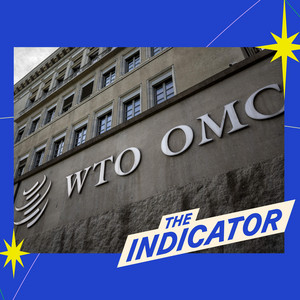
The World Trade Organization and Canada and China have filed complaints against the U .S. with the WTO.
There's just one problem, though, the WTO essentially is a lame duck and it's the U .S. that has been blocking it from playing referee on these trade disputes.
and this hamstringing of the WTO did not start with Trump.
It actually goes back to the Obama years.
Today on the show, what made the US turn against the WTO, an organization it helped create, and how are other countries redefining their relationships in a system where the US no longer wants to cooperate?
This message comes from ServiceNow.
People should do the creative work they actually want to do, not boring busy work.
Now, with AI agents built into the ServiceNow platform, you can automate millions of repetitive tasks in every corner of your business.
IT, HR, and more. So your people can focus on the work they want to do.
That's putting AI agents to work for people.
It's your turn. Get started at servicenow .com slash AI dash agents.
Are we overlooking the challenges facing men without college degrees?
Richard Reeves thinks so.
There are a lot of guys out there who are actually poorer than their dads.
Reeves heads the American Institute for Boys and Men.
Have we updated our view about the role of men as quickly as we change the economy around them?
And the answer is, no. That's from a recent Planet Money bonus episode, a look at the economic and cultural struggles of working class men.
To hear it and get sponsor -free listening, sign up for NPR Plus.
Just go to plus .npr .org.
This message comes from INSPARITY, providing HR services and technology, from payroll benefits and HR compliance to talent development.
Learn more at INSPARITY .com slash HR matters.
After World War Two, powerful countries like the US and the United Kingdom got together to set up the new ground rules for the global economy.
These talks led to arrangements on tariffs and international trade.
And over the years, countries went back to the negotiating table to work out more of these rules.
These post -war arrangements culminated in the creation of the World Trade Organization in 1995.
It's basically a big club of countries that agree to trade with each other using the same set of rules.
Jennifer Hillman knows these rules really well.
She's a professor at the Georgetown Law Center and an expert in international trade.
I could show you my— oh, here it is.
Jennifer showed us her copy of the WTO agreements.
It's a thick document that she's flagged with a bunch of colored sticky tabs.
I have one of the original books as it was issued in 1995 when the original sort of WTO came about.
It has lots of tabs all over it.
So have these tabs been in there since the 90s or have you updated them?
Yes, they have. Yes, they have. — When governments get into disputes over these rules, they go to the WTO.
And here's how that process works.
First, the case gets heard by a panel of experts.
They make a ruling.
— And then the governments can appeal that decision to a different panel of experts.
This group is known as the Appellate Body, and Jennifer served on it from 2007 through early 2012.
— You basically have to be ready to drop everything the minute you are put on to an appeal.
to Geneva, and then the work is quite, quite intense.
Intense, like 70 to 80 hour weeks.
The panel has around just a couple of months to make a decision.
And this ruling by the way is final.
The appellate body in essence has the last word. And if at the end of the day the appellate body says there was a violation, then what it does is recommend that the country bring its measure into compliance.
In other words, fix the problem.
Fixing the problem might mean reducing tariffs on specific products or lifting a ban on certain kinds of imports.
And for a while, the system of settling disputes worked.
Jennifer says countries would generally follow the WTO rulings, even the U .S. And the U .S. did lose at the WTO.
Like several years ago, the state of Washington had to end a preferential tax rate for aerospace manufacturing.
This came out of a long -running dispute between the U .S. and the EU over subsidies to a company companies like Boeing and Airbus.
Quinn Slobodian is a professor of international history at Boston University.
He points out that when it helped found the WTO, the US signed on to a system where it wouldn't always get its way.
It was a moment where America, the world's most powerful country, saw it somehow in its own interest to cede part of their sovereignty to this international institution in a way that was actually binding on them.
However, the U .S. would eventually grow unhappy with the WTO.
Quinn says a big factor here is China, which joined the group in 2001 and became an economic powerhouse.
And yeah, China was part of the same economic club, but it was also claiming exemptions from free trade rules on the basis of it being a developing country.
So for example, China used this rationale to justify by subsidizing its fishing industry.
This kind of behavior wrinkled policy makers in the US, starting with the Obama administration.
Quinn said there was grumbling that China was too rich and too powerful to still be getting those exemptions.
They thought that China was exploiting the rules of the WTO, that they were claiming exceptions that they should no longer be permitted to, and that the rules needed to be tweaked to make sure that they weren't playing both sides.
Also, the U .S. started to have other gripes with the dispute settlement system.
It believed the appeals panel was relitigating evidence that had already been decided and going outside of its narrow mandate of interpreting WTO's laws.
The U .S. believed this approach was hurting American businesses.
Jennifer says these frustrations came to a head during the Obama administration.
And so, the US blocked the reappointment of some members to the WTO Appeals Panel.
It's almost like you moved the goalpost, so now we don't want to participate in the refereeing like we're not going to send any referees.
Correct. That's exactly right.
And the perception is the goalposts were moved because you're interpreting the rules in a way that we would never have agreed to.
We wouldn't have joined the game had we known those were the rules.
During the first Trump administration, the US started blocking all new appointments to the appellate body.
In late 2019, the group stopped functioning because it didn't have enough members.
So it's been paralyzed ever since.
This paralysis continued through the Biden administration, although it had been in talks on reforming the WTO appeals panel.
That work didn't get done before Biden left office.
So, the WTO remains stuck.
That hasn't stopped Canada and China from filing fresh complaints about American tariffs.
And Jennifer says they can get their cases heard by the first panel at the WTO.
Those rulings will almost certainly get appealed, though, and then...
nothing will happen.
Because there's no appellate body to hear the case.
So the appeal just appends forever.
They refer to it as appealing into the void.
Do you ever feel like screaming into the void when you think about this?
Ha ha. Very often. Very often.
That is a, it's a lot more cathartic than appealing to the void, must say.
Yeah, just get a couch cushion and just - Let her rip.
Scream right into that thing, yeah.
So we've got a big and crucial void at the WTO.
Where does this leave other countries?
Well, historian Quinn Silbodian says, governments have been busy making trade deals without the US.
For example, in 2022, to an Asian Pacific trade deal called ARSEP came into effect.
This agreement links 15 countries, including China, Japan, and South Korea.
And in December, the European Union and four South American countries signed a deal they have been negotiating for 25 years.
Quinn says it is not a coincidence they wrapped up this deal right after the U .S. election.
Trump has been outdoing himself in his second term, right, for the inability to sort of expect what new petulant outbursts will lead to some new form of tariffs, which will then be gone the next day, which may come back in a month.
So it's really accelerating forms of integration beyond the United States.
In fact, Quinn says he thinks the future of international cooperation looks like a bunch of regional agreements as opposed to global organizations with the U .S. at their center.
In other words, something more akin to the 90s era before the WTO came along.
Even so, Quinn says the WTO still has value as a place where countries can discuss issues around climate, labor and inequality.
And Jennifer says the WTO remains a source of guidance for its members, including on urgent topics like bird flu.
At a bare minimum, the WTO provides tremendous amounts of transparency.
If you want to look up whether you can and cannot trade in products, you know, that are coming from flocks that are near or outbreaks of bird flu.
What is the latest science go to the WTO?
And other countries might still go to the WTO for these discussions even if the U .S. does not.
This episode was produced by Julia Richie and Lily Kyros with engineering by Jimmy Keeley.
It was fact checked by Tyler Jones.
Kicking Cannon is our editor and the indicator is a production of NPR.
Anis Baba is NPR's Eyes and Ears on the Ground in Gaza.
Wherever you put your eye to the horizon, it's the same, destruction everywhere.
On the Sunday Story, what it's like to be a reporter covering the war in Gaza while also living through it.
Listen now to the Sunday Story on the UpFirst podcast from NPR.
Neuroscientist, Ethan Cross, says you may think it's healthy to vent about what's bothering you.
But . . . The problem is, you often leave that conversation feeling really good about the person you just communicated with.
But all the negative feelings are still there, sometimes they're even more activated.
Tools for Managing Our Emotions.
That's on the Ted Radio Hour podcast from NPR.
are.