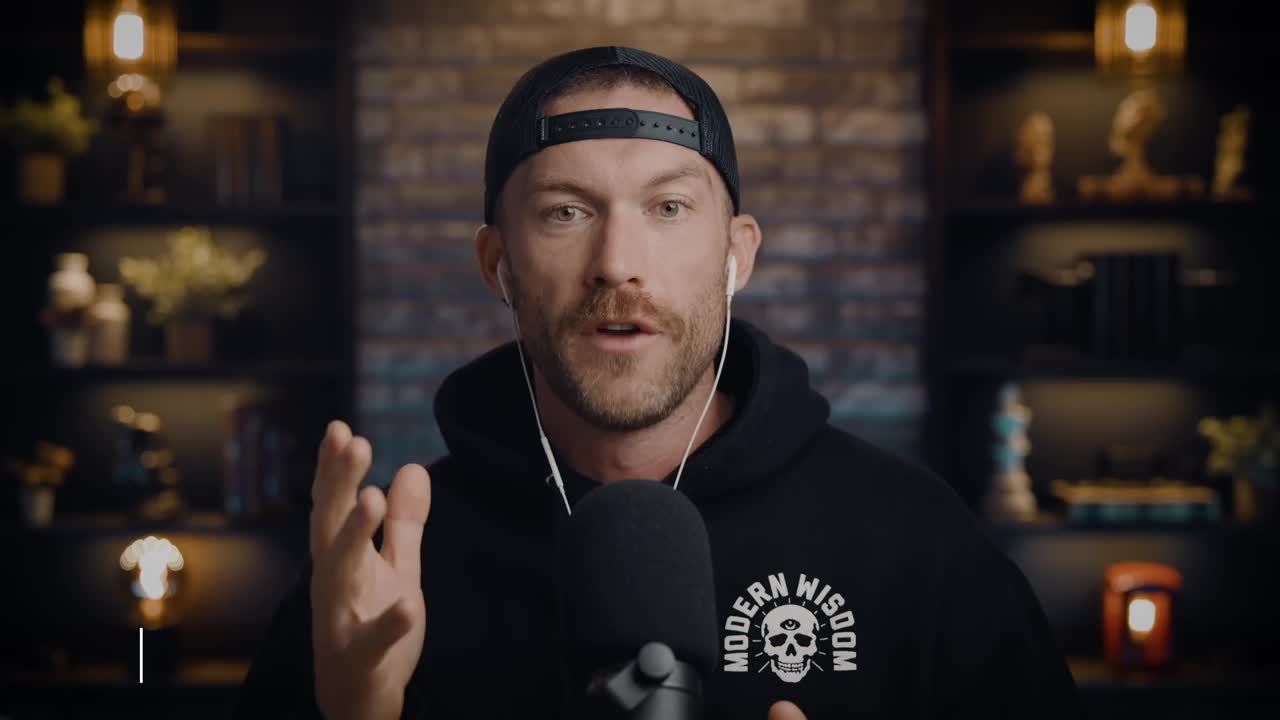
The thing that's weird for me, or that's a little bit of a challenge for me, is that it's difficult to speak to issues that men face without being lumped into this very broad term.
That sort of concept creeped out to include manosphere.
I mean, you know, feminism includes maternal feminists, someone like a Louise Perry who campaigned against rough sex killings and is very pro-family and sort of the most antinatalist, super liberal, super progressive feminists woman.
Like you know, feminism is a very big, broad bucket term that includes everything, and i think that manosphere is basically meninism was just too weird of a term.
So manosphere is sort of the online equivalent of what feminism is, and Shared audiences don't really indicate shared motives.
But I can say as somebody that I think I do good work.
I think I try to create a balanced approach for helping men and women to understand each other and improve their lives.
But it's a difficult needle to thread to just talk to men at all.
And you use a small clip, I think, of Scott Galloway at one point in the documentary.
Richard Reeves as well, from the American Institute of Boys and Men is sort of tangential to him.
Or Arthur Brooks.
Is Arthur Brooks and Scott Galloway.
Are they really the fucking cutting edge of misogynistic content online?
And then I see someone like a Scott Galloway talk about guys should be strong or they should go to the gym, or young people should go out and have experiences and make mistakes.
And he's concerned about the decline of alcohol.
He thinks that people should be going out and getting drunk when they're young and whatever.
I think it's difficult.
I found it increasingly difficult to be able to speak to the issues of men and boys and what's happening with gender relations and sex and declining coupling and all that stuff.
It's become increasingly difficult for me to do that without being lumped in with audiences that may cross over but ideologies that don't really have all that much in common.
And it's been a really interesting challenge because obviously people are pointing at lots of the same issues but their diagnosis and then treatment plan diverge an awful lot.
So yeah, it was very interesting watching the documentary.
I hear that and i'm really curious to know chris, because you mentioned earlier that you felt you'd had a bit of uh flack for for something or other.
Uh, are you able to share anything about that?
Yeah, i mean, it's more general flack.
It's kind of uh rain rather than a atomic warheads.
But um Yeah, there's disagreements around.
Typically it's that I'm too blue pilled, that I don't see.
I know the truth about how men and women are supposed to relate, but I'm not prepared to be sufficiently militant or harsh in my presentation of it.
I i thought you meant that you'd had flack from the, the legacy media.
Oh, i've also got that.
I've also got that for being too manosphere adjacent.
Oh, that's correct.
So yeah, the manosphere think i'm a blue pilled and the guardian think that i'm a misogynist right winger.
So I get kind of ideologically spit-roasted from either side.
I've got sort of one in the front and one in the back.
But yeah, the start of this year was tons and tons.
Manosphere influencer Chris Williamson talks about this blah, blah, blah, blah, blah, blah.
And that's interesting because the term Manosphere has now been inflated to encompass so much that it basically it doesn't really mean anything if, if i am the same as if me, richard reeves, scott galloway are the same as nick fuentes and myron and justin and andrew and sneeko.
Well, I mean, it doesn't seem to be a particularly granular or accurate presentation.
And I don't think that they would agree that they agree with much of the stuff that I say if you were to put it to sort of laid at their feet.
Agreed.
I mean, the term is highly inexact.
And actually, you're right.
And I've been on Theo Vaughn and I've been on Joe Rogan.
And I like those guys.
And I know those have been characterized as Manosphere.
Jordan Peterson would be the same.
Andrew Huberman would be the same.
And in fact, as you say, there's a huge gulf.
There's a huge spectrum within the so-called manosphere community.
We debated it a lot in the process of making the film.
I said many times, I'm not about to make a film where it's like look at these guys, they like to have big muscles and they want to make a lot of money hustle bro, culture and whatnot.
I don't find that interesting.
I don't find it particularly... It might not... be my lane, but actually I like working out.
You know what I mean?
And I feel like self-reliance can be super important.
And it's healthy to have a kind of mixed diet of kind of media intake.
And so my thing was like oh, and we do try and clarify in the documentary like this is the extreme end of a certain world.
And they are a self-identified community, the ones we look at.
They very much see themselves.
You know Sneeko, Justin Waller Myron, from Fresh and Fit.
They are all quite tight, those three somewhat adjacent to Nick Fuentes, in fact, and certainly Andrew Tate is tight with them.
It's a certain so there's, I think, the more we can avoid a conflation of.
You know, everyone who happens to have a male audience, or everyone who advocates for some sort of sense of like there's certain things that are helpful, for men tend to find helpful and it's good for their mental health.
You know, as opposed to oh, the world's run by a shadowy room of.
You know, like these kind of, it's very there's a conspiracy mindset in the world that I was looking at.
There's a it is quite a specific uh rather paranoid, i would say um narrow, a kind of narrow understanding of how the world works, a narrow understanding of what men and women are, narrow sense of what achievement and success look like, and that was, that was very much the precinct that i wanted the film to take place in.
Yeah, I mean, you're right to say that men's self-improvement often gets lumped in with this stuff, but male forms of self-repair are often treated with suspicion.
It's as though sort of any attempt by men to rebuild themselves outside of approved therapeutic and ideological channels is contaminated in some way.
That's probably the best example I can think of and I'm sure that he's been accused of it.
Andrew Huberman, Dr. Andrew Huberman of Stanford is part of the manosphere because he talks about evidence-based ways to sleep better or gain muscle or how much caffeine you should have per day or something. it it seems to be that there's sort of two things happening at the same time one is a big push of which i'm uh like unapologetically a part of that i think that the issues of boys and men need to be spoken about more that i don't think that we need to do this ideological land acknowledgement throat clearing before where we identify the problems that all other groups are facing before we can turn our attention to men because we don't have to do the same in reverse.
We don't have to acknowledge how many men take their own lives, or addicted to drugs, or involved in violent crime, or go to jail or end up home, et cetera, et cetera, before we can then talk about the problems of girls and women.
So one thing is happening which is, I think, that there's been some upending of previous routes toward a sense of belonging and fulfillment and status that men would have previously relied on.
And I think that that puts them in a kind of a very uncertain world.
A lot of the rules that they would have learned from their parents' generation, certainly their grandparents' generation.
It's been such a huge generational shift.
We've now grown up, this generation's grown up on the internet, relying with online content creators, a changing socioeconomic landscape where women out earn and out educate men up to the age of 30.
All of this, okay, so how am I supposed to navigate this as a man?
I don't know.
We've got the most fatherless homes that we've ever seen.
So the previous patriarchs that would have probably stepped into those shoes and would have filled those sorts of roles they've now vacated.
Okay, so who do we turn to?
Well, I've got the internet and this thing's on there.
Now again.
All of that is, I think, important to be addressed and that young boys and men need to be given some really great role models archetypes, game plans, blueprints for how to do this.
I'm sure that you would.
Even as a present father, it would be like the more good information that my boys can access on the internet, the better.
That seems like a good, very pro thing to do.
And also, at the same time, There is a massive moral panic around extremist vociferous content online that is pipelining boys and men to believe in these sorts of crazy things.
And it seems like the legitimate concerns about the second one are used to sort of smear everything from the first one that as soon as you start to talk about male self-improvement that I mean again the fact that I was accused of being a lux-maxer, a term that's been around, as far as I can see, for about three seconds.
Who accused you of being a lux-maxer? some news article, Lux Maxa, Chris Williamson.
I mean that feels a little bit like telling somebody.
It's a little bit of a strange sort of insult, I suppose, given that I haven't tried.
So, you know, I just sort of, I just woke up like this Lux Maxa thing.
It's just interesting these two worlds exist at the same time, right?
Yeah, I think that's really well put.
I think you broke it down beautifully in other news.
You've probably heard me talk about element before, and that's because i am frankly, dependent on it.
Uh, and it's how i've started my day every single morning.
This is the best tasting hydration drink on the market.
You might think, why do i need to be more hydrated?
Because proper hydration is not just about drinking enough water.
It's having sufficient electrolytes to allow your body to use those fluids.
Each grab and go stick pack is a science-backed electrolyte ratio of sodium, potassium and magnesium.
It's got no sugar, coloring, artificial ingredients or any other junk.
This plays a critical role in reducing muscle cramps and fatigue, while optimizing brain health, regulating your appetite and curbing cravings.
This orange flavor in a cold glass of water is a sweet, salty, orangey nectar, and you will genuinely feel the difference when you take it versus when you don't, which is why I keep going on about it.
Best of all, there's a no questions asked refund policy with an unlimited duration.
Buy it, use it all and if you don't like it for any reason, they give you your money back and you don't even have to return the box.
That's how confident they are. that you'll love it.
Plus, they offer free shipping in the US.
Right now you can get a free sample pack of Element's most popular flavors with your first purchase by going to the link in the description below heading to drinklmntcom slash modernwisdom.
That's drinklmnt.com slash modernwisdom.
Congratulations for making it to the end of a clip.
Your brain has not been fried by TikTok.
Watch the full episode here.