Ted Audio Collective You're listening to TED Talks Daily, where we bring you new ideas to spark your curiosity every day.
I'm your host, Elise Hugh.
Why are sad songs so sad?
And conversely, when music moves us to joy, what's going on there?
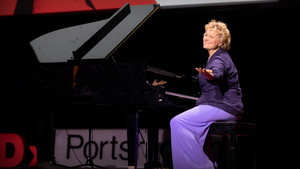
In her 2023 talk, musician and professor Scarlett Keys sits down at a piano to break down for us the exact musical tools that songwriters can use to make us feel one way or another when we listen to certain songs and melodies.
It's fascinating and it's coming up after the break.
Like TED Talks, you should check out the Ted Radio Hour with NPR.
Stay tuned after this talk to hear a sneak peek of this week's episode.
And now our TED Talk of the Day.
Songs are the soundtrack of our lives.
From birthday parties, lullabies, our first love, our first heartbreak, our wedding song, our next wedding song.
And ultimately the song that's played at our funeral.
Songs enhance the moment or the season.
They help us dance.
They make us cry. They make us run the extra mile.
And they can even make us hate sitting in traffic just a little bit less.
Songs help us remember our lives.
They are a time capsule and a time machine.
Imagine you're riding in your car, next to your partner, in your perfectly happy marriage, when all of a sudden that song comes on.
That song, you know, that song from that one summer love.
And as your partner is sweetly giving you a traffic update, you are gone.
Evaporated. Evaporated from your heated seat back to that Greek island.
With the sunset lips of Pericles Constantine Deinos, coming in for a kiss.
You have been transported by a song that was encoded in your brain that summer.
It's not your fault.
Songs are powerful.
Have you ever thought about what's in a song, what's in those three and a half minutes of a range sound that have such impact?
We all listen to and turn the songs.
I've had the privilege of being someone who writes songs.
And as a professor at the Berkeley College of Music, I help other artists write theirs.
And there's tools we use as songwriters that affect emotion.
One of the tools we use is tone.
That's something we all understand.
Tone. Imagine you're sitting in a cold hospital room waiting to meet your doctor, wearing nothing but your underwear beneath your dignity gown, and your doctor comes in.
Nobody wants to hear, hello, my name is Dr.
Watson and I'm your brain surgeon.
We want to hear, hello, my name is Dr.
Watson and I am your brain surgeon.
Because when his tone of voice goes up, so does your heart rate.
And when his tone of voice goes down, you feel calm and like, I'm in good hands.
So tone of voice matters.
The next time you go on a first date, you can either say, I haven't been on a date in a while.
Or you can say, I haven't been on a date in a while.
It matters. It matters.
So think of melody as the song's tone of voice.
How we say what we say is oftentimes more important than what we say.
As Western listeners, we have a relationship to melody, and we have an expectation to that relationship.
So I'm going to play something, and when I stop playing, I want you to tell me what you expect me to play next.
There it is, exactly.
So some notes feel stable, and some notes feel more unstable begging for resolution.
And that's very powerful information for a songwriter to know.
The words we place on those notes make the listener feel certain things.
I'd like to take a moment to ruin an Adele song.
I'm sure you've all heard her song, Someone Like You.
In the verse and in the pre -chorus, she runs into her ex unexpectedly, and she's clearly still in love.
And in the chorus she says, never mind, I'll find someone like you.
Okay, you know the song.
What if she had sung it like this.
Never mind, I'll find someone like you.
What happened? I apologize, by the way.
In my version, we believe her.
We believe she will find someone like you.
No problem. There's plenty of you out there because I have paired stable notes in the key and stable chords, bringing a feeling of stability.
But that's not the melody she's saying.
Those weren't the tones that she's saying.
This is her version.
Never mind, I'll find someone like you.
Do you feel the difference?
So when she's saying never mind, she's saying it on that the most stable note in the major key.
When she's saying find someone, she's saying it on that note that you all wanted me to resolve back to the home note.
Find someone. And then she sings you on the bittersweet sixth degree of the major scale, breaking your heart.
You. In her version, we know she will never find anyone like you.
We know that because she has paired unstable pitches to match the way she's feeling, building empathy with the audience.
Go, Adele. Another way that songwriters emotionalize our lyrics is the use of chords.
Chords are just three to four notes played at the same time.
Three. Four. And chords have a lot to say about how our lyrics feel.
So let's say I want to write a song about eating a Snickers bar.
And let's say that I feel amazing about eating that Snickers bar because they just came out with a fat free vegan version.
I would want to make sure that I picked chords that felt as happy about this news as I do.
Today I ate a Snickers bar.
But what if that wasn't the case?
What if I was despondent or very upset about the fact that I'm eating the Snickers bar?
Because it was my ex's favorite Snickers bar.
It was his favorite candy bar.
And it was the last thing we ate together.
Today I ate a Snickers bar.
So chords help us define the mood of the song.
Another tool that we use is repetition.
Because repetition helps our listener remember our song and sing with us.
So again, I'm going to play something, and I want you to be honest.
I want you to raise your hand when you start to get bored.
I'm hurt! Exactly. How did we all know that, right?
Because in songwriting there's the rule of three.
You can't repeat the same melody exactly the same way three times in a row.
Something's got to change that third time.
Maybe I could have changed a chord.
You are the world's greatest audience.
Or maybe the melody.
You are the world's greatest audience.
So our brains love patterns, but our brains also love surprise.
So I set up a pattern, and then I surprised you, and you were re -engaged.
But too much repetition causes the brain to habituate and zone out.
Too much repetition is a sonic cliché, and our listener stops listening.
How many times have you said to your partner in the same melodic stratosphere, Honey, pick up your towels!
Honey, pick up your towels!
Like, after thousands of repetitions, their brain has habituated to your wife voice, and they don't hear you.
They really don't. They really don't.
So, try changing your melody in some way.
Next time, go, Honey, pick up your towels.
Songs help us process emotion and understand how we feel.
When we listen to songs we love, our brain releases the feel good hormone dopamine.
When we listen to songs we don't like or hate or hold music, bad hold music, our body releases the stress hormone cortisol.
So, try a little bit of this brain science for yourself at home.
Pick a song in the morning to start your day with.
Instead of the usual negative thought train that blazes through your brain taking you with it, put on a song you love that has uplifting lyrics that primes your nervous system for a great day.
Or the next time you have questionable in -laws coming over, instead of awkward silences and small talk, put on a song you know they love and let the dopamine flow.
And now back to the episode.
I like to start a song with a great title or a concept or a clear emotion.
And then use the language that's a mixture of concrete language, metaphor and emotion.
And then I use all of the musical elements in support of that idea.
As music helps us process negative emotions as I've gotten older, I've had to adopt new nouns to my vocabulary.
Words I never thought would belong to me, like jowls, and turkey neck, and most horrifyingly, crepe skin.
So, in order to process my rage, I wrote a song about it.
Alright, so here's a little bit.
Crepe skin. Oh, oh, I've got crepe skin.
I'm just getting started, haven't figured out the journey yet.
Better than I've ever been, but now I've got a turkey neck.
I'm wearing scarfs like Diane Keaton, turtleneck sweaters in the summer when it's heatin', crepe skin.
I know you don't relate, but, yes, I was able to laugh, I was able to laugh at the aging process and better accept it and the delivery of my first AARP magazine.
Over a year ago, I was diagnosed with breast cancer, and I turned to music for my therapy.
In fact, my song was Lizzo's About Damn Time.
Yes. After a double mastectomy, chemotherapy, and going bald, Lizzo's lyrics, I've been so down and under pressure, I may not be the girl I was or used to be, bitch, I might be better.
And the chorus lyric, I've got a feeling I'm going to be all right, okay, it's about damn time, became my fight song of optimism and a shot of dopamine.
There were days that I couldn't face the next round of chemo, and I would get a text message from an old friend or a card in the mail or a knock on the door with a huge bouquet of flowers, and I was filled with love from those simple kindnesses, and that support and that love made me face the next treatment.
It really made me start to understand why I loved that old song, You Are the Wind Beneath My Wings, because I literally felt lifted by the love and the friendship that was surrounding me because I shared what I was going through, which I felt was really important to do, and their love held me when I
couldn't hold myself.
One day, one of my favorite songwriters texted me and he said, How are you?
And I said, It's going to take everything I've got to get through this, and he texted back, Well, it's a good thing you've got everything, but I'm a songwriter.
So that idea, which he will get no credit for, I held on to that idea because I thought, That's where ideas come to me from.
And one day, my dear friend and artist Susan Catanio came to visit and I said, I'm ready to start processing some of this.
I'd like to write a song.
And I told her about that idea, and we sat down, and of course the first instinct could have been the minor key, because that's where we sort of feel that sadness or darkness belongs.
But I was feeling a lot more complicated and complex than that.
I was feeling sadness, but I was feeling fear, but it was all lined with sunlight and hope because of all my amazing friends and the community around me.
And so we decided to write it in a major key, altering one note.
So it was a blend of darkness and light from the major key.
We got the major, and then altering one note, we sort of got a little bit of the darkness.
In psychology, there's a term, name it to tame it.
And when we listen to songs that give name to how we feel or we write them, we can transmute and metabolize difficult emotions.
And I felt better on the other side of this song.
And I'd like to dedicate it to anyone here that's facing the hardest thing.
The Room The room went out of focus When I heard that diagnosis Words I never thought I'd hear I told my family then my friends As we all tried to pretend That nothing bad ever happens here But then there were cards and calls and flowers at my door I don't feel so alone anymore It's gonna take everything
I've got It's gonna take everything I've got Everything to get me through It's gonna take everything I've got Everything I've got Everything to see me through So it's a good thing That I've got everything The Room My head was spinning with a thousand split decisions With my fragile faith and a rose
quartz in my hand Within family, friends and neighbors The kindness of strangers When I think that I can't do this They make me think I can And it's gonna take everything I've got Everything I've got Everything to get me through It's gonna take everything I've got Everything I've got Everything to see
me through So it's a good thing That I've got everything Cause love, love is a real thing And love, love is a real thing And it's the only thing And it's everything we've got It's everything we've got Everything to get us through It's gonna take everything we've got Everything we've got Everything to get
us through So it's a good thing That we've got everything That was Scarlet Keys at TEDx Portsmouth in 2023 If you're curious about TED's curation Find out more at TED .com slash Curation Guidelines And that's it for today.
TED Talks Daily is part of the TED Audio Collective.
This episode was produced and edited by our team.
Martha Estefanos, Oliver Friedman, Brian Green, Autumn Thompson and Alejandra Salazar.
It was mixed by Christopher Faizi -Bogan.
Additional support from Emma Toppner and Daniella Ballarezo.
I'm Elise Hugh. I'll be back tomorrow with a fresh idea for your feed.
Thanks for listening.
National Geographic fellow Dan Butner studies places around the world where people live well into their 90s and beyond.
But he doesn't think a long life should be that unusual.
If you do everything right and you have an average set of genes, you can set your financial plan to age 95.
Nurturing longevity.
That's next time on the TED Radio Hour from NPR.
Subscribe or listen to the TED Radio Hour wherever you get your podcasts.
PRX