I finally committed to getting back in shape.
Hit the gym, ate clean, did everything right.
But after two days, I felt drained.
My body just couldn't keep up.
That's when I found StemRegen.
It supports the release of my own stem cells to repair, recover, and actually rebuild from the inside out.
Now I'm not just working out, I'm bouncing back.
I feel stronger, more energized, and more like myself every single day.
StemRegen didn't just change my routine, it changed my recovery.
Empower your body to recover from within, whether you are focused on recovery, longevity, or just overall wellness.
Stem Regen helps your body feel the best it can.
Release the best version of you.
Try Stem Regen today at stemregen .co.
Use code POD25 for 25 % off your first order.
Again, that's stemregen .co, code POD25.
ACAST powers the world's best podcasts.
podcast. Here's a show that we recommend.
Hey, guys. Welcome to Giggly Squad, a place where we make fun of everything, but most importantly, ourselves.
I'm Paige DeSorbo. I'm Hannah Burner.
Welcome to the squad.
Giggly Squad started on Summer House when we were giggling during an inappropriate time.
But of course, we can't be managed.
So we decided to start this podcast to continue giggling.
We will make fun of pop culture news.
We're watching. Fashion trends.
Pep talks where we give advice.
mental health moments, and games and guests.
Listen to Giggly Squad on A -Cast or wherever you get your podcasts.
A -Cast helps creators launch, grow, and monetize their podcasts everywhere.
A -Cast .com Welcome our buddies back to Pod and Chill.
I'm Gwen, and today I'm holding a warm cup of tea while talking to you.
And I'm Leo, not holding tea, but definitely ready to spill some stories.
We hope you're doing okay.
Or at least breathing gently to start a new day.
Yeah, sometimes just breathing gently is enough.
I already take a fresh breath for today's episode, so now can I tell you something that's been on my mind?
Go ahead. You know, Gwen, lately I've been thinking about our listeners, about those quiet evenings when they sit with their notebook, but the words just don't come out.
Hmm? Or the mornings when they open an English video, full of hope, and close it two minutes later, feeling lost. I know that feeling too well.
One friend told me, Leo, I study hard, I listen, I read, I try, but when I speak, I freeze.
That sounds like so many people I've met.
Yeah, and then they say, maybe I'm just not good at English.
That line always breaks my heart.
Mine too, because the more I listen, the more I realize.
It's not laziness or a lack of talent.
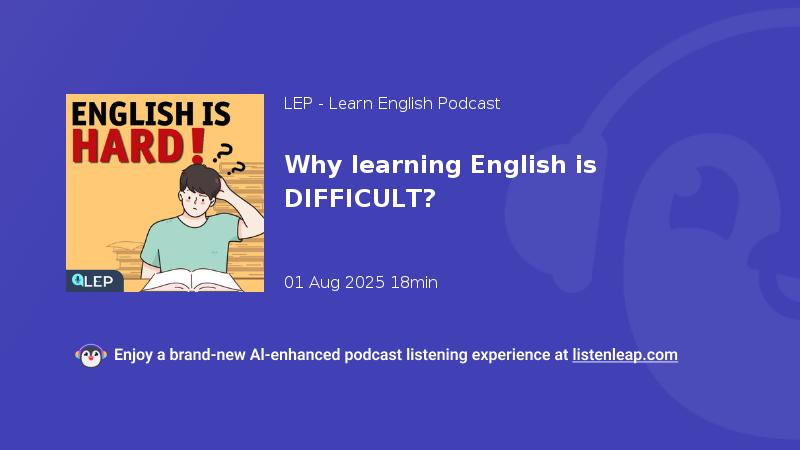
It's just, English is hard. Yes, and not many people say that out loud.
But we should, because when you know the mountain is high, you stop blaming your legs for being tired.
Exactly. So today, let's talk about that mountain.
And remind our friends, if you've been struggling, it's not because you're weak.
It's because the climb is just really tough but we can climb together slowly kindly with rest stops when we need them no one gets left behind and now Let's take our first step Hey Gwen when I first started learning English, I thought I was a genius that sentence already sounds suspicious No, really.
I learned, I go, I eat, I like pizza, and felt like, yep, I can speak English now.
I get that feeling.
When we learn the present simple tense, everything feels simple.
Subject, verb, full stop.
I even wrote a few English diary entries.
Today is sunny, I eat chicken.
Looking back, it sounds wrong, but I was so proud.
That's the sweet part of learning a language.
Your brain isn't tired from grammar rules yet.
And English really is easier at first. Unlike French or German, there's no masculine or feminine for nouns.
Exactly. No gender for table or window.
What a relief. Verbs are simple, too.
Do is still do. And I did works for yesterday.
And maybe the day before, too.
That joy at the beginning.
It's like a honeymoon phase.
Everything is new, cute, and I think, yeah, I can do this forever.
Until the honeymoon ends?
That's when English shows its real face.
I still remember the first time I saw the word psychology.
I read it as P -I -C le guy.
That sounds like a dish on a strange menu.
Well, it was a recipe for failing the test. Or take the word island.
Why is the S silent?
Or receipt. Why is the P silent, too?
I'm pretty sure whoever made English spelling didn't expect us to survive it.
But here's the thing.
It's not because we're bad at English.
It's because English is kinda broken.
True. Spelling and pronunciation just don't match. A study from Oxford University found that over 60 % of English words aren't pronounced the way they're spelled.
That's like playing a guessing game and losing every time.
It's because English borrows from so many languages, French, Latin, Greek, and each one has its own pronunciation rules.
So the word looks French, sounds American, and gives you a headache.
Spelling stayed the same for centuries while pronunciation kept changing.
And we're stuck in between.
So if you keep pronouncing things wrong, don't blame yourself, Just laugh a little, check the pronunciation, and try again gently.
No one gets it right on the first try.
Even native speakers spell things wrong sometimes.
Exactly. So don't let spelling or pronunciation make you give up.
And what matters most is that you keep trying.
But that's not the end.
Because next comes memory.
Ah, yes, the part that's not for the faint of heart.
Memorizing the rules is already tiring.
but English also makes us remember the things that break the rules.
Like children instead of childs, mice instead of mouses.
Or go went gone. I don't even know who's going where anymore.
Ah. I watched a funny video on TikTok about this the other day.
I want to show everyone!
Sure, let's see how funny it is.
I hate verbs in English.
I dance, you dance, he dances.
Why? Is he dancing more than me?
I don't think so. 645 people dance and he dances.
How much does this motherfucker dance?
Oh wow, that video really captures the struggle of learning English.
After learning 10 irregular verbs, my brain starts to feel irregular too.
And the worst part, these exceptions show up all the time in real conversations.
So if we don't remember them, we end up guessing.
And often guessing wrong.
wrong. That feeling of getting it wrong again and again, sometimes it makes you want to give up.
But the real goal of a language is to communicate.
If you can share your idea and someone understands, you've succeeded.
You're just learning something very complex with all your heart.
That is already amazing.
But if English is this hard, how do we keep walking without giving up with kindness and with small habits little steps that don't scare your heart like watering a plant not too much not too fast just enough to keep it alive each day that's how I see language learning not a race but a quiet walk so friends let us share with you some habits habits that don't need you to be perfect just present we'll start with one that's soft and simple.
Just listen. You don't need a notebook.
Just press play. That sounds fun.
Yep. A podcast while brushing your hair.
A YouTube video while waiting for dinner.
A soft English song while walking to class.
Even if you understand only 30%.
It's okay. It's more than okay.
That's how how your ears start to feel safe with English.
Language is sound. So let it become the music of your day.
I remember I used to panic when I didn't catch every word. Now I just smile and say that word will come back later.
Because it always does.
It comes back in daily conversations, conversations, songs, shows, again and again until it sticks.
That's how your brain learns, through real -life, repeated moments.
And next is a tip that some of you may find familiar, shadowing.
This one made me laugh the first time.
I was talking to my phone like a parrot.
But that's the idea.
You listen to one sentence, and you say it again right after.
Try to match the voice, the feeling, the speed, even the silly pauses.
It's not about perfection.
It's about rhythm. It helps you sound more natural without memorizing rules.
And it wakes up your mouth, like warming up before a run.
Some days I pick one sentence from a movie.
I repeat it five times, loud.
My neighbors think I'm weird, but I sound great.
Weird and wonderful.
wonderful, the best combination?
You know, after all that shadowing, something started to shift. English didn't just stay in my mouth anymore, it moved into my head.
Into your thoughts?
Yeah. Like one day I was running late and suddenly my brain just said, you're late.
That's when English becomes part of you.
Not just something you use but something you think in.
It felt kind of quiet but nice.
Let's talk about that.
thinking in English even just a little I started small it's hot today I'm sleepy this bread smells amazing I do that too sometimes it's just a word floating in my head like grateful or rainy and And sometimes, I argue with myself, don't check your phone, but I want to.
Oh no, two Leos. Yup, both dramatic.
But that's practice too.
Every thought in English is like a whisper, a soft repetition that builds your reflexes.
And it feels less scary than speaking out loud.
No one hears, no pressure.
pressure. That's the beauty of it.
You're still learning.
Quietly. Gently. Even when no one's watching.
One day you just realize you didn't translate.
You just knew. That's a sweet moment, like watching a flower bloom and realizing it grew while you weren't looking.
Yeah, and that's how English grows, too.
Quietly, while you're just living.
So what What if you let it grow in even more places, not just in your thoughts, but in your everyday life?
Like letting English sit beside you while you do little things.
How can we do that?
Change your phone to English.
Trust me, you'll feel totally lost for a few days.
The first time I saw airplane mode, I thought it was for watching flight videos.
And did you press it?
Yes. Then I wondered why no one could call me.
But after a week, I started reading update, settings, reminder, and suddenly, they weren't scary anymore.
They just became part of your world.
Exactly. And it wasn't study time.
It was just me checking Instagram.
I saw a meme that said, I'm not lazy, I'm on energy -saving mode.
I didn't know what energy -saving meant, but it felt right.
So you saved the meme and looked it up later?
Of course. That meme taught me two words and made me feel seen.
Sometimes Instagram knows you better than a dictionary.
And that's how it sneaks English into your day, one post at a time.
That's such a gentle way to learn.
Here's another thing I love.
Keeping a journal. Just three short sentences at night.
like today I walked in the rain my socks were wet I want hot chocolate that sounds oddly cozy it is and it's real it's your English describing your day and the more personal it is the more it stays with you moreover you can also send voice notes to yourself or to your English buddy I'm really grateful that you don't get annoyed when I send silly messages in English Gwen as long as it's for learning English.
I won't complain. Gwen is such a good friend, right, guys?
You should find someone like that, too.
A friend who learns with you.
Oh, and we have TikTok.
Oh, right. Never underestimate the power of a good 10 -second video.
If I hear a cool sentence, I pause, repeat it five times, try the same expression.
You copy the vibe, too, don't you?
Of course. I'm basically auditioning for an imaginary English drama.
But that kind of playful learning is powerful.
You're not forcing English into your life.
You're welcoming it.
One small, silly, honest moment at a time.
You know, Leo, we've talked a lot today.
Yeah, like two friends walking and sharing snacks.
But the snacks are English tips.
Exactly. Now, before we open the vocabulary basket… Can we stretch a little first?
My brain is cozy, but my back is stiff.
Good idea. Wherever you are, take one small breath.
Or two, if today's been heavy.
Let's take one small breath together.
Inhale and slowly exhale.
Okay, let's pick a few friendly words from today's episode.
Repeat after us if you'd like.
First word, freeze.
I freeze when I speak English.
It's like your brain hits pause.
Everything stops. Even I freeze sometimes, like when I see my old English teacher.
Next word, struggle.
I struggle with English means it's hard, but you're still trying.
Like swimming in deep water.
But hey, you're still swimming.
Now we have exception.
It's something that does not follow the usual rule.
Yes. Most English past tense verbs end in ed, like talk, talked.
But go becomes went.
That's an exception.
Then we have shadowing.
It's a method of learning by listening and repeating immediately.
Shadowing is fun and awkward at first. I used to repeat after movie lines while brushing my teeth.
It helps you match rhythm, tone, even emotion.
The next word is gentle.
The meaning of it is being soft, kind, not too harsh.
Agreed. Learning should be gentle, not like a strict coach yelling, try harder.
Definitely. Gwen, after talking through all this, I feel lighter.
Me too. Like we've just told the truth that needed to be heard. That English is hard, and that's not your fault.
No need to blame yourself for something that's naturally difficult.
You don't have to push yourself to study three hours a day.
What matters more is just coming back to it gently, daily.
Waiting to feel ready can take forever, so don't wait to feel ready.
Start where you are, even with small mistakes.
mistakes. Right. English doesn't need to be perfect.
It just needs to be used.
So what will you choose to do today?
Whisper a line? Write a journal?
Repeat one sentence out loud?
Whatever it is. Let it count.
And tell us in the comments what small step will you take today?
We're cheering for you.
Always. Keep going my friend!
Goodbye. See you in the next episode.
Acast powers the world's best podcasts.
Here's a show that we recommend.
Hey, guys. Welcome to Giggly Squad.
A place where we make fun of everything, but most importantly, ourselves.
I'm Paige DeSorbo. I'm Hannah Berner.
Welcome to the squad.
Giggly Squad started on Summer House when we were giggling during an inappropriate time.
But of course, we can't be managed.
So we decided to start this podcast to continue giggling.
We will make fun of pop culture news.
We're watching. Fashion trends.
Pep talks where we give advice.
Mental health moments.
And games and guests.
Listen to Giggly Squad on Acast or wherever you get your podcasts.
Acast helps creators launch, grow, and monetize their podcasts everywhere.
a -cast .com