There's nothing better than treating yourself.
Accept maybe treating yourself to high -end, top -quality pieces at half the cost. That's what Quince is all about.
From European linen apparel starting at just $30 to handbags crafted from the finest Italian leather, Quince can elevate an everyday outfit at a fraction of the price.
By working directly with top artisans and cutting out the middlemen, Quince gives you luxury pieces without the markup.
Go to quince .com slash style for everyday affordable luxuries with free shipping and 365 day returns.
Hey it's Paige from Giggly Squad.
Real talk, if there is one store that I absolutely love walking around, it's Sephora.
It's my total guilty pleasure.
They have amazing brands that other people don't have and I find something great every time I walk in.
And there's literally one down the street from me so I do that a lot.
It's so fun to shop in the store and online and the products are just too good, no regrets ever.
For example, one of my favorite beauty brands is Makeup by Mario who just launched his new lip gloss that I absolutely love So the next time you're in the market for great beauty shop all the hottest products and brands only at Sephora When we started writing our thoughts down on paper it opened up endless possibilities Ideas could grow beyond the borders of the mind and it changed the world Somewhere along the way we lost touch with paper Distracted by devices made for every purpose except for thinking and focus.
On edge. Waiting for the next notification.
But what if new technology didn't pull us away from paper, but brought us closer to it.
Listen. That's not paper.
It's the sound of the new, remarkable Paper Pro.
Rewriting the future.
A paper tablet with a true -color ink display, and unheard of tactility, with digital features for taking notes, thinking, and organizing, without any distractions.
Paper is about to change the world, again.
Get your paper tablet at remarkable .com today.
Hey there! Welcome back to Podcast and Chill, where you kick back and pick up some actually helpful stuff from me, Gwen.
And where you get all the laughs and chaos from me, Leo.
So, Leo, have you ever bailed on something just because the beginning was way too hard?
Ugh. You mean, like that time I tried learning to play the guitar and I gave up before I even learned a full chord?
Rough. But, hey, you're not the only one.
Studies show most people quit early on, whether it's a new workout plan, an online class, or just trying to build a habit.
So, you're saying I should feel less like a total failure?
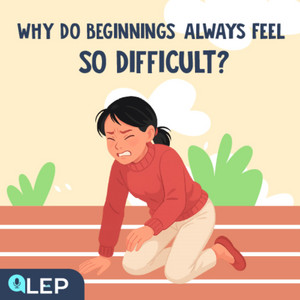
Way less. Especially once we dig into today's big question, why do beginnings always feel so difficult?
Finally, I get to defend my past failures.
Let's go. So, tell me.
Why do the beginnings of things always suck so much?
Honestly? Blame your brain.
Wait, are you saying I'm just not smart enough?
No, silly. It's not about smarts.
It's biology. Oh? Now I'm intrigued.
What's going on up there?
Do you know the amygdala?
Amy, what now? Sounds like someone I went to high school with.
Nope. It's a part of your brain that deals with emotions.
Especially fear and anxiety.
So that's what's freaking out every time I try something new.
Good to know who to blame.
Yeah. Whenever you face something unfamiliar, your amygdala hits the panic button.
But why though? Why can't it be excited instead?
Like, oh, something new, yay.
Yeah, no. Unfortunately, your brain is wired to see new as potential danger.
It's trying to keep you safe.
So whether it's salsa dancing, filing taxes, or starting a business, my brain's like Abort Mission.
Pretty much. And there's more.
When you try something new, your brain has to work overtime.
Meaning? Your brain burns glucose every time you think.
But when you're doing something unfamiliar, Here, it uses twice as much to build new connections.
And what's the aftermath?
Your mind gets worn out twice as quickly.
Oh, so that's why I felt totally wiped after trying to bake a fancy cake that first time.
Five layers and I needed a nap.
Yeah, that's what I'm talking about.
But that's not all.
When your brain senses a challenge or a known, it can trigger the fight -flight -freeze response.
You mean like, caveman survival mode?
Yes, you feel anxious, your heart races, you procrastinate or totally shut down.
All reactions from the nervous system trying to protect you.
This explains so much!
I literally freeze when I open a French textbook, and suddenly, I'm scrolling through memes instead.
That's the freeze response in action.
Your brain would rather be comfy than risk failing at something new.
So what you're saying is, it's not my fault.
Not if I end up doom scrawling when I'm supposed to be productive.
Not your fault, but it is your responsibility to figure out how to outsmart your brain.
Yeah, that checks out.
But I guess I can't just blame my brain for everything, huh?
The good news is you don't have to blame your brain all the time.
True. The bad news is you do have to blame a few other things, too.
Dang it, there are more culprits?
Oh yeah. Yeah, there are some major psychological roadblocks that mess with us whenever we try something new.
Name them. I'm ready to hunt them down and destroy them.
First up, your brain loves patterns.
Why? Because patterns help it guess what's gonna happen next.
You know for survival and all that… Like muscle memory for thinking?
Yep. But when you're starting something completely new, there's no pattern, no experience, just uncertainty and the brain hates that.
That actually makes a lot of sense.
Another obstacle is identity crisis.
Why does that sound so dramatic?
It kind of is. When we start something new, we go from being competent to being a total beginner and that messes with our ego.
Oh yeah, been there, it's the worst. Yeah, it can feel threatening, or even shameful.
It's called ego threat.
And studies show that if your ego takes a hit, people tend to struggle to regulate themselves.
Weirdly enough, this reminds me of the whole Enron meltdown.
That's a good example.
A lot of those executives let their egos get way out of control, started taking massive risks, ignoring ethics, and boom.
Total collapse. OK, I'm two for two here.
What's the final boss?
The last psychological obstacle is quite obvious.
It's the fear of failure.
I know I have it, but I don't know why I have it.
It's because at the start, there's no track record, no proof you can succeed, just imagination.
And, usually, worst -case scenarios.
So, my brain's like, you're going to mess up, everyone will see, and then you'll have to move to a cave and eat moss forever.
Pretty much? That fear can totally frees you in place and stop you from even trying.
But like, what if JK Rowling never got the guts to submit her draft?
Right? No Hogwarts.
No Harry. No magic.
Total tragedy. I get that my brain's trying to protect me from feeling bad.
But man, I wish it was a little braver.
Less run and hide. More let's do this.
You're in luck. We've got some great strategies for how to reframe that thinking.
I'm ready to hear it.
We'll definitely get to that!
But first, we've got to figure out the real culprit behind this whole mindset.
Isn't it my brain? It's not entirely your body's fault.
A big part of why starting something new feels so hard actually comes from the outside, too.
Finally, I've got other people to blame.
One of the most insidious external pressures comes from… comparing ourselves to those who have already succeeded.
Oh totally. Watching someone else breeze through what you're struggling with is such a buzzkill.
But, what we forget is we're only seeing their highlight reel.
The winds, the smooth moves.
Not the blood, sweat, tears, and late -night meltdowns that got them there.
So basically, I'm comparing my day 1 to their year 5.
That's not even a fair fight.
Nope. Not even close.
It messes with your confidence and kills motivation before you even get started.
It's like we talk ourselves out of trying before we've given ourselves a chance.
And it's not just comparison.
There's also pressure.
From other people and from yourself.
You don't say. Pressure can be a motivator, but it also creates a heavy burden.
I get it. The fear of disappointing yourself or others can become overwhelming.
And if that's not enough, try doing all this without a support system.
That's another massive hurdle.
Ugh, yes. Starting something new when you feel totally alone?
It's like walking into a storm with no umbrella.
I know, right? Without someone to lean on or guide you, it's way harder to push through.
Yeah, it can be hard to find in our immediate circle, who understand the challenges or can offer relevant guidance.
Especially in this age of information, when we have too much information.
It's so true. you. Instead of clarifying the path, it muddles it.
Should you read this book or watch that video?
Which method is best?
The paradox of choice can lead to analysis paralysis, where you spend all your time researching how to start, rather than actually starting.
This is so common for aspiring coders, who get lost in the endless options of programming languages and frameworks, before writing a single line of code.
Source? I have a bunch of IT friends.
That's a spot -on example.
So with my brain doing its thing, my psychology playing tricks on me, and all this outside pressure – no wonder getting started feels impossible.
But recognizing why it's so hard is actually the first big step to pushing through – that initial discomfort and finally getting to the good stuff.
I'm here for that. Let's figure out how to push past the mess and get to the good stuff.
So, the first thing we can do is the 2 -minute rule.
Oh, I remember this rule.
It sounds like a cooking tip, but it isn't, guys.
Yeah, it's the tip from the productivity expert, James Clear.
The idea is, if a task feels big or scary, just commit to doing it for 2 minutes.
That's it. So easy, isn't it?
Folks, if you want to start a novel, you don't have to write a whole chapter on your first day.
Leo's right. You just need to sit down, Open a document, or grab a notebook, and write for two minutes.
That's all it takes to get started.
Two minutes might sound tiny, but trust me, they can make a huge difference.
Right? It's because the goal isn't progress, but momentum.
Once you start, your brain stops panicking, and continuing becomes easier.
That's sneaky, I like it.
The next hack is the if -then planning strategy.
This one is new to me.
I'm all ears. Think of it like giving your future self a very clear, easy to follow instruction manual for sticky situations.
Instead of just saying, I'll exercise more, you map out exactly what you'll do when a specific situation comes up.
For example? For example, I finish work on Monday, Wednesday and Friday.
Then I will go straight to the gym.
Hm. But why does it work?
Psychologist Walter Mitchell says our brain has two systems. One that wants instant rewards, and one that's long term and logical.
These if -then plans help train the logical side to show up first. So I'm basically programming myself like a robot, if this, then that?
The point isn't to be robotic and never break the plan.
It's about creating habits.
That don't rely on sheer willpower which, let's be honest, can run out pretty fast. Facts!
Got anything else for us?
Now, let's talk about environment design.
Like, if you want to read more, put the book right next to your bed.
Oh, I see where it goes.
If I want to exercise, I should lay out my workout clothes the night before.
You got it right. I get the tip, but why does it actually work?
Because it directly tackles what I call friction.
What is friction? Think of friction as any little obstacle, or extra bit of effort.
That stands between you and the thing you want to do.
And? Our brains are incredibly lazy in a good way.
They're always looking for the path of least resistance.
That's right. If a good habit has a lot of friction, and a bad habit has very little, guess which one you're going to pick?
Ugh, the bad one? Bingo.
So, we make the good stuff easier to do, and the bad stuff harder.
That's smart environment design.
I'm into it. What else do you have?
Progress tracking. Like, checking things off a to -do list?
Correct. Why does it matter, though?
Our brains love rewards and seeing progress.
When you're just starting, those big wins might be far off – so focus on tiny wins.
What counts as a tiny win?
Open the book. That's a win.
Write for two minutes.
Win. Did your stretch. Check.
How does that help?
Those tiny wins give your brain a little dopamine boost, like a mini reward. It reinforces the habit and keeps you moving forward. Okay, I love these hacks.
But sometimes, even with tools, my brain still goes, this needs to be perfect or don't even try.
That's where mindset comes in.
Our thinking shapes our behavior.
So what should I do?
A crucial step is to fundamentally reframe your thinking about beginnings.
One key shift is going from I have to be perfect to I just need to start.
Easier said than done.
My inner critic is loud.
Mine too. But perfectionism is a trap.
Psychologists call it paralysis by analysis.
We're so afraid of doing it wrong that we don't do anything.
So what do I do? Embrace the mess.
Remind yourself that your first attempt at anything will likely be messy and that's not just okay but expected.
I'll try. Anything else I should keep in mind?
Next, reframe your current knowledge, especially when you feel like you don't know anything.
What do you mean by that?
So, instead of thinking, I don't know anything, tell yourself, I am learning.
Why? I'm pretty clueless all the time.
This simple shift transforms a statement of perceived weakness into one of growth and Potential so I'm not ignorant.
I'm simply in the process of acquiring knowledge and skills Which is a powerful position to be in that's such a nice way to think about ourselves to be honest and finally Normalize the struggle meaning struggle is good I mean when it feels incredibly difficult Instead of thinking this is too hard for me reframe it as this is a normal part of the process How so?
Every single expert, every master, every successful person was once a beginner who found it hard. So what?
So, understanding that initial difficulty is universal makes your own struggles, feel less isolating, and more like a shared human experience.
How do you not think about struggling when you're actually struggling?
My advice? Treat beginnings not like these huge, scary commitments, but more like experiments.
You're just testing the waters, collecting some data, and figuring things out as you go.
That way of thinking takes off lots of pressure.
Yeah, and it allows you to approach new challenges with curiosity rather than dread.
It's amazing how talking about changing your mindset makes all that hardship feel so much less heavy.
Yeah. Although mindset doesn't erase the challenge, it makes it doable.
Wow, that was a lot to unpack!
How about we break down some key words before we go?
Love that idea! Let's help everyone remember these helpful terms. First up, Amygdala Amygdala.
The part of the brain that controls emotions, like fear and anxiety.
Example. My amygdala kicks in every time I try something new and scary.
Next one. Ego Threat.
Ego threat. A situation where your confidence or self -image feels challenged.
Example. Speaking up in class was a big ego threat for me at first. Let's do Fight Flight Freeze next.
Fight Flight Freeze.
Your body's natural stress response when facing danger or challenge.
Example. When I opened the new software, my brain went straight into Fight Flight Freeze mode.
Now onto friction. Friction.
Small obstacles that make it harder to do something.
Example. Keeping my guitar in the closet added friction to my practice routine.
What about paralysis by analysis?
Paralysis by analysis.
Overthinking so much so that you can't take action.
Example. I read 10 different recipes but never bake the cake!
Total paralysis by analysis.
And finally, progress tracking.
Progress tracking. Recording small wins to see how far you've come.
Example. Seeing my checklist full gave me a boost through progress tracking.
These words really explain why new beginnings can feel tricky.
Ready for a quick quiz?
First question. Why does our brain trigger fight -flight -freeze when starting something new.
Because new situations feel like danger to the brain.
The amygdala sends fear signals to protect us.
Exactly. Our brain prefers comfort, not uncertainty.
Second question. How does paralysis by analysis stop us from taking action?
It makes us overthink too much. Instead of doing something, we get stuck in planning or worrying.
That's right. Too many choices or too much thinking can block us from even starting!
Now your turn. What's one new thing you want to start this week?
Tell us in the comments!
Gwen, this has been way more helpful than I expected.
I finally get why starting something new feels so dang hard. I'm so glad to hear that.
Between your brain's biology, those psychological blocks and all that outside pressure, it's definitely a lot to deal with.
But once you get why it's happening, you can actually start doing something about it.
And it's great to have the tools to deal with it.
From the 2 -minute rule, the IF -THEM planning to changing our environment and tracking micro wins.
Don't forget the mindset shifts!
That part's huge! Yeah, that as well.
So, guys, when you understand why you hit those walls and you've got the right tools in your hand, you actually master the art of starting.
Remember, it's not about being fearless but being smart!
We've got a challenge for you!
Pick one thing you've been avoiding.
Set a timer. Do it for just 2 minutes.
Then comment below what you did and how it felt.
We seriously want to hear from you!
Thanks for hanging out with us today.
Catch you in the next episode of Podcast & Chill!
Location, The Lab. Quentin only has 24 hours to sell his car.
Is that even possible?
He goes to Carvana .com.
What is this? A movie trailer?
He ignores the doubters, enters his license plate.
Wow, that's a great offer.
The car is sold, but will Carvana pick it up in time for - They'll literally pick it up tomorrow morning.
Done with the dramatics.
Car selling, in record time.
Save your time. Go to Carvana .com and sell your car today.
Pick up fees may apply.
Looking for high quality maternity and baby clothes that don't break the bank?
Quince has you covered.
Think super soft PJs and sleep sacks for babes, bump friendly styles, and all the postpartum essentials you need.
All at half the cost of similar luxury brands.
By partnering directly with top artisans and factories, they pass that saving onto you.
Get elevated essentials for mom and baby with Quince.
Go to quince .com slash little luxuries for free shipping and 365 day returns.
quince .com slash little luxuries.
Hey it's Paige from Giggly Squad.
Real talk if there's one store that I absolutely love walking around it's Sephora.
It's my total guilty pleasure.
They have amazing brands that other people don't have and I find something great every time I walk in.
And there's literally one down the street from me so I do that a lot.
It's so fun to shop in the store and online and the products are just too good.
No regrets ever. For example one of my beauty brands is Makeup by Mario, who just launched his new lip gloss that I absolutely love.
So the next time you're in the market for great beauty, shop all the hottest products and brands only at Sephora.