This is Planet Money from NPR.
We have all been there.
Do you have a restroom I could use?
No? No? You're walking around in a town, in a city, and you have got to go.
So, you pop into my nail salon.
Hello! Do you have a restroom we could use?
All right. No one the nail salon.
You try a smoke shop.
I'll try anywhere, I don't care.
This is Teddy Siegel, and if you're out in New York City, Teddy's got your back.
Are you a public toilet influencer?
Sure, yeah, I guess so.
She's being humble.
Teddy's created this crowd -sourced publicly accessible Google map.
It is like a maze. Of all the places you can just walk into and use the bathroom.
It really just depends like when you're catching the toilet.
Churches, bookstores, hotels.
Barnes and Noble is like close -ish that way.
It started in New York and now includes the US and a bunch of other countries.
It's called Got2Go.
People come up to me on the street and are like bathroom girl.
It all started a few years ago when she was new to the city.
She was out shopping and needed to go, but no store would let her use their bathroom.
Finally, she went to a McDonald's and they told her she had to buy something to use their bathroom.
So I quickly bought a water bottle, ran up the stairs, thankfully made it in time.
And when she did, the bathroom was just there.
Open. Accessible to anyone.
Like, she didn't actually have to buy anything.
So she went outside and made a TikTok.
Guilt free places to pee in NYC.
McDonalds. I want you baby.
Then she made another.
Here are the top ten best free bathrooms in New York City according to an expert on public bathrooms, aka me.
And another… If you're out in New York City and gotta go, here are my top five tricks on how to find a bathroom quickly.
And now, every time she's out in the world, she's adding and subtracting from her bathroom mat.
We check out a dim sum place.
It says, rest room for customers only.
Please help keep it clean.
Everyone just keeps nodding, no, no, no. Now Teddy isn't just a public toilet influencer, she is also a professional opera singer.
Is there a toilet song?
Um…I don't think there is a toilet song, but… There is an aria that is all about desperation.
About this girl begging her dad to marry this guy, and if he says no she's going to throw herself off a bridge.
Very dramatic. But that's sometimes how I feel.
Like I will do anything that it takes in order to find a bathroom.
And so, in the middle of Manhattan, flanked by skyscrapers while cars and people whiz by, she starts to sing.
O, mi ava vino cara.
Mi bia gi bella, bella, anda in varno todo.
Do you have a bathroom that we could use?
Okay, that's okay. Thank you.
Do you have a public restroom we could use?
I bet they have a coat on the door.
Hello, and welcome to Planet Money.
I'm Erica Barris out here in these streets using crowdsourced maps just to find a place to go.
Why is this a system we have?
There could be a very simple free market solution to all this.
We could pay to use a bathroom.
Why can't we? Today on the show, we hardly have any public toilets in the US, but we used to and we also and people used to have thousands of paid toilets.
This is the story of how they both went away.
That is a satisfying flushing sound.
It is. you can automate millions of repetitive tasks in every corner of your business, IT, HR, and more, so your people can focus on the work that they want to do.
That's putting AI agents to work for people.
It's your turn. Get started at servicenow .com slash AI dash agents.
When I set out to understand why it is so hard to find a proper place to pee, I discovered two surprising reasons.
Michael and Ira. Two brothers who grew up in Dayton, Ohio in the 1950s and 60s.
What kind of kid were you?
Were you like a mini beat poet?
I would maybe describe myself as a creative nerd. This is the younger brother, Michael Gesell.
He and Ira had this one pet peeve, pay toilets.
Pay toilets were everywhere.
Pay toilets? Like a payphone?
Think a bathroom, but with a lock on the door.
You'd put in a dime, and get to use the bathroom.
And when Michael was growing up, they were all over the place.
Pay toilets were in the main department store.
Pay toilets were in Greyhound bus stations, in restaurants.
They were really everywhere.
Cities and businesses would lease locks from private companies, so they could profit off of people's need to go.
Newspapers sometimes published how much money the pay toilets made, like at the San Francisco Airport.
they brought a net profit of $48 ,456, in one year, in 1960's money.
You couldn't live life without encountering pay toilets.
And these pay toilets have a fascinating history.
First, when cities started becoming crowded in the late 1800's with industrialization, immigration, there was this problem.
Rich people had plumbing but most other people did not.
They just went outside.
It was unsightly and diseases could spread.
So cities started putting in free toilets.
Like in some places, little standalone brick buildings with signs that said, comfort station.
And pretty quickly, an idea for a new market emerged.
In 1893 at the World's Fair in Chicago.
Pay toilets made their splashy debut.
These toilets were an upgrade.
Toilet 2 .0. These pay toilets had luxuries like attendance and soap and towels and almost immediately actually at the World's Fair there was an uproar.
These pay toilets were a lot nicer than the free toilets.
But also there were complaints about equity like why were their haves and have -nots when it came to toilets.
Well, the pay toilets took hold anyway.
So by the 1960s, when Michael was a kid, there were about 50 ,000 pay toilets.
They were the norm.
My brother and I thought that pay toilets were an unfair infringement on our rights.
We were offended by pay toilets.
This was the era of civil rights, women's rights, rebellion against the status quo.
Michael's rebellion was against pay toilets.
To me, pay toilets were extortion, and I was not going to be extorted.
Why do you think they were extortion?
Well, because if you had to use a toilet.
You had to use a toilet.
There were still free public toilets too.
And men had the option of urinals also free.
But basically you had these two tiers of toilets.
Nice ones you pay for or dump your free ones.
And in 1968, when Michael was 14 and Ira was 17, they decided they wanted to do something about it.
They made their big plans on New Year's Eve.
We weren't real party goers.
We tended not to get invited to parties, so Ira and I were sitting alone trying to come up with something to do.
And so Ira sat down at his typewriter And he wrote an article called, End Pay Toilets.
And it urged people to write to Congress to support legislation to ban pay toilets.
Ira got his op -ed published in a school newspaper and it caught the attention of other kids.
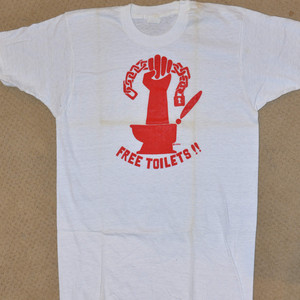
Ira and Michael and some friends eventually started a club the Committee to End Pay Toilets in America, SEPTIA.
You know, like septic?
They published a newsletter called the Free Toilet Paper.
They had a logo, a clenched fist, clutching chains and rising out of a toilet.
They wrote songs, like the Talkin' Toilet Blues and the Ballad of the Pay Toilet.
How did the Ballad of the Pay Toilet go?
Can you sing it for me?
You know, I think I'll pass on that.
Or maybe he won't pass.
I reached my dime all...
I walked into the men's room one day and I went to the toilet, but had to pay.
I reached in my pocket and searched for a dime, but nature was calling — I hadn't much time." And then it started getting a little bit more serious.
They put out this resistance guide, ways to get around the locks on the pay toilets.
There was the sacrificial lamb, where you paid and held the door open for others.
The American crawl, where you slipped under the door.
The club stopped feeling like just an outlet.
— Either we actually do something or we just give up and move on.
— There's an expression about that, right?
Isn't it like, piss or get off the pot?
— Yeah, something like that.
Michael and his friends planned protests, boycotts, pressure campaigns.
And this was coming soon after people pushed for racial desegregation in all kinds of facilities, including bathrooms. Bathroom equity was on people's minds in lots of ways.
There were other small groups like Michael's, like FLUSH.
Free Latrines Unlimited for Suffering Humanity.
Also around this time, feminists were pissed about the pay toilets.
If urinals were free, why did pay toilets cost a dime?
In 1969, there was a Down with Pay Potties protest. A huge crowd of people marched to the California state capitol with a brass band, waving signs that read Put Up or Flush Up, and We Don't Give a Dime.
At the center of it all was then California State Assembly member March Fong Yew.
You know, as most of you know, I hadn't intended that I would get as much support as I did, but, evidently, the pressure is mounting.
She is wearing a pink suit, black pumps, she has her hair teased in this perfect arc around her head, and she's speaking next to a toilet encircled by a locked chain.
The movement is on.
And then, she takes a sledgehammer to that toilet.
Yay! I missed the laugh!
I missed. Yay! Oh, she was the hero.
she had pulled her stunt and she was an inspiration for the Committee to End Pay Toilets in America.
Pretty soon, newspapers started writing about Michael's Club.
We got hundreds of heartfelt letters, we got enormous support from people who had been feeling the same way that we felt, but really had no one to complain to.
After a few years, Michael and his friends all went off to college and started club chapters in different cities.
And in 1973 they decided to hold a press conference in Chicago, where they spoke of biological function and discrimination and the indignity of pay toilets.
By that time, there were already local officials in Chicago pushing to ban them.
Some even came to Michael's event.
And soon after, the mayor banned pay toilets in public places in Chicago.
It was like, wow! We actually did it!
we actually got something done.
If we are serious, we might actually be able to accomplish our mission of eliminating pay toilets from the United States.
And then did you? We kept on going.
Michael's movement went the 70s version of viral.
Over the next few years, legislators in many States started banning pay toilets.
Now, the pay toilet companies obviously hated this.
So did businesses like Greyhound.
They didn't want to offer free toilets that they would have to clean and maintain and stock.
So they sued. They fought it.
The biggest toilet lock company was called Nickel Lock.
And in their lawsuit, they predicted what economists call an unintended consequence.
They wrote that getting rid of pay toilets would actually encourage the deterioration and closing of the free toilets.
But they couldn't stop it.
At the height of pay toilets when Michael was in high school, there were about 50 ,000 of them.
By 1980, there were just about none.
And just as Nickelloch predicted, the public toilets started going away too.
I think the activists who wanted toilet equity did not imagine the solution would be no toilet or a fight with businesses over who's going to be able to use the toilet.
This is John Cochrane.
He's got a blog called The Grumpy Economist. And he once wrote a post about how when the pay toilets went away, so did the public toilets.
There needs to be incentive for somebody to build and maintain the toilets.
Without that incentive, Nickolak was right.
The free public toilets were overrun with people who had to go, or people abusing drugs or having sex. Cities were changing.
In lots of places, they struggled to fund and maintain public places.
With no income from the toilets, taking care of them was harder than ever.
Cities couldn't deal.
Eventually, they closed them or let them fall into disrepair.
The pay toilets may have been flawed, but they served a purpose that no public or private entity has been able to effectively fill since.
John says this is a classic tale of a price control, when the government imposes a price.
Anytime the government says here's the price at which you can charge, you can't charge anything more, then more people want it, then would want it otherwise, and then other people don't have the incentive to provide it, so there's less less supply and more demand, and you can't get what you want.
This is of all prices.
Price control at zero.
They just made them all… The price control at zero is exactly what Michael Gesell wanted when he started his fight a half a century ago.
When the pay toilets started going away, what did you think would fill in that void?
There'd just be a hole where a lock used to be.
Over the years, Michael has read critiques that blame his movement for the decline of Toilets, even the decline of cities.
Do you have any regrets?
No regrets, and I feel very proud of the work that we did.
I think that pay toilets were offensive and I think that to have contributed in a way that eliminated them, at least in the United States, is a good thing, and I think it's just not credible to blame a bunch of high school and college students 50 years ago for the decline of downtown and urban areas.
So who should be in charge of toilets?
And we find our way to a modern version of a good old fashioned pay toilet.
That's after the break.
Rick Weinmeier is a public health law professor at Loyola University in Chicago.
And because he studies toilets, his friends are constantly sending him photos of the most delightful and the most disgusting stalls around the world.
I was in this country, I was in this city, and I had to use the bathroom, and I thought about you, right?
Nothing warms my heart more than that.
And I asked him, are public toilets a public good?
I would think so. I would argue that they're a public good.
A public good. In economics, a public good is something that everyone can benefit from, and very importantly, one person benefiting from it doesn't stop another person from benefiting from it as well.
Think clean air or lighthouses.
Governments typically decide what to treat like a public good.
And Rick says he would put public toilets on that list. They contribute to human flourishing, right?
They contribute to the construction of our society and our communal well -being.
The problem is the The U .S. government has never fully embraced toilets as a public good.
It's just not been a priority.
If you're worried about failing schools, public toilets don't necessarily capture the imagination of politicians or of constituents necessarily to the level that these other pressing challenges pose.
Toilets fall into this economic and legal netherworld.
Where pay toilets are prohibited, the government is preventing the free market from solving the problem.
But they also aren't treating it like a public good.
They're not providing sufficient bathrooms to the public.
And when they do, it can be the stuff of nightmares—like this bathroom Rick once used in Central Park.
There were no doors.
There was a little bit of toilet paper but no soap.
It was just like hot, hot, hot because there was no air -conditioning.
A lot of the toilets didn't have seats.
I was just like, you know, miserable and exposed to the world.
In most places, there are some basic bathroom rights.
There are building and plumbing codes requiring certain types of businesses to offer bathrooms. Or if you have a pressing medical need, you can get a card and legally access just about any bathroom.
But most people don't know these rights.
They don't know how to hold businesses accountable.
Someone's gonna have to enforce that right?
Someone's going to have to come along and right and we don't have bathroom police.
Would you call this like a regulatory failure?
I would call this an across -the -board failure.
I think it's a market failure, I think it's a regulatory failure, I think it's a public health failure.
The average person needs to use the bathroom six to eight times a day, and the fact that you cannot fill that need is just shocking.
And the way, of course, that many of us feel that need is by paying just not the way we used to.
You go into Starbucks and you pay for a coffee or you go to Nordstrom's and you buy a shirt and then you can go and use the restroom.
I've done it, yeah.
We all have, right?
And so in certain ways we already have kind of this defacto pay toilet system.
but we have this way of kind of dancing around what that need is.
Is it so bad? Is it so terrible?
I think it's not a great idea.
One, businesses can pick and choose who they let into their bathroom, and that leaves a lot of room for discrimination.
Plus, a lot of businesses just don't want to be a public bathroom provider.
And I don't necessarily fault them for that, right?
Like, if I have an Italian restaurant, I wanna be focused on providing the best Italian food for my customers.
I don't wanna necessarily be providing bathrooms to the rest of the public.
So, providing toilets has just fallen into this huge crack where some of our most complicated needs also get stuck, like housing, healthcare, education, somewhere between a market solution and a government one.
The pure market solution would be to bring back pay toilets.
Have a bougie $10 a visit boutique pay toilet, insta ready with neon, music playing, oons, oons, fresh cut flowers.
If you're balling on a budget you get fake flowers and you pay $2.
And then there's the no frills but you just got to go option that is 25 cents.
But that wouldn't serve people who can't pay at all.
Like people without homes who arguably need them the most. The pure government solution would mean treating bathrooms like a true public good, something everyone can benefit from together.
But that means convincing taxpayers to foot what can be a hefty bill.
San Francisco infamously planned to buy one public toilet for more than a million dollars.
So the search is on for the right blend of government and market solutions.
Tax breaks for businesses that allow the public to go, or tokens instead of quarters for bathroom locks, which would get around the ban on pay toilets.
Meanwhile, in the city of New York, they are no longer banned.
You are getting pay toilets.
New York City has an exception that it can have pay toilets.
In 2006, the city announced they'd add 20 pay toilets to the 1 ,000 or so public toilets in the city.
They installed seven and the others have been in storage since apparently they're pretty hard to install and maintain.
So does anyone have a quarter?
Let me check, I don't think I do.
Public toilet influencer and opera singer.
Teddy Siegel took me to see the very first one they installed.
So this is it. This is it.
One stall off of Madison Square Park, a rectangular metal pod with what looks like an elevator control panel next to a sealed door.
You have to put a quarter in in order for it to open, and there's a sign on it that says 15 minutes max and so I guess you have 15 minutes to do your business and then the door is going to open whether you're done or not.
There is also what looks like a pee puddle behind it.
I don't know if that's water or just pee.
And the occupied sign stays red for longer than 15 minutes.
So maybe it's out of order?
If you're new to Planet Money there is more to us than just toilets.
We also talk about trade Deficits, tariffs, and the egg shortage.
New shows drop every Wednesday and every Friday.
When along came a man with a big, hairy chin, he said, what's the matter?
And I started to holler, I need a dime and all I've got is a dollar.
This episode was produced by Willa Rubin with help from James Sneed.
It was edited by Mary Anne McCune and it was fact checked by Sierra Juarez.
Engineering by Sina Laffredo.
Alex Goldmark is our executive producer.
Big thank you to Rob Underburn.
I'm Erica Barres. This is NPR.
Thanks for listening.