On this week's episode of Wild Card, Poet Laureate Ada Lemom tells us how to give yourself
a little grace.
The nice thing about being in my mid-tooled 40s, yeah I forgive myself all the time.
Join me Rachel Martin for NPR's new podcast Wild Card, the game where cards control the
conversation.
This is Planet Money from NPR.
In the last couple of months, the price of gold has gone way up.
It hit a new high last month, just over $2400 per Troy ounce.
Now gold has had a kind of shiny quality to it for thousands of years, both literally,
and in the marketplace.
It was once used as currency, I think gold coins.
And even once we went to paper, a lot of currencies around the world were still backed
by gold.
This was the gold standard.
And even though we are no longer on the gold standard in the United States, gold is still
special.
Hello and welcome to Planet Money, I'm Sally Helm.
Today, we're going back in the Planet Money Time Machine to an episode where we try to
understand out of all the elements, why gold?
What is it about gold that makes people value it so highly?
With a break, our colleagues Jacob Goldstein and David Kestinbaum will go through the
entire periodic table of elements to figure out which element would make the best money.
Does it have to be gold?
Because to me, asmium seems like the logical choice.
I'm rooting for asmium, the densest element.
You know David, I'm no scientist, but for some reason I really got my heart set on lithium.
I do that is not going to end well.
This message comes from NPR, sponsor Grammarly.
What if everyone at work were an expert communicator?
In box numbers would drop, customer satisfaction scores would rise, and everyone would be more
productive.
That's what happens when you give Grammarly to your entire team.
Grammarly is a secure AI writing partner that understands your business and can transform
it through better communication.
Join 70,000 teams who trust Grammarly with their words and their data.
Learn more at Grammarly.com.
Grammarly, easier said, done.
Summer is for going to the movie theater because it's too hot to stay home.
It's for driving the windows down, listening to your favorite music.
It's for stretching out while you're on vacation to gobble up a TV show.
For a guide to some of the TV, movies, and music, we are most excited about this summer.
Listen to the pop culture happy hour podcasts from NPR.
There's this quote that I really love widely attributed to Warren Buffett.
A quote is, gold gets dug out of the ground in Africa or someplace.
Then we melt it down.
We dig another hole.
We bury it again and we pay people stand around guarding it.
It has no utility.
Anyone watching from Mars would be scratching their head.
Now, that's a little bit of an overstatement.
Gold does have a few practical uses.
People, I get for jewelry, occasionally it's still used for dental fillings.
It has these uses in electronic cell phones.
It's a good conductor.
Still, a lot of the gold in the world, it's owned by people who aren't doing anything with
it.
It's just sitting there.
The question I had, before I was a journalist, I was a physicist.
The question I had is, why gold?
It's just this metal.
We got 118 elements in the periodic table.
It's just an atom.
It's got 79 protons.
That's what makes it gold.
You add one more proton.
You got mercury.
You add one more.
You got phallium.
Is there really anything that's special about it?
Or something so special that it deserves to be the thing that humans have valued for
so long?
So today, we're going to go through the entire periodic table of elements.
For those of you who haven't seen a periodic table since 10th grade chemistry class, it
looks kind of like a bingo card.
It's this grid with a bunch of squares.
Each square has an element in it, a type of atom.
There's a box for each element that exists, one for hydrogen and carbon, et cetera.
It's organized into columns.
The elements in each column have some similar properties.
Today we're basically going to play periodic table bingo.
We're going to take the whole table and just try and start crossing stuff off.
You're welcome to play along at home.
Go print out your periodic table and take out a big red pen or something.
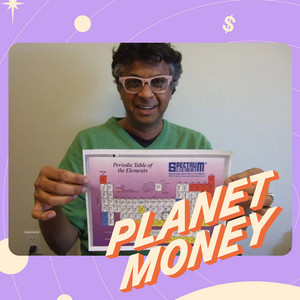
We printed out our own copies and we went to visit Sonot Kumar.
He is chair of chemical engineering at Columbia University.
The first thing you notice about him are his glasses.
Link on the top, regular 1950s style plastic frames, plastic lenses.
These are dynamite glasses.
He bought them in Soho and he just, he looks like a million bucks and he's like the hippest
chemistry professor who I've ever seen.
So Sonot is perfect for this because he has a chemist perspective but he also comes from
a place where gold really does have this special status.
His grandfather who lived in the south of India was fairly well off, had a big house, a big
family and he owned a lot of gold.
Growing up my grandfather had a goldsmith who would work in the back of the house.
They were two of them and they had this little ball in which there was husk and they would
put a little bit of coal in the middle and there was nice little crucibles.
They would melt coal and pour it.
I was fascinating to watch that.
They had these wonderful balances that I wish had kept because there's these really
old fashioned balances that were good down to a milligram.
And what was the finished product?
What were they making?
Jewelry.
More Jewelry and even more Jewelry.
You understand the concept of dowry and stuff like that.
So if you have seven daughters you got some dowry to take care of.
So in India gold really is a kind of currency.
It was when you were growing up it is now.
It's more than a currency.
It's how you measure.
I mean people talk about putting currency into your pillows and your mattress, right?
This was our analog of doing that.
You buy gold and you had these big safes and you stored them.
It was easier to store than putting money into a mattress because money didn't mean
a whole lot.
It would burn.
Gold wouldn't burn.
So they love gold even to this day.
Jacob you know what I say to that?
Yes, so it doesn't burn.
Let doesn't burn either.
Okay.
Okay.
So let's get to the bingo then, right?
So we're there with Sonata and we pull out the periodic table of the elements and we
start with the column on the far right.
The elements in this column have a really appealing characteristic.
They're not going to change. They're chemically stable.
Helium neon argon, Krypton, Xenon, Radon.
Those are the noble gases.
Correct.
So they're good in a way because they're non-reactive.
They're not going to change.
Big drawback, a gas.
That's right.
Have your money like in a jar but then if you open the jar you'll be broke.
Helium is one of those things that will actually leak away.
People actually calculated that if you make a metallic container and left it out there,
Helium will diffuse through the container and go away.
Because the atom is so small.
It's so small and it's got very special quantum properties.
For some reason it's just like, it's able to rush through metal.
So you couldn't even leave it sealed in a container.
I mean that's just bad news all the way around.
So I'm feeling like super safe about my Helium.
Don't worry about it.
I got it sealed in a metal box with a quantum mechanics.
That means I broke.
Basically.
Yeah.
Alright so if you're playing at home you can cross out the right most column, Helium
down through radon.
Okay so right most column gone.
Now let's jump over to the left most column.
It's called group 1A.
Hydrogen is on top.
That's a gas.
We can cross that out right away.
Below that is my pick lithium and sodium.
I don't know how many if you've played with sodium for example it's extremely flimable.
That would be bad for a current.
That would be very bad.
As you go down the table it becomes more metallic but they still are very reactive.
So you can start ruling out group 1A for example as being the most reactive.
And why don't we want a currency to be reactive?
Obviously exploding is bad.
Well lithium is for example known very well.
You have lithium ion batteries and if you expose lithium to air it will cause a huge fire
that can burn through concrete walls.
So I had a colleague of mine who works on new batteries and he had a lithium leak and
it burnt its way through three feet of concrete wall.
So that created a few problems.
I don't think you want your currency to be sort of doing that in your pocket.
Alright so I'll give up on my dream of a lithium standard.
But when Sanat says reactive he doesn't always mean it's going to blow up or make a hole
in a concrete wall.
Sometimes it will just kind of corrode.
And that's one nice thing about gold is that it stays gold.
I mean you'd think you got gold coins sitting on the bottom of the ocean.
They're going to corrode or get all messed up.
But you can find them hundreds of years later brush them off and they're unchanged.
Nice, shiny gold after centuries on the ocean floor.
And it turns out this is a pretty rare quality of elements on the periodic table.
So Sanat really gets some momentum going now.
He starts crossing off a lot of stuff because it turns out that most of the elements on
the periodic table are pretty reactive.
They like to bond with each other or you know some kind of chemical reaction happens when
they're around each other.
So Sanat crosses out the left hand column and the next one and the next one and five
more columns on the right.
I ask him then about these two weird rows at the bottom.
They're always kind of broken out separately from the main table.
And the elements there have some awesome names like Prometheum, Einsteinium, Keston
Valmium.
You wish.
All right, there's no Keston Valmium.
Nice try though.
Nice try.
You almost got to pass.
These are referred to as the lanthanides and actinides.
And many of them for example, the actinides are all radioactive.
So these are again things that would not make a very good coin because you'd come back
a half a second later and it would have half decayed or you'd come back a year later
and two percent of it would be gone or something.
Maybe more than that.
But in the process you'd be dead as well.
Okay.
All right, you can mention we can cross those off.
Okay, so we've eliminated the columns on the left side and we've gotten rid of the
columns on the right side and now we've crossed out those rows on the bottom.
And I feel like we're converging in this kind of sweet spot at the center of the periodic
table.
In all by now, if you're following along at home, we've crossed off 78 elements.
We still got 40 left.
So to summarize our criteria this far, if you want something to serve as money, one,
should not be a gas, two, shouldn't be very reactive, shouldn't burst into flames or
corrode, three, should not disappear through radioactive decay.
Also four, should not kill you if you hold it in your pocket.
All right.
And now, it's a new requirement.
A number five.
You want the thing you pick to be rare.
And here again, there's this very elegant way the periodic table is set up that can help
us.
As a rule of thumb, rare elements tend to be more toward the bottom of the table.
That weirdly is because of stars and supernovas.
Turns out all the elements in the periodic table pretty much are forged in stars or stellar
explosions.
And it gets very hard to make heavier elements because you basically got to stick together
a bunch of light stuff.
So there are fewer of the heavier elements out there in nature.
So this gets rid of a bunch of the light stuff toward the top of the periodic table.
Like say, silicon, which is the key ingredient in sand.
Silicon is the most common thing on earth, I think, after carbon.
Maybe it's even more than carbon.
I think silicon and iron are probably the two most ubiquitous things on earth.
So that makes it have almost no value.
I could go to the beach, pick up a bunch of sand.
It'd be as rich as anyone else.
That would be like hyperinflation, right?
It like suddenly, wait, I got all this sand.
That was not worth anything.
Well, I think in the end more than that's one reason, but it's also the reactivity that
would come back to play.
Another element that's too abundant is copper.
It sounds promising.
We make coins out of it.
But there's this great backstory here.
Sweden, it turns out, has a lot of copper.
And back in the 16 and 1700s, they decided they'd use it as money.
But because copper was so abundant, they had to make their coins really big.
There's actually one coin worth 10 dealers, whatever that means.
It weighed 43 pounds.
So I'm going to just knock these set of things out.
Titanium, vanadium, chromium, manganese, iron, cobalt, nickel, copper, zinc.
Now, we're looking for an element that's rare, but we don't want it to be too rare.
And unfortunately, that is why my favorite, Asmium, a nice blue, gray metal, the densest
of all the elements, Asmium gets the axe.
Asmium is probably one of the rarest things around.
Why?
I have no clue.
It apparently comes in with meteorites.
Asmium and iridium are found in meteorite rock.
And so you can find them, but they're very, very hard to find and very hard to mind for
that reason.
So we shed a tear for Asmium, and we are down to just five elements.
The final five.
Why does gold win out?
And why do its competitors end up on the monetary scrap heap?
Also, David and Jacob try to figure out whether this little gold coin they bought is legit.
That's off of the break.
When the economic news gets to be a bit much…
Listen to the indicator from Planet Money.
We're here for you, like your friends trying to figure out all the most confusing parts.
One story, one idea, every day.
All in ten minutes or less.
The indicators are from Planet Money.
You're a friendly economic sidekick.
From NPR.
This is Sam Brigger, longtime fresh air producer and sometime interviewer.
In a special extended podcast episode, I talk with Maggie Rogers about nostalgia, her
new album, and her decision to go to Harvard Divinity School.
I think at its core, music has always been the most sacred and most spiritual thing that
I've ever been a part of.
Find NPR's fresh air wherever you get podcasts.
In any great story, there's a moment that sparks your curiosity.
There is more to uncover.
How did this happen?
How did we get here?
That's where Embedded comes in.
We are NPR's home for documentary journalism, immersive and intimate stories.
I was stone-called speechless.
Nothing will ever, ever, ever be the same here.
Find Embedded wherever you get your podcasts.
Humans are kind of overrated.
Over on Shortwave, a science podcast, we're only kind of kidding.
We're bringing you the wondrous world of animal science to your daily life.
From queer animal love stories to songbird memories, we're showing you how critter knowledge
informs human science.
Listen now to Shortwave, a podcast from NPR.
Darien Woods here.
As the US federal debt grows, so too does the interest on it.
And this year, it hit a milestone.
Interest payments this year will actually be larger than national defense spending for
the first time.
And that's not a small number.
That is one of the largest items in the entire federal budget.
That's from our latest bonus episode.
It's my conversation with a long-time debt hawk about the potential risks to the economy
and when spending makes sense.
You can check that out now if you're a Planet Money Plus listener.
If that's you, thanks for your support.
If it's not, it could be.
You get bonus content, sponsor-free listening and support the work of Planet Money.
Visit a plus dot NPR dot log.
Ladies and gentlemen, our final contestants are...
Rodium, Pladium, Silver, Platinum and Gold.
And David, this is really impressive because Sinat has just based on chemical reasoning and
the structure of the periodic table.
He's ended up with a list of what actually are precious metals.
They're rare, they're stable, they don't react.
And they're all expensive.
Rodium sells for more than $2,000 in ounce.
So from this point forward though, things get a little tougher.
So Silver, which is on the list, has been used as money, but to not throw it out because
he says it tarnishes.
Now you can polish it off, but the tarnish has silver in it.
So when you polish it, you're actually losing some silver.
It's not the best choice, so we throw silver out.
The way I think about it is that Rodium, Pladium, Platinum and Gold are the four choices
you would come down to.
Take that Gold.
You thought you're special, but you're not that special.
I mean, I'm imagining some parallel universe now where the US had fights about whether
we should go off the Rodium standard or where Medieval Kings had chests of palladium,
they're fighting wars over.
I like the idea of Medieval Kings and chests of palladium, but there are a couple of
sort of historical problems here.
A big one is that palladium and rodeo weren't even discovered until the early 1800s.
Yeah, that's fine, but that still leaves you with platinum and gold.
And platinum turns up in streams just like gold, so it could have been platinum.
It could have been platinum, but say you're in ancient Egypt or whatever you want to make
your platinum coins, you're going to need some kind of magical furnace from the future.
Can we look at what's the melting point of platinum?
I can certainly look at it's high.
Melting point of platinum is 1772 degrees centigrade.
Yeah, Jacob, that's over 3000 degrees Fahrenheit.
In fact, we visited this guy in the jewelry district who told us that melting platinum
is a real pain.
You have to use this special crucible, which you can only use once, and it's really expensive.
Gold, it turns out, is much easier to melt into bars and coins.
Just by chance, it melts at a much lower temperature that you can get just by burning coal.
And one other pretty compelling historical argument here for picking gold over platinum,
one thing you want for your element that's going to serve as money, you want to be able
to test it.
So if someone says, hey, trust me, this is money, you want to know you're not getting
ripped off.
Platinum looks like a lot of other stuff.
It's kind of silvery and color and gold really looks special.
It looks like gold.
And it turns out gold is something that's actually pretty easy to test.
This is something we went and saw with our own eyes.
We went back to visit Hank Mendelssohn in the New York jewelry district with our coin.
And I said, how do we know this isn't a fake?
You sold it to us?
I want you to test it.
And he did this really simple test.
He took out a black stone and some sort of pumice.
This is what we do.
What you hear there is Hank taking our coin and scraping the edge against the stone.
And it leaves this gold smudge.
And then he goes fishing around in his desk drawer.
You have his drawer in your desk and your kind of like that.
He's driving a jig around in his bottles with clear liquid.
What are all these different liquids in the bottles?
It's some form of acid.
So here, this is 22 carrots.
So let's see what happens here.
So what he's got is this little bottle.
It's a particular strength of acid that he can use to test to see if the gold has a
purity of 22 carrots.
And he puts a drop of it on the stone where he scratched our coin.
And the smudge stays there.
So that means our coin is 22 carrot.
But then he picks up this gold pendant, which he says is 14 carrots.
It's less pure.
And he does the same test.
He scratches it and there's a smudge and he puts the acid on it.
But the result is really different this time.
Just turns and...
Oh, I would totally just vanish.
So yeah, so it's the...
I do scratch this on every piece of gold we buy.
To make sure that it's gold.
And it's a very treacherous business.
You buy wrong.
You are making two or three percent to you.
By one thing, it's not gold.
You can lose a whole day's worth of profit.
So you don't need fancy equipment.
You just got a stone here and some acid.
Little bottles of acid.
That's right.
That's what everybody does.
Even the little, the small jewelry store in Mampastore,
that's this is what they use.
So you've heard the expression acid test.
This is the kind of thing that expression is referring to.
And apparently, there are writings dating all the way back
to ancient Greece about using a touch stone
to judge the purity of gold.
And basically, you rub the gold against the stone.
And by looking at the smudge it leaves you can tell
how soft the gold is and how pure it is.
All right, all right.
So I was really at the beginning of this thinking
that gold was kind of arbitrary.
But it turns out you can make a pretty strong case
for a gold stable.
It's non-toxic.
It is rare, but it's not too rare.
It's easy to test.
And you can find it just sitting in rivers,
this beautifully colored golden thing.
What is the most important thing?
Planet Money actually did a whole series on gold
where we bought a bit of gold, like a little bit bigger
than the size of a nickel.
And we learned all about gold and how it worked.
If you want to check out the whole series,
the link is in our show notes.
Next time on Planet Money, there's
a dirty little secret about the internet.
A lot of the software that the internet runs on
is written by small teams of unpaid people,
sometimes just one person.
And this system might have led to one of the most audacious hacks
in cybersecurity history.
This was incredibly well orchestrated.
I think somebody should make a movie about this.
I mean, I definitely watch it.
I watch it in IMAX.
We dive into the story of how the XZ hack went down.
And what that tells us about the strange economics
of how most modern software gets made.
Our rerun today was produced and fact-checked by Willa Rubin.
It was edited by Keith Romer.
Alex Goldmark is our executive producer.
Anne Sally Helm.
This is NPR.
Thanks for listening.
MUSIC PLAYING
On the inheriting podcast, one event
can change a family for generations.
Green Americans, we call it TIE Group.
Did you ever realize when you were a child that you became
an orphan?
Camp was such a hard time.
How do you think you got through it?
Listen to inheriting.
Our new podcast about Asian American
and Pacific Islander families from LA
studios and the NPR network.
Wherever you get your podcasts.
The embedded podcast brings you eye-opening reporting.
There's something that hasn't been disclosed yet.
Immersive journalism.
Like it smells smoke.
I could smell the dust.
Personal stories.
How is scared?
Like I can't protect you.
We are NPR's home for documentary storytelling.
Find embedded wherever you get your podcasts.
Jasmine Morris here from the Storycore podcast.
Our latest season is called My Way.
Stories of people who found a rhythm all their own
and marched to it throughout their lives.
Consequences and other people's opinions be damned.
You won't believe the courage and audacity in these stories.
Hear them on the Storycore podcast from NPR.