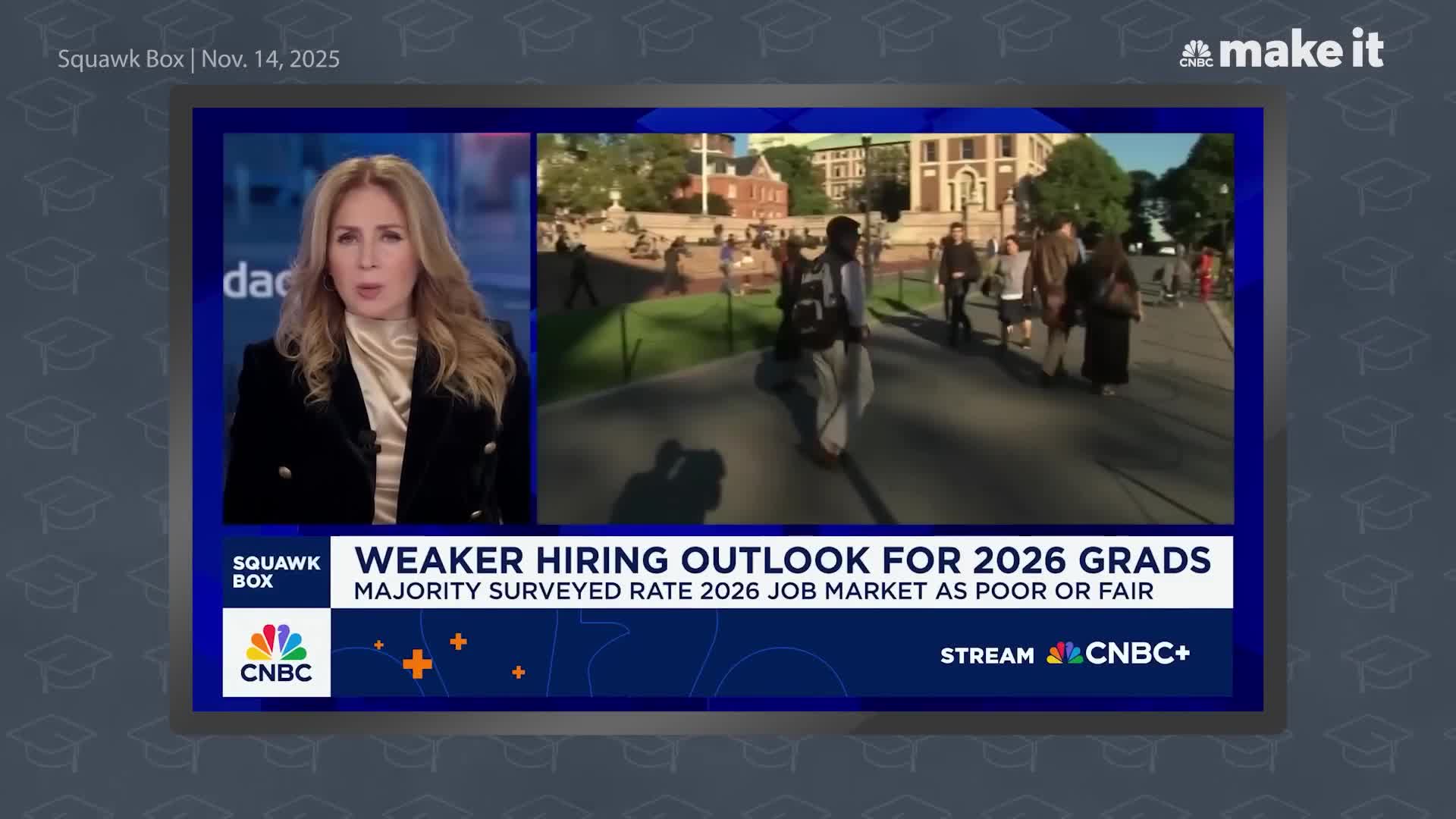
A dismal hiring outlook for the graduating class of 2026.
Surveys show that job prospects for recent graduates are down significantly from a year ago.
So what is going on?
Gen Z college graduates face an intimidating job market.
2025 saw over two million undergraduates earn their degrees, and most of them are struggling to find work.
I am still on the job hunt.
It is something I have to motivate myself every day to kind of wake up and do.
It's not that new grads aren't trying to find work.
It's that employer demand for entry-level workers is shrinking.
According to one survey, 76 of employers reported hiring the same number or fewer entry-level employees in 2025 than in 2024.
That same survey found that only 30 of 2025 graduates reported finding a full-time job in their field of study.
At the same time, layoffs are at their highest level since the pandemic, with nearly 11 million job cuts reported between January and October 2025.
I actually had a couple of friends, a couple of colleagues, and they were struggling the same way I was.
They couldn't find a job or they were going from job to job.
I still have friends today after graduating college, where they just got laid off and they're trying to find a new job.
The lack of new jobs for young job hunters is due to many factors like post-pandemic overhiring, rising costs from inflation and AI taking on a larger role in the workplace.
Folks are kind of just sitting still.
They're not looking for new roles.
They're not leaving their current roles.
And without those new jobs available, it's hard for an entry level employee to get their foot in the door and start their career.
Whatever the reasons for the hiring freeze, Gen Z must now figure out how to compete in an increasingly tight job market and whether or not a college degree is still necessary for a stable job.
For 23-year-old Ashley Terrell, going to college wasn't optional.
For my parents, college was an expectation.
It wasn't something they're asking me to do nicely.
It was something that I was expected to do out of high school.
Ashley attended the University of Hawaii at Manoa.
She graduated in 2024 with a degree in marketing, international business, entrepreneurship and management.
After college I hope to kind of work either like at a startup doing something marketing related, ideally.
But despite months of networking and filling out job applications in the run up to graduation, the only offer Ashley received was from power tool manufacturer Tektronik Industries promoting their products at a local Home Depot for 25 an hour.
I was basically a retail employee in the new Home Depot on islands.
I was down stocking Milwaukee and Ryobi products.
I was drilling in display sets that you see when you walk through the aisles of a Home Depot.
Ashley eventually got another job at a local Marriott hotel, but was laid off in September 2025.
At the time of our interview, she was still looking for work.
I want to say that I still am hopeful.
Things are just changing really, really fast around.
It seems like all industries, not just one.
Half of the classmates that I graduated college with didn't have a job when they all walked the stage with me.
And so it kind of feels like we're all in the same boat of how can we help each other when none of us are really thriving.
Ashley and her classmates are not alone.
Since 2022, the unemployment rate for recent college grads has ticked up, topping out at 97 in September 2025, the same as for 20 to 24 year olds with only a high school diploma.
At the same time, the hiring rate for new grads in traditional white collar industries has fallen, particularly in May and June, when many companies hire entry level employees.
The hiring rate has dropped pretty heavily from the summer of 2022 and 2021 through this past summer.
In order to keep up with what we expect people to need as they enter into the labor market, we would want a hiring rate between seven and eight percent.
And we're seeing around four to five percent.
Nick Tremper, a senior economist for payroll and HR service provider Gusto, says that many companies over-hired in the post-pandemic economy in 2021 and 2022.
Most of those hires have not moved on from their positions and companies are now slower to take on new employees or refill roles following layoffs.
And what that means is that the job market is frozen in place for people who are just starting out their careers.
This means they're not getting that first step.
They may not be getting that first entry level job.
And even more importantly, they're not moving on at a rate that we would have expected to see.
Early in your career.
You move around a lot to increase your earning potential, to increase your wages now and over your lifetime.
A frozen labor market, especially for people in their 20s, means that that's just not happening.
Tremper also points to external factors over the last few years that have slowed down hiring.
We went from rapid wage growth to inflation, to a stagnation in the labor market, to unknown tariff policy.
That meant that a lot of folks paused hiring.
The rise of AI has also contributed to the hiring freeze, though not necessarily in the way people might expect.
To date, we're not seeing people letting folks go because an AI can do the same type of job.
But AI is allowing for this pause while small businesses evaluate where it's best to add that next employee.
They're able to use AI to fill the gaps as they're thinking about their overall hiring strategy and what that looks like going forward.
In fact, AI may be responsible for some recent strength in one sector of the economy, the tech industry.
Hiring for new entrants at small businesses in the tech industry this summer I think is associated with AI builders.
A lot of this is driven in San Francisco and San Jose.
These are really the incubators for the next AI products that are coming out.
They're not hiring folks to just use AI, but they're also hiring folks to build tools that incorporate AI, that expand on its abilities and can serve some sort of market need.
But young job seekers like Ashley Terrell still see AI as a hindrance to finding a job.
I definitely feel that AI has affected the number of jobs I'm able to apply to.
I have noticed in the last couple of months that there have been fewer job postings that I am qualified for, just because I feel like AI is taking away some of those jobs.
Ashley says that many of her friends have given up on finding a job that matches their degrees.
Some of them have kind of settled for the underemployed route and have taken those jobs and some of them went to trade school after getting their BBA.
One such person is 25-year-old Chris Henderson.
He graduated from Rowan University in 2022 with a degree in business management.
At the time I saw myself getting a job in a financial firm, in an office firm, but I wasn't able to find anything that was really in my salary range.
Instead, I was seeing roles like a store clerk that didn't need a business management degree.
After three months of job searching, he decided to work for his family's electrician business.
Basically, my father said you know Chris, the electrical trade.
There's always going to be work in the field and it is a safe career.
And if you are ever having any doubts on the job market or the careers with the bachelor degree, you can always fall back on the trades and it's always going to be a safe spot and there's always going to be work there.
After a year, Chris decided to pursue electrician work as a career.
I actually do find it really satisfying and fulfilling as an electrician, because it's nothing better than working with your hands and completing a job that you did on your own, versus like working in an office job.
Something about you doing it yourself and you perfecting your craft and doing something.
It gave me a satisfaction like no other.
Chris is now making about 72000 a year and plans to use his business degree to either run his family's business one day or start his own contracting company.
Right now, with all the AI, the electric vehicles, electric vehicle charging there's so much demand and it's just going to keep growing.
And we don't have enough younger Gen Z tradesmen to do these type of roles.
If you like, working with your hands and you are a problem solver.
I think that the trades are a great route because they offer a nice job, a nice pay, a great future, and There's nothing wrong with it.
The Bureau of Labor Statistics predicts an increase of more than 77000 new electrician jobs over the next 10 years.
It also predicts more job openings for construction workers, nurse practitioners and registered nurses, software developers and home health care aides.
Many of those jobs require college degrees, but it still may take a while before the job market picks up steam.
I think in the short term, this is going to be the new normal for a little bit longer.
But you know, I think that there are positive signs on the horizon as the Federal Reserve continues to lower its interest rate.
It'll increase the simulation in the economy, which could lead some of these small businesses to get off the sidelines and start making plans on how to grow and look towards the future.
Even as she searches for a job, Ashley Terrell says she's still glad she earned her college degree.
I don't have any regrets about going to college.
The biggest way it paid off for me was just being able to grow a bit more independent away from my parents and to get some life skills.
Chris Henderson agrees.
I don't regret anything about college.
There's certain aspects of college that teach you things like no other, such as time management.
You learn a little more about yourself.
I think that college was really a great route to really know what is your true passion.
I think the number one most powerful skill is to learn how to manage AI.
Learn how to use the tool incorporated into what you're doing now.
Learn how to communicate the fact that you can manage multiple tasks simultaneously through using tools like artificial intelligence and large language models.
Flat hiring among Gen Z is something that we need to keep an eye on, for not just right now, but the implications that has for the next 10 and 20 years, as these folks are trying to get skills that are able to support their long-term career progression, their overall wage growth and also their own promotion potential.
So getting folks into jobs and finding ways to do that is really important for not just today, but also for two decades from now.