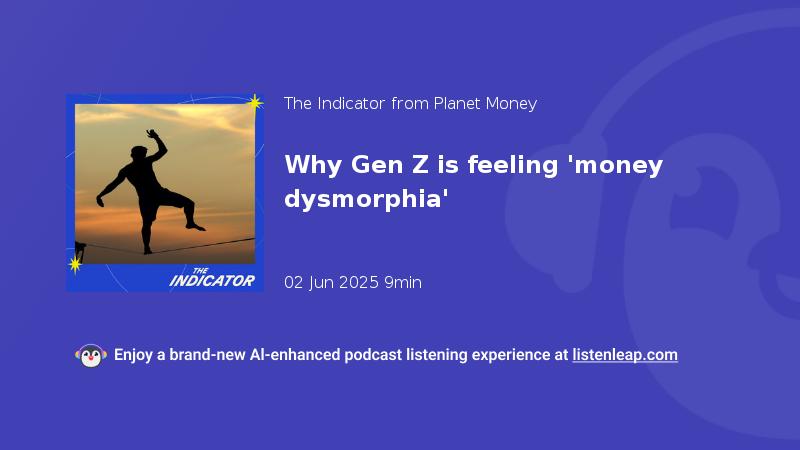
NPR. In Brooklyn Park, a group of 20 -somethings toss a frisbee.
There beside some picnic blankets, a bottle of champagne and some red solo cups.
It's a Tuesday. One guy hovers over a slack line, walking the tightrope.
His name is Wilder Troxell.
He's celebrating his friend's 27th birthday.
An audio reporter crashes the party.
You want to talk about money?
Damn yeah I'll do it.
Wilder works in film and also at a climbing gym.
We chat about his money.
Um, I don't, I do not have a lot of it.
I think like it would be cool to have more.
Wilder is Gen -Z. He's part of a generation anxious about debt and bills.
Credit One Bank surveyed young American adults aged 28 and younger.
And three out of five said they were stressed or anxious about their finances and yet What if I said Generation Z was the richest generation at that age ever?
is that related at all to like inflation you account for inflation and On average they're doing well.
So why are they complaining so much?
I don't know Good question.
Yeah This is the indicator from Planet Money.
I'm Darien Woods. Today on the show, financial dysmorphia.
We speak to a neuroscientist who has a theory about why a lot of us of all generations can feel like we're in the economic dumps when many of us are actually doing alright.
Support for this podcast and the following message come from Thrive Market, built for Those who value transparency in their food organic first clean label groceries all delivered get 30 % off and a $60 gift at thrive market dot com slash podcast. Once teens and 20s can always be in anxious time economically.
You haven't built up much savings yet.
You're early in your career.
You're still getting your footing.
But there is a puzzle here that could shed light on economic anxiety in general.
Young people in the U .S. today are richer than young people yesterday.
The median income for a 25 -year -old is somewhere between 42 ,000 and 50 ,000 dollars a year.
Millennials, Gen Xers, Baby Boomers, all earned significantly less at that age, even accounting for inflation.
Baby Boomers earned less than two -thirds of that when they were 25.
Young people's wealth is also higher.
And yet, a significant portion of young people today feel like they don't have enough.
There is student debt, high house prices and inequality, yes, but they don't fully explain this mismatch. Overall the economic picture is looking pretty benign, if not bright, for young Americans today.
Tali Sharit is a neuroscientist at MIT and University College London.
She thinks there are some other factors at play.
In order to be happy and satisfied, we need to see ourselves progressing.
That is true on every level, whether it is intellectually or whether it's financially.
A sense of progression is important, Taly says, because we easily get used to the status quo.
In all domains, like a smokey room.
Within 20 minutes you can't perceive the smell of smoke.
You adapt and what happens in the brain is that the neurons stop responding to smoke or to a sound or to a smell, if it's been there for a while.
But, what's interesting is, a similar thing happens to more complex things in our life.
So, it might be that you have great things in your life like an interesting job or a comfortable home, but you're less likely to react to it emotionally.
It brings you less joy on a day -to -day basis because it's been there all the time.
This is called habituation, a fundamental concept in psychology.
And so, coming back to the Gen Z kind of idea is that well the fact that they have quite a bit doesn't mean that they don't then feel that they need more.
The second reason for young people's financial dissatisfaction, Tali says, is comparison.
They are the generation where social media is a huge thing that they kind of grew up with, right?
Everyone's posting their travels or their whatever, and half of it is not really an accurate representation, while it's true.
So now you're comparing yourself, even if you're in a very good state, to what appears to be your peers and that will definitely have a negative effect.
What this can add up to is what has been called informally, money dysmorphia.
This is money dysmorphia.
This is not a clinical diagnosis.
It's a label that sprung up on TikTok and money blogs a couple of years ago.
Here are the symptoms. Feeling confused about where you are financially compared to other people, right?
Tully Sherratt says that the pains of comparison are real.
There's so many studies.
And some of these, these are studies that we've conducted that show that people will care more and are happier if they get more rewards, in this case, money relative to others.
Say somebody is getting paid $100 ,000 a year and that's more than anybody else.
Tali says, that person will be happier than someone on $200 ,000 a year whose peers are getting more.
After all, comparison is the thief of joy.
And it makes sense, you know, you're unconsciously what your brain is doing all the time, it's kind of trying to figure out where you can go relative to where you are.
The importance of expectations for happiness shows up in all kinds of areas.
Tarley talks about a curious fact when it comes to women's rights.
In the early 1970s, women reported being happier than men.
At the same time, women generally needed a man to co -sign their application for a credit card. From those decades through to the early 2000s, discrimination against women lessened.
Women's rights have definitely become better but what has been shown is that women's happiness and well being did not necessarily grow with it.
And that's the paradox.
What Talley says happened is that girls were told they could be anything.
An astronaut, a president.
But that meant that expectations for equality rose faster than the reality of equality.
And when those girls grow up to be women, facing less pay and more housework, that's a recipe for unhappiness.
And to be clear, Uptali is not saying that women should lower their expectations.
I wonder if this could be applied to the U .S. as a whole.
I mean, the U .S. is among the richest nations in the world and yes, it has major problems with poverty.
Inequality is very high.
The social safety net is a lot lower than European countries say.
but despite its wealth a lot of people in this country feel like economic victims. Donald Trump embodies the sense of other countries ripping America off, despite it being among the very richest countries in the world.
Do you think this may relate to this at all?
Right, exactly. People don't necessarily realize that what they have is actually more, relatively speaking.
Now, somebody listening in to our conversation might say, you two are gaslighting me.
You're saying that the economic situation is not that bad, that I shouldn't be feeling anxious over money, I'm in a precarious position, and that you're essentially saying this is all in your head.
What do you have to say to that critique?
I agree with the fact that what matters is your subjective experience.
It doesn't matter what reality is, because if I'm sad, I'm sad.
If I'm anxious, I'm anxious.
Here's the thing, if the reason you are anxious and sad and you know, could be potentially lessened by simply not following certain people on social media, maybe having a break from social media, if it's reality TV or whatever it is, maybe it's worth trying different things, maybe not.
Maybe that's not the case, maybe it's, it's more substantial.
I mean, try to make a change in your habits to see whether, as a result, maybe that does have a positive effect on how you're feeling.
Tali also points out that dissatisfaction with the status quo can be a powerful driver for change.
You know, I think it's OK to have ambition.
You know, it's OK to say, yes, this is reality, but I want to live a different way.
After all, if we'd stayed happy with how things were thousands of years ago, we might never have left our caves.
This episode was produced by Koopa Cats McKim, it was engineered by Neil Rauch and Debbie Daughtry.
It was fact -checked by Sarah Juarez and edited by Kakin Cannon.
The indicator is a production of NPR.