Our hottest update for Starbirds is out now!
Earth seems like a paradise for life, but it's actually kind of mid.
Big parts of it are covered by hostile deserts of ice, fire, rock or darkness.
Could there be a planet that's not just more suitable for life, but ideal?
So perfect for the emergence of life, filled with not just biomass but also biodiversity, that Earth is a barren desert compared to them.
As we've begun to look deep into our galaxy, we've found a new and weird type of planet.
Super Earths.
Planets larger than Earth that have the potential to not only host life, but to be super habitable.
Let's take all the science on exoplanets we have and imagine a perfect world.
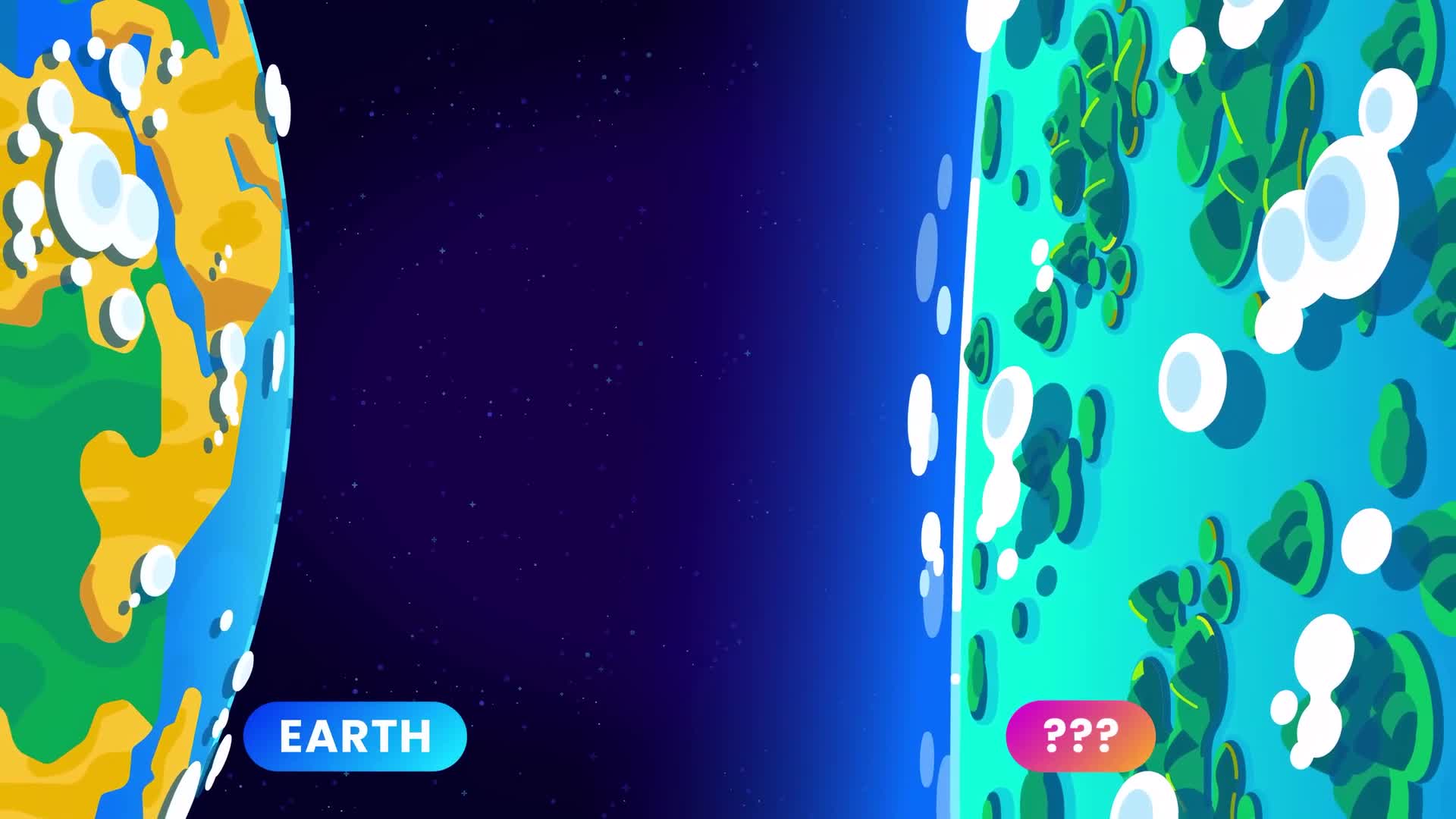
Hestia after the Greek goddess of the comfy home, the best possible planet for life in the universe.
First of all, we want a perfect star.
The perfect world needs a perfect star, but that may not be a yellow dwarf like our Sun, because they die in under 10 billion years and keep getting hotter as they age.
70% of the window for life on Earth has already passed.
Earth has a mere couple of billion years left before the Sun ends it all.
70% of stars are red dwarfs, pretty small and alive for trillions of years, basically forever.
Since they're not that bright and hot.
Their habitable zones where water can be liquid are pretty close to them, which makes it very likely that their planets are tidally locked one hemisphere a hot desert and the other an icy hell.
Also, young red dwarfs tend to vomit deadly radiation that sterilizes their planets or boils their oceans away.
The perfect stars for life might be orange dwarfs.
In the Goldilocks zone between red and yellow dwarfs.
Their energy output is very stable, radiation tends to be less aggressive and, most importantly, they live up to 70 billion years, giving life plenty of time to emerge, evolve and thrive.
So here's our perfect star, an orange dwarf born 3 billion years ago in a calm galactic neighborhood.
For the next tens of billions of years, it will be super stable.
Among dead rock planets and massive gas giants, one planet is our super-habitable super-Earth, Hestia, where life can thrive like nowhere else in the universe.
The perfect planet, a super habitable world.
Hestia's radius is 1.3 times Earth's, so it has 70% more surface area, a lot more space for life.
With almost twice Earth's mass and 20% more surface gravity, walking on it you'd feel 20% heavier.
Unfortunately, it's a hot, dead desert.
Like Mars and Venus today, it's still missing two things.
Firstly, a magnetic field that protects Hestia from solar storms and the cosmic radiation that sterilize its surface and blow its atmosphere away like poor Mars.
So deep inside Hestia gets a massive metallic core spinning in a liquid mantle that creates a magnetic field of exactly the right strength for super-strong protection.
And Hestia needs plate tectonics to mix its surface around.
Venus turned into a 470-degree hell because, without tectonic plates breaking and mixing, the tension and heat below its surface unloads in apocalyptic volcanic eruptions.
Continental plates moving into the depths also remove CO2 from the surface, which is great, because excess CO2 makes the atmosphere heat up too much and they bring up a vital mix of water, minerals and elements that life can feast on.
We also have something for you to feast on, our latest video game.
We've been working on this game together with the amazing birds over at Tucana Interactive for almost three years.
Starbirds is a relaxing factory building and resource management game in which you mine asteroids, collect resources, craft goods and create brain-twisting interstellar production networks.
Level by level, you guide your crew to new star systems, each with its own set of challenges.
Frosty cold, scorching heat, and...
Wait, is that an alien tentacle?
Since we launched the game in Early Access last year, a lot has changed, thanks to all the feedback we received from those of you who've already played it.
We continued the story campaign and added two whole new star systems, introducing many more levels production, buildings and alien life.
There's also a brand new free play mode that lets you travel beyond the story campaign and generate your own levels.
And we also added controller support if you'd rather play on the couch or on the go with your Steam Deck.
This is the second big update before we gear up for the grand finale.
We're looking forward to your feedback and experiences and are now hard at work on the last big content update the Starbirds full release.
Grab Starbirds for a special early bird discount on Steam now!
Okay, now that the basis for life is set, let's see how the surface turns out.
We still need to make a bunch of character choices to make Hestia super habitable.
Each upgrade comes with trade-offs life has to work with.
We want Hestia to have mild seasons that create migration boom and bust cycles and evolutionary pressure.
So we tilt its axis slightly and give it 36-hour days and four small moons that hang like pearls in the night sky.
Moons are crucial because, with the right resonance, they create stability, avoiding overly punishing disruptions.
The perfect land.
Wet, isolated, warm.
Earth has one huge downside.
Most of its land is bound in large continents whose central areas are very far away from water, creating deserts with scarce resources and hostile environments.
So for Hestia we maximize coastlines and avoid megacontinents will give it many fragmented continental plates, creating a geology that's ideal for producing long island arcs.
Hestia is now an archipelago world with a few dozen continents and millions of islands of all sizes and shapes.
All of its land has access to water, salt or fresh, without a single desert, creating the maximum land surface area for life.
Hestia's biomass on land is also supercharged because we'll make it 5 degrees Celsius warmer than Earth.
This doesn't sound like much but, as we know, Earth has plenty of spaces that are uncomfortably cold for much of the year, while tropical rainforests have ideal conditions for life.
On Earth.
They hold more biomass than any other land.
Ecosystem and Hestia is nothing but tropical forests and ice-free polar regions.
Hestia's islands have hundreds of thousands of unique habitats, with hundreds of thousands of little private niches to fill each home to unique creatures that are ultra specialized for it.
All possible variations on a theme manifest in different species, one stranger than the next.
On Earth.
Tropical forests like the ones in these islands house 50 of all species on just 10 of its land.
The isolated tropical islands have given nature thousands of attempts at building funny tree-type things that densely cover Hestia.
On Earth plants are green to best catch energy from the sun, but with Hestia's orange dwarf they take on darker shades to hoard the fainter light.
We could spend hours diving into cacti forest islands, where slow-moving hunter plants shoot poison needles at screeching feathered lemurs or the fungi forests of the high plateaus, dominated by armored centipede lizards.
But we should move on to another ecosystem that Earth can only dream of.
The sky.
The best possible sky, another world to inhabit.
Hestia's large mass holds gases much firmer than Earth, so its atmosphere is much thicker, with just under one and a half times the pressure, but much richer in oxygen and CO2.
This could be catastrophic for life, because high levels of oxygen make wildfires more likely and more devastating.
But since Hestia is so warm and humid, evaporation produces so much rain that wildfires never get powerful enough to wipe out ecosystems.
The upsides are clearly worth it.
On Earth.
The size of animals that breathe by diffusion is limited, which might be a good thing for us.
But on Hestia all kinds of weird creatures can grow huge, like the four-legged insect Megafants dominating the largest continent.
All that oxygen also lets animals have a faster metabolism and sustain higher activity levels.
Predators hunt more explosively, prey flees more dynamically, especially in a completely new dimension conquered by life.
Up.
In Earth's thin atmosphere, flight costs a lot of energy.
But in Hestia's super dense air, it's super cheap.
Despite the higher surface gravity, animals need much smaller wings and less energy to stay afloat.
Over billions of years, thousands of branches of Hestia's evolutionary tree have discovered flight, and the skies are full of flying animals of all sizes.
Like this sky whale shooting through the clouds, swallowing millions of tiny bird-like critters.
Enormous as they are, they never touch the ground except to lay eggs, and when they die.
The thick atmosphere also does another thing really well, transfer sound.
Hestia is not a quiet place.
Anywhere you are, animals are communicating, warning each other, or screaming for mates.
This created super weird adaptations, like hunters not trying to sneak up but masking their direction of attack with disturbing and distracting noises.
But we haven't even talked about the largest ecosystem, the best possible oceans, as many edges as possible.
Earth's oceans make up most of its surface and are on average 3700 meters deep, but sunlight can only reach 200 meters deep.
This sunlight zone is the only place plankton, the basis for the food web, can turn sunlight into sugar.
So it's where 90% of marine species live.
95% of the sea is in permanent darkness, much of it an abyssal desert.
So we don't want Hestia to have as much water as Earth.
We do want to cover most of its surface, but it should be shallow.
Almost all of its oceans should be continental shelves 1 to 200 meters deep.
Virtually all of the ocean and its floor is a sunlight zone.
There are downsides to shallow oceans, of course.
They heat and cool faster, which creates stronger seasons and more storms.
But again, disruptions drive life to specialize and make it more diverse.
Hestia's oceans house breathtakingly vast ecosystems.
Corals form living megacities stretching over thousands of kilometers, home to trillions of animals competing for real estate and forming complex relationships.
Pseudocrabs and fish lizards and whatever this thing is supposed to be.
Bordering the megacities are kelp and algae colonies filled with life like tropical rainforests.
But there's another biodiversity supercharger coastlines where land and sea ecosystems meet, nutrients mix, birds eat fish and crocodiles hunt gorillas.
Even if they occupy only 7% of the total marine area, they're home to more than half of marine life.
Hestia's coastlines are 45 times longer than Earth's, creating niches for dozens of millions of species.
A pretty mid-planet like Earth hosts some 9 million complex species.
Hestia, with its huge surface area, super-habitable conditions and sheer, endless ecosystems, could hold hundreds of millions.
What about intelligent life?
Well, our perfect planet has so many ecosystems and opportunities that it would probably develop sooner or later.
Maybe even multiple times at once.
Imagine a planet where different alien civilizations exist in parallel, each with their own empires of stone and wood, maybe metal and silicon.
How different would their perspective on living things and the nature of life be?
Would they try to eradicate each other?
Respect nature more or less on a planet where any wound you cut would be filled up in no time.
What would they think of our desert planet with winters and ice, with a few specks of green?
Would they look at space and say no thank you to planets that are so obviously inferior?
We don't know if a planet like Hestia exists, but it actually could.
Maybe among the quadrillions of planets in the universe, somewhere around a small and super-stable orange dwarf, there's a place that's home to more life today than Earth has hosted in its entire history.
Here at Kurzgesagt, we know a thing or two about helping people learn.
For instance, for most of human history, the best way to learn something hard was to learn from someone who already knew it.
On a perfect planet, every student would have access to a great tutor.
But that simply hasn't been possible.
Until now.
Meet the new Brilliant.
Brilliant just launched a world-class tutor and his name is Koji.
Like the best human tutors, Koji doesn't just give you answers, he guides you to find them yourself.
You can ask him questions, have him clarify concepts or break down problems.
And when you get stuck, Koji helps you get unstuck.
He can see and draw right on your screen, bringing concepts to life, helping you see different ways of approaching a problem and adapting in real time.
While other breakthrough technologies simply think for you, Koji makes you a better thinker.
Brilliant is already our favorite way to learn.
Its curriculum is designed by experts from MIT Harvard, Stanford and Caltech, covering maths and coding from grade five through college and beyond.
It's also perfect for summer break, helping students return to school even sharper than when they left.
A perfect planet gives life the conditions to emerge.
Brilliant gives minds the conditions to flourish.
Click the link below to get started with Brilliant's tutor for free.
You can also upgrade to Premium to get full tutor support.
And right now Kurzgesagt viewers can get 20% off an annual subscription at brilliant.org.
You want to listen to the beautiful soundtrack without my annoying voice?
Well, it's up to you.
Just select the audio track Interlingua down here and watch the video again as a music video.