Ted Audio Collective You're listening to Ted Talks Daily, where we bring you new ideas to spark your curiosity every day.
I'm your host, Elise Hugh.
It is spooky season, so what better than to look deeper at the fascinating history of vampires?
And I'm delighted to ensure this 2024 talk, because not only is it full of fun facts about vampires, it's from my friend and former colleague, podcaster Eric Newsom.
It's coming up after a short break.
And now our Ted Talk of the Day.
Eric Newsom We're here today to hear compelling ideas, new innovations in thinking, science and medicine, and innovative solutions to our most vexing problems in society.
So they said to me, Eric, do you have anything that you can add to this compelling list of stories or ideas?
Something you can talk about here on the Ted stage.
And I said, of course I do.
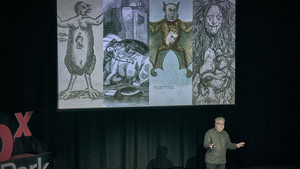
And the question I want to explore with you today is why don't vampires cast reflections in mirrors?
So you've probably seen this before in movies.
The humans are suspicious of the new dark stranger, and they band together in this moment of confrontation.
And they open up a mirror in front of them, and bam, there's no reflection there.
Proven to the humans that the new dark stranger is in fact a vampire.
That's right. So where did this start?
How did this happen?
This idea that you could hold a mirror up to an undead creature and learn that they are a vampire?
Well, we're going to find that out.
The thing you have to keep in mind is as we look through the history of vampires that they change over time.
Every culture in history has had a variation on the vampire.
So they don't always call them vampires, but every culture has a version of a supernatural creature who comes back from the dead and gains power by preying on the living.
Our version of the vampire really came about in the 16th century.
It was a way to conveniently explain some misunderstandings about death and dying.
Some sketchy activity happens in the village.
Someone gets an idea, hey, let's dig up Wolfgang.
And they open his coffin, and they find that his hair and his fingernails and his teeth have all seemed to grow since he died.
And they see some fluid around his mouth, which they mistakenly think is blood.
Proof that Wolfgang is a vampire, but this is actually what happens to a body when it's decomposing, not that they're undead.
Our understanding of vampires really exploded, or our lexicon for vampires really exploded in the 18th century after a rabies outbreak in Hungary and Romania.
The thing to remember is that when a human contracts rabies, it can take a couple weeks before symptoms start to manifest.
So some really common vampire characteristics, like an avoidance of bright lights, or strong smells like garlic, an aversion to water, and suddenly aggressive behavior are not signs of the undead.
They are signs of rabies.
But back then, they couldn't put those things together.
They didn't think that the neighbor who's acting funny now, it wasn't because of the raccoon that bit them two weeks ago.
It's because now a much more logical explanation is that they are in fact a vampire.
So most of our ideas of vampires that we all think of came about in the movies.
Count Dracula and Sherlock Holmes have been in a decades -long battle to be the most depicted fictional character in film.
It goes back and forth every couple years.
But when we think of the vampire in film, there are some things that are quite iconic to us, like Nosferatu.
Here's a fun fact for you about Nosferatu.
Outside of it, most people get something wrong.
They think it's the first vampire movie, but it was the first one that was anything like approaching a hit.
The fun fact I want to share with you is that every copy of Nosferatu that any of us have never seen is an illegal bootleg.
The Bram Stoker's widow sued the filmmakers for copyright infringement.
She was worried that Nosferatu was going to cut into the quite lucrative royalties from the stage version of Dracula that was being performed in the UK and the US.
She won that lawsuit, and in her settlement, she demanded that every copy of the film be destroyed.
Most people think of vampires as the 1931 Todd Browning classic starring Regal LeGosse as Count Dracula.
You almost can't overstate how huge a movie this was.
It not only really established vampire movies, it started a vampire movie trend that lasted for over two decades.
It was the first mainstream hit that was a horror film and really established horror as a genre in film and set up expectations for like even Frankenstein.
It came later that same year.
Since this whole craze of vampires really started with Dracula, we've had so many hundreds of variations of the vampire.
We have had samurai vampire, we have had plumber vampires, we have had vampire babies, we have had stripper vampires.
We have had a vampire movie about every member of Dracula's extended family, son of Dracula, daughter of Dracula, father of Dracula, bride of Dracula.
We have even had Dracula's dog in Zoltan, hound of Dracula.
There is one definitive thing I can tell you about vampire movies, and that is vampire movies suck.
And I'm not being metaphorical here.
Vampire movies are not good movies.
So why is this? Why is it that these movies don't really last very long?
It's because we keep changing our idea of what terrifies us and what scares us.
Speaking of things in common, there's one thing that vampire movies do not have in common.
Does anyone want to guess what vampire movies do not have in common?
Vampires. It became such a hot trend for vampire movies that people would slip the word vampire into the title even though there wasn't a vampire in the movie.
There's multiple ones of these.
The most notorious of these was the 1952 stinker called My Son the Vampire which did star a late state, late career Bela Lugosi.
But he didn't play a vampire, and no one else in the cast did either.
But they figured it would be a big trend, get in on a big trend and did this.
So not even this happened.
And now back to the episode.
So I think we've established over the last several minutes that there are many colors in the vampire rainbow.
So let's not get too far away from our original point.
Why don't vampires?
In all these bad films, bad novels, bad stories, why do none of them ever cast reflections in mirrors?
I mean they're not one but several vampire tales where the vampires are deathly scared of uncooked rice.
Yeah, true. Count Von Count from Sesame Street is based off of the idea that vampires are obsessed with counting and if they see sand or rice on the ground they're going to have to stop and count every grain, the sun comes up and they die.
There you go. We'll improvise a little bit for you right there.
So now see if I can find my place back into what I'm talking about.
So if you want the answers to why they don't cast reflections in mirrors, the answer is that there really isn't a clear answer to this question.
The consensus thinking is that when you hold, it comes from the habit or something people did of holding a mirror up to a deceased person's face to see if the warm breath would fog up the mirror and if you think about it, if someone's laying thrown and you hold a mirror up to their face, what you're
going to see in that mirror is the wall.
You're not going to see that.
Therefore no reflection in the mirror.
But I think there's actually a far simpler answer than this.
When you look at vampires and how they change over time.
What was once terrifying and evil becomes dull in camping.
We change the vampire to match our time.
In the 1890s Bram Stoker's Dracula the novel was thought to be an allegory for the end of Victorian morals.
In 1931 when the Dracula, sorry Bela Lugosi came out, the idea was that that represented a fear of Eastern European immigration.
In the 1950s vampire films represented a fear of communism.
We morphed the vampire to match our tone.
So with this, why don't vampires cast reflections in mirrors?
I think it's because the vampire is the reflection.
They are a reflection of us.
They are a reflection of what we fear.
They are a reflection of what we consider to be unchecked power without accountability.
They are our idea of the ultimate villain that lies almost undetectable until someone holds a mirror to them.
All our talks today are themed around unity, the idea that when we come together we are stronger.
I would argue that it's not only about the things that we share in common as far as beliefs and things that we believe, but also the darker things that unite us.
When I know what you fear, when I know what goes bump in your night, perhaps I can help protect you.
Perhaps we can help protect each other.
There are so many vampires in the world today.
But I want to leave you with this.
One thing that I see in so many vampire stories is the thing that brings about the monsters decline, is when the humans, who are weak and powerless individually, come together and unite and they prevail.
It's a concept called unity.
That was Eric Noozum speaking at TEDx Aspiry Park in 2024.
If you're curious about TED's curation, find out more at TED .com slash curation guidelines.
And that's it for today.
TED Talks Daily is part of the TED Audio Collective.
This episode was produced and edited by our team, Martha Estefanos, Oliver Friedman, Brian Green, Autumn Thompson and Alejandra Salazar.
It was mixed by Christopher Faizi -Bogan.
Additional support from Emma Tobner and Daniella Valarezo.
I'm Elise Hugh. I'll be back tomorrow with a fresh idea for your feed.
Thanks for listening.