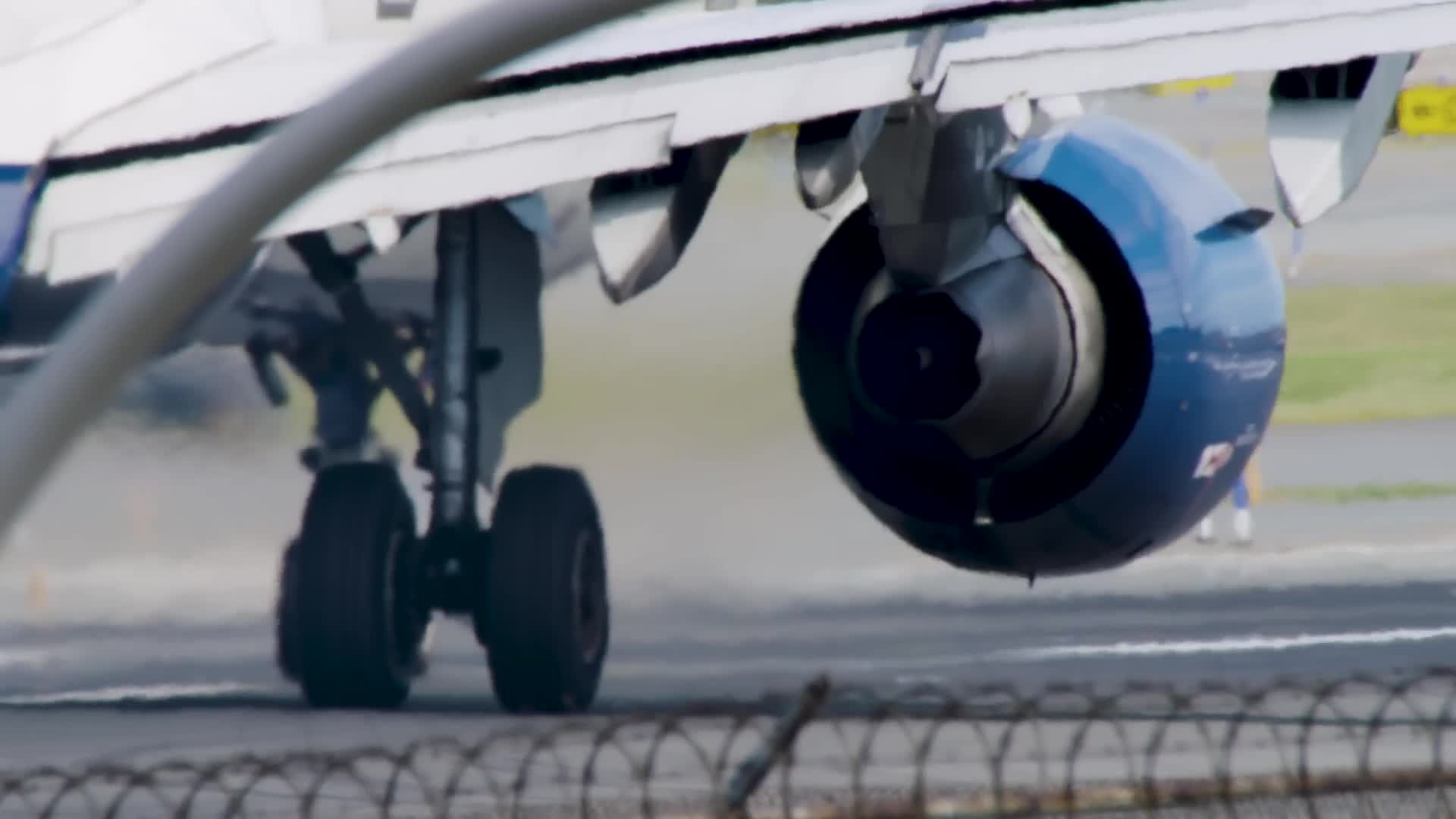
This is one of the most powerful jet engines in the world.
And it actually runs at temperatures 250 degrees Celsius hotter than the melting point of the materials that make it up.
That's 1200 degrees.
So the question is, why doesn't a jet engine just melt into a puddle?
We are right at the boundaries of the laws of physics.
That is wild.
It's at the same temperature now as it would be inside the jet engine.
But here they're liquid.
Every time I get on a plane, I'm thinking, this is never gonna work.
And yet, it does work.
Right now, there are over 10,000 planes in the sky powered by engines just like these.
Maybe you are on one right now.
So how do they work?
This is a jet engine, specifically a turbofan engine.
At the front is this giant fan.
During takeoff.
These rotating blades push 13 tons of air backwards every second, and around 10 of that air gets compressed.
The compressors force the air into increasingly narrow chambers.
They compress the air to about 50 times atmospheric pressure.
And just by doing that, the air heats up to around 600 degrees Celsius.
This compressed air is then forced into the combustion chamber, where fuel is sprayed in through a ring of nozzles and ignited.
That chemical reaction gives off a lot of heat, so the temperature jumps to around 1500 degrees Celsius.
So now you've got this high pressure gas from the combustor that just wants to expand.
And now it's got an incredible amount of thermal energy.
But between the combustion chamber and the outside air is this, rows of turbine blades.
So in order for the gas to expand and get out, it needs to push these turbine blades out of the way.
And in pushing the blades, that is how it transfers its energy to the engine.
This is where all the power really comes from.
In modern jets on takeoff, each high pressure turbine blade is generating as much power as a Formula One car.
And there are 68 of them.
As the gas rushes through the turbine and nozzle, its pressure drops from around 50 atmospheres down to one, and it expands by almost 20 times.
And that spins these turbine blades up to 12,500 revolutions per minute.
The fan that is pushing all that air backward and all those compressors that squeeze the air down.
All of that is powered by the turbines back here.
It's a kind of funny, really counterintuitive way to think about an engine.
It's what's happening in the back that's actually driving everything up front.
As the hot exhaust gas is shot out the back of the engine, it pushes the engine forward.
That generates thrust.
But did you know that in a modern passenger jet this accounts for less than 20, the thrust of the engine.
The vast majority of the thrust over 80 of it just comes from that big fan at the front of the jet.
Remember how only 10% of the incoming air gets compressed?
The other 90% bypasses all that.
It's simply propelled backwards by the fan.
It goes right around the guts of the engine and comes straight out the back.
The fan pushes that air backwards, so the air pushes the fan forwards.
That's how you get 80% of the thrust.
It's basically a huge ducted propeller.
So why do it this way?
I mean, why not compress all the incoming air and put it all through the combustion chamber and turbines?
Well, some fighter jets do exactly this, and it makes for very powerful engines, but they're also horribly inefficient.
To see why.
Remember that the impulse pushing the plane forward is equal to the change in the momentum of the air backwards.
So you've got options.
For example, you could push twice as much air back half as fast.
Or you could push half as much air back twice as fast.
Both will generate the exact same impulse, but the kinetic energy of the air is proportional to V squared, so it takes four times as much energy to speed up the air in the second case, and a lot of that energy is just wasted in the exhaust.
So ideally, you want to push as much air backwards as possible with only a small change in velocity.
That's why jets have gotten bigger and bigger over the years.
And the increasing fraction of bypass air has the added benefit that it surrounds the hot exhaust gases and that reduces noise coming away from the jet.
But there is another major factor when it comes to engine efficiency, and that is temperature.
At cruising altitudes around 35000 feet, the outside air is around negative 55 degrees Celsius, while inside the engine it's over 1500 degrees Celsius.
The hot high-pressure gas inside the engine wants to expand into the much colder lower-pressure air outside.
It's that difference that lets the engine turn heat into useful work.
But there's a fundamental limit to how much work any heat engine can get from that.
It's called the Carnot efficiency.
It's equal to one minus the temperature of the cold outside air divided by the temperature of the hot gas inside the combustion chamber.
So, looking at this, you can improve the efficiency of the engine in two ways either fly where the air is colder or raise the temperature in the combustion chamber.
One problem with that though, is that it turned the inside of a jet engine into one of the harshest environments we have ever built, in which machinery has to survive.
To keep a turbine blade whole and unaffected within an engine is like putting an ice cube inside your oven, turning up to max, leaving for work, coming back after an eight-hour shift and finding it still completely frozen in the oven.
That's what we've got to try and do within that engine.
It sounds absurd.
Not only do the turbine blades sit in a stream of gas that's over 1500 degrees Celsius, they're also spinning at 12500 RPM, with the tip of each blade slicing through the air at nearly 1900 kilometers per hour.
Now every blade wants to fly straight, but it's forced to spin in a circle, which means something has to be constantly pulling it inwards.
That's the centripetal force.
If you take a representative 300 gram high pressure turbine blade and run it at that speed and radius, it has to be pulled inwards with a force equal to the weight of 20 metric tons.
That's roughly the weight of two London double-decker buses tugging on each blade as it spins, all while they're glowing hot.
To make matters worse.
At these temperatures, oxygen wants to react with the metal of the blades itself.
And, on top of all that, the air rushing through the engine often carries dust, sand and pollutants that can damage and erode the surfaces inside.
And somehow these blades have to survive this punishment for tens of thousands of flight hours without deforming, cracking or failing.
They really determine how efficient you can make the engine, because you can't make the engine so hot that the blades can't withstand that temperature.
So they determine the maximum temperature of the combustion chamber and therefore the maximum efficiency you can realize with a jet engine.
So what kind of metal could possibly survive these conditions?
Well, we sent Veritasium producer Amelia to the Department of Materials Science and Metallurgy at Cambridge University to put some different metals to the test.
So this is the steel?
This is the steel sample, yes.
Okay.
So we've got about 200 megapascals to start with, which is sort of comparable to some of the stress that's seen by these components in real applications.
And we're going to put that stress on and then slowly increase the temperature.
This is a mild steel.
It's relatively strong and easy to form into complex shapes.
It seems like a pretty good bet for a turbine blade.
And at first, under this load and at these low temperatures, it holds up pretty well.
We're essentially tugging on all the atoms within the metal.
We're not breaking or forming any bonds, we're just making them flex a little and that slightly changes the spacing between the atoms and as a result the metal gets slightly longer.
This resulting change in size, specifically the per unit change in length, is what we call strain.
Critically, at this stage, the material is behaving elastically.
If we remove the load right now, the material just snaps back to its original size.
In an engine, some elastic deformation like this will occur.
It can't be too big or it'll cause problems.
But what we really don't want is plastic deformation if the shape changes permanently.
And that's exactly what starts to happen as we keep increasing the temperature.
It's getting hot now.
That's a little bit of oxide.
There you go.
See this starting to deform?
Now, bonds are breaking and reforming as the metal lattice deforms permanently.
But this doesn't happen all at once.
So I got the mechanical engineer on our team, Henry, to build this demo.
Okay, so you can see we're getting a bunch of tiny little bubbles and just naturally they're packing into this hexagonal arrangement.
And there are actually a lot of materials that have atomic structures just like this.
But you can see it's not perfect.
Like right here you can see there's an extra half plane of atoms.
Well, in this case bubbles.
This is called an edge dislocation.
It becomes really interesting when I try to pull this raft apart.
You can see these little dark lines that zip back and forth.
Those are dislocations, and they move through the lattice.
As the dislocation moves, it'll cause one plane of bubbles to shear past the other one, which shifts the structure by exactly one spacing.
But there isn't just one dislocation.
There are plenty of them, and altogether their movement produces dramatic changes in the overall shape.
That's exactly what's happening here.
Everywhere that stress is high enough, billions of dislocations are moving and interacting.
The steel starts to deform continuously under this constant load in a process called creep.
It takes energy to break the atomic bonds as a dislocation travels through the lattice.
So as we ramp up the temperature and all the atoms get more thermal energy, it no longer requires as much stress to break these bonds.
It becomes much easier for the dislocations to move.
The metal effectively gets softer.
Now the steel's strength drops so much that the slow, time-dependent creep gives way to rapid deformation.
As it stretches, it rapidly decreases in cross-section and eventually the remaining metal can no longer bear the load.
Now you could try doing similar tests for other metals, like this titanium alloy.
Titanium is about half as dense as steel.
Should feel that's quite a bit lighter.
Yeah, it's like loads lighter.
So if we were to make turbine blades out of titanium, each blade would be much lighter and that would reduce the enormous centripetal forces it would experience.
So it seems like a great choice.
And at first, it performs really well.
That's 100 degrees.
It's hanging in there.
But as we push the temperature higher... Oh, I can see some glowing.
Oh, look at this.
Oh, it's gone already.
Just like the steel, its strength drops rapidly as temperature increases, and that's true for most metals.
Yet the first jet engine dating back all the way to 1941 actually did use steel turbine blades.
It was designed by British pilot and engineer Frank Whittle.
His engine powered the first flight of a British jet aircraft, the Gloster E2839 prototype.
When a colleague excitedly told Whittle Frank it flies, he dryly quipped that was bloody well what it was designed to do, wasn't it?
But Whittle's prototype had two major flaws.
The first was that the gas inside the engine only reached temperatures of around 780 degrees Celsius, which was one of the reasons it was inefficient.
And the second was that it was only allowed to fly for up to 10 hours.
Any longer, and it was too likely parts inside the engine would fail.
And both of these drawbacks were largely due to the steel turbine blades.
Something that occurred to me is why aren't they made out of tungsten?
I mean because tungsten doesn't melt until 3400 degrees Celsius, which is more than twice the temperature inside a modern jet engine.
But tungsten is also incredibly dense.
It's about two and a half times denser than steel.
And it's also brittle, which makes it hard to manufacture.
And using a material that heavy wouldn't just make the blade a problem.
The components that hold the blade in the engine would also have to carry much higher loads, well beyond what current materials can handle.
So you can optimize for one thing like the melting point, or a different thing like strength or weight, but the turbine pushes every variable to its limit.
So what are these blades actually made of?
Well, to find out, we went to Rolls-Royce's precision casting facility in Derby.
And it turns out the world's most advanced metal parts begin life as, well, something surprising.
What is with the, like, the pink and the green there?
I'll come and show you.
I'll come and show you.
I'm just seeing so many cool things around here.
I'm like, what is that?
Why does it look like that?
You just enter this room and I smell the wax.
Smells like a candle factory in here.
Absolutely.
So investment casting is a really, really ancient technology.
So our ancestors have been doing investment casting to make jewelry, to make weapons for millennia.
We've just perfected it here to make turbine blades.
It's so wacky.
This is just not how I'd expect it to happen at all.
Turbine blades strike me as one of the most high-tech things in the world.
And yet, this facility is using wax as a starting point.
What you will see through our tour today is that actually it's a really highly technological process.
This is our wax pattern die.
This is how a turbine blade starts its life.
So this is what's going to go inside the wax pattern, a ceramic core.
This is going to create the hollow inside the turbine blade.
So what's happening now is we're injecting into the die.
So that's the very start of the life of a turbine blade.
That is really neat.
What we'll actually see is that a lot of these features, such as the aerofoil and the amulet surfaces, are not touched further, so we will cast that, and that will remain as cast as it goes into the engine.
Every surface here has to be perfect because this wax is what will become the blade.
So Kim is our wax pattern assembler.
So she's responsible for taking the product straight from that dye, making sure that things like dye lines have been removed, so where the dye blocks come together and leave a small amount of flash.
The operative word in all of wax assembly is smooth.
Every tiny imperfection in the wax would become a flaw in the metal.
So this takes an incredible amount of skill.
Then it's the case of getting that wax pattern attached to the unit runner to create the assembly.
I mean, the thought that occurs to me, right?
Shouldn't you be doing this with a robot?
So Rolls-Royce has facilities that do this by robot, but our facility in particular is very much focused on bringing in those new products.
And it's far, far easier for us to work with human beings to develop that method of manufacture that's going to bring the next generation of product through.
I'll bet.
I can see the skill here.
Like it's phenomenal.
I'll just make a mess of it.
Absolutely.
So would I. Would you like to go?
No.
Once the wax assembly is perfect, it's ready for the next stage.
Everything that is wax is going to become air.
It's going to become negative space, right?
It's going to become our cavity.
And then we're going to fill that air with metal.
So we take that wax assembly and we've got to build a shell.
Shell is made of many different layers.
It's a zircon-based shell system.
We're going to dip into a primary slurry.
It's really quite thin, like a light syrup or a thin honey.
Oh, yeah.
And what that's designed to do is map all of those really complex geometric features.
Beautiful.
It's like making icing.
So that's actually the analogy we use.
So it's a bit like if you put icing on top of a bun or a cake, you need to sprinkle it with some sugar afterwards, otherwise it's all gonna slop off the top.
So we've got the slurry on there, we're gonna get a nice even coat, drain it, make sure that it's an even thin layer and then we're gonna sand and that's then gonna set that layer in place.
So cool.
Whoa.
We're then going to dry it, so it's air-dried for many, many hours.
And then we can create our backup layers.
So our backup layers.
It's a much thicker slurry, more like a treacle, and the sand is much coarser, more like a granulated sugar.
And we're going to maybe put four five, maybe even six layers to back up, because what we need is we need a mould that can withstand the casting parameters that we're putting it under.
You know, it's got a lot of work to do.
The wax is then melted out. and the mold is fired.
Oh, yeah.
That is wild.
Cleaned and tested to make sure there aren't any cracks.
When it's done, this shell is ready to hold molten metal.
This is a billet of alloy that's going to fill the whole of that mold.
So just that amount of metal is going to fill that whole mold there.
It doesn't look like enough.
This is a nickel alloy, the first nickel alloys used in jet engines were developed in the 1940s.
By adding chromium and cobalt, engineers created alloys that could handle 800 to 900 degrees Celsius, around 100 degrees hotter than the steel used before.
And these alloys could keep their strength for thousands of hours, a tenfold improvement in life.
But the real breakthrough came when they added a touch of aluminum.
So we wanted to see how it held up under the same lab conditions as the steel and titanium.
In fact, around this temperature, it's actually getting stronger.
So why would heating a metal make it stronger?
Well, when these nickel alloys were first used in jet engines, no one actually knew.
But about 10 years later electron microscopes had improved enough for engineers to finally see what was happening inside.
As we zoom in on the alloy, a pattern emerges.
The microstructure isn't uniform.
Instead, it kind of looks like a city grid made up of blocks with roads in between them.
Only each block is so small, over 300 would line up across the width of a human hair.
Now surprisingly, both the roads and the blocks are made up of the exact same atoms, mostly nickel with a little aluminum.
They even have the same crystal structure a grid of tiny cubes with atoms sitting at the corners and at the center of each face.
The only difference is that the atoms are arranged slightly differently.
In the road structure, the aluminum and nickel can take any spot.
There is no repeating sequence from cube to cube.
And this is known as the gamma phase.
But in the blocks, aluminum always takes the corner spots and nickel the faces.
And you get a perfect repeating pattern cube after cube.
This is the gamma prime phase.
And it's this difference that is crucial when a dislocation tries to glide through the lattice.
In the Rhodes, this motion is easy.
Each layer of atoms can shear smoothly past the next, leaving the structure looking unchanged behind it.
But if you try to do the same thing in the blocks well, now you're actually changing the order of the atoms.
Nickel and aluminum end up sitting in the wrong places.
That takes energy, so the lattice resists it.
So when a dislocation moving through the roads hits a block, it gets stuck.
And that's what makes this alloy so strong.
But if you keep pushing and the stress gets high enough, dislocation can finally force its way in.
The catch is that this dislocation leaves the lattice in such a high energy mess that the only way that it can keep moving is if there's a second one right behind it that puts things back in order.
So in the gamma prime phase, dislocations have to travel in pairs called super dislocations.
I need that creation of those super dislocations and I need that very high stress to be able to shear.
So that's why the strength is very high relative to other alloys.
What happens is ultimately because you're shearing through that gamma prime with two dislocations.
As the temperature continuously increases, you're adding more and more thermal energy in the material.
What happens is the atoms are going to vibrate more and more and more.
So there's a likelihood, as I'm doing this and I'm oscillating in three dimensions that the thermal energy is going to drive me to actually slip down rather than just slip in one plane.
So now, if one cross slips, they're no longer on the same plane.
Think of it as if we're standing in a in line, and the only way that you can move is i push you right and then i keep on pushing you and then suddenly you drop.
So if i now try to push you, i i cannot find you right.
You're not in front of me anymore.
Your, your shoulders are now below me.
I should have used the other example, you pushing me, but anyway.
But it's exactly that.
It's the exact same analogy.
There's nothing to push me anymore.
There's like, I am not able to do it.
So now you've got these two dislocations that are on different planes, so they can't travel together anymore.
And as a result, they're both now locked into place.
And you can see that effect on this graph.
While steel and titanium strength drops off, in the nickel superalloy, you actually get a peak.
That's because the extra thermal energy lets more dislocations cross-slip and get separated.
And it's that that shuts down the motion of dislocations.
But if gamma prime is so strong, why don't we just make the entire turbine blade out of it?
Well, that strength comes at a cost.
Gamma prime stops the dislocation so effectively that it becomes brittle.
All it takes is one crack or a sudden impact and it could lead to a sudden failure.
So the real trick is in striking the right balance between enough gamma prime to trap the dislocations and to prevent this creep, but also enough gamma to keep the alloy ductile so that it can bend without breaking.
And in our test, you can see exactly how that plays out.
1,000 degrees and still nothing.
Still nothing.
There we go.
Oh, my gosh.
That is... That's 1,100 degrees C. It's stretching.
I mean, it's still holding up, like... It's doing a good job.
That's 1,200 degrees C.
1,200?
That's where the teleprinter program is stopped.
And it's still surviving.
Still going.
But if you push the temperature too far, even this alloy reaches its limits.
Cross-slip becomes easier.
The paired dislocations can now hop between the planes together.
And the ordered cubes of gamma prime start to dissolve.
So the dislocations break free and it finally gives out.
Oh, it may have just, uh, did it break?
Oh, yeah, yeah, it did.
It broke.
But strength alone isn't what makes these alloys special.
When you heat up, the alloy aluminum at the surface reacts with oxygen to form a thin, continuous layer of aluminum oxide.
Unlike the brittle oxides that form on other materials like steel or titanium, this layer stays intact at high temperatures, protecting the metal below.
And by adding other elements, we can tune these superalloys.
Each one brings a specific property that we want.
Most modern superalloys contain as many as 10 different elements, all carefully balanced in their relative abundances for the desired properties.
Chromium improves resistance to oxidation and corrosion.
Cobalt, titanium, niobium, tantalum, and vanadium help stabilize the gamma prime phase.
Molybdenum and iron strengthen the gamma matrix.
And then there's rhenium.
Rhenium has one of the highest melting points of any metal at 3,180 degrees Celsius.
It's second only to tungsten.
In the nickel superalloy.
It slows the atomic scale rearrangements, enhancing the alloy's resistance to deformation, even at temperatures above 1000 degrees Celsius.
It's one of the rarest elements in the Earth's crust, at less than one part per billion.
And more than 80% of what we mine ends up right here in jet engines.
But even with these advancements in alloy chemistry, there's still one fundamental problem.
And that's that metals are crystalline.
Any metal you see, from the tip of this ballpoint pen to the spoon in my coffee cup, they're all actually made up of millions of little crystals stuck together.
It's kind of like grains in this sugar cube.
If I crush it, it's not like I've broken any individual crystal.
I've just broken them apart.
It's the boundaries between the grains that are the weak point.
And it's the same thing in a metal.
So if we zoom out from the gamma and gamma prime structure, it looks something like this.
One crystal is basically a three-dimensional lattice of atoms all lined up in the same orientation, but the crystals themselves are all in different orientations.
So where they meet, their lattices don't line up, and that mismatch leaves more open spaces and broken bonds, and you also get defects there, like vacancies and impurities, all of which make grain boundaries the weakest point.
And this also has another consequence.
It makes it easier for atoms to move along the boundaries.
They become kind of superhighways for atomic diffusion.
This becomes even more of a problem at high temperatures when atoms have more energy to move around.
Add stress, like the massive centrifugal loads on a turbine blade, and the grains can actually start to slide past each other.
The whole structure slowly deforms, stretching, almost like warm taffy.
As long as it has grains in it, it will creep and fail far more easily.
And that's a really hard problem to solve because normally, as a molten alloy cools, tiny crystals start to form all throughout the liquid.
So you have to find some way to control them.
This is one of our furnaces.
They're all induction heated.
There's no kind of gas fire or anything like that.
And they're all under vacuum.
So we only cast under vacuum in the absence of any atmosphere, but particularly oxygen, which is obviously metallurgically going to cause us all kinds of problems with oxides.
You start by pouring molten superalloy into a ceramic mold that's mounted vertically and heated to about the same temperature as the melt.
The mold fills from the root up toward the tip.
At the very bottom of the mold sits a copper plate cooled by water.
Its surface is patterned with tiny grooves that act as nucleation points for the first crystals to start to form.
It's here that solidification begins.
Then the entire mold is slowly lowered out of the hot zone, so the solidification continues in just one direction.
It's a very slow process in the magnitude of hours.
Once that's finished, the whole machine will then index round and it will push the completed mold up out of the other side.
Oh, wow.
So our casting temperatures are roughly 1500 degrees Celsius.
It's kind of at the same temperature now as it would be inside the jet engine.
It's absurd that you're making the turbine blades at the same temperature that they're going to operate, but here they're liquid.
Now if we just did that on its own you'd end up with a blade that looks like this.
Here's a directionally solidified blade and what you can probably see, there is the contrast between the grains.
These are all different crystals, but they're all running on this axis of the blade, which makes it significantly stronger than an alloy that is cast where all of the crystals are separate from each other.
So those are like individual crystals?
These are individual crystals.
Yeah, absolutely.
So we're looking at crystals on kind of a macro level, where normally we'd be talking about crystals on a micro level.
In a rotating turbine, the blade is being pulled along its length.
With columnar crystals all lined up along this span, the blade can carry those stresses far more effectively.
There are no grain boundaries that cut across the blade, creating weak points for it to crack.
But scientists have found a way to do even better.
If you introduce a bend in the mold just above the chill plate, something strange happens.
The number of columnar crystals that make it through drops sharply.
And if you add another bend, even fewer survive.
So engineers added a helical passage known as the pigtail here at the bottom of the mold.
The pigtail is doing the job to select the single crystal.
The spiral is gonna choke out every other grain bar one.
So we're only gonna have one grain that is then gonna grow through the entirety of that blade and cast that blade as a single crystal, or at least that's the theory.
That's crazy.
So this is a starter attached to a spiral that we've etched so that we can reveal that structure.
So you can see down at the bottom we are starting to grow directionally solidified grains.
But as we get up here we can start to see that we're growing directionally solidified grains and then, as we're going up the spiral, the grains are starting to be choked out by the upper surfaces of that spiral until when we get to the top with just as a single crystal, and then that then allows that to grow right the way through the blade.
That's amazing.
And what we should end up with is a blade like this.
So this is a blade of a single crystal.
It's a really impressive thing to look at.
The shimmer is beautiful.
Yeah.
Even after the blade solidifies, it's still not ready for the engine.
It's heated again almost to its melting point, and that might sound risky because we've spent all this time making sure it's a perfect single crystal.
But this heating step lets the atoms shuffle around just enough to spread out evenly and form the final desired microstructure of the gamma and gamma prime phases that make these superalloys so strong.
And as if casting as a single crystal is not enough, actually the orientation of that crystal is also of paramount significance.
So you may have cast this as a single crystal, but if the crystal orientation is off by a certain amount, you get completely different stress responses within that blade.
Today, after decades of development, over 95% of blades can be cast successfully as single crystals.
Just think about how incredible that is.
We've gone from a turbine blade that contained on the order of 50000 crystal grains down to just one.
When we grow these things, they don't solidify as a uniform front.
On a microscopic scale, the solidification front looks like a forest of tiny tree-like branches, called dendrites, that are pushing their way into the liquid.
At first glance, it looks messy, like millions of separate trees jostling for space.
There are up to 10 elements in there, each with its own density and melting point.
Yet somehow, every one of those trees is locked into the exact same crystal lattice.
So the final crystal is comprised of more than six times 10 to the 24 atoms.
That is more stars than there are in the observable universe.
When all these atoms are repeating the same pattern, perfectly aligned from root to tip.
This completely transformed what jet engines can do.
Single crystal blades can withstand stresses and temperatures that would destroy ordinary alloys.
They last up to nine times longer against creep and thermal fatigue and are more than three times more resistant to corrosion than blades made from multiple grains.
That's why modern jet engines can now run for 25000 hours between major overhauls, something that would have been unthinkable before.
Single crystal blades.
And the impact has been huge.
Between 1960 and 2010, jet aircraft became about 55% more fuel efficient.
And a huge part of that improvement comes down to advances in these nickel superalloys.
Back in the 1960s, flying was a luxury few could afford.
A one-way flight from New York to Paris would set you back 310, which is about 3750 adjusted for inflation.
But as engines became more efficient, able to handle hotter cores and equipped with much larger fans, airlines could carry more people farther using less fuel.
So tickets got cheaper and air travel exploded.
Today, at any given moment, there are roughly 10,000 to 14,000 planes in the sky.
That scale of movement is possible because of these turbine blades.
In the furnace, the nickel superalloy outperforms all the other samples surviving up to 1200 degrees Celsius.
But wait, that's still 300 degrees less than the temperature inside a jet engine.
So why don't the blades melt?
Well, there are two final layers of defense.
The first is built into the shape of the blade itself.
We then have to leach the core out.
So we do that in a caustic solution of potassium sodium hydroxide under pressure and temperature, to leach the core out.
That will leave those core passages completely empty.
And those passages are the real secret to the turbine blade's survival.
So as the air is flowing through, it is turbulent.
And as such, it can remove much more heat from the surface of the blade.
Yeah.
Is it these ridges here that we're talking about?
Yeah, these ridges here.
They're intentional to trip the flow into turbulence.
To trip and turbulent that airflow so that it's removing as much heat as possible from the metal.
So then we get on to the really juicy part, which is film cooling.
So we talked about the ice cube in the oven stat keeping our blades as cool as possible.
So this is where we start to drill in what we call film cool holes, and what we're aiming to do is we're aiming to get into those cooling passages.
So we saw that core earlier on.
They are the cooling passages inside and these holes have got to get right into those cooling passages to allow that air to come out.
And the air is then going to blow as a film over the surface of the blade a film cool hole to create a film of air which is preventing that metal from melting in those temperatures.
This cooling air isn't exactly cold.
It actually comes from the high pressure compressor section of the engine at around 600 degrees Celsius, but that is cool enough to help keep the blades from melting.
But it's still not quite enough and you can't just add more cooling air, because every extra bit of air you use from the compressor you lose from thrust and actually make the engine less efficient.
So every turbine blade is also coated with two protective layers.
First, a thin metallic bond coat that resists oxidation, and then a ceramic top coat.
Even though it's only about a quarter of a millimeter thick, this ceramic coating can keep the metal beneath it 100 to 170 degrees cooler than it would otherwise be.
And this is the final barrier that stops the blades from melting.
So now we've got this insane piece of engineering that can survive the 1500 degree gas, the intense load and the oxidation.
Problem should be solved.
Well, it would be, except for one thing.
At 36000 feet.
You wouldn't believe this, but there's dirt and dust in the atmosphere that our engines are ingesting.
The dirt and dust comes and it sticks on the blades, but it also goes through the whole cooling circuit.
And it blocks the cooling from getting through to cool the blades.
And then the blades burn up.
Usually every time I get on a plane, I'm thinking this is never going to work.
No, I mean, it's incredible how an engine can work because there's so many moving pieces.
There's so many parts.
The environment's so terrible.
And now we have this dust and dirt, which is really bad.
I am at test bed 80 and they're about to fire up this jet engine and then throw dust into it.
The same stuff that makes up sand and volcanic ash, exactly what real engines encounter in flight.
So this engine is the 97K.
It goes on the A350 and is our high thrust version of that.
So 97,000 pounds of thrust is what this engine's producing.
When we're running an engine like this, we try and carefully recreate exactly what happens in service.
How much dust goes in the engine?
Not very much.
It was surprising when I found out exactly how much we put in.
It's in the order of tablespoons worth per cycle.
Start master on.
Ignition power on.
Master fuel lever on.
Start request in three, two, one, now.
So what does the dust actually do inside a jet engine?
So once it gets through to the hot section of the engine and hits kind of turbine blades, it's going to be melted.
And so it sticks to the outside of our turbine components and it slowly rips layers of that thermal barrier coating off.
And then you lose your temperature reduction that comes from the barrier coating.
So your nickel alloy underneath it gets hotter and hotter.
And that's when it starts to deteriorate the turbines.
That's why engineers at Rolls-Royce are still refining these blades, developing new ceramic coatings designed to resist molten dust and extend the life of the turbine by up to 30.
That's just the latest step in a story that's been unfolding for decades.
These blades have been refined and perfected to the point where they operate right at the edge of what is physically possible.
You're always on a knife edge, pushing every material, every process to the limit to build an engine that can do the seemingly impossible run hotter than its own melting point.
The more I learned about the brutal environment these blades have to survive, the more it felt like they shouldn't work at all.
And yet, they do.
Every day, these machines carry millions of people across the world, and we barely stop to think about them.
They're a monument to human ingenuity.
What happens when we refuse to accept limits, when we turn the impossible into the routine?
I can't grow a single crystal turbine blade in my kitchen, but with the help from this video sponsor KiwiCo, I can grow a crystal garden with my kids.
This month they sent us their crystal garden chemistry kit.
We set everything in place, mixed up the chemical solution and then watched as colorful crystals started to bloom over the next 48 hours.
Every few hours my kids would run back to check how much the garden had grown.
They were totally fascinated and it sparked so many questions about crystals and atoms, how things arrange.
Pretty soon we were talking about how Metals are crystalline too, and setting ourselves the challenge of growing one giant crystal turbine blade style.
I love how simple KiwiCo makes this.
Everything we needed came right in the box, so we could just open it up and dive straight in doing the experiment.
And it's not just chemistry.
They've got crates for robotics engineering art, design techniques and so much more.
There is something for every age and interest.
KiwiCo crates also make a great gift for the holidays.
It's creative, hands-on, and gives kids something they can actually make and be proud of.
They're kind of messy and hard to make, but not too hard, but hard enough to make it fun.
So if you want to try out KiwiCo, click the link in the description or scan this QR code.
Use my code VERITASIUM to get 50% off your first monthly crate.
I want to thank KiwiCo for sponsoring this video, and I want to thank you for watching.