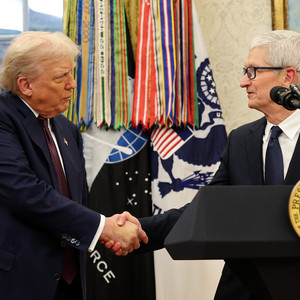
President Trump has spent his first year back in office blurring the lines between business and government and creating a lot of headaches for business leaders.
His trade war and his immigration policies are adding costs.
He's demanding a government cut of some of NVIDIA's sales in China and an outright government stake in Intel.
He wants to cap how much interest credit card companies charge their customers and how much defense companies pay their CEOs.
We just did an episode on that.
He's also being kind of a bully about everything.
Last week, he even sued JPMorgan Chase and its powerful chief executive, Jamie Dimon.
But as the president goes storming through corporate America, business leaders aren't exactly mounting a strong defense.
Billionaires and big tech CEOs are publicly competing to kiss Trump's ring, while almost everyone else seems afraid to stand up for their companies or the broader US system of free market capitalism.
This is The Indicator from Planet Money.
I'm your non-billionaire host, Waylon Wong, and my co-host today is NPR financial correspondent Maria Aspin.
Also not a billionaire.
Maria, you have spent the last year covering how corporate America has responded to President Trump's extremely let's say disruptive second term.
Yes, I have.
Today on the show as Trump rewrites the rules of doing business.
Why aren't business leaders doing more to speak up?
This message comes from Charles Schwab.
When it comes to managing your wealth.
Schwab gives you more choices, like full-service wealth management and advice when you need it.
You can also invest on your own and trade on Thinkorswim.
Visit Schwab.com to learn more.
This message comes from Wix.
Nothing beats seeing your ideas turn into cold hard cash.
Well, if you use Wix Harmony, you better get used to it.
Wix Harmony makes it unbelievably easy to create a fancy new website that's built to sell.
Get the perfect blend of AI and drag-and-drop tools that puts you in control of every detail, plus an AI agent to help you every step of the way.
Try it for free at wix.com slash harmony.
On River to River, we talk to people impacted by change.
Unless they hear our stories, it's not going to have the same effect.
And how to accept change.
A little bit of humility and a little bit of genuine human interaction really matter.
Understand our changing state on River to River an Iowa Public Radio podcast part of the NPR Network.
This has been a pretty eventful month for corporate America, even by the standards of Trump's second term.
It started with the US attack on Venezuela and Trump pressuring US oil companies to invest there, and then sniping at ExxonMobil after its CEO called the country uninvestable.
Then last week, Trump went to the World Economic Forum in Davos, Switzerland.
He threw a private reception there for CEOs, but he pointedly left some big names off the invite list.
Trump was also more than 90 minutes late to his own party, according to the Wall Street Journal.
And there were no chairs.
I read that.
High tables only.
Now the Journal reported that Jamie Dimon was invited to this White House reception, but he had to leave before Trump got there because Dimon had to go host a party for his own company.
This is like a Jane Austen novel where there's very intense drama about who snubs whom at a party.
Well, and are you saying President Trump is Mr. Darcy?
He reminds me more of Lady Catherine de Bourgh.
That is such a good, such a good example or analogy.
But dance cards aside.
This was all happening at a time when the public relationship between Trump and Dimon seems to be getting more tense.
Now Dimon runs the country's biggest bank and he's been more outspoken than most CEOs during the past year.
By the very mild standards of corporate America.
Take this reaction to Trump's tariffs last year.
I'm taking a calm view, but I think it could get worse if we don't make some progress here.
For a while last year, it seemed like Diamond could speak that truth to Trump's power and be heard.
But more recently, something seems to have soured between the two men.
Diamond has continued saying that the Federal Reserve should stay independent at a time when Trump is trying to take control of the central bank.
Trump has also proposed putting that cap on credit card interest rates, which would hurt JPMorgan Chase's business.
At Davos last week, Diamond said this.
It would be an economic disaster.
I think it's wrong for the government to get involved extensively in pricing of stuff.
But I've got to deal with the world, I've got.
A day later, Trump hit JPMorgan Chase and Jamie Dimon personally with a lawsuit seeking 5 billion in damages.
The lawsuit was ostensibly about some of his long-simmering grievances against JPMorgan Chase and several other banks.
Trump claims that these banks closed his accounts after the January 6th riots by his supporters in 2021 because the banks didn't like his politics.
But Trump has been complaining about this for years.
He only filed the lawsuit after Jamie Dimon called one of his newer proposals an economic disaster.
And he sued Dimon personally.
A JPMorgan Chase spokesperson said in a statement the lawsuit is without merit and that the bank doesn't close accounts for political or religious reasons.
The bank declined to comment on Diamond's relationship with Trump.
Meanwhile, the White House declined to comment on Trump's relationship with Diamond.
Oh, all of a sudden, no one has anything to say.
Now JPMorgan Chase is the biggest bank in the country and Diamond's been running it for two decades.
They should be just fine.
But if this is an example of the cost of speaking out against Trump, a lot of other companies and CEOs are choosing the path of least resistance.
You don't want to say anything unless it's like, clearly exactly in your core interest, in your core business, and at no risk.
That's Daniela Ballou Ayers.
She's an entrepreneur and consultant who worked in the Obama administration.
Now she runs the Leadership Now Project, a coalition of business leaders.
In October, her group and the Harris Poll surveyed business leaders across the political spectrum.
They found that 84 are worried about how the current political and legal climate will affect their businesses.
We're hearing this a lot from CEO surveys.
In private, executives are pretty worried.
In public, they don't want to talk about it.
What we have right now is a lot of personalized decision-making, chaotic decision-making, instability that we're seeing the cost of.
That said, from a business perspective, the past year has had some chaos for corporate America.
Profits are up, the stock market is up and Trump's tax and spending law will largely benefit businesses.
So in the short term, business leaders do have some reason to be happy, as long as Trump isn't paying too much attention to their industry.
In the sectors where Trump is paying a lot of attention, some CEOs are going out of their way to court him.
Take the big tech companies that are giving him fancy golden gifts and donating to his ballroom or showing up to a private White House screening of First Lady Melania Trump's new documentary.
As indicator listeners know, this has some political commentators, including Daniela, ringing the alarm bell over crony capitalism.
That's a corrupt system in which businesses rise and fall based on how much a political leader likes them.
Some American business leaders have been, from our perspective, naive about where that type of engagement with government can ultimately go.
In the most extreme cases of crony capitalism, it doesn't go anywhere good for the broader economy or for individual business leaders who ultimately fall out of favor.
I talked about some of this with a White House official who agreed to speak with me on condition of anonymity and who largely dismissed claims of crony capitalism.
The official calls Trump's policies by and large the traditional free market policymaking that you would expect coming out of a Republican administration.
Some of what's going on with business leaders is about more than Trump.
Even before he was reelected, companies wanted to be talking less about politics in public.
That is probably a pretty futile hope, as we are seeing in Minnesota right now.
Big companies have mostly tried to avoid weighing in on the federal government's violent immigration crackdown.
But then federal officers shot and killed Alex Preddy in Minneapolis this weekend.
Now Minnesota CEOs have put out a very carefully worded letter calling for quote an immediate de-escalation of tensions.
This won't be the last time that business leaders will be expected to wield their power during Trump's presidency.
Right now, they're mostly focused on the costs of speaking up.
But there are also long-term costs to staying silent.
This episode was produced by Andrew Correras with engineering by Robert Rodriguez.
It was fact-checked by Sierra Juarez and edited by Julia Ritchie.
Kicking Cannon is our show's editor and The Indicator is a production of NPR.