Discussion keeps the world turning.
This is Roundtable.
You're listening to Roundtable, I'm your homin.
Here at Roundtable, we are passionate about advocating for cultural communication and fostering
people to people exchanges.
One of the best ways to achieve this, besides discussing fun and intriguing stories from
around the globe, is by bringing fascinating individuals to our table to share their experiences
and insights on various issues.
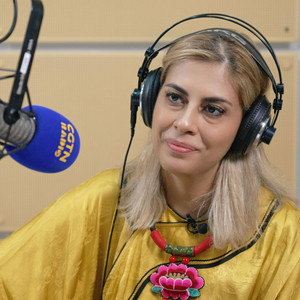
Today, we're honored to have Ms. Carla Canalis as our special guest.
So without further ado, let's welcome her onto yet a different kind of stage to share
her stories and opinions on music, art, and cultural communication.
Ms. Carla Canalis is an American singer, educator, and arts advocate.
She is currently the Senior Advisor and Envoy for Cultural Exchange at the President's
Committee on the Arts and Humanities.
Along with her undergraduate degree from the University of Michigan, her masters from
McGill, Ms. Canalis also holds an Executive Education Certificate from Harvard's Kennedy
School of Government and was a 2021 Advanced Leadership Initiative Fellow at Harvard University.
By the way, she was the youngest in history to achieve that.
She is currently teaching at Harvard University's Kennedy School of Government.
She's back in China to visit multiple cities.
Sheaman is one of them.
Zhang Zhu is another.
Guangzhou and of course here in Beijing.
And she's kind enough to join us on Roundtable today.
Ms. Canalis, oh I'm sorry, I've been instructed to call you Carla.
Welcome.
Thank you so much for being with us today.
Thank you for having me.
I'm really delighted to be here and get to share some of the joy and the stories of these
last few days here.
So you've been coming to China for a really long time.
14, 15 years in total now.
How's the trip?
How's the experience been this time around?
It's amazing.
I mean what really touches my heart the most is the development and the deepening of the
friendships that I first established, you know, 14, 15 years ago.
So some of those folks now have children, some of them even have grandchildren.
And that to me is just such a beautiful thing to witness because as an artist oftentimes
we're traveling to different places sometimes for just one or two days and maybe sometimes
we don't get to go back.
But in this particular case, China has been a constant in my life for a very long time
and the friendships I think reflect that, they're very important to me.
How does it feel for you, you know, compared to the first time when you came?
On a personal level.
Yeah, it's a good question.
I think that the first time that I came, everything was brand new, slightly overwhelming
in the best of ways.
I'm a person who probably has a low-ish capacity for boredom.
I'm a very curious person.
So being in such a new environment was a real just heightened sensation.
All of my senses were, you know, on rapid, just excitement mode.
And it's a lot of things.
I had a swivel type thing.
Totally, totally.
Now coming back, I have my favorite things that I like to visit.
You know, my favorite shops, my favorite foods I want to eat.
I feel I have a slightly better understanding of the language than I did 15 years ago.
I certainly know where near where I would like it to be.
But I feel it's kind of like coming back home.
I mean, a lot of things have changed in the world and in my life personally over 15
years.
And to have one place that I've come back to for the last 14, 15 years, I can't really
think of any other place in the world, even where my parents live, my actual home, that
I have been so connected to over time.
So it is a very special feeling to be here.
How have you seen things change relationship-wise when you come back to the country so many
times?
Yeah, I mean, you know, there are ebbs and flows in any relationship.
Our two countries are big countries.
There are countries that I mean certainly I'll speak for the United States.
We've had tremendous change over the last 15 years.
We've had periods, for instance, under the Obama administration where there was a lot
of support for people to people exchange, for educational exchange.
We had other periods where, for example, unfortunately, the Fulbright opportunity seized
with China during the Trump administration.
And I just want to point out that that opportunity is now back on the table of Congress.
The Fulbright relationship with China is a very special one because China was a first
country to enter into the Fulbright opportunity with the United States.
So I very much hope that that comes back.
But I am excited now because I feel we are back in a place of a lot of optimism and opportunity
with the meeting between President Xi Jinping and President Biden that took place last November
and this pledge to really renew the commitment and make more opportunities and possibilities
from to existence and fruition for people to people exchanges, for cultural exchanges
and for educational exchanges.
So this particular last six, seven months has actually been a tremendous time for these
opportunities.
And to add to that, the State Department launched its Global Music Diplomacy Initiative
in September, which is also offering so many opportunities for artists to come.
That particular initiative, it's a funny story.
And one that perhaps is known here, it was launched at the State Department by Secretary
Blinken.
And I was lucky enough to be in the room when that happened.
And at the end of the night, with all of these wonderful performers, you know, doing their
thing and just a lot of sort of excitement in the room, Secretary Blinken got up in front
of everyone and performed.
Goodness me.
Yeah, yeah, he did a sort of blues jazz song and he's singing and he's playing guitar.
And so, you know, it's a good time.
We have a Secretary of State who understands the power of music, who understands the importance
of cultural diplomacy and cultural exchange.
And I really feel like he's walking the walk in this way.
And I certainly want to say also that I have first hand benefited and seen the commitment
of the Chinese government and Chinese people on also welcoming these types of exchanges.
So I'm really very, very happy and optimistic at this point.
Why do you think these types of programs are so important, full-bright, for example, now
that it's back on the table?
Why is it so important in your opinion that these types of programs exist at all?
Well, look, the best way I can answer that is by offering you a story.
And I'll keep it brief.
But it's a pretty well-documented story.
And as I understand it, unfortunately, when the United States was looking at making the
plans for the testing of the atomic bomb.
There was a serious discussion to have that happen in Kyoto.
And one of the selected people in the room making the decision said, hey, my wife and I
went to Kyoto for a honeymoon.
Kyoto is beautiful.
We have friends there.
We made some really close friends.
Let's not do it in Kyoto.
Let's find another city.
Now obviously, it's a tragic example.
But can you imagine if everyone making these types of decisions had some personal
connection, some friends, some experience or exchange, I think that that's a very powerful
example because of the consequences.
And now we have the benefit of living in a interconnected global moment where everything
is at the benefit of this digital era.
So not only are we experiencing travel or opportunities in person, but we can continue
those friendships, those opportunities and those exchanges digitally.
So again, I think that it is extremely important for us to benefit from friendships.
And I like that word even more than cultural exchange.
It's really what it's about, friendships.
In ways that will build empathy, build understanding, mutual understanding, and allow us to see different
countries, different cultures from the authentic perspective of the people that live there.
I think you're right.
You know, when people watch the news and they hear terms like, um, on-voy or atache or
cultural exchange, it feels somewhat political.
But from speaking to you right now, it's not political at all.
It's about people meeting other people, hearing their experiences, who they are, where they're
from.
What language they speak.
Let's talk about that a little bit.
Let's talk about the foods that you love to eat.
And then when you bring that back to a different community and you share those experiences, that's
sounds to me like that's what you're talking about.
Absolutely.
I think that there are two kind of core principles for me in this work quote unquote.
I mean, I'm the luckiest, I think I'm the luckiest person ever that my job is really about
forging friendships, learning from other people, and getting to do it through song.
That's the dream job.
But the first principle for me is that when, if and when, I am fortunate enough to be
invited into a new community.
So for example, uh, shaman is a place I had only been for a few hours before and I was
invited there for the first time.
If I have that opportunity, it is then my responsibility to open myself up to listening,
to better understand the stories of the people, the history, the culture in a way that I can
kind of become a vessel for those stories and digest those stories, holding onto the truth
and authenticity and then bring them forward in every other community I get to go to.
That's really the number one principle.
I have that obligation if I'm lucky enough.
The second is just in terms of like, what does it mean to develop a friendship?
We spend a lot of time throughout the world, throughout history, talking about love, talking
about romantic relationships.
I think we spend relatively little time talking about friendships.
And what it means to be a good friend, what listening is about, how do we really foster
trust?
And so I have a very simple three point kind of formula.
I like to teach, so I keep things in this kind of academic mode.
The first is to say, hey, you and I, we're new friends.
Can you show me, how do you see X topic?
How do you think of food?
How do you think of music?
How do you think of visual art?
And then I get to listen.
And if we can get to step two where I say, hey, would you allow me to tell you how I see
this thing, this topic?
Then we've advanced.
We've gone from the first trust building to the second.
And in step one, you've, they've listened and then you've listened.
It's all about the listening.
And I think it's through that listening and kind of speaking back and saying, hey, I hear
you saying this.
This is right.
This is accurate.
The third and final step is to say, my new friend, can we hold hands and can we turn
around and revisit that thing?
Can we look at this again?
Can we re-examine this element of culture?
And what did, do you see it differently now?
Do I see it differently?
Of course, because we've now have a different perspective.
We have a different voice in the back of our head.
So it might sound a bit formulating, but it cannot be a one-way street.
And I do prefer cultural exchange, cultural diplomacy, because at least it does focus on
that word exchange, right?
The exchange of ideas, the exchange of trust, the exchange of understanding.
That's the core, I think, to any friendship and to any relationship, really.
When you make your new friends here in China and you're letting them know about American
culture, what is it that you want them to know if you have to choose maybe one or two
things about American culture because I'm sure people are so curious?
My question is twofold.
When you go back to the United States, what is it that you share with your friends or
your family or your colleagues about Chinese culture, about the people, the stories that
you've heard here?
What is it that you want them to know?
Yeah, well, that's a great question.
I'll start with, would I share here?
So I think the very first way I try to address that question is that there is no quick answer
or definition for what is American culture.
You've often used the metaphor that America is like a melting pot.
I like the Canadian metaphor that Canada is like a mosaic, but at any rate, it is a place
that has welcomed a lot of different cultures that has been built on immigrants and people
from all different cultures, backgrounds, countries.
So defining American culture is extremely challenging, but therein also lies the example
of what is America.
It's a place that values that diversity.
It's a place that celebrates that diversity.
So I try to sort of embody that message in that my father is Bulgarian and my mother is
Mexican and I'm the first born in my family.
I feel like...
No pressure.
Well, I mean, pressure, that's for sure.
But, you know, I grew up with confusion.
I was culturally confused from the time I was born.
Questions were in my blood of, you know, who am I, what does this mean?
I saw your TED talk.
Where am I from?
That was one of your difficult questions that you struggled with for a long time.
Yeah, yeah.
And, you know, I was...
I remember preparing that talk and feeling very unsure if this would resonate, you know,
because as I said, I was like the kid in the cafeteria that didn't have a place to
sit.
I didn't know where I belonged.
But the older I've gotten, the more I've understood just how many people do experience
that same thing on some level.
We're all in the same box as you say.
Yeah.
It's a funny story.
My mom got a call from the principal in middle school because on some test before I got
into the questions, you know, their name, your birthday, and then it said something about
your background and the options back then, I'm not going to date myself, but this must
have been the 80s, were, you know, white, black and other.
And I created a new box, sort of put there, and I checked it and I wrote all.
I wanted to belong to the all box, the human box.
What do we all have in common?
Let's start there and then go to our differences.
So I guess you could just say I've been grappling with these questions for a long time, and when
I come here, I don't really think about any kind of promotion of anyone culture or brand
of music or anything.
I think about just the opportunity to share my authentic story from that same place of
vulnerability.
And I got to say I really feel lucky that the State Department has a history of sending
artists like myself with just that that's the only kind of note that we get is be yourself.
Be authentic, share your story.
There's never a desire to sort of promote one art form over another.
The power of music you've spoken about that extensively.
What does that mean to you?
And how have you changed your perspective, says a singer and as a teacher at Harvard?
And as a citizen of the planet, all the years you've been coming to China, have, if those
perspectives have changed, how have they changed?
Oh, definitely.
Well, let me jump quickly because I know I'm talking a lot, but let me go back to the
previous question on the part B, which I think will also connect here.
When I go to the States and friends and folks ask me, well, wait a minute, so you were
in China, what did you learn?
What did you think?
I always just try again with that same authenticity to share stories.
And one of the ways I love to do that also is through clothes, through food, through,
you know, clothing and food are two opportunities for artistic expression that all of us have
every day.
We each have to get dressed and we have to eat something.
So I think that those are really great points of entry.
But I'll go back to that more in a moment.
Look, my answer to your question about the power of music is a very simple one.
Many people reference music as a universal language.
I don't.
I think it certainly has universal appeal, but the universality of music has to do for
me with the fact that music allows us a safe space to better understand the human condition.
And especially to express and understand the human emotional realm, we all feel.
It doesn't matter what age, gender, nationality, et cetera.
We cry, we love, we laugh, we feel sorrow.
And music gives us a space to better understand those feelings.
However, the real power of music is that it can serve as a gateway.
It's like a vehicle, if you will, to transport us from this real world that we're in, the
hustle and bustle of every day, to a world where we unlock our imagination.
And even in one single song, you can close your eyes and be transported to a moment where
you might imagine something brand new.
You might listen to Imagine, John Lennon, and really take in a lyric and say, wow, what
if I could imagine that world?
And you might listen to Beethoven's ninth and to join and reflect on, hey, I really want
to further investigate that friendship.
That's the real superpower is our imagination and music can help us unlock that.
And that's been true for a long time.
Bob Marley would be an amazing example of that.
And that's proof, isn't it?
That it doesn't change.
So many things change over the decades, culturally speaking, language wise as well.
New words are always introduced, but the power of music doesn't change.
And it does.
It does bring us back to the point that we're all people.
It doesn't matter where we're from.
In fact, this is my own personal opinion.
We're all from the same place.
Yes.
It's just a big apartment that we happen to be sharing together.
So let me ask you this, then, people love stereotypes.
But what do we do to get rid of the ones that don't keep us moving forward?
Look, I'm not a psychologist, but stereotypes are sort of a form.
They're a quick form, a quick circuit, if you will, to make judgments.
And fundamentally, we are animals.
We are mammals.
And mammals make judgments in order to survive.
It's really not so much about the stereotypes as it is for me, about the fostering of understanding,
because there may be very, very good reasons behind some of the behaviors associated with
stereotypes.
I'm not defending stereotypes, but I just think I'm looking for work that I'm doing
that's a little bit deeper, so that we can really understand the motivations behind
some of the cultural behaviors that we tend to have misconceptions about.
When you're teaching your students at Harvard, what is it that you want your young students
to know?
I would be honest with you, they teach me more than I think I can teach them.
Oh, interesting, tell me.
Yeah, we tend to have a lack of connection, I think, intergenerationaly right now in
the United States and perhaps around the world.
So one of the things I'm very interested in is finding ways for dialogue between different
generations.
And so getting to be with people who are perhaps 20 some years younger than me gives me an
opportunity to better understand what are they challenged by, whether they worried about
what are they optimistic about.
Harvard Kennedy School of Government is really special in that there are so many international
students.
So I think last term, probably 90% of the students in my class were international.
And that offers the amazing opportunity for cross-cultural learning in a classroom setting.
So we can pose a question, like some of the questions I presented earlier about how
do you see this?
You think of this.
And then we can kind of collectively answer that from different perspectives, fostering that
understanding even within the classroom.
I think the one thing I do hope to offer any younger person is the same advice I got
from my teachers.
Never give up, never give up, never give up.
There are such challenges that I had and it is relatively easy and I think the biggest
risk for most young people to just say, you know what, this is too hard or this is impossible,
change is impossible.
I can't do this.
And I really want to motivate and inspire young people to say, just don't give up.
It might take your whole lifetime.
It might take many, many, many years.
But stick to it because you will see a difference someday and it may not even be that you get
to see it in your lifetime.
I think you will, but having people work toward those goals of change, of social betterment
is what will move the needle.
And I think we need to really support and offer that advice.
And for artists, especially artists, writers, humanitarian leaders, we need to remember that
the work we do is devoted to creating more beauty in this world.
And that's especially why we need to never give up because that is the most precious thing
that we have.
And by beauty, I mean it in the philosophical sense, in the sense that Lao Tzu and Confucius
and Aristotle and Plato spoke of it.
So to me, that's really fundamental to support the young people.
What a delight to have you here today.
We won't keep you much longer.
You're in China for a relatively short period of time, which means your schedule is jam packed.
What will you be doing for the remainder of your time here?
Now that you're invashing?
Well, I've had the pleasure of revisiting and reconnecting with a lot of my friends here.
You know, some of these folks, as I mentioned, these are 10 year, 12, 15 year long friendships.
And I don't take that for granted.
I spend a lot of time really thinking about that question, what does it mean to be a friend?
What does it mean to be a good friend?
And what I've often seen in these situations is that I might meet extraordinary people,
have a great connection, a great conversation.
But that is just the beginning.
And what I'm interested in now is watering those seeds, planting the plants, the foundation
for the garden and the forest, hopefully, that will come of these friendships, not just
for me, but in my introducing those friends to other friends.
And then hopefully, just helping to foster more of these connections.
Many people have done that for me.
I'm certainly just a very, very, very small grain of sand in this vast, you know, existence
and universe of all of this.
I'd politely disagree with you.
Well, let me tell you a story.
So when I was in Shaman, I got to work with someone who is my hero.
Her name is Maestro Jen Shaoying.
She's 95 years old.
She was the first musician to perform outside of China.
So this is not a gendered topic.
She's not the first woman.
She's not the first, you know, she's the first period.
She brought classical music and opera to China in a way that we are now seeing that forest
bloom, right?
Certainly, some of the very best orchestras and opera companies in the world are here.
If you go to any major symphony opera company, anywhere in the world, you will find a significant
percentage of those players, of those musicians, of those artists are Chinese.
So this is someone who single-handedly took her grain of sand and has kept going.
She is 95 and I had the privilege of performing my favorite opera, Carmen, with her, just
a few days ago, to get to sing my favorite music with my hero that has never happened before.
And here's the thing about her.
She's 95.
This is a woman who could easily retire.
Say I have, and she has created a legacy, but she was in every rehearsal, conducting,
arriving early, pushing us to do our best.
And what I got from her and what I've always seen from her is that there is one standard
of excellence.
But oh, there's a western standard and an eastern standard.
There's a female standard and a male standard.
Generation, no, one standard.
You do your best.
You hold yourself to that standard, not to impress other people, but for your own sense
of pride, for your own desire of self-betterment.
And here's this 95-year-old woman walking the walk, living that, you know, in a living proof
way.
And so I just think to myself, that's the inspiration
that's my hero.
That's, she is setting a standard also for me.
When I get to go back and tell my friends about the trip, I tell them about her.
I tell them about the eight-year-old boy who taught me what Zhiyin means, this idea of
deep friendship.
I tell them the stories of the people I met and show them the pictures because, again,
it's my job to be that vessel.
And I feel very privileged that I get to do this.
You're right.
I have the best job in the world.
I always thought I had the best one, but yours is pretty good, too.
This canal is, what a treat to speak with you today.
I could talk to you all day long.
Senior advisor and envoy for Cultural Exchange at the President's Committee on the Arts
and Humanities and just overall delightful person.
Thank you so much for being on roundtable today.
And I hope that we can see each other again and continue our chat.
I hope so, too.
I hope that we're planting the seed right now for a longer friendship.
Thank you very much.
See you when you come back.
That brings us to the end of today's roundtable.
Until next time, keep the dialogue going and continue to embrace the richness of our
diverse world.
I'm your homelyin.
Thank you for listening.
See you next time.