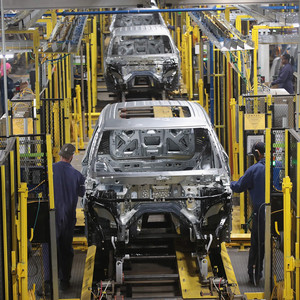
This is Planet Money from NPR.
Both Democratic and Republican politicians and presidents certainly seem to think there's something special about manufacturing.
Bringing manufacturing jobs back to the United States is one of the big motivations behind President Trump's tariffs.
And even before Trump took office, President Biden also aimed at dramatically boosting domestic manufacturing through things like the Inflation Reduction Act, the Chips and Science Act.
America is now actually building a ton of new factories.
Spending on manufacturing construction has nearly tripled in the U .S. since 2021.
The manufacturing industry is expected to need 3 .8 million additional workers by 2033.
But will people want these jobs?
Just recently, there were almost half a million unfilled manufacturing jobs.
So... Hello and welcome to Planet Money.
I'm Greg Rosalski. And I'm Sarah Gonzalez.
Some people want more made in America, but is it just because of nostalgia and political pandering, or is there a strong economic reason for this?
Today in the show, are manufacturing jobs actually good jobs?
And if so, why are there so many vacancies?
Also, is having a factory in your town particularly good for the economy?
Is it better than other industries?
Like, why are we all in on manufacturing?
This message comes from NPR sponsor, U .S. Bank.
With U .S. Bank Business Essentials, you get more than just a bank.
you get a dedicated partner that provides you a powerful combo of checking and card payment processing with quick access to the money you've earned, proving that there is nothing as powerful as the power of us.
Visit usbank .com today to learn more.
Member FDIC. Copyright 2025, US Bank.
This message comes from NPR sponsor Holiday Inn by IHG.
It's a new day for a new stay at Holiday Holiday Inn for business travelers.
With modern spaces for meeting and working, plus delicious dining from breakfast to happy hour and dinner, you have everything you need to get work done.
Give your everyday business travel an upgrade.
Book your next business trip at Holiday Inn by IHG.
Visit HolidayInn .com to book your stay.
Okay, Greg, our wonderful Planet Money Newsletter writer, you have been...
Oh, Sarah. No, you're wonderful.
We're both wonderful.
And we've both been covering manufacturing a lot recently.
But you in particular kind of wanted to figure out like what all the fuss is about when it comes to manufacturing jobs.
Yeah, Sarah. I mean, like the question that I've been kind of asking is like, why do politicians like kind of obsess on this one sector?
Why do they want to bring these jobs back?
So I asked a bunch of economists the same question.
So why don't you have the floor?
Is manufacturing special?
It is special. Let's talk about that.
First question, just big question, you have the floor.
Is manufacturing special?
Manufacturing was special and it has been less and less special with every passing year.
Is manufacturing special?
No, it's not. You know, if we're talking about importance to the economy, no, it isn't.
So, I guess I would maybe frame the question a little bit differently.
And maybe this is why there's some disagreement.
So, Greg, classic, ask a bunch of economists, get a bunch of different answers.
Tell me about it. By the way, that was Gordon Hanson, Enrico Moretti, Norbert Michael, and Susan Helper.
There is a lot of research on this, and that's what we're getting into.
Now from the yes, manufacturing is special camp, why do they think it's special?
Like what economic evidence actually supports this?
First up, a former manufacturing executive executive who really didn't want to give up on manufacturing.
I was 65 and they said it was time to retire.
And you're like, what am I going to do with my time?
I'm going to try to fight to bring back manufacturing.
Yeah. So that's Harry Moser.
He's the founder and director of the reshoring initiative.
Reshoring as in bringing manufacturing back to America's shores.
And we We asked him, why should we care about manufacturing more than, say, like any other sector?
Because, you know, there's some free market economists out there and libertarians and others who are like, we're a growing economy.
Sure, we've lost a lot of manufacturing jobs, but we've gained a lot of jobs in other areas.
That reminds me of an economist maybe 20, 30 years ago who said, computer chips, potato chips, what's the difference?
If there were jobs and there was GDP being produced, and obviously for an economy, there's a difference between having enough potato chips.
You could do without them if you had to.
Okay, basically, Harry is saying here that some industries are, yeah, more important than other industries.
You wouldn't have your job if it weren't for chips.
But I'd have a lot of potato chips.
No, you wouldn't. You couldn't afford them because you wouldn't have a job.
That's true. You're right.
Anyway, so what makes manufacturing special?
special. First, goods, manufacturing produces goods as opposed to services.
And goods are absolutely essential.
Yeah, manufacturing produces goods.
It produces things we need, like computer chips and microphones for Greg and I to do our jobs or clothes, pillows, rockets, whatever.
And, you know, having goods is good.
Now, of course, that doesn't mean these goods need to be made in the U .S., right?
They could be made somewhere else.
But people think it's important to make goods domestically for national security reasons.
For one, that's why we make tanks and vaccines in the United States and, you know, case of wars or pandemics or other national emergencies.
And some people are like, we need to make even more things in the U .S. for, you know, national security reasons.
And there's people who argue that manufacturing just like leads to more innovation, which leads to economic growth.
So they say that makes it special.
Others say it's special just based on where in the U .S. these jobs and factories tend to be, in places with not a lot of good job options.
Or they say, you know, manufacturing is special because these jobs have been historically more unionized and they've provided a good path to the middle class.
Right. But here is probably the most popular reason for the yes, manufacturing is special camp among economists.
The pay. pay. As long as we've been able to measure earnings in the sector, it's just paid workers more, especially workers without a college education.
So that's Gordon Hanson.
He's an economist at Harvard Kennedy School, who's probably one of the leading researchers on American manufacturing.
He says manufacturing pays more than a lot of other industries.
Economists call this the manufacturing premium.
And Gordon points to what he calls the gold standard of research on this from economists David Card, Jesse Rothstein, and Moises Yi.
They followed over 100 million Americans as they jumped between industries.
Basically, according to their research, if you take two statistically identical workers, like same background, same skill, same race, gender, education, everything, and you randomly plop them in different industries, here's what you would see.
Let's take someone working in in the restaurant industry, which has the lowest average earnings, so like a server, if a server were to quit their restaurant job and switch over to working in manufacturing, they would get, on average, a 35 % pay bump.
Not a bad bump. I want that.
That's a good bump.
Hello. Yeah. So pretty substantial premium.
It's higher than if that restaurant worker moved over to retail, which would be an 11 % premium.
Or if they moved into like agriculture or education or healthcare, it's even better than the pay bump from moving into finance and insurance jobs, which would be a 32 % increase.
Now, obviously people in finance tend to, you know, get paid a lot more than people in manufacturing.
But when you put aside education level and everything, there's something about manufacturing that delivers workers an extra pay bump.
So pretty special in terms of pay.
Although the manufacturing premium is lower than some other sectors.
Like, if the restaurant workers switched to working in utilities, they'd see a 49 percent premium.
Working in mining, oil and gas, that's a 62 percent premium.
So, I don't know. I'm going to say manufacturing is, like, medium special when it comes to pay.
Yeah, though we should say that jobs in manufacturing can really vary, right?
Like, so, like, garment workers, they don't get much of a pay bump, if any at all.
But if you're making cars or planes or petrochemicals, the premium is a lot higher.
And yet there are still a lot of vacant manufacturing jobs in the U .S. right now.
There were recently about 500 ,000 openings, including in the higher end, higher premium paying manufacturing jobs.
So the U .S. is having a hard time filling the existing manufacturing job openings right now.
And yet politicians are going all in trying to create more of them.
So why is that, right?
Like if it pays such a premium, why aren't Americans taking these manufacturing jobs?
Part of the story here is that there's been a pretty tight labor market, right?
A lot of industries have had a hard time filling jobs.
But it's not just that.
It may be that the pay premium just isn't high enough, right?
The obvious econ response here is raise the pay, people.
I have less than zero sympathy for employers who go around complaining about labor shortages and skills gaps.
Oren Kass is the chief economist and founder of American Compass, a conservative think tank, and he's also a vocal advocate for Trump's tariffs.
And when it comes to all of these manufacturing job vacancies, he's actually like, I don't know what to tell you, companies pay more.
I don't know if I'd mentioned, on the side, I run an incredibly innovative biotech company that employs leading scientists at $10 an hour to develop extraordinary cures.
I have 500 ,000 job openings as well, and I have not yet been able to fill one of them.
Yeah, pay workers more, and I bet you won't have so many job openings, right?
And this sounds great, but if companies have to pay more, would they still be profitable in the U .S.?
I mean, that's one of the reasons manufacturing went overseas in the first place.
I mean, to be internationally competitive, if the going rate is not enough, like if the reservation wage of Americans is so high that they're going to have to hike their wages up because there's already a pay premium, right?
But especially when it comes to the lower end stuff like apparel, I mean, like, is that just like, are we just not going to be competitive because the wage that they're going to have to pay is so high that it just makes it not doable here?
So I think there's a real confusion that people have when they start asking, how much can we afford to pay and so forth?
Because the question is about productivity level.
If somebody in the United States is 20 times as productive as somebody in China, and you have to pay them 20 times as much, you're no better or worse off as a result, that you are equally competitive in either their case.
The competitiveness problem emerges from a labor force and wages perspective when you get the opportunity in some places to pay a lower wage relative to the worker's output, which is a polite way of saying you have a problem when it's much easier to exploit workers in some places than others.
Yeah. So in the US, Oren is saying if workers are a lot more productive than workers in say, you know, China, American companies can pay higher wages and still remain competitive.
But little problem, in recent years, American manufacturing has actually seen an alarming decline in productivity growth.
So, okay, maybe these jobs are just not paying enough and that's why there are so many openings.
But also, there is a skills issue here.
Right. That's what a lot of economists and people in the industry say is actually the biggest challenge.
People People don't have the necessary skills for these jobs.
Carolyn Lee, president of the Manufacturing Institute, a nonprofit, says these jobs often require a lot of training.
Half of our jobs, our open jobs in manufacturing, the last time I checked, required a college degree.
And half of them didn't.
And I will say that every single one of them requires skills or the ability to learn and attain new skills.
Speaking to industry leaders and economists, I heard that one of the big issues in the United States is we lack a strong workforce development system.
Things like apprenticeships and certificate programs at community colleges to give people the skills they need to work in advanced manufacturing.
Recently, President Trump ordered his administration to create, quote, a plan to reach and surpass 1 million new active apprentices.
Though many other politicians have also talked a big game in this area and we haven't seen much progress.
So the pay, the skills, that is part of the story here.
But the elephant in the room here is kind of that like maybe there is a skills gap because people don't want to invest all of the time and effort to learn these skills because they don't think that these jobs will exist in the future because of automation, for example.
Manufacturing in the U .S. has been seen as dying for decades.
Carolyn and others in the industry say manufacturing in the U .S. might have a bit of a PR problem.
She says people have an outdated view of what manufacturing work actually is.
They are high paying, high quality jobs, right?
It is not, you know, manual labor necessarily.
And it is not, you know, that you're standing on an assembly line and doing the same thing for 40 years.
It's not what your job is today.
Okay, there is a wide variety of manufacturing jobs out there.
You can be the machine operator or an engineer on the R &D side of things and marketing.
Those are considered jobs in manufacturing too.
Not all manufacturing jobs are directly involved in, you know, making stuff.
In fact, just about two in five are.
But we have spoken to workers who are making things, like on the factory floor, like garment workers in L .A., for example, and they talk about the long hours, the below minimum wage pay, the monotony of the job, the toll that doing the same arm movement, for example, over and over and over for hours a day for years of your life can have on your body.
Yeah, and other factory floor workers have said things like factories can often get really hot when you're wearing protective gear and you're around a bunch of machines whirring.
They said things like shift schedules can be inflexible.
So manufacturing jobs are not always the best and most satisfying jobs for workers.
After the break, are manufacturing jobs good for the economy?
Like when a factory comes to town, how much does that make an economy grow?
Can bringing back manufacturing revitalize the heartland?
Over the last 50 years, as computers and free trade revolutionized America's economy, economy, job opportunities became more and more concentrated in America's big cities.
Big cities grew, got expensive to live in, had a bunch of college -educated people living in them, all of that.
Economists now call these economically successful metropolises superstar cities.
Meanwhile, a lot of towns across America lost their factories and saw a process that looked like the reverse of superstar cities, an unwinding, a loss of good jobs, and communities struggling.
And there's this hope among some that revitalizing the manufacturing sector could promote economic growth in those places, like in the heartland.
And the theory behind this is pretty fascinating.
Okay. When manufacturing plants went away in some of these places, they took something with them.
The whole economic ecosystems that those plants created around them.
And the theory is bringing manufacturing in particular back would be good because in order for a community or city to see a lot of growth, that city has to export something or sell something to people outside of the community.
The growth of a city is a function of the growth of its export base.
You don't have to export to the rest of the world, but you've got to export to somebody outside the city boundaries, rest of the state, rest of the country.
tree. And that's because you're not going to grow just by selling to yourself.
This kind of sector is known in economics as a tradable sector.
Tradable sectors pull in wealth from the outside.
They include manufacturing, but also agriculture, like farmers who grow, I don't know, like Brussels sprouts and sell it around the country or world.
But it can also include like colleges that educate students from outside the community or or fancy hospitals where people fly in to get surgeries, tech, finance, mining, tourism.
Non -tradable sectors would be like restaurants, gyms, barbershops that just kind of circulate wealth that already exists in a community.
You know, the way I always put it is like, we can't all just be cutting each other's hair.
Is this because I'm bald or...
I cut my own hair, okay?
You know, I'm self -sufficient.
So a popular way to think about how valuable a tradable sector is, is to calculate how many jobs each tradable sector job creates in other sectors.
Enrico Moretti, an economist at UC Berkeley, estimates that for each one job in the manufacturing sector, 1 .6 additional jobs get created in the local community outside of manufacturing.
It's called the multiplier effect.
And here is what drives the multiplier effect.
First, manufacturing plants need suppliers, right, often nearby.
That creates jobs. But also workers get paychecks and they spend their money in the community on things like going out to eat, getting haircuts, going to the gym.
And the better the manufacturing job, meaning the better the pay, the more the worker spends and the more jobs are created.
That's the multiplier effect.
So, yeah, the average manufacturing job, it creates 1 .6 extra jobs in the local community.
That's over 10 years.
By comparison, Enrico calculates that the average tech job creates five additional jobs.
So it's a much higher multiplier.
That said, high -end manufacturing jobs, like say making computers or computer parts, those can get pretty close to matching the multiplier of the tech jobs.
So can manufacturing revitalize a community?
It kind of depends.
It depends on things like what they manufacture.
manufacturer? Is it advanced or not?
That, you know, determines how much workers get paid.
And it depends on things like how many workers, you know, a plant employs.
But either way, Oren Kast specifically supports policies that would bring manufacturing in particular back to the heartland.
He says it's not the only industry that can revitalize it, but that it is probably a strong bet.
Would it be financial services?
Sure. Could it be tourism?
Sure. Manufacturing isn't the only answer.
But manufacturing is a good answer.
And there are a lot of places where manufacturing is a much more likely answer than some of the things that we've seen be successful elsewhere.
So there's a sort of spatial allocation of jobs that seems to be lurking behind what you're saying.
What makes you think that manufacturing will go to the same places that they were lost, like left behind communities?
Well, if you're thinking about where to locate manufacturing, manufacturing, you're just looking at a very different set of factors than if you're asking where to locate an investment bank.
Yeah. Oren says opening up an investment bank has just different needs than opening up a manufacturing plant.
What are the key things that you need for manufacturing?
Certainly a trained workforce is one element of it, but you also need a lot more space, right?
Good luck setting up your manufacturing in Manhattan.
You need close connection to natural resources, potentially potentially low -cost energy, logistics and transportation, infrastructure, and so forth.
And so at a minimum, the answer is going to be not the same place as you're doing media and finance and tech. Oren thinks policies that boost manufacturing could help lead to more regionally diversified economic growth.
But Gordon Hanson, who is also on Team These Jobs Are Special, says that even though manufacturing manufacturing jobs provide good paying jobs to people who are in desperate need of good paying jobs, particularly people without a college degree, he suggests that politicians may be taking the love of manufacturing a little too far.
Like maybe it's not worth starting a trade war and exploding the rest of the economy for the sake of this one sector.
I think we've developed kind of a collective fetish for manufacturing, which is really unproductive.
The problem is not too few manufacturing jobs.
The problem is too few good jobs for workers without a college education.
We should then think about how do we create more of those good jobs.
Yeah, Gordon says we need more good jobs and manufacturing jobs are good jobs.
But the reality is that going forward, manufacturing will always be like at best a small slice of the US economy.
Jobs in manufacturing have been declining around the world, in large part because of automation.
So maybe instead of obsessing on bringing manufacturing back, Gordon says we should focus on trying to replicate some of the things that made manufacturing jobs special in the first place, like trying to get more high -paying industries outside of manufacturing to lower some of the barriers for people without a college education.
If you like today's episode, you can learn more about manufacturing at the Planet Money newsletter.
This episode was actually based on a series that Greg wrote about manufacturing in America.
You can read more at npr .org slash manufacturing.
Also last week, we ran an episode about what manufacturing work in the U .S. can be like for workers.
The focus was on garment workers and how much they're paid to make each piece of clothing made in America.
you can listen to that episode right now in the Planet Money feed.
It's called Made in America.
This episode was produced by Sam Yellowhorse Kessler.
It was edited by Jess Jang and fact -checked by Sierra Juarez.
Engineering by Debbie Daughtry with help from Robert Rodriguez.
Alex Goldmark is our executive producer.
I'm Sarah Gonzalez.
And I'm Greg Wachowski.
This is NPR. Thanks for listening.
you