Hi! I'm Lindsey. And I'm Marshall.
Welcome to Tumble, the show where we explore stories of science discovery!
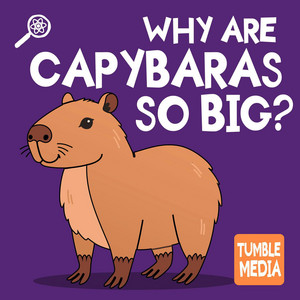
Today we're talking about capybaras and how they got to be so big.
Wait, what are capybaras?
Well, they are giant animals, and they're also huge internet superstars!
We're gonna find out how these rodents evolved to hit the big time.
Our question today comes from Tumble listener Adrian.
Hello, my name is Adrian and I'm nine years old.
My question about capybaras is what do they have to teach so big?
That's a great question from Adrian.
Why are capybaras so big?
I have to admit, I really know absolutely nothing about capybaras.
They're like big brown furry things, right?
Have I got that right?
Yes. So capybaras are rodents, just like mice and rats.
But they're huge and, like Adrienne says, they have huge teeth.
All right. Well, so are we going to learn the tooth about capybaras and their humongous chompers?
We'll get to the tooth of the matter.
But first, let's ask our listeners, Why do you think capybaras have such big teeth?
And how do you think scientists would find out?
We'll be back with a scientist who is big into studying capybaras.
So to answer Adrian's question, we called up a scientist named Santiago Herrera -Alvarez.
My name is Santiago Herrera Alvarez.
I'm a biologist. Santiago lives in Chicago but he's from Colombia, one of the countries in South America where capybaras live.
They are kind of like very iconic of the South American animals.
So you're saying capybaras are icons?
Yes, they're iconic and they're spread all across parts of South America.
The name Capybara actually comes from Guarani, an indigenous language.
But different countries have their own nicknames for Capybaras.
In Colombia, they're called Chiguidos.
– That's kinda cute.
– I had gone to some places in Colombia where you can see them, so like in the eastern part of Colombia, you can actually see herds of capyaras.
Like they live in groups of 20, 25, even sometimes 30 animals.
So when Santiago started studying to become a biologist in Columbia, the giant capybara caught his attention.
I was like, wow, this is amazing.
Right? Like how can a rodent, which are like, they are usually super small, how can there be like a species that is like so huge?
So now Santiago's wondering if everyone in the rodent family, like mice and rats and guinea pigs are all pretty tiny.
Why does their family have a cousin who's so gigantic?
Wait, how big are these rodents anyway?
Are they like, garbage truck size?
Bigger than a house, smaller than a house.
Well, they're about the size of a very big dog, but they look more like a giant guinea pig.
Oh my gosh, I kind of can't imagine a guinea pig the size of a dog.
Like a guinea pig mixed with a coconut.
Like a coconut? Like if a coconut ate a guinea pig, and then ate a dog.
What is going on? Yeah.
I would probably describe them as like a huge, cute coconut ball, basically.
A huge, cute coconut ball.
Why the coconut part?
I'm having trouble understanding that.
It's because their fur feels like the outside of a coconut.
And what's more, Capybaras are super -friendly and super -chill.
They are cool with every other animal.
They hang out with, you know, monkeys, with ducks, even with crocodiles, which is actually mind -blowing sometimes.
They must be very confident swimmers hanging out with crocodiles.
Yeah, capybaras are actually a really important part of wetland habitats in South America.
Maybe that's part of the reason why they're so beloved by other animals, and they're entertaining millions of YouTube viewers all over the world at the same time with their extreme and chillness.
Santiago told us his favorite YouTube video is of a capybara swimming.
Like, they just like move like a torpedo underwater, and I don't know, like there's something about that video that I can just like watch it, like over and over and they just look so like, you know, unboltered, just like so perfect.
Alright, do I get to see this?
Alright, let me, let me show you one of my favorites.
Okay, here we go. I'm clicking, I'm opening.
Wait, that's a capybara?
It's got a duck It's got a duck and the duck is biting him and it doesn't mind where do these things come from.
So I was like oh my god I was like falling in love with these animals.
I was like, okay you know what I really kind of like want to study them.
If there are more videos of capybaras with their duck friends I could definitely see wanting to study them.
Another reason Santiago wanted to study them is because they're part of the culture in many parts of South America.
I mean these animals are super iconic.
They're super important, but we don't know a lot about them, right?
What do you mean we don't know?
I mean clearly we know that ducks can stand on them without them getting bothered What else do we need to know?
Well, scientists didn't know the answer to a very basic question about capybaras that Santiago couldn't stop thinking about It became like super super super interesting in understanding was why are they so big?
Huh. But they're like internet famous, and no one's like asked why they're so big?
I mean, people might have asked, but no one had the answer.
And it turns out, their big teeth are just… the beginning of the story.
Wow, so capybaras are like an enigma wrapped in a mystery, wrapped in a coconut that ate a dog.
Exactly. And for some mysterious reason, they grew to be bigger than any other rodent!
Much much bigger. And with big teeth.
Big teeth, big body, big everything.
But they're not like the only giant animals on Earth, right?
I feel like elephants exist. Yeah, exactly.
Scientists know that other animals have evolved over time to be gigantic, like elephants and whales.
We know that changes in body size are very common, but we don't know how they happened.
So Santiago wants to find out how capybaras became the giants of the rodent world.
But how can he find out?
Does he need to find a talking capybara?
Not quite. We'll find out how Santiago found the answer after a quick break.
TUMBL is brought to you with support from iXL Learning.
iXL is an online learning platform that enriches your home school curriculum and enhances your kids' learning goals no matter where they go to school.
It offers practice in math, English language arts, science, and social studies while adapting to each child, meeting them exactly where they are.
Plus, iXL encourages kids to be curious and empowers them to take control of their own learning.
My son has been using iXL to keep up on topics that aren't being covered in school right now, and I really love the way that iXL's dynamic platform tracks his performance, gives him immediate feedback and corrections, and really helps him stay on top of things.
iXL lets him choose which topic to study, gives him real -time feedback, and helps him take charge.
Make an impact on your child's learning.
Get iXL now. and Tumble Science podcast for kids listeners can get an exclusive 20 % off IXL membership when they sign up today at ixl .com slash tumble visit www .ixl .com slash tumble to get the most effective learning program out there at the best price From the creators of the popular science show with millions of YouTube subscribers comes the MinuteEarth podcast. Every episode of the show dives deep into a science question you might not even know you had.
But once you hear the answer, you'll want to share it with everyone you know.
Why do rivers curve?
Why did the T -Rex have such tiny arms?
And why do so many more kids need glasses now then they used to?
Spoiler alert! it isn't screen time.
Our team of scientists digs into the research and breaks it down into a short entertaining explanation jam -packed with science facts and terrible puns.
Subscribe to MinuteEarth wherever you like to listen.
We're back. We've been learning about capybaras who are not only friends with ducks and turtles and crocodiles, but they're also giants among rodents.
And we're gonna discover just how their bodies became so big.
Obviously, they ate their vegetables, kids, if you wanna grow big and strong.
That's what you do.
They are grass -eaters, that's actually the meaning of their name, grass -eater.
Oh for real? Yes, yes, but it was more than just the grass -eating that gave the world the gift of these giant rodents.
And Santiago hoped he could find a clue by studying the capybara's DNA.
DNA, could we explain what that is real quick?
Sure. So DNA is the genetic code that's in the cells of every living thing.
It's like an instruction book that tells the cells what to do, and it's made out of four chemical compounds that scientists have named as letters.
Imagine like a huge book.
It's just like a huge, huge book written on like these four letters.
These letters make up our genetic code.
All of our DNA is basically just like combinations of these four letters, which is actually very amazing because like, you know, it's like just four letters can do crazy stuff, right?
I guess crazy stuff like super -sized rodent?
That's what Santiago was hoping to find out, and that's why he needed a sample of capybara DNA.
And he wanted to try getting it from a capybara in the wild, which proved to be a wild challenge.
Taking samples of these animals in the wild is actually very very hard. Wait.
I mean why couldn't you just make like a duck and climb on its back and just hang out they get there all day.
It seems like that would work.
Oh, they're not too into that.
They are not easy to capture.
They are super sneaky and they actually look very fast. I have to say, those YouTube videos don't really show that side to them.
That is true. So Santiago called for help.
In Colombia, like in the eastern part of Colombia, there is kind of like this, like a cowboy culture a little bit.
Wait, are you saying he called up cowboys to help him catch capybaras?
Yup, capybaras live side by side with cowboys on the grasslands or yanos of eastern Colombia, and the cowboys know how to catch capybaras.
Like in their horses, they're just like chasing these capybaras and with like a lasso, basically they're just like lassoing them, and that actually turned out to be like easiest way to to catch them.
Oh the thing scientists do for science.
Call up some cowboys.
Yes, the cowboys, or cappy boys, lassoed the capybaras, and Santiago couldn't have been happier.
I mean and once you, you, you catch them then you can just like take a sample of blood or something.
A little bit of blood, or even hair, was all that Santiago needed to get his DNA.
That seems like really far to go to just get like a little bit of DNA from a hair.
So it was actually a little bit crazy but very fun as well for sure.
Santiago also got some DNA from a capybara in his suit, which was a lot easier of a process, but then he was able to analyze it or create the DNA instruction book.
So now that he's got that capybara instruction book, how does he find how they got so big!
He can't just read their history in the DNA, right?
It's only four letters.
Well, Santiago had a really good idea, because even though scientists hadn't studied capybaras much before, they already knew a lot about the capybara's rodent cousins.
Because we know a lot about mice.
We know a lot about rats.
And so I was like, okay, we can use this information to try to, like, find out, like, how capyotas are, basically, became, became this big.
I know scientists do study mice and rats a lot because they're just always in labs being made super smart.
Exactly, and that provided Santiago with a good starting point to study their giant cousins.
Great! So he has the DNA of all these different rodents, and then what does he do?
Well, if The DNA is like an instruction book.
When you look up one gene at a time in the big genetic code, it's kind of like looking up the same chapter in three different books.
Then you can compare that book to the guinea pig book.
You can compare that to the rat book.
You can compare that to the mouse book.
And when you start comparing these books, you can say like, OK, what happens if we compare, for example, chapter 3 in all of them?
OK, I'm on the edge of my seat here.
three different cliffhangers and three different books at the same time...
Which one makes a rat?
Wanna know? So what happens when Santiago compares all these DNA samples?
Well, then he can start to spot the differences.
Like if you start reading it, there is like not a lot of changes in these letters.
But when you look, for example, in chapter three in the capoeira, you suddenly see that like that are like a lot of changes.
It's kind of like almost like a lot of typos, so to speak.
Right. Ooh, a mutation.
It's like evolution's plot twist, a mutant plot twist that makes a turtle crave pizza.
Mutations are a change in the order or sequence of DNA.
One or more of the letters in a gene or many genes gets changed randomly and that gives the body an instruction to do something different.
Like suddenly grow like really humongous?
Well, it's not quite that simple.
Becoming a giant takes many mutations working together.
And then you get giant house -sized rodents.
I call them hippo hamsters.
So is that the answer to Adrian's question of why they have such big teeth?
Well, actually not.
The teeth aren't a typo.
Capybara have big teeth because they're rodents and all rodents have big chompers.
They keep growing for the rest of their lives.
They grow, and they grow, and they always, always, always grow.
So, if their teeth are always growing, that means they need to trim them, like they need to get a tooth cut.
Pretty much. That's why rodents are always chewing on something to keep their teeth under control.
Like, if you see squirrels, they are always kind of like munching, you know, like these acorns with their teeth.
Squirrels are always munching.
But okay, so are big teeth just part of the whole big capybara package, and that's because of mutation, right?
Exactly. So Santiago found the DNA code for the capybara's hugeness mutation, and the next step was to find out what these mutations actually did, like how did they actually turn capybaras into giant rodents?
So when we were looking for some of these typos and kind of like the signatures in the capybara genome, And we found that a lot of these typos were in genes that are involved in producing more cells.
Santiago found that the capybara's cells, like the tiny building blocks that make up its body, have instructions from its DNA to create more cells.
And that's how you end up with a humongous rodent.
You're essentially just kind of like blowing up like a guinea pig to a size almost like a thousand times its size.
So that would mean like if there was another kind of human that was as big as a house.
That's literally what it would be.
Exactly. So these typos or mutations that Santiago is talking about are one of the main tools that evolution has to create diversity or different kinds of life.
And for capybaras, it's supercharged their growth.
they actually grow faster than rats and mice.
They keep producing more cells, they keep producing like this, you know, like enlarging their skeleton.
And that is kind of like what makes them like a chip, kind of like this, these huge body sizes.
Well, that's neat. So capybaras got so big because of some mutations in their DNA which told them to produce more cells all over their bodies, not because they tripped on an enchanted rock or found a genie that granted them a wish.
Kapiparas do seem almost magical on earth though and that's why Santiago wanted to learn so much about them.
You think you know everything and suddenly, I don't know like a semiaquatic gigantic coconut rodent appears and you're like oh my god.
A semiaquatic gigantic coconut rodent.
New band name. Call it.
For sure. Um, hello!
We are semiaquatic giant coconut rodent.
It's so cool that Santiago was able to learn not just from the capybara DNA, but from information that he'd gathered from the scientists before him and from their mice and their rats.
There is so much more to capybaras than just being cute and really, really chill.
Santiago has started to open up that enigmatic coconut just by asking the right questions.
It is really about being curious.
It is being more about being passionate, you know, it's like there are so many things that are out there that we still don't know.
Well now I'm curious about some things and I'm determined to find out!
I want to know how I can meet a capybara.
Ideally without leaving my house.
I think there's a video platform for you.
Alright! Now that you've heard all about the mutations in Capybara DNA, think about what kind of mutations you might design yourself.
If you were to design a mutation in an animal's DNA, what would it look like?
Would this animal's new characteristic or trait help the animal live longer or do something like find more food or build supercool and protective nests?
Would it be some kind of teleporting superpower?
Whatever your wild mutation idea is, email it to us and let us know at tumbledpodcasts gmail .com.
We would love to hear about it.
Thanks today to biologist Santiago Herrera Alverez, PhD candidate in ecology and evolution at the University of Chicago.
Hear more from our interview with Santiago on a special bonus interview episode that's available to Patreon members who pledge at the $1 level or higher at patreon .com slash tumble podcast. We'll also have more free resources to learn about capybaras and oh my gosh, yes, we'll have YouTube videos on our website at SciencePodcastForKids .com.
And if you want to tell us something, go ahead and leave us a review with the help of a parent or guardian on Apple podcasts.
We really love your feedback.
Vanessa de la Cruz -Pavas did the interview and research for this episode.
It was written by Michal Richardson.
This material is based upon work supported by the National Science Foundation under grant number 2415575 culturally situated STEM podcasts for kids.
Special thanks to our research and cultural editorial team, Dr. Remy Dou, Yasmeen Katriceo and Nori Annette.
Sarah Roberson -Lentz is our managing editor in Design the Episode Arts.
Chad Genai is our Assistant Producer.
Gary Calhoun -James is our Engineer and Mixer.
I'm Lindsay Patterson, and I'm the Executive Producer of this show.
And I'm Marshall Escamilla and I made all the music and sound design for this episode.
Tumble is a production of Tumble Media.
Thanks for listening, and stay tuned for more stories of science discovery.
Hey everybody, here we are at the end of the episode, and that means that it's time to wish some happy birthdays to all of our wonderful supporters on patreon.
I also want to give a shout out to our new patrons this week, all of whom have birthdays Charlie, Ethan, Jonna, and Maggie.
Thanks so much you guys.
Alright, here we go with the birthdays.
A happy belated birthday to new Patreon supporter Maggie on January 31!
You're a gem with love from Mama and Dada.
A very happy Valentine's Day birthday to new patron Jonna on February 14th.
Mom and dad love you and your curiosity.
To new patron Ethan, happy birthday on February 15th.
Mom, dad and Cody are so proud of the good human you are and love you more than anything.
A very special happy 11th birthday on February 15th to Emmett, who is a real special guy.
Your mom and your dad are super proud of all that you're up to and wish you all the best this year.
To Mozzie, happy birthday on February 17th.
Keep learning and being curious.
Mom and dad love you.
A happy birthday on February 23rd to Josephine the growing adventurer.
Dad, Mom and Jamie love you so much. To Mom, Dad and Alden's favorite shark scientist Claire, we love you.
And happy birthday on February 23rd. And finally to Reece.
Happy birthday little dude on February 27th.
A thanks to all of you and to everyone who supports TUMBL on Patreon.
If you want to get a birthday shout out of your own like these Find folks simply support tumble on patreon at the $5 level or higher by going to patreon .com Slash tumble podcast. Once again, that is patreon .com slash tumble podcast