This message comes from Bonterra.
Your nonprofit's mission is big, but your team is small.
With fundraising software from Bonterra's Network for Good, you can focus on changing lives.
Big impact, less stress.
Learn more at bonterratech.com slash NFG.
You're listening to Shortwave from NPR.
Hey, short wavers.
Regina Barber here.
And today I'm joined by NPR science reporter Jonathan Lambert.
Hey, John.
Hey, Gina.
OK, so you're here today to make a case for scavengers like vultures and hyenas that they're good for human health.
I mean, honestly, I believe it.
They're usually smart.
They clean up dead stuff.
Yeah, totally.
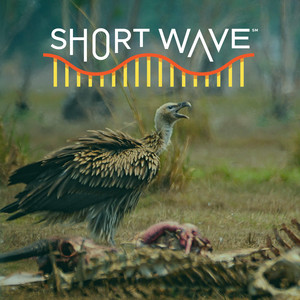
To me though, health isn't the first thing that comes to mind when I picture a vulture hunched over the rancid, rotting flesh of a dead cow, tearing strings of lifeless meat from bone until there's nothing left.
I really love this visual you're giving me.
Yeah, it's that rotting stuff laying around that's not good for us humans.
Right.
And scavengers' taste for that rotting stuff actually has major benefits for human health, which is maybe best conveyed by a little story.
Excellent.
I love stories.
Let's do this.
Okay, so we're going to India.
Way back in the early 1990s, there were some 50 million vultures across India.
But in the mid-90s, they started vanishing.
And over the course of several years, their numbers plummeted by like 95%.
95%.
That is huge.
So why was that happening? a painkiller for livestock that just happens to be toxic to vultures.
Its patent ran out in 1993, and usage spiked once cheaper generics came onto the market.
Vultures started eating dead cows to have the drug in their system, which led to a mass die-off.
Oof, that is terrible.
Okay, how did this mass die-off affect the area, though?
Well, some researchers estimate that the absence of vultures led to hundreds of thousands of additional deaths in the five years after the crash.
Wait, human deaths?
Yes, humans.
And you said hundreds of thousands.
Yeah, yeah.
It's one of the clearest examples of how scavengers are connected to human health.
But it's far from the only one.
And a new analysis suggests that many other scavengers are declining worldwide.
So today, on the show how human health is intertwined with scavenging animals, why their decline could lead to more human disease and how conservation could help.
You're listening to Shortwave, the science podcast from NPR.
America's global role is shifting fast on sources and methods.
We explain how and why.
I'm Mary Louise Kelly.
I've talked to spies.
I've reported from war zones.
I've interviewed ambassadors, generals, presidents.
Want to understand what is happening around the world and how it affects us?
Join me and my fellow reporters as we break it down for you.
Listen to sources and methods on the NPR app or wherever you get your podcasts.
Every year in the U.S., about 1,000 people die in jail, many of them awaiting trial.
This isn't a problem that someone else has to deal with.
We all are at risk for dying in jails.
In a special series, we'll look at why people are dying in jail and how to prevent it from happening on Here and Now, Anytime.
A podcast from NPR and WBUR.
You care about what's happening in the world.
Stay informed with NPR's State of the World podcast.
In just a few minutes, we take you to stories around the globe.
You might hear the latest developments in world conflicts or about what global events mean for the price of your coffee.
Listen to the State of the World podcast from NPR.
OK, John, so back to these vultures.
How exactly did their disappearance lead to hundreds of thousands of people dying?
The answer lies in the fact that vultures are really, really good at cleaning up dead bodies.
I knew it.
I knew it.
Like they can pick a cow carcass clean in under 40 minutes.
That is super fast.
Yeah, and rotting flesh is host to all sorts of bacteria, many of which can cause human diseases.
And these vultures, they're not getting sick, so what's going on there?
They're super well adapted to eating dead meat.
One fun fact, their stomach is like 10 times more acidic than ours.
This is making my acid reflux look like nothing.
Yeah, yeah.
I spoke to Anant Sudarshan, an environmental economist at the University of Warwick, who studied the fallout of this mass die-off.
Here's what he had to say.
What happens to these carcasses if vultures are not removing them?
And at least in India.
A lot of them will end up in water bodies, because that's one easy way to dispose of them.
As a result, waterborne pathogens like coliform bacteria can become a bigger problem.
Anant and his colleagues analyzed mortality data from the country and found it ticked up 4 because vultures disappeared.
That's a lot and translates to about 100,000 additional deaths a year.
I mean, it does sound like these vultures are essential for like sanitizing the environment.
Yeah.
And their absence had another crucial effect.
All that extra meat ended up becoming food for feral dogs, which spiked in number.
Oh, wow.
Here's Chinmay Sonawane, a biology grad student at Stanford.
Millions more feral dogs, millions of more people being bitten by these dogs, and it's estimated something like 50000 additional people were dying from rabies as a result of these cascading interactions.
Rabies?
I mean, that's very, very scary.
Okay, so this decline of vultures sets off these series of dominoes that like, ultimately results in more people dying.
Oof.
Yeah, and to Chinmay.
The story of these vultures really exemplifies the huge but often hidden benefits that scavengers provide.
So I'm guessing other scavengers are doing maybe the same thing?
For sure.
Chinmay told me there's been a burst of studies looking at the relationship between human health and scavengers in the past few years.
So what other scavengers have actually been studied?
So one study estimates that hyenas scarfing up cattle carcasses outside of one of the largest cities in Ethiopia prevents five cases of anthrax and bovine tuberculosis each year.
Oh, wow.
Okay, hyenas, I mean, they get a bad rap in Lion King, but maybe they're awesome.
Yeah, yeah.
Another study found that civets and other scavengers in Malaysia actually reduce the amount of diarrhea-causing bacteria that build up on flies by quickly eating carrion.
So flies have less time to multiply.
Flies are a big vector for these kinds of diseases, so reducing the bacteria load on them could lead to fewer people getting sick.
Okay, let's back up for a second.
What's a civet?
They're kind of cat-like, but also like a long-legged weasel.
Google them after this.
And turtles in Australia eating carrion was associated with improvements in water quality in wetlands.
The list really goes on and on, but there's one big problem.
Oh yeah, what's that?
Yeah, like I mentioned, many of these species are declining.
Chinmay and his colleagues published a big analysis of all this work in the journal PNAS in June, looking for broader patterns on how scavenging species influence health and also how those scavenging species are doing.
They looked at over 1300 species and found that up to 36 are declining or threatened with extinction.
Oof, that is a lot.
Why?
Yeah, it's a combination of habitat loss, hunting, and the wildlife trade.
But they found that not all scavengers were equally at risk.
The biggest, most specialized scavengers, things like vultures or hyenas, were more likely to be threatened.
Wow.
When we lose these large wildlife, smaller wildlife tend to replace them.
Okay, what kind of smaller wildlife is he talking about?
Smaller or less specialized scavengers who sometimes eat carrion but can eat other things too.
Think things like rats or mice, or in India, feral dogs.
Okay, but if those smaller scavengers are still eating carcasses, wouldn't they maybe sub in for these other scavengers?
Chinmay actually thought that going into his study, but he and his colleagues ended up finding that these smaller scavengers just aren't as good at scavenging as what they call apex scavengers.
Okay.
Apex scavengers.
This is like the great white sharks of eating dead stuff.
And these smaller ones just can't keep up.
Yeah, exactly.
Here's Chinmay again.
Therefore, there's more carcass waste, therefore more pathogens in the environment, and then therefore people are more likely to pick up disease from these sources.
Right.
I mean, that logic makes sense.
Yeah, and smaller scavengers like rats or dogs are more likely to carry pathogens themselves.
Plus, humans are a lot more likely to come into close contact with those than, say, a vulture.
So, in the end, what does this all add up to?
Chinmay says basically that a world with fewer apex scavengers is one that could make humans sicker.
Other researchers I spoke to agreed.
Here's Christopher O'Brien, a biologist at Maastricht University.
The take-home message is that we need to be always factoring in nature into the equation of human health, human suffering, human well-being in general, and we can't ignore it.
So what's being done and what can be done to help these scavengers?
Conservation, basically.
Chinmay and his colleagues argue that taking steps to conserve top scavengers by protecting their habitat or restricting their hunting could help preserve some of the benefits they provide.
But what happened to India's vultures offers a cautionary tale of sorts.
What's going on right now with those vultures?
Yeah, so the Indian government banned the use of that toxic painkiller by veterinarians in 2006.
But the vultures are still struggling to get back to anything close to their old numbers.
That is very devastating.
Yeah.
And this all just shows how dependent our collective health is on the natural world and parts of it that we often ignore.
And it shows how widening our sense of what we can do to improve health to include something as seemingly random as protecting animals that are really good at eating dead stuff could lead to a healthier planet for everyone, us included.
John, thank you for reinforcing my love for scavengers, actually.
Happy to do it.
Shortwavers, if you like our show, do us a favor and share it with one friend.
It helps us grow and sustain our show.
We appreciate you.
This episode was produced by Burley McCoy and edited by our showrunner, Rebecca Ramirez.
Tyler Jones checked the facts.
Jimmy Keeley was the audio engineer.
Beth Donovan is our senior director.
And Colin Campbell is our senior vice president of podcasting strategy.
I'm Regina Barber.
And I'm Jonathan Lambert.
Thank you for listening to Shortwave from NPR.
For world-renowned cellist Joshua Roman, long COVID caused an identity crisis.
That was probably the lowest point.
No confidence in my ability to recover.
Crisis of faith about what music meant.
On the TED Radio Hour, how he found his way back to music and a new sense of self.
Listen on the NPR app or wherever you get your podcasts.
Is the American dream a scam?
Alligator Tears, a new memoir by Edgar Gomez, tackles that question.
Who are the people who are benefiting the most from this idea that we need to keep working, that we need to keep our heads low, that we need to keep going out and risking our lives?
You can hear more about that on Code Switch from NPR, wherever you get your podcasts.