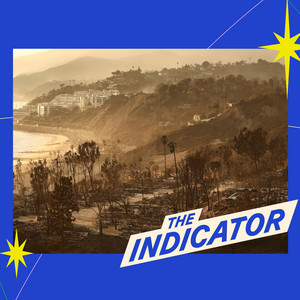
N -P -R Hmm, ummm… This is the indicator from Planet Money, I'm Wyle N' Barbie ,unching and I'm Adrian Mah.
Kail GEK has lived in California for most of his life, and that's meant living with Fire conc !
Baniy S. He says he's had to evacuate three times, although currently he lives on the Central Coast, which is far from the wildfire devastating Los Angeles.
He does wife bought a fixer -up or near Monoray in 2020.
It's a very small street.
It's one way in one way out, and that's one of the scary things as far as fire goes, but it's just like, you know, we have room for all of our animals.
We have five dogs in a mini horse.
Well, you have a mini horse?
Yeah, his name is Willow.
And he's, he's raised with dogs, so he pretty much just sleeps on the porch.
So life is pretty grand for Willow the mini horse but biodiversity, had a pretty big snag about a year after buying the house.
His home insurance company said it would no longer cover him for fires.
His insurer said one problem was too many overgrown shrubs and trees on the property, so Kael got a witness he cleared the land himself.
But then he says his whole zip code was deemed too risky.
Kael couldn't get fire coverage from any insurance company.
You don't have fire insurance in your mortgage, she'll drop you.
So we had to get on a fair plant, the fair plant.
It's a fire insurance program in California that's known as an insurer of last resort.
With traditional insurance companies quitting the state, a growing number of homeowners are turning to the Fair Plan.
And that's putting a strain on an insurance system that was already under pressure before the LA wildfires.
Today on the show, we explain how the Fair Plan works.
the role it plays in California's stressed Insurance System, and the existential problems it now faces.
After more than a year of war between Israel and Hamas, a ceasefire deal has been announced in Gaza.
State of the world brings you the latest news, as the deal is tested, and hostages are released.
Our reporters in the Middle East will provide details, context, and reaction from the region and around the world.
Listen to the state of the world podcast from NPR.
year. Joe Yomah, Boy genius, Shaka Khan, Billy Eylesch weird owl.
One thing all these big stars have in common, they've all played behind NPR's Tiny Desk and if you enter NPR's Tiny Desk contest play, enjoy and hope, and light into a space that doesn't normally have it.
Ideas about navigating uncertainty that's on the Ted radio hour podcast from NPR completely on the NPR Politics podcast Washington DC.
place where there's an old saying that person L is policy.
That's why we have created a new podcast called crumbs terms, where you can follow.
And pieres coverage of the incoming Trump administration from cabinet secretary.
Join me. Every Sunday on the up first podcasts to sit down with the biggest stories from NPR.
Home insurance is typically required for anyone with a mortgage.
So without insurance, people can't get alone to buy a home.
And insurance premiums are also price signals, a high premium signal to a homeowner that pay your insurance company thinks this is a risky area, are you sure you want to do you sure you want to live here?
But in the last few years, it's the insurance companies who who've decided an area is so risky they don't want to be there at all.
Faced with catastrophic hurricanes, floods and fires, some insurers have pulled out over thecomb of the previous episode that will link to in the show notes.
Each of those states also is something called an insurer of resort.
California's version is called the fair plan.
Fair stands for mixes to insurance requirements.
Basically, only for fire insurance, although it does cover lightening and smoke.
The state legislature created the program in 1968.
Amy Box is the co -founder and executive director of the United Policy Emi Bach is the co -founder and executive director of United Policyholders.
It's a non -profit that helps people shop for insurance and advocates for consumer -friendly regulations.
Emi explains that the Fair Plan was created by lawmakers, but it's not a government agency.
Nor does it use taxpayer money.
It's actually privately run by insurance company executives.
It's called an involuntary association.
What it means is that if you are what's called an admitted insurance company in the California which means you are fully regulated and in compliance with our laws and regulations.
You must participate in the fair plan by and like a traditional insurance company the fair plan makes money by taking in premiums and investing those funds.
Now when it comes to those premiums Amy says, fair customer is tend to pay higher costs for more limited," says.
Fair customer is tend to pay higher costs for more limited coverage compared with typical insurance A fast spokesperson told a local new station in 2022 that the average annual premium was around 3200 dollar.
Remember that is just for fire insurance.
As a consumer advocacy organization United positive we don't want to see anybody in the fair plan because the products they sell are very thin for the protection they provides and they're relatively expensive.
Fensive. And though the only thing a fair plan policy really covers is fire, the doesn't cover water doesn't protect you from lawsuits.
In California, where it's become harder to get fire insurance in the last few years, more homeowners and business services have gone on the Fair Plan.
Take Pacific Hunger Made, which has been devastated than the La Wildfire.
This is one community where state -form dropped customers last year.
In 2020, the Fair Plan has about 300 -54 that number had grown to around 1 ,400 policies.
That represents $6 billion in exposure.
Now, because the fair plan is a last resort option, it has just a single -digit slice of the California residential insurance market.
Ideally, homeowners only stay under the fair plan until they can get coverage from a traditional insurance company.
Meredith Fally is a professor at UC Berkeley who studies the economics of wild, professional at UC Berkeley, how studies the economics of wild fires.
She says there's growing concern that fair plan customers are getting stuck in the program.
The whole goal is to get people back into the larger market.
But if it's hard for people to find insurance, they're going to have to stay in the fair plan and the fair plan just wasn't designed to be a permanent solution for a large swath of the market.
Meredith also points out that the fair plan was designed decades before insurance companies and regulators were thinking about how to price climate risk.
If you think about the standard risks that insurance have been managing, like dog bites and broken pipes, they could look on their data, they could just estimate, if in the zip code We expect to pay this.
Game counters at the Home Insurance companies have decades worth of historical data that analyze for those common claims, you know, the dog bites and broken pipes that Meredith mentions.
Severe weather events are a lot more challenging to predict.
And these catastrophic threats because they're so rare, they don't have like lots and lots of experience to draw.
The fair plan rates adequate.
It is a real challenge to understand what even is an adequate.
But it is a real challenge to understand what even is and adequate premium to charge.
And then there's the matter of paying out.
Initial estimates suggest that the LA wildfires could be the co - soloist fires in US history.
This represents an unprecedented stress test for the California insurance industry.
So how will the fair -plan payout claims?
Well, the program does have reserves that can draw on.
It also has its own insurance, which is called aunt.
And if the fair plan exhausted those sources and still needs to pay out, it would turn to its members.
The private insurance companies.
These companies would have to pony up an amount that's proportional to their market sharing California.
If this projects has dropped customers, could end up indirectly paying out money to those same customers?
We reached out to the fair plan and a representative decline request for an interview.
The president of the fair plan, though, did say it adhering last use for an interview.
The President of the Fair plan, though, did say at a hearing last year that the program was one event away from asking insurance companies to kick in funds.
Amy Bach, the Insurance Consumer Advocate, she says this would be another test for the fair plan.
If that happens, I'm sure it's going to be controversial.
I'm sure there'll be a lot of negotiating on the math.
For Cow Back, our homeowner near Monterey, his annual Fair Plan Premium is around 24 home insurance costs have gone up.
Still, cow says you can live with it for now.
If you want to live where you can have five dogs in a mini horse in California, you're going to be in fire -risk.
There's no way around that.
Even before them California, you're going to be in, there's no way around that.
Even before the LA wildfires, California's insurance regulator has been trying to stabilize the market and keep companies from quitting the state.
One measure requires insurers to up their coverage in wildfire -distressed areas.
Officials have also declared a one -year moratorium on insurance cancellations for areas affected by the palisades eaten and other fires.
Those homeowners will stay covered for a year, regardless of whether they lost their homes.
This episode was produced by Corey Bridges with Engin0ing by Neil Tebelte.
It was edited by Julia Ritchie and fact checked by Sierra Juarez, kickingDE cannon surgeons editor and the indicator is the production of NPR.
For Every Headline, there's also another story about the people living those headlines.
Tie our Heelie's size 11 Matt was a medical clown!!
The whole of a medical clown is to re -introduce the sense of play and joy and hope and light into a space that doesn't normally inhabit.
Idea guard wherever you get your podcast.
Every weekday, up Girls gives you the news you need to start your day.
on the Sunday's story from up first, we slow down.
We bring you the best reporting from NPR journalists, Ernie, Maj hob carbohydrate, okay?
My book is up guys!
So I'm on the side you can't afford it.
I'm Rachel Martin, Michelle Beuthel is on the Wild Card Podcast, to show where cards control the New York times.
It's Season 20 of NPR's embedded podcast.
Wait, wait, don't tell me.
fresh air. Up first, NPR News Now, land of money Ted Radio our through line the