This is The Indicator from Planet Money.
I'm Darian Woods.
And I'm Waylon Wong.
In October, we heard some good news for beef lovers.
A White House official told Reuters that the US is going to ratchet up beef imports from Argentina.
This was after President Trump talked to reporters about possibly buying Argentine beef.
We would buy some beef from Argentina.
If we do that, that will bring our beef prices down.
This sparked a question from indicator listener Sebastian Sanchez in Massachusetts.
I grew up in Argentina and always miss Argentine beef as it is a staple of Argentine barbecue asado.
And last month I saw the White House announce a plan on quadrupling the amount of Argentine beef the US purchases.
How does the U.S. government actually do this?
I love this question because President Trump's words in October were we would buy some beef from Argentina.
So does that mean the new White House ballroom is going to have a giant freezer of these prized cuts?
Or is the government going to force butchers to order from Argentina?
Other deals have raised similar questions from our listeners.
For example, Japan and South Korea are pledging to invest in the US as part of their trade deals.
So who's actually doing the investing?
Today on the show, we've got the answers.
We visit an Argentine butcher and call up a seasoned trade negotiator to find out who spends the money.
This message comes from AT&T.
America's first network is also its fastest and most reliable.
Based on RootMetrics, United States Root Score Report 1H2025, tested with best commercially available smartphones on three national mobile networks across all available network types.
Your experiences may vary.
RootMetrics rankings are not an endorsement of AT&T.
When you compare, there's no comparison.
AT&T.
Support for NPR and the following message come from Edward Jones.
A rich life isn't always a straight line.
Unexpected turns can bring new possibilities.
With 100 years of experience navigating ups and downs, Edward Jones can help guide you.
Let's find your rich together.
Edward Jones, member SIPC.
This message comes from Capital One.
Banking with Capital One helps you keep more money in your wallet with no fees or minimums on checking accounts.
What's in your wallet?
Terms apply.
See CapitalOne.com slash bank for details.
Capital One N.A., member FDIC.
To learn about how butchers were reacting to the Argentine beef deal, we went to one in New York with a cute name.
El Gauchito.
El Gauchito.
Little Cowboy translates.
Okay, yeah, yeah, yeah.
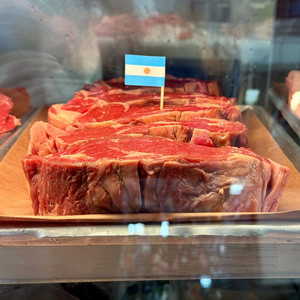
El Gauchito's manager is Marcelo Cervelli, who showed me the Argentine beef cuts, all laid out inside the counter marked with the country's sky blue flag.
The ribeye, this is the picanha.
And then we have vacio flap steak and the matambre, which is the roast beef that we usually put on the grill.
Darian, I used to live in Buenos Aires, so I ate a lot of steak.
And there was this one restaurant I'd always take visiting friends to because they would do this parlor trick, where the waiters would cut your steak in front of you with a spoon to show how tender it was.
That might be coming to the U.S. more.
Marcelo Cervelli says Argentine beef has this distinctive taste.
It's different to American beef.
But, you know, still, it's not for everybody.
Well, it is for Waylon Wong.
Part of Argentine beef's famous flavor is that a lot of the cattle is raised eating grass initially.
It's not fully 100% grass-fed.
At the end they grain feed it to make it a little bigger, because the cows are much smaller in Argentina.
Marcelo said he'd be happy to play his part in porting more Argentine beef.
Of course, if it's possible, yeah.
Why not?
But he also said he had no idea how the White House announcement would actually work.
We looked into the details and the answer is fairly simple.
Basically, the U.S. government is promising to lift a quota on Argentine beef.
There's a certain amount that's allowed in each year, and then above that is charged a 26% duty.
And by raising that quota significantly, it'll be cheaper for businesses like El Guachito to buy more beef.
So it is still private companies buying the meat.
We explained this to our listener, Sebastian.
Does that make sense?
That does make sense.
So they would purchase more because it's cheaper.
Yeah, basically no extra tariffs.
Those political lines about we're buying the beef, really just message simplification.
So that's Argentine beef coming into the U.S.
But in a country where the state actually runs more companies, like China, the answer to these types of questions might be different soybeans.
When the US hiked tariffs on China, suddenly soybean farmers found they weren't getting any Chinese purchases.
Now, in this case, it's relatively easy for the Chinese government to basically flick a switch.
State-owned companies like Sinograin and COFCO import almost all the soybeans.
And if the Chinese government wants to put pressure on the US, Xi Jinping can tell these companies to buy from Brazil rather than the US.
And if China and the US sign a deal making up, well then Beijing can tell them to buy soybeans from the US again.
Of course, this is all complicated in the real world.
There is right now a huge glut of soybeans in China.
It stockpiled tons of soybeans from South America earlier this year.
We got a related question in the indicator inbox from Claire Lecornu.
Claire wrote in about other countries pledging to spend lots of money here in the US.
My question is I keep hearing about countries that have committed to invest hundreds of billions of dollars in the US.
For example, after Trump's recent trip to China, he received commitments of investment from Japan and South Korea.
What does it mean for a foreign country to invest in the US?
What does that actually look like?
To answer this question, we spoke to Wendy Cutler.
Wendy is Senior Vice President at the Asia Society Policy Institute and has worked on her fair share of trade deals.
Those are the types of deals that cover all kinds of aspects of both countries' economies, from labor standards to copyright law.
And getting to these deals is a much deeper process than what we've seen recently, where we have these agreements that are just a few pages long.
I chatted with Wendy earlier this year about that.
Wendy says you can think of basically two main ways this investment is happening.
The first is... private companies like HD Hyundai pledging spending.
HD Hyundai has pledged to spend billions of dollars improving American shipyards.
Wendy walked us through how the South Korean government might have gotten that investment commitment.
The conversation would go along the lines of we are meeting again with the United States to negotiate a trade agreement.
The United States has made it clear that they want pledges of increased foreign direct investment in the United States.
Hyundai, can I count on you to pony up X billion dollars and announce a new plant in the United States?
Wendy says these announcements make sense for the companies, firstly because they may have been planning them anyway.
Because foreign companies accrue benefits by investing in the United States.
However, the numbers that are being pledged now to kind of placate our president, who loves big numbers and big investments,
This is, we're in a whole different dimension of foreign direct investment now.
And another motivation for these companies is that a big announcement is generally helpful for them to curry favor with President Trump.
And finally, even if the investment doesn't really make business sense well, writing a press release is not a binding contract.
I think some of the companies that are pledging, frankly, view these as pledges.
And given that actual investments in the United States take multiple years, maybe some of them are hoping that over time, either this administration will forget about their pledge or there'll be a new administration that won't really care about these pledges.
And there's a second form of investment as part of these deals.
What the Trump team is doing a bit differently is deals with countries like Japan and Korea to set up an investment fund.
So, for example, there's now a specific fund jointly overseen by US and Japanese government agencies.
Wendy says this fund works by picking projects for investment in the US and then Japan, channels both private and public money into areas like energy, semiconductors or shipbuilding.
That said, Wendy suggests looking at all these huge commitments with caution.
I think it's easy to make a pledge and it's easy to come up with big numbers, but time will tell if these investments actually materialize.
Many will, but I suspect some won't.
So in all of these trade deals, how the spending is done varies.
For things like Argentine beef, that's just changing the rules to motivate private businesses.
For deals with countries where the state is more hands-on, like China.
It might involve the government directing state-owned enterprises to buy goods like soybeans.
And for the investment pledges involving mixed economies like Japan and South Korea.
The deals are kind of this hybrid blending carrots sticks, persuasion and those press releases with the big numbers.
This message comes from NPR sponsor, Capella University.
With Capella's FlexPath learning format, you can set your own deadlines and learn on your schedule.
A different future is closer than you think with Capella University.
Learn more at capella.edu.
This message comes from Bombas.
Treat your feet right this season with merino wool, cashmere, long staple cotton, and more.
Premium materials, better basics.
Visit bombas.com slash NPR and use code NPR for 20% off your first order.
Support for NPR and the following message come from Rosetta Stone the perfect app to achieve your language learning goals, no matter how busy your schedule gets.
It's designed to maximize study time with immersive 10-minute lessons and audio practice for your commute.
Plus, tailor your learning plan for specific objectives like travel.
Get Rosetta Stone's lifetime membership for 50% off and unlimited access to 25 language courses.
Learn more at rosettastone.com slash NPR.