This message comes from Memorial Sloan Kettering Cancer Center.
With nearly 2,000 clinical trials underway, the next cancer breakthrough is just around the corner.
Make your triple-matched gift at msk.org slash holidaymatch.
Hello there, short ravers.
Emily Kwong here with a quick word before the show.
So this week is Giving Tuesday.
That is the global day of generosity that NPR celebrates every year.
But this year is different.
Because it is the first time in 50 years that NPR is operating without federal funding.
That is a huge deal and a big challenge.
But it is one that we can take on together.
At Shortwave, we bring you science coverage that is fun human, that introduces you to new ideas, amazing discoveries and everyday mysteries.
That helps you feel a little more connected to this planet and the people we share it with.
We know all of this matters to you.
And that is why some of you have already stepped up to share in the cost of bringing you shortwave each week.
Like our listener Catherine in Minnesota, who says I love shortwave and how they make science updates easy to understand and fun.
Catherine, you get us.
We get you.
Thank you so much.
And if you have also stepped up to support NPR this year, please accept our gratitude.
If you haven't, please do it now.
Mark Giving Tuesday by signing up for NPR+.
It's a simple recurring donation that gets you perks to NPR's podcasts.
Join us at plus.npr.org.
Thank you again for your support.
All right, let's get on to the show.
You're listening to Shortwave from NPR.
"'Tis the season of eating."
I'm joined by health correspondent Ping Huang.
Hey, Ping.
Hey, Emily.
We want to invite you on the show to talk about your experience with a continuous glucose monitor, a CGM.
What prompted you to start wearing one?
Yeah.
So I've been pre-diabetic for a few years now, like on and off.
And most recently, it's been mostly on.
And I saw that they got approved for overly counteruse last year.
So a few months ago, I decided to try one.
Yeah.
And I know that Prediabetes is really common in the U.S.
Around one in three adults have it, but not everybody knows they're prediabetic.
Right, yeah.
I mean.
Being prediabetic basically means clinically that a person's glucose levels are higher than people without diabetes, but not quite in the diabetic range.
You may see higher glucose. glucose rises after certain meals.
You may see bigger changes in your glucose, whether you're sedentary versus active.
So you will see more variety in the glucose levels.
This is Sarah Kim.
She's a diabetologist and professor of medicine at the University of California, San Francisco.
Yeah, and a lot of what she's saying actually matches experience that I've been having.
So my levels spike after meals, especially if they're super carb heavy or if I'm basically just sitting around for most of the day.
Which sometimes journalism is like that.
Yep.
I see you pounding away at your keyboard.
Sitting for hours.
Those glucose levels just go doot, doot, doot, doot.
How does your CGM help you manage?
So what that continuous glucose monitor is actually doing is that it's measuring the glucose levels just under your skin, in the interstitial fluid, which is basically the fluid between your cells.
And then that glucose level in that fluid is then converted to a number that shows your blood glucose.
Oh, OK.
So you're watching your numbers.
Like how and how is it reading your numbers? levels?
Yeah.
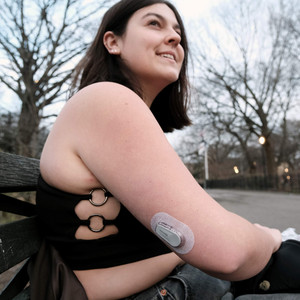
So it's like this little plastic gray circle that's embedded into the side of my upper arm with a tiny needle.
It lasts for about two weeks each time and it's connected to my phone so that I can use an app to track my levels throughout the day.
Yeah.
I mean, in addition to revealing your current blood glucose level.
Sarah told me that CGMs can also show how your blood glucose is trending.
Yeah, for sure.
I mean, you know, when I see a reading, it'll tell me that it's at a certain level and it's either rising or steady or falling.
It can tell you.
We think, based on the way that your blood glucose is trending, you might have a very high glucose in the next 30 minutes.
The decision to use a CGM is totally something you should talk to your doctor about.
But Ping, what have you learned from using yours?
Yeah, it's been really useful for me personally.
I've learned a couple things about how my body responds to, you know, carbs, for instance.
Like I'm really sensitive to carbs.
If I eat a sandwich for lunch, it's going to really spike my blood sugar.
It is also really helpful for me to take walks after meals, like just for 10 or 15 minutes.
And I can actually see the impact of that immediately on like the graph that's attached to my phone.
Wow.
And the other really critical thing that it told me was that I really just wasn't exercising enough.
And so it's prompted me to exercise more.
And I've also seen that that's made a big difference in my body's ability to, you know, deal with blood sugar.
Ping, thanks for coming on the show.
Happy eating this holiday season.
Thank you.
Short Ravers, stick around because we are going to continue riding the glucose rush.
Wave.
We'll talk to Sarah Kim about why your body needs glucose to function and what happens when there's too much or too little.
I'm Emily Kwong and you're listening to Shortwave, the science podcast from NPR.
This message comes from AT&T.
America's first network is also its fastest and most reliable.
Based on RootMetrics, United States Root Score Report 1H2025, tested with best commercially available smartphones on three national mobile networks across all available network types.
Your experiences may vary.
RootMetrics rankings are not an endorsement of AT&T.
When you compare, there's no comparison.
AT&T.
This message comes from Superhuman.
To do to done faster.
Unleash your superhuman potential today.
Learn more at superhuman.com slash podcast.
That's superhuman.com slash podcast.
This message comes from the John D and Catherine T MacArthur Foundation, recognizing extraordinarily creative individuals whose ideas, solutions and discoveries expand people's expectations of what's possible.
Macfound.org.
Okay shortwavers, to go even deeper with glucose and digestive health.
I am talking to Sarah Kim, the doctor at University of California, San Francisco, who you heard from earlier today.
And Sarah.
I just want to start with some of the basics about sugar in the body, because we ultimately need glucose to function right.
Absolutely.
Where does it come from?
So glucose comes from the food that we eat.
It comes from carbohydrates specifically and sugars.
And glucose is the specific kind of sugar that the body uses for energy currency.
So we absolutely need glucose all the time to fuel our cells.
I remember having to draw from memory the Krebs cycle in freshman biology class, and it was all about how the mitochondria convert glucose to usable energy, to ATP.
You remember many details of that.
I'm impressed.
But we get our ATP from glucose.
We can get ATP from fat and other things, but glucose is ultimately the main currency.
Okay.
Glucose is the thing we're after for energy.
So how does it get stored in our bodies?
So each cell can store some glucose and some cells can store a lot more glucose, like your muscles that need a lot of glucose because they're the ones you know moving your body.
And we store that in the form of glycogen.
And then your liver... is actually the organ that stores extra glucose to share later.
And when you are not eating, like when you're sleeping at night, the liver will give out glucose to the rest of the body, so that we have glucose all the time.
Okay.
And I know that part of what's happening with glucose uptake, like the cells sucking in that glucose, involves this hormone called insulin.
What's insulin doing?
So hormones are just chemical messengers in the body.
Insulin comes from a specific cell in the pancreas and insulin goes to throughout your body and allows cells to actually take up the glucose into the cell.
So imagine your cell is a house and it has a door.
But in order for the glucose to go into the house, it needs the key.
So you use the key to open the door.
The key is insulin.
So if you don't have insulin, that doesn't happen and there's a problem.
And we all know how frustrating it is to get locked out of the house.
You know when you're just at the door and all you need is that dang key.
Yeah, and humans, when you lock those insulin keys, it looks like diabetes.
Type 1 diabetes means the body does not produce insulin, so people take insulin medication, whereas type 2 diabetes means the body has more insulin resistance.
What is that?
Yeah, great question.
So type 2 diabetes is a little bit different.
It is a combination of insulin resistance and some insulin deficiency.
So insulin resistance means that the insulin's there, the keys are there, but you need like five keys to open the door instead of just one key, because the one key is not strong enough.
And so your body has to make extra insulin to in order to do insulin's job.
And then over time one can say that the cells that make insulin get exhausted, they start to die and are non-functional.
And so you have actually then a decline in insulin production.
So you have both a resistance to insulin and also just not enough insulin.
So I have two family members with type 2 diabetes.
And They were always talking about their blood sugar.
Like, I got to watch my blood sugar.
And when I was a child, I just thought my grandpa's blood basically was made of cookies.
But what is blood sugar?
And why is that pertinent to diabetes?
So when we say blood sugar, it's just our casual way of saying blood glucose.
Okay, so before glucose gets stored, it travels.
Through our bloodstream?
Yeah, because it's the sugar in the blood.
And blood glucose has a healthy range.
So in people without diabetes, blood glucose can range anywhere from as low as maybe 60 milligrams per deciliter of blood up to maybe about 140 after a meal.
Milligrams per deciliter of blood.
And...
Having glucose concentrations above that and below that can be problematic.
So we do want it in that healthy range.
Can you expand more on what can happen if the body spends a lot of time above and also below that?
Yeah.
So the glucose is actually not getting into the cells where they're needed.
And so instead, they're still in circulation.
They're still in the blood.
The blood is like the highway of the body.
It's trying to deliver lots of different things to all parts of your body, including glucose.
And so when that happens, actually, the blood vessels can get damaged over time.
It's like damaging the roads.
And this is essentially the root of the diabetes complications.
So we have some very vulnerable vessels in our eyes, in our kidneys, that supply the nerves, and like our feet, and those get damaged early and then you can get damage to bigger vessels, to our heart and to our brain.
So it's the vessel complications of diabetes that are what we want to prevent, and that can happen with prolonged high glucose levels.
Wow.
Okay.
And I know type 2 diabetes and type 1 have strong genetic components.
There's also lifestyle that can really change how it looks for folks.
So how does diet interact with glucose levels, considering that what we eat is where glucose comes from?
Absolutely.
So what we teach people with diabetes is that we can choose carbohydrates that are slower digesting so that whatever insulin the body is making, we can handle a slower load of glucose and rather than a big burst of glucose say, from a glass of juice.
If you have like the whole fruit, it has fiber.
It's digesting more slowly, the glucose goes into the bloodstream more slowly.
Then the body can handle that better, even if it has an impaired insulin making system.
And then always remembering to include the other macronutrients, the proteins and the good fats to balance out your diet.
And then exercise is really important, because exercise actually makes your body more sensitive to insulin.
And so when you exercise, instead of five keys needed to open the door, you may only need three.
And Sarah, what about time of day?
Does time of day impact blood sugar?
Especially when you're eating foods that are high in glucose.
Everyone tends to be more resistant to insulin in the morning hours.
And that's because of the other hormones that are circulating in the morning that are helping you to get up and get ready for the day.
Gotcha.
Okay.
So when people have diabetes, they're number one, more insulin resistant in the morning, naturally.
And then if they eat a big carbohydrate meal in the morning, It's kind of like a double whammy for the system.
And so their glucose levels may go higher than they want.
Okay.
For all of us, diabetic or not, what are your top tips for keeping blood sugar in a healthy range?
Especially heading into the holidays.
Okay.
My big message for the holidays is don't worry about the holidays.
If you really wanted to focus on your health, I would say focus on the other 350 days of the year.
And, you know, don't torture yourself during the holidays.
Just enjoy the delicious season.
Indulge in the holidays and maybe try not to indulge so much when it's not the holidays.
That should be the message.
Sarah Kim at UCSF, thank you so much for coming on Shortwave to talk about this and happy holidays.
It was so fun.
Thank you.
This episode was produced by Rachel Carlson and edited by Rebecca Ramirez.
Tyler Jones checked the facts.
Kweisi Lee was the audio engineer.
Beth Donovan is our senior vice president of podcasting.
I'm Emily Kwong.
Thank you for listening to Shortwave, the science podcast from NPR.
This message comes from BetterHelp.
The holidays are a time of traditions, like making your grandmother's pudding recipe or watching that movie you've seen a thousand times.
Incorporating therapy into your life can help you take time for yourself during what can be a joyful but sometimes tough time of year.
And by caring for yourself, you can show up more for the important moments.
This December, start a new tradition by taking care of you.
Visit BetterHelp.com slash NPR for 10% off.
This message comes from Capital One.
Banking with Capital One helps you keep more money in your wallet with no fees or minimums on checking accounts.
What's in your wallet?
Terms apply.
See CapitalOne.com slash bank for details.
Capital One N.A., member FDIC.
Public radio is as American as apple pie.
This Giving Tuesday is our first without federal funding.
We need you to keep asking. this American tradition alive.
Give now at donate.npr.org.