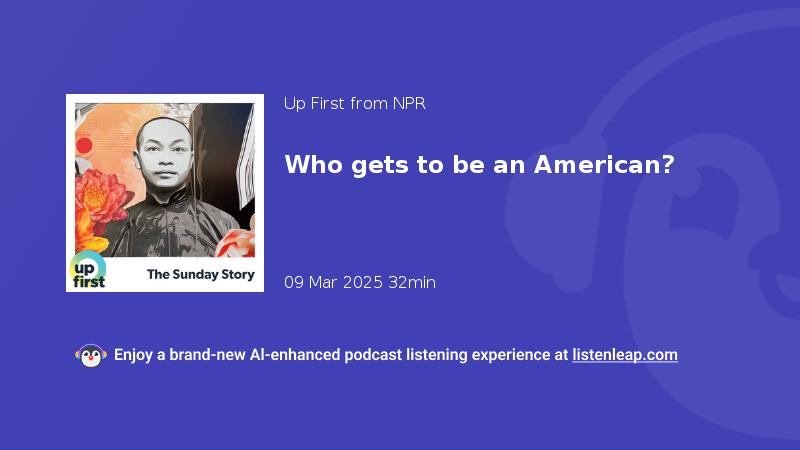
I'm Aisha Roscoe and this is A Sunday Story, where we go beyond the news of the day to bring you one big story.
So a fundamental question is being asked right now, who gets to be a U .S.
citizen. On his first day in office, President Donald Trump signed an executive order attempting to end birthright citizenship for children born in the U .S.
whose parents are in the country illegally.
Trump's action, although dramatic, wasn't exactly a surprise.
He'd been talking about doing exactly this over and over.
We are fighting hard to get birthright citizenship or automatic citizenship for the children of illegal aliens.
This is Trump at a GOP event at his Doral Golf Resort in Miami on January 27th of this year.
It was not meant for everyone to come into our country by airplane or charging across the borders from all over the world and think they're going to become citizens.
After Trump issued his order, 22 states quickly filed lawsuits.
And then federal courts temporarily blocked the order, which means that now the issue will move slowly through the legal system.
At the heart of this fight is a question that's centuries old.
Who is truly American and who gets to decide?
Recently, my colleagues at NPR's History Podcast, ThruLine, revisited the story behind the 14th Amendment and how it came to be.
The story focuses on one man, Wong Kim Ark.
He was born in 1873 in San Francisco to Chinese parents, at a time that the U .S.
was turning against Chinese immigrants.
In part one of their episode, Throughline lays out how in the 1800s, thousands of Chinese laborers immigrated to the U .S.
to work in factories and build America's railroads.
But when an economic downturn hit, politicians turned against the Chinese, claiming they were taking low -wage jobs because they were willing to work under slave -like conditions.
There were mob attacks and mass lynchings, and in 1882, Congress passed the Chinese Exclusion Act.
That prohibited Chinese laborers from entering the country.
Under these conditions, Wong Kim Ark and his parents went back to China.
But a few years later, he returned to the U .S.
to work. He'd make occasional visits back to China to see his family.
In 1895, he returned back to San Francisco after one of those visits.
But officials refused to let him leave the steamship.
The U .S. government was looking for a test case to expand the Chinese Exclusion Act, and he was it.
after the break through lines run abdel fatah and ramteen ira bluey and part two of their story the test case this message comes from npr sponsor odoo some describe odoo like a magic beanstalk because it scales with you and is magically affordable odoo exactly what a business needs sign up at odoo .com that's o -d -o -o dot com This message comes from ADT with Trusted Neighbor, the new standard in home access.
Through the ADT Plus app, grant and automate event -based or scheduled access for neighbors, friends, and helpers.
Notify trusted individuals of events and set access windows for guests without interrupting your day.
Visit ADT .com. When every second counts, count on ADT.
Requires ADT Complete Pro Monitoring Plan and Compatible Devices.
Copyright 2025, ADT, LLC.
All rights reserved.
This message comes from Attentive.
Imagine getting a message from your favorite brand tailored just for you.
Attentive, the SMS and email platform, helps marketers transform interactions into personalized experiences.
More at attentive .com slash upfirst.
You're listening to The Sunday Story.
Here are my colleagues Ramteam Arablui and Rond Abdel -Fatah from ThruLine with an excerpt from their episode on birthright citizenship.
Here's Rond. We're looking back at the story of Wong Kim Ark, a man whose legal battle shaped who gets to be an American citizen.
In August of 1895, Wong Kim Ark was sitting on a steamship, detained and watched over by guards.
He was there because, according to the government, he was not a U .S.
citizen, even though he had documentation showing he was born in San Francisco.
It must have been a lonely, bitter feeling to be just a few miles from his hometown, rejected by his own government.
But he wasn't alone.
Almost immediately, a group of people started working to get him out.
So I'm guessing they had lots of contacts and networks who were aware of who was coming in and what was happening on those steamships.
This is Amanda Frost, professor of immigration law and author of You Are Not American, Citizenship Stripping from Dred Scott to the Dreamers.
The group was known colloquially as the Chinese Six Companies.
The Chinese Six Companies, also known as the Chinese Consolidated Benevolent Association.
It was a group of representatives from all the different regions of China who were immigrants to the U .S., living in the U .S., who had made it in the United States.
They had some money, they had some resources.
And when the Chinese Exclusion Act went into effect, they mobilized.
And they said, we are going to fight back.
They frequently hired lawyers, white lawyers, to help Chinese laborers who were subject to deportation under the law.
And so the Chinese six companies hired a lawyer for Wong Kim Ark, a well -known lawyer named Thomas Reorgan, and he files a habeas petition on Wong Kim Ark's behalf.
A petition for a writ of habeas corpus was filed on behalf of Wong Kim Ark, alleging that said Wong Kim Ark is unlawfully confined and restrained of his liberty on board of the steamship Coptic and prevented from landing into the United States.
So while Wong Kim Ark sat imprisoned on the steamship, his case headed to a California district court.
The question to be determined is whether a person born within the United States whose father and mother were both persons of Chinese descent and subjects of the emperor of China, but at the time of the birth were both domiciled residents of the United States, is a citizen.
The district court was faced with a monumental decision, one that hinged on a single sentence in the 14th Amendment of the Constitution.
14th Amendment, Section 1.
All persons born or naturalized in the United States The 14th Amendment was added to the Constitution after the Civil War to achieve, quote, equal protection of the laws.
It was intended to make sure newly emancipated Black Americans had full, equal citizenship and rights.
Some of the most impactful Supreme Court cases have hinged on this amendment.
There's Plessy v. Ferguson, which upheld the constitutionality of segregation.
Brown v. Board of Education, which reversed that, even Roe v.
Wade, which guaranteed the right to abortion.
Wong Kim Ark's case focused on a specific part of the 14th Amendment, the Citizenship Clause.
All persons born or naturalized in the United States and subject to the jurisdiction thereof are citizens of the United States and of the state wherein they reside.
and of the state wherein they reside.
That phrase, jurisdiction thereof, it's key because the court had to decide what makes a person a U .S.
citizen. Do all people born on U .S.
soil fall under its jurisdiction, its laws?
Or is jurisdiction about where your loyalties lie?
Are Chinese people living in the United States really subject to U .S.
laws? or should they be considered subjects of the Emperor of China?
And then what does this legal argument mean for all immigrants across the country?
Could this same logic be applied to birthright citizens from Europe?
Given the attention that this case drew in the local press, it seems that everyone understood that this was going to be the big challenge.
Julie Novkov is the dean of Rockefeller College of Public Affairs and Policy at the University at Albany SUNY and co -author of American by Birth, Wong Kim Ark and the Battle for Citizenship.
It was going to have a broader impact than whatever was going on in San Francisco.
One of the most important Chinese cases for many years being the application of Wong Kim Ark to land as a native son.
Wong Kim Ark was still stuck on a steamer off the coast while his case played out in court.
It had been months, and he was right in the middle of a bigger battle between the U .S.
government and Chinese Americans.
The case of Wong Kim Ark promises to become historic, for the question raised is whether a Chinese born on American soil is a citizen of the United States.
So although there had been previous rulings that had touched on this issue, this one did immediately garner quite a lot of attention, even before the ruling came down.
The decision of several hundred other cases depends upon its outcome.
Finally, in the fall of 1895, the court came to a decision.
He wins. He wins. From the law as announced and the facts as stipulated, I am of the opinion that Wong Kim Ark is a citizen of the United States within the meaning of the Citizenship Clause of the 14th Amendment.
He has not forfeited his right to return to this country.
His detention, therefore, is illegal.
He should be discharged, and it is so ordered.
the experiment of blending the social habits and mutual race idiosyncrasies of the chinese laboring classes with those of the great body of the people of the united states has been proved by the experience of 20 years to be in every sense unwise impolitic and injurious to both nations.
Wang Kim Ark was technically free, but his victory was short -lived.
So the government doesn't give up, but the government immediately says, we're appealing this.
And in fact, Wang Kim Ark is only allowed off that steamship because he posted a $250 bail.
And those records are lost to history, but I'm guessing that the Chinese six companies produced that $250.
He was kept for four and a half months, and he was only released on January 3, 1896.
The government appealed the case up to the Supreme Court.
They did this because they wanted to enforce and expand the Chinese Exclusion Act.
Even the president at the time, Grover Cleveland, was in full support of excluding Chinese immigrants.
This has induced me to omit no effort to answer the earnest and popular demand for the absolute exclusion of Chinese laborers having objects and purposes unlike our own.
So the government did it.
It appealed the case all the way up to the U .S.
Supreme Court. And the Solicitor General, the lawyer who represents the government in front of the Supreme Court, was right out of central casting.
A man named Holmes Conrad.
And Holmes Conrad was tall, patrician.
He looked like exactly the kind of person that could be trusted to convey the law clearly and accurately to the justices.
His reputation at the time was that he was an excellent lawyer, an excellent representative of the U .S.
government. But if you dig a little deeper into the background of Holmes Conrad, you see some really interesting personal details.
Holmes Conrad came from a prominent slave -owning family.
He had spent the Civil War as an officer, fighting for the Confederacy.
And here's some nice irony for you.
Because he fought for secession during the Civil War, Conrad actually had his citizenship revoked.
So for at least a little period of time, a short period of time, Holmes Conrad, too, was not a citizen of the United States.
He wouldn't have been able to vote or hold office.
It's interesting to think that, at least for a brief period of time, he shared this issue with Wong Kim Ark about whether he would be considered a citizen of the United States.
Meanwhile, Wong Kim Ark, after being detained those horrible four months on ships, was back to his hardscrabble life in San Francisco.
He was earning money and sending it to his wife and kids in China.
And all the while, the government was trying to beat him in court, questioning his citizenship.
Yet behind the scenes, he's got an all -star, high -powered legal team on his side, paid for by the Chinese six companies.
They had lawyers on retainer.
Some of these lawyers were extremely well -positioned.
Some of them had had positions in the federal government.
This is political scientist Carol Nakanoff, who co -authored the book, American by Birth, Wong Kim Ark and the Battle for Citizenship.
Some of them had argued before the Supreme Court.
Some of them were working for the railroads.
And the businessmen wanted the Chinese that they had brought over to get into the country.
For this case, they hired two accomplished white lawyers.
One was Maxwell Evarts.
In a way, he wore a dual hat.
He was hired by the Chinese six companies, paid by them to represent Wong.
But the railroad, which he also worked for, clearly supported him.
Many big businesses had a keen interest in the Wong Kim Ark case.
They needed labor, cheap labor, to expand and be profitable.
So they jumped to support Wong Kim Ark's case.
The second lawyer was a man named J.
Hubley Ashton. who had worked for President Lincoln, and both men deeply believed in Lincoln and the Reconstruction era's mission of not just ending slavery, but establishing racial equality.
Evarts and Ashton had argued cases before the Supreme Court before, but...
I would have to think that they were pessimistic at this point.
The two of them were coming off a loss in a high -profile case involving a Chinese client.
Going into this case, they had every reason to doubt the outcome, an outcome that would be potentially devastating for Wong Kim -Ark and thousands like him.
He surely knew that if he lost, he would be forced to leave the United States, the country in which he'd been born and spent most of his life.
Coming up, Wong Kim -Ark heads to the Supreme Court.
Welcome back to The Sunday Story.
This message comes from HubSpot.
As a marketer, you have to generate leads, create content, and make your brand go viral.
It's a lot. Thankfully, there's Breeze, HubSpot's suite of AI tools.
Now you can turn one piece of content into all the assets you need, find the best leads, and beef up your reporting all in one place.
Visit HubSpot .com slash marketers to see how companies like yours are generating 110 % more leads in just 12 months.
Support for NPR and the following message come from Washington Wise.
Decisions made in Washington can affect your portfolio every day.
Washington Wise from Charles Schwab is an original podcast that unpacks the stories making news in Washington.
Listen at schwab .com slash WashingtonWise.
This message comes from HubSpot, where you can create content fast, get better leads, and crush reporting all in one place.
Visit HubSpot .com slash marketers to see how companies like yours are generating 110 percent more leads in just 12 months.
Team, continue their episode of NPR's ThruLine podcast.
We're looking back at Wong Kim Ark, the man who won the Supreme Court case establishing birthright citizenship, meaning if you were born in the U .S., you are automatically a citizen.
But that wasn't how it worked when Wong Kim Ark was born in San Francisco.
As a young man, he took a trip to China, and when he returned, wasn't allowed back into the United States because the government argued his ethnicity meant he wasn't a citizen.
His legal battle shaped who gets to be an American.
Part 3, Jurisdiction Thereof.
On March 5th, 1897, on a Friday afternoon, the day came.
The case of the United States for Swan Kim Ark began.
They're in the Capitol building because there was no Supreme Court building at this time.
Amanda Frost is a professor of immigration law and author of You Are Not American, citizenship stripping from Dred Scott to the Dreamers.
And they were in front of these nine black -robed men with Chief Justice Fuller in the middle, who was very short, so he was sitting on an elevated chair.
Chief Justice Melville Weston Fuller was the leader of the nine justices that made up the Supreme Court.
And let's just say they had a bit of a reputation.
The Fuller Court is known among constitutional scholars as one of the most racist iterations of the Supreme Court that has existed across the span of American history.
They're responsible for Plessy v.
Ferguson. Julie Novkov is a political scientist and co -author of the book American by Birth, Wong Kim Ark, and the Battle for Citizenship.
Many members of the court were on record as being hostile to Chinese immigrants.
The argument took place over two different days, Friday, March 5th, 1897, and Monday, March 8th, 1897.
So the United States government, represented by Holmes Conrad, swung first.
He would have argued, as he did in his brief, that the 14th Amendment, which guarantees citizenship to all born in the United States, has a caveat, or he would have said an exception, which is only those who are born in the United States and who are subject to its jurisdiction are automatically birthright citizens of the United States.
The case turned upon the meaning of the language subject to the jurisdiction thereof, jurisdiction being of two kinds, territorial and political.
And so Holmes Conrad would have grasped on to that language and said, well, Wong K.
Mark, sure, he was born in the United States.
We can't refute that.
but we do not think he was subject to the jurisdiction of the United States because his parents were loyal to the emperor of China and so was their son by sort of automatic transmission.
And so that means the son cannot automatically acquire citizenship based on birth.
That was the first piece of Conrad's argument, but then he made a bigger, bolder claim.
Also said to the Supreme Court that the 14th Amendment of the U .S.
Constitution is itself unconstitutional.
And his reason for that was he said the South was coerced into ratifying the 14th Amendment in 1868, and therefore it was never validly a part of the Constitution.
And we can see in that argument, of course, that he's trying to litigate the Civil War.
He's trying to say, the Reconstruction Amendment should not be law.
We should turn back the clock.
Conrad was making this argument in 1897 in front of the Supreme Court, over 30 years after the ink on the 14th Amendment had dried.
And in fact, the lawyers for Wong Kim Ark call him on that.
And they say in their brief, this nation spilled so much blood to fight for the end of slavery and to establish the 13th and 14th and 15th Amendments and change our nation and change our Constitution.
And you should not accept the argument that these amendments are invalid.
The government made its argument.
Then it was Wong Kim Ark's lawyers' chance to counter.
Well, in very simple terms, Wong Kim Ark's lawyers have two main claims.
One is that this principle of birthright citizenship is a longstanding principle in common law.
not just American common law, but English common law.
Their second claim is that this common law principle was adopted in the 14th Amendment.
And therefore, if you look at the history of this principle, if you look at how it has played out over time, if you look at what the 14th Amendment was attempting to do and how discussions around it unfolded, and then you look at subsequent developments in lower federal court cases and a couple of Supreme Court cases.
There's plenty of grounding there to support the idea that the descendants of Chinese born in the United States are entitled to birthright citizenship.
Millions of immigrants from Europe and around the world had moved to the U .S.
in the 19th century.
They were encouraged to come and populate the West through laws like the Homestead Act.
And their children who were born here were de facto citizens They could vote, at least the men could, start companies, and they were making up more and more of the population.
So the Supreme Court was suddenly having to address a fundamental issue.
If the sons and daughters of Chinese are not citizens, then what of the sons and daughters of the English, the Irish, the Germans, the French, other people who have come to the United States?
Carol Nakanoff co -authored the book American by Birth, Wong Kim Ark and the Battle for Citizenship.
If you are not a citizen upon being born on this soil, then none of those others are citizens either.
That principle is universal.
And if you undercut it for the descendants of Chinese, you're basically undercutting the foundations of quite a few American citizens.
So the length of time between the oral argument and the ruling was over a year.
So the case was argued March 5th and March 8th, 1897, and the final Supreme Court decision wasn't announced until March 28th, 1898.
And that was an extraordinary long period of time.
It would be extraordinary today.
It was even more so then.
If you had been looking at this case not necessarily knowing what was going to happen, only knowing what you know about the fuller court going into it, I think you could be forgiven for being a little bit uncertain about which way this one was going to go.
So you can imagine the fear that Wong Kim Ark might have been feeling as month after month went by without a decision.
And it's the sign the Supreme Court was really struggling with what to do in this case and how to decide it.
And his lawyers were probably also greatly concerned.
But they were brilliant lawyers.
And they told the Supreme Court, if you rule for the government, that the children of immigrants are not citizens, you will take away citizenship from hundreds of thousands, maybe millions of people, including lots of white people.
And the court heard that loud and clear and even noted that in its opinion.
That to deny citizenship to one group would be to deny Citizenship to thousands of persons of English, Scotch, Irish, German and other European parentage who have always been considered and treated as citizens of the United States.
It took over a year, but finally, the Supreme Court issued a ruling in the case of U .S.
v. Wong Kim Ark. On March 28th, they issued a ruling, six to two, because they were down a member, so only eight members.
And Justice Gray authors the opinion.
And he finds that Wong Kim Ark and all others similarly situated are indeed entitled to birthright citizenship.
Regardless of the immigration status of their parents, are citizens of the United States.
It is conceded that if he is a citizen of the United States, the acts of Congress known as the Chinese Exclusion Acts prohibiting persons of the Chinese race, and especially Chinese laborers from coming into the United States, do not and cannot apply to him.
The fact, therefore, that acts of Congress or treaties have not permitted Chinese persons born out of this country to become citizens by naturalization cannot exclude Chinese persons born in this country from the operation of the broad and clear words of the Constitution.
All persons born in the United States and subject to the jurisdiction thereof are citizens of the United States.
Justice Gray. The court focused on that language, said all persons.
This is intended to apply to everyone, and it's not intended to be so restrictive as to take away citizenship or bar citizenship from the children of immigrants.
And remember, the United States is a nation of immigrants.
It's not like there's just a few people who are born to non -citizen parents.
It's a significant percentage of the country every year is born to immigrant parents.
Quick note, all persons did not necessarily include Native Americans.
And that's because tribes recognized by the U .S.
government were considered sovereign nations with their own governments and court systems.
And then the court threw in at the very end, they said, and if we were to rule any other way, We would take citizenship away from lots of children of not just the quote -unquote obnoxious Chinese, which is how the court often referred to this group, but also the children of English immigrants and German immigrants and French immigrants.
The court ruled that citizenship is determined by whether or not someone is born on U .S.
soil, not by blood or race.
That, I think, also pragmatically led them to say, no, Wong Kim Ark, we're ruling for you, not so much because we're sympathetic to children of Chinese immigrants, but because we can't undo the citizenship of the children of immigrants in this country.
Wong Kim Ark, with the support of the Chinese Six Companies, had won his case.
He was recognized by the U .S.
government as a birthright citizen, a ruling that his lawyers knew would have an impact on generations to come.
And Wong Kim Ark could finally go back to his life in San Francisco.
Well, I would love to say it was a fully happy ending.
His problems were not over in part because the U .S.
government didn't fully give up.
It gave up on that formal legal argument.
But I feel in some ways they just switched the battle to other venues.
So Wong knew that if he wanted to leave the country again, he would have to prove to everyone's satisfaction, all of these white immigration inspectors, that he was the man who'd won the Supreme Court case, that he was Wong Kim Ark, that he was a citizen born in the United States.
And that if they disbelieved him, he'd be stuck all over again in the steerage hole of a steamship trying to argue he could enter his country.
And that must have made him very leery to even think about leaving the United States.
But Wang Kim Ark didn't need to leave the U .S.
to land in trouble with authorities.
He was living in El Paso, Texas just a few years later after his win, in October of 1901, living and working there, and he was arrested and charged with being a Chinese immigrant, not a native -born American, a Chinese immigrant who was illegally in the United States.
He had to post a $300 bond.
That's over $10 ,000 in today's money.
And it took months before he could convince these officials, I'm the guy who won the Supreme Court case establishing birthright citizenship.
That's who I am. I am a citizen who gets to stay.
This is the racial profiling of its time.
That story was brought to you by Ram Team Eri Bluie Rond Abdel -Fattah and the rest of my colleagues at ThruLine You can hear the full episode on NPR's ThruLine wherever you listen to podcasts We also put a link to the episode in the show notes As for Wong Kim Ark he continued to live his life between the United States and China, where he had kids and a wife.
He was even able to bring some of his kids to live in the U .S.
Though Wong Kim Ark's fight for recognition didn't make his own life much easier, it did clear a path for his own family and the descendants of millions of others, whose rights are, for now, secured by soil and not by their skin color or ethnicity.
He went to visit China one last time in 1931 when he was in his 60s.
He never returned to the U .S.
I'm Aisha Roscoe. Thanks for listening to the Sunday Story from Up First.
We'll be back tomorrow with all the news you need to start your week.
Until then, have a great rest of your weekend.
This message comes from homes .com.
The right agent can make or break your home search.
That's why homes .com provides an agent directory that details each agent's experience, so you can find the right one and, ultimately, the right home.
Homes .com. We've done your homework.
This message comes from Mint Mobile.
Mint Mobile took what's wrong with wireless and made it right.
They offer premium wireless plans for less, and all plans include high -speed data, unlimited talk and text, and nationwide coverage.
See for yourself at mintmobile .com slash switch.
This message comes from Bombas.
Nearly 30 % of marathoners end their race blistered.
Bombas running socks are strategically cushioned to help say bye to blisters.
Run to bombas .com slash NPR and use code NPR for 20 % off your first purchase.