
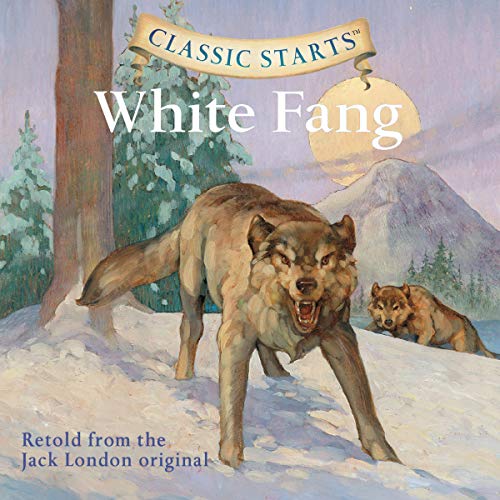
[A Journey Through the Wild: Exploring Jack London’s 'White Fang']-[White Fang - Part 01]
📋 Summary
Introduction: The Call of the Wild
Jack London’s White Fang, adapted by Kathleen Olmsted and narrated by Rebecca K Reynolds, stands as a seminal exploration of the intersection between the primal forces of nature and the civilizing influence of humanity. This classic narrative follows the life of a wolf-dog as he navigates the unforgiving environment of the Yukon Territory, ultimately transitioning from a creature of pure survival instinct to one capable of forming deep, emotional bonds with mankind.
The Law of Meat: Survival in the Frozen North
At the heart of the story is the harsh reality of the wilderness, governed by what London famously describes as the "Law of Meat." The narrative emphasizes that in the frozen North, life is a constant, brutal struggle. White Fang’s early existence is defined by the necessity of "eat or be eaten." As a cub, he learns that the world is a place of "silence" and "hunger," where the only morality is the ability to survive. The author underscores that the environment is indifferent to the suffering of its inhabitants, shaping White Fang into a creature of "cunning" and "ferocity."
The Duality of Existence: Nature versus Nurture
One of the most compelling aspects of this retelling is the psychological evolution of White Fang. He is a product of two worlds: his father, a wolf, and his mother, a dog. This hybrid nature makes him an outsider in both camps. As he encounters humans for the first time, he perceives them as "gods"—beings of immense power who control the fire and the food. However, this perception is shattered by his experiences with cruel masters, which force him to become "hardened" and "suspicious." The text highlights the pivotal role of "nurture" in shaping temperament; the abuse he suffers at the hands of Beauty Smith turns White Fang into a "fighting animal," a creature defined by his "viciousness."
Redemption and the Power of Kindness
The trajectory of the narrative takes a profound turn when White Fang meets Weedon Scott. Unlike his previous owners, Scott treats the animal with "patience" and "kindness." This interaction serves as the catalyst for White Fang’s transformation. Through this relationship, the wolf-dog experiences a shift from "instinctive hatred" to "devoted loyalty." The story posits that even the most savage creature can be tamed by love. This transition is not merely about domestication; it is about the awakening of a capacity for "love" that had been suppressed by the cruelty of his earlier life.
Conclusion: The Legacy of the Wild
Ultimately, White Fang is a meditation on the transformation of the spirit. By the end of the narrative, the "wild" remains within him, but it is tempered by a newfound sense of belonging. The story concludes that the essence of a being is not fixed; rather, it is malleable, shaped by the environment and the connections forged with others. Through the masterful storytelling of Kathleen Olmsted and the evocative narration of Rebecca K Reynolds, the listener is invited to reflect on the thin line between the beast and the human, and the redemptive power of compassion in a world often defined by its indifference.

Deep Learning with ListenLeap


