Tipping.
It's a big part of life here in the United States and it can be confusing even for people who live here.
How much should you tip?
When should you tip?
And is it 10%, 15%, or 20%?
And what happens if you don't tip at all?
Today, I'm going to explain American tipping culture in an easy and simple way.
Let's start.
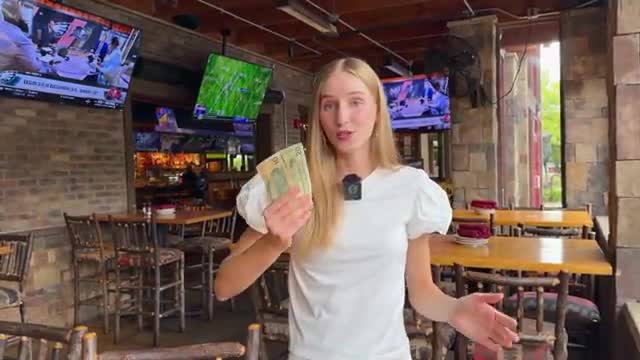
The most common place to tip is at a full-service restaurant like the one I'm in right now.
A normal tip for good service is around 15 to 25, but why is it so high?
When the server brings your bill, he or she will bring you two copies one for the restaurant or the merchant copy and one for you.
On your copy there's a line that says tip.
So my total for my food is 3495, but i do have to tip my server for her service.
So if i leave a tip the total will be a lot higher than I thought.
So you're not just paying for your meal.
I'm not only paying $34.95, I'm going to be paying 15% to 25% more because I do have to leave a tip.
Also, I do want to add that if you are with a group of six or more people at your table, some restaurants will add an automatic tip, which means that the tip is already included with your order.
So if you are with a big group of people, go ahead and check that bill and check for gratuity and it'll be 18 to 20 already added to your bill.
And why am I telling you that?
Well, one time I went out with a big group of friends and of course I didn't know.
The restaurant already had a tip included in the receipt.
So when I received the bill I put a tip amount in this section without looking at the original price, with the tip already included.
I'm telling you this to be careful and double check the receipt to make sure you don't leave a double tip.
But if the service was really good and you do wanna leave a double tip, that's totally fine.
But I do know some people don't know the rules here in America.
So make sure and double check if you are sitting with a group of six or more people.
Just ask the restaurant if the tip is already included in the check.
Why do we tip so much and where does the system come from?
Well, in many states, restaurant workers, especially servers, earn a sub-minimum wage.
That means their wage is a lot lower than the normal minimum wage.
And that's the reason why many servers and restaurant workers depend on tips, because most of their income comes from that.
The idea is that this encourages better service.
So the more attentive and more friendly your server is, the more likely you are able to tip well, which means your server will make more money.
And this is all based on a performance-based payment system.
But what happens if you don't tip well or at all?
For a server, that's just not a bad day.
It can essentially mean they worked for free or even lost money, since they often have to tip out a portion of their tips to bussers or other workers in the restaurant.
This is a high stake system for them.
But now, let's go ahead and ask my server, Evelyn, what she thinks about tipping culture in America.
This is my wonderful server, Evelyn.
She took care of me today.
So Evelyn, what do you think about tipping culture?
I think it depends on every circumstance and every restaurant.
Like here, we make a little bit more below minimum wage just because we do make bigger tips.
Tipping's not always necessary.
By any means, if you can't tip, you can't tip.
It's honestly appreciated.
But as someone who mainly works for tips, it's a little frustrating when I do get sicked or when somebody doesn't tip like according to the bill.
Have you had times where someone left like zero tips?
Yes, all the time.
It could either depend on they felt as if they didn't get as good service, or they didn't like the food.
Anything can go into it.
I've had times where I've gotten zero tips, but I've had times where I've gotten up to 300 at a time.
So since you work as a server, how do you tip in real life?
Like, do you tip at restaurants?
Do you tip at cafes?
I tip everywhere, even on DoorDash and deliveries.
I typically tip always 20%.
And then if it's really great service, I go beyond that.
And then here's your tip.
Thank you so much.
I just tipped my server in cash.
So on the receipt, I'm going to write cash tipped.
And then I will add my total, which is $34.95, but in theory, I did give her $20.
And now I will sign the receipt and I will do that to the other copy too.
Talking about tips, did you know the word tip has so many different meanings?
It really depends on if you're using tip as a verb, so an action word, or as a noun meaning a thing.
Depending on the situation.
When tip is a verb, it can mean to make something lean, fall or accidentally push it over.
For example, oops, I accidentally tipped the glass of water.
Tip can also mean to secretly give someone information.
Someone tipped the police off about the robbery, meaning they told the police secretly.
Tip can also mean to touch something very lightly or quickly.
She tipped her hat to greet someone.
Just a quick touch of the hat.
And of course, the one we all probably know.
To give a small amount of money for a service.
Did you tip the taxi driver?
Now, when tip is a noun, it also has many different meanings.
For example, the very end or top part of something.
The tip of a pen, the tip of an iceberg, or the tip of your finger.
Tip can also mean a piece of advice or a helpful suggestion.
She gave me a useful tip for baking.
As you can see, tip is an incredibly versatile word with many meanings.
This is a great example of how important context is in language.
And it's something that platforms like Busuu, our sponsor today, help you understand when you're learning a new language.
Many of my students want to move abroad, to the United States, and some feel a little overwhelmed when it comes to speaking English.
Well, speaking of helpful tips and feeling confident.
If you're learning English or any of the 14 languages offered by Busuu, you'll find tons of great support there to help you on your way.
In fact, Busuu even has a specific English course called Life in the US, and it's designed for people who want to move there, so you can learn not just the language but also the culture and everyday communication you'll need.
Busuu is an interactive language learning platform.
With Busuu, you can practice with real native speakers directly in the app, which makes your learning feel truly authentic and practical for daily conversations.
They also give you personalized study plans to help you motivated and on track with your goals.
And Busuu's AI tools provide instant feedback, so you can correct mistakes right away and improve your pronunciation.
So if you're ready to master a new language and get all the best tips for real-life conversations, I highly recommend checking them out.
You can sign up for Busuu today and enjoy a 7-day free premium trial.
Thanks to Busuu for sponsoring this part of the video.
Now let's get back to learning more about tipping culture in the US.
Tipping at a bar is a little bit different but just as important.
You'll tip every time you get a drink or you'll probably tip at the very end if you have a tab.
Here's a quick tip if you do order a drink at the bar.
Think of the tip as the price of the drink.
So, for example, if you order a cocktail that costs 10, you'll probably want to tip around 2 to 3 for that.
So instead of paying $10, the cocktail will be $13.
That's the price you'll pay.
If you're not willing to pay for a tip, that's totally fine, but you'll probably not want to go to a bar.
Instead, it's probably better to just drink at home.
But now, let's go ahead and ask the bartender what she thinks of tipping.
Hi Sierra, what is the process like to tip at a bar?
Basically, they tip either 18, 20, or 25% of however much the total is.
So here it'll show you 18, 20, and 25%.
So instead of having to do the math, it does it for you.
And you can just check mark the box and sign.
Do you basically live on tips, I guess?
Yeah.
So our hourly wage is going to be significantly less than anywhere else.
And we basically live off tips.
Have you ever been in a circumstance or position someone just drank something and then they never left a tip?
It has happened, but it's super rare.
It's not really etiquette to not tip.
And you working in the service industry, do you always tip wherever you go?
I over-tip because I'm in the industry, yes.
Perfect, thank you so much.
Yeah, you're welcome.
This one is a bit tricky.
Right now, I'm inside a coffee shop.
So unlike a full-service restaurant, there are baristas working behind the counter.
And they're usually the ones that earn a full minimum wage.
So is tipping required here?
The new way of tipping, especially with those big tablet screens, can feel like you're under a lot of pressure.
I mean, they're right in front of you, so it feels like everybody is watching.
But remember, you don't have to tip.
That being said, giving tips is a very kind gesture, especially for baristas because remember, they earn a full minimum wage.
So when you do give tips, that increases their wage and makes a big difference in their take-home pay.
So a dollar or a couple of dollars in the tip jar will make them feel appreciated.
Hi, what do you think about tipping culture in the United States?
I think tipping is a way to show appreciation to workers, but also it's a two-way street.
So if I'm giving good service, I don't expect that tip.
However, it's up to the customer to give the tip ultimately.
So do you normally tip at restaurants?
Oh, 100%.
Absolutely.
Yep.
Do people normally tip on this little iPad or do they give cash tips?
Either or, whatever's easier.
So if they have a car tip, you know, they'll do that.
Or if they have cash, they'll do that as well.
I don't expect it, you know.
But if they tip it's great, but if not whatever, you know, I'm not exciting of it.
So
And you don't expect it because you earn a full minimum wage, unlike other restaurants, for example, where they live off their tips.
I would say so, yeah.
I would say so, yeah.
In a sense.
You know I earn a good wage, so it's like I don't need that tip necessarily, but it's a way for, I guess, customers to like kind of show their appreciation, which is neat.
But again, I don't expect it as much.
Thank you so much.
Let's talk about another type of service.
Haircuts.
I'm here with a barber.
Do your clients tip you after a haircut?
Yeah, they normally do around 20% from the price of a haircut.
And have your clients never given you a tip before?
It depends on the client and where they're from.
It's more like a culture thing.
You know, something that they do here in the United States is that they tip the barber.
Where I'm from is Venezuela and South America, and we don't like have to tip the barber.
Usually they put everything on the price of the haircut, but it's something that it's from here.
So that's why you expect your clients to tip you, right?
Yeah, I do.
As you can see, tips show appreciation, and they are a big part of income for barbers and stylists.
A common tip is 20%, but it can be up to 25 to 30% if it's great service.
Tipping culture extends far beyond just restaurants and bars.
You'll find yourself tipping in many other situations.
For example, a car valet.
So you'll probably tip a few bucks once they bring you back your keys and your car.
Hotel bellboys.
Yes, the people that bring your luggage or your suitcases up to your room.
It'll probably be a few dollars per bag.
Uber or Lyft drivers.
So the people that give you a ride to a certain place, like an airport or to your hotel.
You can leave a tip easily on the app and it makes a huge difference because you are paying for their service.
DoorDash and other food deliveries.
Just like a restaurant, you are ordering a service where they bring you your food directly to your door.
So this is a great way to appreciate the people doing the service for you.
Also, for spas, massages, or beauty treatments, I would recommend to tip 15 to 25%.
And remember, always, always check the receipt because some places add gratuity automatically.
Also, here are some extra tipping tips.
Always bring cash because workers can just bring it home that same day and it doesn't get taxed.
Now for the final and most confusing part, where you don't tip.
The general rule of thumb is this.
If you're at a fast food restaurant, a self-service counter where you literally just order your food, or maybe a food court, you don't need to tip.
The person behind the counter is not a server.
They are an employee earning a minimum wage, which right now it's actually $23.
So there you have it.
Tipping in America isn't a simple transaction.
It's part of how many workers get paid.
Understanding the why is what makes it a lot easier.
Thanks for watching my video about tipping culture in the United States.
Also, what's your take on tipping?
Do you guys tip in your country?
Let me know down below.
If you guys liked this video, go ahead and give me a like and subscribe and I'll see you guys next week.
Bye!