Hi all you wonderful people listening.
This is Joy Dolo. As you no doubt know, I'm not afraid to get silly, like really silly, like keep an elephant in my closet, make a couch out of gum, collect ancient toilets.
Silly, silly, silly.
But today I've got something very unsilly to talk about.
In fact, it's quite serious.
Forever ago is a public media show and public media is threatened like never before.
That's why I'm asking you to donate, like you, you.
The you that's hearing this and thinking, is she talking to me?
Yes. You're the you, I mean.
I need you to go to forevergo .org slash donate.
Literally give any amounts, $6 .79.
$102 .03 nickels, $10 ,000 and no change, because honestly that's an amazing enough gift right there, but just give something to help us get through this difficult moment.
I know Forever Go fans are caring and I know there are a lot of you.
If you and everyone else listening chipped in just $10, we'd be all set, but we need you now.
Forevergo .org slash donate.
Again, please go to ForeverGo .org slash donate.
That way I could stop being so serious and get back to my silly side.
I've got underwater submarine sandwich shops to run, Mayonnaise Haters Club meetings to lead.
So chip in now and a very sincere thank you.
Marvin! I'm so glad we're finally putting our vision boards together!
I just love cutting out all my hopes and dreams and putting them on paper.
There's so many good pictures and quotes to choose I feel so inspired.
It's like you always say, Joy.
You can't be bored when you're making a vision board. I do always say that, plus this is perfect because I put vision boarding on my last vision board. And look, my dreams are coming true.
Hey, could you pass me the glue stick?
I just found the perfect picture to put on my board. Ooh, exciting stuff.
Here you go, Marvin.
Thanks. And done. Wanna see?
Uh, do some frogs have opposable thumbs?
Yeah! I wanna see your board!
Wait, do some frogs have opposable thumbs, like us humans?
Yes! The waxy monkey tree frog in South America has opposable thumbs.
I just learned about it in ThumbWrestlers Monthly magazine.
This frog picture has to go on my vision board STAT!
I've always wanted to thumb wrestle an amphibian.
Okay, Marvin. Let's see your vision board. Marvin Well, there's no thumb wrestling frogs on my butt.
Ta da! Ashley Oh, it's beautiful!
Is that a picture of Tokyo?
Marvin Yeah, I'm learning Japanese.
And it would be really cool to visit someday.
Ashley Totally. Marvin I also have some trees because they love being outside and somebody dropping in on a skateboard because I really want to learn.
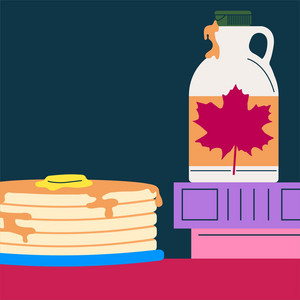
And of course, this picture of maple syrup, because maple syrup is the best. Get out.
I also have a picture of maple syrup on my vision board, see?
Right next to this photo of actor Jason Momoa and the picture of a koala, both of whom also have opposable thumbs.
Whoa, I think this is a sign, Joy.
That we should have an ultimate thumb wrestling tournament with Jason Momoa, a koala and a waxy monkey tree frog?
Uh, I was thinking we should do an episode about maple syrup.
Even better! Welcome to Forever or Go from APM Studios.
I'm Joy Dolo and I'm here today with Marvin from Grand Rapids, Minnesota.
Hi, Joy. Forever or Go is a nonprofit public radio program which means we rely on support from our listeners to keep the show going.
There are tons of ways you can support the show.
You can donate, become a Smarty Pass subscriber, or buy our merch. Head to ForeverAGO .org to show your support.
Thanks. Today we're talking all about the best breakfast topping, pancake's favorite friend, the sap that slaps.
Maple syrup. We were inspired by our vision boards and this question from Mona.
My question is, what is the origin of maple syrup?
Such a great question.
Marvin, do you like maple syrup?
Yes. What foods do you like to put maple syrup on?
Probably pancakes. What else could you put maple syrup on?
Probably whipped cream.
Oh, that's a good idea.
Whipped cream, maple syrup and just eat it with a spoon.
Which do you like better, pancakes or waffles?
Definitely pancakes.
Okay, do you like waffles?
Yes. Okay, is there just something about the squares that you don't like?
No, just pancakes are better.
So, I love pancakes and waffles but I like waffles more because I like the waffles that they have at the hotels that you put inside of that iron thing and then you smush it and it goes ssss.
And then also like the outside is like super crunchy.
And it also gives you all the different kinds of toppings.
Like you could have whipped cream and maple syrup or you can have sprinkles or you can have chocolate chips or like fruit and stuff on it.
What's your favorite topping on your pancakes?
Definitely either strawberries or blueberries.
Yeah, those are good fruits.
So before we get into the history of this delicious treat, first, let's talk about how maple syrup is made.
It all starts with sap, a liquid that's inside all trees.
If you've ever climbed a tree or looked at tree bark up close, you might have seen sap coming out of the tree.
It's usually clear, watery, and super sticky.
You can think of sap like the blood of the tree.
Just like blood helps move nutrients throughout our bodies, sap helps spread nutrients throughout trees.
all the way from their deep roots to the tips of their branches.
Sap also has a little bit of sugar in it.
All trees make sap, but not all sap can be made into sweet syrup for us to eat.
Some trees make more sugary sap than others, like birch, box elder trees, and, of course, maples.
Maple trees usually make the sweetest sap.
That's why they're the most popular for making syrup.
The best time to collect sap is in the late winter or early spring, when the temperature is above freezing during the day, but still freezing during the nighttime.
When temperatures bounce back and forth, it builds up pressure inside the tree and helps the sap flow better.
To transform your collected tree sap into syrup, you have to boil it on a stove, sort of like if you were cooking a stew.
Most of the water boils off and evaporates from the sap, leaving a thick sugary liquid, syrup!
Making maple syrup can be a complicated and sometimes long process, and you might be wondering who figured out how to do this anyway?
If you've ever had maple syrup on your pancakes or waffles, you have the native people of what's now called North America to thank.
When we say native people it might sound like we're talking about one group, but we're actually referring to a very large and diverse group of people who lived here long before European colonists arrived.
You might have also heard the terms Native Americans or Indigenous people.
Native people are part of many different tribes and tribal nations, and these groups have unique languages, cultural traditions, histories, and spiritual beliefs.
Like my family, my mom's from the Mille Lacs band of Ojibwe, and my dad's from the Lower Sioux Dakota Oyate, and there are hundreds of other tribes across the United States.
Like we mentioned, maple syrup was first made by Native people.
They've been making it for hundreds, maybe even thousands of years.
To help tell us more, we have a special syrup guest, Chandra Colvin.
Chandra is a reporter with Native News at Minnesota Public Radio and she's also a member of the Bois Forte Band of Chippewa.
Hi, Chandra. Hi, Marvin.
Hi, Joy. I'm so excited to be here.
Did you know I put being a podcast guest on my vision board for this year?
Right next to starting my own book club and trying 30 new desserts.
Wow, vision boarding is so powerful.
So Chandra, you've been doing a lot of reporting on maple syrup.
Can you tell us more about where it first came from?
Well, native people have been making maple syrup for a long time.
Maple syrup was an important source of food for native people because it provides nutrients.
It was also used for preserving meats and sweetening bitter medicines and making maple syrup is a longtime tradition that native people still do today.
We call it maple tapping or sugar bushing.
Oh, yeah sugar bushing a forest of maple trees is sometimes called a sugar bush because of their sweet sap Mmm a sugar forest. That's my favorite kind of forest. Mine, too Native people tell all different kinds of stories about the origins of maple syrup, too To learn more, I talked with my other favorite forest, Forest Hunt.
They're a descendant of the Turtle Mountain band of Chippewa Indians in North Dakota, and they shared an Ojibwe origin story of sugar bushing they learned as a kid.
The story begins with a tricky spirit named Nanaboojoo.
Nanaboojoo was walking in the forest one day when he came across a band of people that were just laying on their backs on the ground underneath these maple trees, and they had their mouths open, and they were just having the sap drip right into their mouths.
And they weren't doing anything else, they were just sitting there with the maple syrup, this pure maple syrup, sugary like what we have on pancakes just dripping directly into their mouths.
And Nanabuju saw this and he got a little bit upset.
He was like, this is not how we are supposed to live, we're supposed to work for our food and care for the land.
So Nanabuju got very frustrated with these people and tried to motivate them to be like, you need to work, you need to hunt, you need to take care of the land, that's part of what you're supposed to do is take care of the land.
So he grabbed these big buckets and I'm sure back then it was probably birch bark buckets, filled them with water from a lake nearby and dumped them directly onto the trees.
And when he did that, the thick syrup that was dripping from the maple trees, it turned watery, and it wasn't delicious anymore.
It wasn't providing the sustenance that these people needed.
And he said, so now you have to work for your food.
You have to actually tap the trees and boil down the sap, and it's gonna take a really long time.
It's a complicated process.
And so now you will work for your food rather than just lay there and be lazy.
But that's what we have today.
we have the watered down sap instead of the pure maple syrup.
So, like Forrest mentioned, the spirit, Nanna Buju wanted the people to work for their food and provide for themselves.
That's why he turned the pure maple syrup into sap.
And this is just a story, but it's true that a lot of work goes into making maple syrup.
It can be tiring, but it's also very rewarding.
Yeah, we talked a little about this earlier, how you have to collect the tree sap, and then that gets turned into maple syrup.
But, how do you get the sap out anyway?
Well, you take a special tool called a spile.
It's a metal peg with a hole, almost like a straw.
You gently tap it into the tree, and sap should start flowing out.
You'll want to use a special bag to catch all of it.
Then you wait. Usually it takes a couple of days and once you've collected the sap, you boil it either over a stove or a fire.
So cool. Marvin, I've heard you've done sugar bushing too.
Yes. So who taught you?
My mom and dad, actually.
We just have like three trees out in our yard. We tap those.
Oh that's cool. Do you have a favorite part of sugar bushing?
Umm...probably waiting for the sap to boil.
Do you guys just chat?
Yes. Is there anything challenging about doing it?
Probably bringing the heavy buckets up from the river.
Oh yeah, that sounds harsh.
How can you tell when the sap has boiled enough?
Well, it gets like really thick, that's syrup consistency, and it gets like golden brown.
Okay, so do you ever get syrup from the grocery store?
Yes. Do you have a preference of grocery store or your trees?
probably the trees does it taste different yes what's the biggest difference in the taste definitely more watery it's more watery yeah yeah yeah so it's like thinner yes cool will you take me sometime sure so like Marvin and his family lots of people do this with their families I talked with Shirley Boyd and Betty Sam all about this their elders in the attacked band of Ojibwe and they told me the word for maple syrup in Ojibwe is gee wah gummies again they did sugar bushing with their families as kids and they'd make taffy or sugar cakes with the maple syrup well they used to get give us some
a piece of it the pure standing around there watching but that's what us little kids used to wait for then you we'd her to cool off then eat it you lick it.
Yum! That sounds so good.
I know you can make sugar cones and sugar candies from maple syrup if you boil it down a lot.
Marvin, have you ever tried maple sugar candies or other kinds of maple treats?
I've actually made a lot of maple sugar candies before and they're very delicious.
And how do you maple sugar candies so you boil the sap down into syrup right?
and then you take the syrup and then you boil it down even more until it turns into like a sugar and then you can like mold it because it's all still little sticky and you can mold it into maybe like little stars circles.
I like candy so I'm won over already.
There's so many delicious things you can make with maple syrup.
You know, I I was actually able to go out and sugar bush this year.
Hold up. My 11th new dessert is ready to be picked up.
It's a banana split ice cream cake.
I got to pick it up before it melts.
Dessert duty calls.
Be right back. While we wait for Chandra to get back, Let's play First Things First. That's the game where we take three items and put them in order from oldest to most recent in history.
Today we have three sticky things, super glue, molasses, and post -its.
Marvin, do you know all these items?
Uh... not molasses.
So molasses is a super thick, dark syrup that's used in baked goods, like gingerbread.
It's super dark brown, almost black, in color.
So which do you think came first, which came second, and which came most recently in history?
I think molasses came first nice nice guess why is that?
Because it seems like you would be able to make it more easier than like with super goo and post -its that probably use more of like chemical manipulation too so molasses would be run for a lot easier for people a long time ago to make it.
Yeah I bet they're making molasses a long time ago.
So we have molasses first. Do you think super glue or Post -its came next?
Hmm, probably super glue.
Okay. All right, and then Post -its last and the reasoning behind that order?
Because Superglue is like an adhesive and also post -its use both paper and adhesive Yes Those are some great answers and stuff to back it up By the way, is that your final answer?
All right. So we have molasses, and then super glue, and then post -its.
Yes. Yes. All right.
Great guesses. We'll hear the answers at the end of the show after the credits.
So make like syrup and stick around.
We're working on an episode all about the Girl Scouts.
Girl Scouts earn badges for gaining special skills from first -aid to good sportsmanship to cooking a delectable dinner.
And we wanna know if you could give a badge to an important person in your life, what badge would you give them, and why?
For me, I would give my husband a I make yummy food badge because he makes yummy food with cheese on it.
What about you, Marvin?
Is there someone in your life who deserves a badge for something?
Probably mom, because I would give it to her for being the best mom.
The Best Mom badge.
All right, that's great.
Listeners, we wanna hear from you, too.
Record yourself describing who you would give a badge to and what it would be for, and send it to us at ForeverAGo .org slash contact.
You can also send us questions and fan art.
Yes, like your own vision board for Forever AGo, or a picture of me thumb wrestling a tree frog with one hand and a koala with the other.
I can't wait to see it.
Brainzon universe is a family of podcasts for kids and their adults.
Since you're a fan of Forever Agold, you'll love the other shows in our universe.
Come on, let's explore.
It's Alien Exercise Hour!
Hi -yah! Hoo -ha. While I stretch my snootles and bounce on my trampoliney, I'll listen to a new podcast. I'm going to try Smash Boom Best!
The best debate podcast ever!
Tell us why Alice in Wonderland has such grand command.
Drop the beat. Ladies and gentlemen.
Esteemed judge of Smash Boom Best. I'd like to start with a few rhymes.
Ah, yo. Catch me in the rabbit hole, dazzled by a magic show.
Zzzzzzzzzzzzzzzzzzzz.
Come back here, podcast. Must listen to Smash Boom Best now!
Listen to Smash Boom Best, wherever you get your podcasts.
You're listening to Forever Ago, I'm Joy.
I'm Marvin. And I'm Chandra.
I'm back and full of banana split ice cream cake.
I would give it a solid 7 out of 10, but today we're talking about a different sweet treat, maple syrup.
Before the break, we learned that native people in North America have been tapping maple trees and making syrup for hundreds, maybe thousands of years.
They call this process sugar bushing.
Sugar bushing is really important to some native people because it's a source of food sovereignty.
Wait, what's sovereignty?
Good question. Basically, sovereignty means the right that Native nations have to make decisions for themselves without outside interference.
And food sovereignty is Native people's ability to keep making and enjoying traditional foods, the foods that were here long before European settlers came to the Americas.
So those traditions don't get lost?
Exactly. Speaking of which, Chandra, you went sugar bushing not too long ago, right?
Yeah, I stopped by Porky's Sugarbush Camp.
It's not too far outside of Minneapolis, Minnesota.
They've been making maple syrup for 50 years now, and every year, they invite the community out to help make maple syrup and sugar.
That's cool! Did you get to collect sap from the trees?
By the time I got there, they'd already collected all the sap and boiled it in these big black kettles.
To make just 1 gallon of syrup, you need to boil down 40 gallons of sap.
That's about enough to fill a bathtub, so you can imagine how long that would take to boil.
Oh, wow! I had no idea it took that much sap to make a gallon of syrup.
That's amazing! I know.
I got to help out with canning the maple syrup and I had to wear these thick gloves, because it was really hot from boiling for so long.
So what was your favorite part?
I think being able to just smell the sweet scent of the sap.
They also let me taste the syrup.
To me it was more watery than the kind you get at the store and it had a smoky taste from the wood fire.
Did you learn anything new about Sugar Bushine?
I learned how much patience it takes to make Maple syrup.
You have to be patient in collecting the sap and patient when boiling it.
But it's worth the wait once you finally get to taste it.
There's nothing better than maple syrup on your waffles or pancakes.
Totally. Thanks so much for sharing all your reporting with us, Chandra.
Rockstar reporting.
I hope I get to go sugar bushing too someday.
It sounds amazing. Thanks for having me and making my Vision board dreams come true.
Now I just have to tackle my 12th dessert.
Brown sugar souffle pancakes.
Wanna get some with me?
Do some tree frogs have opposable thumbs?
Yeah, we wanna eat pancakes.
Wait. Tree frogs have opposable thumbs?
Just like Koalas and Jason Momoa.
Don't worry. We'll fill you in over pancakes.
Native people in what's now called North America have been making maple syrup for hundreds if not thousands of years.
There are many native stories about the origins of maple syrup, and it's a very important tradition for some tribes.
It starts every spring by collecting tree sap and boiling it down into syrup.
It takes a lot of time, and dedication, and patience to make the maple syrup, but it's worth it.
This episode was written by Chandra Colvin and Ruby Guthrie.
It was produced and fact checked by Nico Gonzalez -Whistler.
And edited by Shayla Farzan.
Engineering help from Josh Savajo with sound design by Rachel Bries.
Original theme music by Mark Sanchez.
We had additional production help from the rest of the Brains On Universe team.
Beth Pearlman is our executive producer and the executives in charge of APM Studios are Chandra Kavati and Joann Griffith.
Special thanks to Forest Hunt, Mille Lacs Band of Ojibwe Elders, Shirley Boyd, and Bette Sam, Travis Zimmerman, Jim Seamus, Deb White, Porky's Sugarbush Camp, and Leah Lem.
And if you want access to ad -free episodes and special bonus stuff, subscribe to our SmartyPass.
Okay. Marvin, are you ready to hear the answers for First Things First?
Yes. Yes. Okay. So as a reminder, you said that molasses was first and then super glue and then post -its.
Here we go. dr .d .d .d .d .d .d .d .d .d .d .d .d .d .d .d .d .d .d .t .t .t .t .t .t .t .t .t .d .t .t .d .d .t .t .t .t .t .t .t .t .t .t .t .t .t .t .t .t .d .d .t .d .d .d .d .t .d .d .d .d .t .t .t.
Nobody can see my face, but you got it right.
Yes, really great guessing.
So first off you're right molasses and that was traced back to 500 BC.
That goes back to India, so that means it's more than 2 ,000 years old which is the oldest right?
So molasses is made by pressing sugar cane into juice, then boiling the sugary juice down until it thickens.
In 1919 there was a great molasses flood in Boston, Massachusetts.
A giant barrel of molasses exploded and over two million gallons of molasses flooded the streets.
That sounds like quite the sticky situation.
Yeah. And then you're right again, next up it was super glue, and that was made in 1942.
So superglue was invented by accident.
During World War II, a scientist named Dr. Harry Coover was working with chemicals trying to develop a clear plastic for the military.
However, the chemicals were always too sticky, which made them impossible to work with.
He later figured out he could use those chemicals to make a sticky glue that we call super glue today.
I can't tell you how many times I've opened a super glue and had my fingers stick together.
Have you had that happen before, too?
Yes. And it's just...
Thanks so much, Dr. Harry Couver.
He made my fingers stick together.
And last, but certainly not least is Post -Its, and that was invented in 1977.
So Post -Its were released in 1977, and they originally were called Press -n -Peels.
I like that name more than Post -Its.
Press -n -Peels. It all started when a scientist named Spencer Silver invented an adhesive that could both hold paper together, but also allow the papers to be taken apart without tearing them.
Years later, one of Silver's co -workers was at church singing and wished he could bookmark his hymns without damaging the pages.
He realized Silver's adhesive would be perfect to make reusable sticky bookmarks and the Post -It was born.
I have also used a Post -It as a bookmark as well, so thank you Spencer Silver.
What do you find interesting about these facts here?
probably how the super glue was made during World War II, because I was not expecting that.
Yeah, yeah. Me neither.
I think you did really great guessing with the adhesive and the adhesive -paper combo.
Like that was really smart and that seems like that was the order it was created.
Good job, Marvin! We'll be back next week with a new episode about the Girl Scouts.
Thanks for listening.