Discussion keeps the world turning.
This is Roundtable.
Stepping into a shopping mall, school, or hospital in China, the floors shine.
The trash is nowhere to be seen.
Everything feels in order.
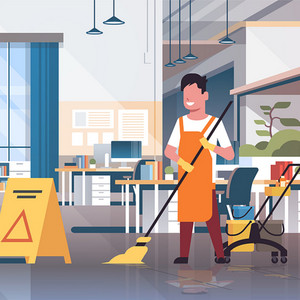
But behind that order is the cleaning staff constantly on the move, often without a proper resting area.
As cities in China grow more polished, It's time we also refine how we care for the people who keep them clean.
Coming to you live from Beijing, this is Roundtable.
I'm He Yang. For today's program I'm joined by Steve Hatherly and Yu Shun in the studio.
First on today's show!
As shoppers browse, students run a class or patients wait in the corridor.
Cleaning staff are in the background.
Sweeping, mopping, disinfecting, turning the place squeaky clean.
They move quickly, rarely stopping, because their work doesn't wait.
And yet? When it comes to taking a moment for themselves, their options are few.
No couch, no kettle, sometimes not even a chair.
We've normalized cleanliness.
But are we overlooking the people who make it possible?
Recently, this issue has caught fire online.
Online posts, news articles, and personal stories are shedding light on the lack of proper resting areas for the cleaning staff.
So where did this outcry all start?
Yeah, it actually all began when several netizens shared photos showing cleaners eating and resting in harsh environments such as just restroom corners, stel wares, and also utility rooms one widely circulated image featured the last stall in the bathroom as a title of this picture, you know in this picture and in this bathroom crammed with mops Trash bins and also the personal belongings of a cleaner and these you know Hidden corners have shed light on a troubling Reality, which is many cleaners lack their access to even the most basic rest spaces Yeah, it's really great that this has gotten
the attention that it deserves, and in response, a lot of people have taken action.
They're leaving messages on national government service platforms. They're offering suggestions to their workplaces.
They're actually even writing letters to school principals, and all are calling for one simple and necessary change, and that is a dedicated rest area for cleaning staff.
Mm -hmm. And in the public discourse in previous years we've seen a lot of discussion about the benefits and welfare of sanitary workers and usually that term refers to workers who clean and they work outdoors and this time is kind of new at least in the Chinese public sphere to talk about this when finally the attention has turned indoors to look at the cleaning staff who work so hard to keep all these places to look speck and span and there's a lot of work that goes into it and guys could you also offer us a reality check on the current situation of the treatment of cleaning staff yeah as we
discussed one thing is that the lack of decent or proper rest areas even when a rest area does exist, there might be like situations of being located far from the area that they're responsible for and that's prompting them to stay maybe near their work zone and rest in like make shift uncomfortable spaces to ensure that they can respond very quickly when they're needed.
Yeah, a lot of cleaners don't have a designated space, right?
A designated break room and then when they do have their break time or when they want to take a rest, they have to do that in places like a restroom or a stairwell.
You may have even seen this right, if you were walking up or down stairs and you'd see one of the members of the staff sitting and maybe, I've seen this myself, checking their phone or something like that and that could very well be their break time and that's where they're taking that break.
It could be a utility closet, it might even be in outdoor corridors or outside somewhere and these conditions, these spots, they're just, I think simply speaking, they're just not good enough, right?
They're just not appropriate for the staff to take a break.
Yes. And the way you portrayed it, Steve, I think I've seen a similar situation as well, and when you have eye contact with the cleaner staff, there might even be a moment when that person looks a little bit shy, almost slightly embarrassed almost like oh you caught me looking on my phone oh you caught me not doing the cleaning work and I it made me wonder if there are like proper resting hours as well this I really do not know much about but when you think about it it's natural and it should be that everybody's got your resting hours your office hours your your working hours versus you know some
time to get rest and it's perfectly okay and your rights to do so as well as you know it'd be great to have a place to sit down at least and to have a break.
Yeah I was in a stairwell in a building, and as I walked into kind of the entrance of the stairwell, there was a member of the maintenance staff sitting and looking at his phone.
And when he looked up at me he kind of jumped up like he was doing something wrong, I just patted him on the shoulder I said take a break.
Have a seat, don't mind me at all.
I'll be on my way. Yeah it feels like there's kind of a rules of their jobs like they should be like walking all day or all their work time to make sure that they are like they look like they're responsible for that area.
That's the job oftentimes it involves really long hours of standing or constant walking and just always bending over standing up squatting down picking things up moving things it's absolutely exhausting work.
One example, I guess, would be dormitory cleaners at universities.
They have to clean multiple floors of dorm rooms and bathrooms and also the public areas too and that requires them to constantly go upstairs and downstairs and upstairs and downstairs.
Another example would be shopping mall cleaners.
They're always working during the business hours so they need to clean up spills and messes that happen and they can't wait, right?
When that happens, they have to do it immediately, and then they're working 10 or 12 hours a day.
They don't have enough time to rest and to manage their heavy workloads frequently they'll cut their lunch break short to make up for the time that they need to to get back to work.
Are you describing the situation in Canada?
Well, when I looked up the situation in other countries, I was trying to find out legally what was required or what wasn't required.
I found a lot of stories related to COVID times where hospital workers were complaining about not having a space for them to take an adequate break.
Legally speaking it seems to depend where you're talking about in the world and then even sometimes within a country you might have different areas within the country, America for example, where it's state by state and they have different laws there.
And when we turn our attention back here to China, I suppose this big discussion has really zeroed in on this issue of the rest or the resting area of cleaning staff, and the question is no longer whether this is acceptable but why it's been accepted for so long.
What is behind this Yes, and that I think comes from another reason or situation of the cleaning staff, is the wages and their limited social recognition.
The wages for cleaning staff are generally low and their work is often undervalued or overlooked.
According to China Youth Daily, a whitepaper on the income status of sanitation workers Revealed that over 80 % of sanitation workers are in around 2 ,000 yuan.
That's roughly 274 US dollars per month in most two regions in China, so that kind of situation may lead to even not only the public but also These group of people too.
I don't think they have their you know the awareness of they should fight for their own rights well yeah limited bargaining power might be one of the issues it might cause them to remain silent even though they may feel that their rights to rest are being violated and maybe that's one reason why the issue has been ignored for so long i think another reason is because not always but sometimes cleaning staff are hired on a basis, and there tends to be high employee turnover within the industry, so because of those factors too, employees may feel like there's no need to - employers, excuse me, might feel
like there's no need to invest in something like a break room for their staff.
And if the staff are hired on a temporary basis, they might feel like, oh I'm only here for a short time anyway, what's the point?
Can I also bring our attention to one thing of the - or a bug in the design.
Urban building designs often prioritize commercial space over staff welfare facilities.
In high density cities that we're all familiar with in China, every square meter counts.
Design decisions tend to maximize retail, office, or consumer facing areas for benefit or aesthetics.
Spaces for cleaning staff, if planned at all, are often tucked into leftover corners, such as storage rooms, stairwells, or restroom stalls.
And this results in a lack of designated dignified spaces for staff to rest, eat, or recharge.
And it's really important that now we've all realized that this is a problem.
And could you believe that during the planning and building or the architecture building stage, this previously was just overlooked, and this is not just in China, but in many places around the world.
Yeah, and when it's not built into the design, right?
Then you end up with these kind of, oh, let's just use that space, or let's just turn that area into a rest space.
So it becomes a makeshift rest area, as opposed to a designed rest area, which means more Often than not, it's not going to be good enough.
And also, maybe sometimes it wasn't even taken under consideration that your cleaning staff shouldn't always be on their feet the whole day.
That we're all people, we need to rest a little bit.
But also, this makes me think of all the cleaning robots that are roaming the some of the floors of Chinese shopping malls and well, I guess they can be on their feet all day.
And also, you have something to say here.
Yeah, speaking of the design of something, of course, the design of these establishment is one thing and also design of maybe labor contracts is something that is limiting.
They are getting their own rights.
Rest space are not clearly defined as a labor right in some of the contracts due to maybe varying requirements across industries and job types and rest areas are not uniformly defined under labor laws as such employers are not like legally obligated to provide dining storage or just rest areas.
One example is that you know if cleaning staff are dispatched to working shopping malls through a labor outsourcing like worker contract.
You know according to a lawyer at a Jiangsu based law firm, Shidong.
He said that, although according to article 62 of the labor contract law, the employing unit in this case, the mall, is obligated to provide appropriate working conditions and labor protections that's legitimate.
If the outsourcing agreement does not like specifically mention these provisions for arrest area.
Hard to hold them accountable then.
Yeah, right. It becomes difficult to hold the employers to you know, be accountable for providing one Yeah, that's a specific example from here in China.
I found one from the United States.
This is from a long time ago It's from the LA Times from 2002 But it applies to what we're talking about today in the LA Times There was a section for questions and then legal answers legal questions and answers and this was the question I work in a hospital laboratory and I'm supposed to take my break from 2 to 2 30 a .m overnight working, right.
But the janitors have been told to lock the cafeteria from 2 to 7 a .m. because the graveyard shift has been messing it up but now I can't get access to the vending machines, I can't buy food, and I don't have a clean place to eat.
And the labs and the counters and the tables, they're contaminated with hospital -type things, so I can't eat there.
So what's the legal obligation from the company?
Can they legally lock the cafeteria?
Don't they have to provide a clean area for us to eat?
Here's the answer legally speaking.
Employers are obligated under California law to make, quote, suitable resting facilities, that means separate from restrooms, available to employees during working hours.
Employers are also required to provide a suitable place for employees to eat their meals if employees are required to eat on the premises.
But there's an important stipulation there.
if the employees are required to eat on the premises, they have to provide a space.
Which implies to me if they're not required to stay on the premises during their break, then they are not legally required to do so.
It's tricky, right?
It is tricky and kind of frustrating too.
And you guys point to the different entities involved and I guess they're all responsible.
and in China, during this big online debate or discussion, some talk about, you know, the role that, you know, the bystander or the average person could play here and I suppose this awareness is important and it made me sort of think about or it recalled my memory of a certain sociology theory that explains why the public has for way too long sort of ignored or simply have not seen the so -called invisible labor and it might have even something to do with one small thing that is the invisibility through uniforms is well -documented also so logical theory so because the janitorial staff or maintenance
staff are almost not almost always but often in a uniform that might lead to them being quote -unquote invisible to the public in a way it is uniforms are meant to identify roles, but when designed in plain, muted, or overly utilitarian ways, such as the dull colors, aprons, et cetera, they can actually strip away personality.
Or identity, right.
Yes. Yes, identity.
And this contributes to cleaning staff blending into the background of the environments they maintain.
And scholars, such as sociologist Arlie Hochschild and others have discussed how certain jobs, especially those related to care or maintenance are designed to be unseen.
Cleaning is expected to just happen, often during off hours or in ways that don't disrupt the aesthetics of a space.
Uniforms virtually or, excuse me, visually reinforce that role.
I understand what you mean now.
And I'm not saying that staff who work in this field don't deserve more attention or break rooms or appreciation.
I think they're definitely underappreciated.
That's a that's a worldwide thing.
But I get it from a business point of view.
Right? You wouldn't want to have a staff dressed up in I don't know neon pink and purple or or whatever to stand out, drawing attention from perhaps whatever products are being sold, whatever performance is happening.
So do you know what I mean?
From that side, I get why uniforms would be designed in that way.
Yes, and I suppose is this looking for an excuse for the of the public sort of to shed the responsibility off our shoulders that, you know, it's meant to be that way.
But it's also interesting that there's—this is a contrast with high status uniforms such as what a police officer would wear.
Airline staff or luxury hotel concierges, etc. But yeah, I thought it was a really interesting theory that offered me a different pair of lens to look at this.
And what public responses and actions are helping to improve the situation since there is this big uproar online of people zeroing in on this particular issue.
Yeah and I think what is fortunate is that this discussion sparked huge popularity online.
You know on Chinese social media and lifestyle platforms, xia hong shu, related topics have already garnered more than 5 million views with many users calling for proper rest areas for cleaning staff.
Students are advocating across regions for proper rest areas for cleaning staff.
Over the past two weeks universities, students in Beijing, Zhejiang, which is in Eastern China, Hunan in Southwestern China, Guangdong in southern China and other regions have actively called on their schools to provide rest areas as Steve said in the beginning like writing letters to the principals you know for cleaning staff and their efforts have inspired a growing even growing number of people across society to join the cause.
Yeah this is nationwide then.
Yeah. You mentioned areas almost all over the country which is a which is a really great thing.
Yeah this is the power of media when used properly isn't it?
People are on the sites to share the realities, the difficult realities, that cleaning staff face and this is what's gotten people talking and this is what's gotten people concerned and then this wave of attention is prompted some organizations to take the issue more seriously which is great right because when people bring it to their attention and then they recognize it and deal with it, then the situation is being taken care of.
Here's an example. There was an Edison who posted a photo of that last stall in the bathroom.
We know what we're talking about there, right?
It's usually against the wall and where the buckets and mops are held and things like that.
That person who posted that also communicated directly with the mall management.
and they created a group chat to coordinate further action and that is helping to push for better rest spaces for cleaners, how great is that?
And also in other areas some actions have also been taken.
One Netizen from Bao Tou, in Inner Mongolia Autonomous Region reported that after making such a suggestion on a local government app, she received prompt follow -up calls from hospital and cinema management in the area who confirmed that professional staff had been dispatched to evaluate and improve rest facilities, at least they're taking actions and maybe team up to make a special space right now.
And it sounds like they responded almost immediately to that.
Yeah, letters to principals, letters to university presidents, submitting proposals, urging schools to set up dedicated rest areas for cleaning staff, that's happening.
And the response from businesses and these institutions who are receiving these types of comments or letters or contact, it's paying off.
Some companies and schools they've already begun offering proper rest and meal spaces for cleaning staff.
They are equipping those spaces with tables and chairs and water dispensers and microwaves and air conditioning, and all the things that are supposed to be there for your hardworking employees.
And I think that actually created a positive cycle.
You know, more and more people are doing this, more and more people are advocating for this, and more people are realizing this kind of situation.
And that is also causing the public awareness of the needs of cleaning workers, you know through all of these advocacy media coverage and documentary style reporting more people are recognizing the importance of respecting and protecting the rights of these workers including the right to a safe clean and dignified place to rest. Yes, public awareness is important here the more people see and speak up the harder it becomes to ignore, and what do you think What will it take for real change to happen, the outlook, the reflections of the future?
There's more things to look at, I think, right?
Work injury recognition, is another thing that needs to be dealt with.
We talked about how hard these people work, and how physically dem - these jobs are physically demanding for young people.
And lots of young people do these jobs, but oftentimes older people will be doing these jobs as well, right?
And that can lead to physical injuries.
So that needs to be dealt with.
Also, just the right to rest. Cleaners need is not just a physical space, but the actual rest itself.
And that can be supported by fair work schedules and better labor conditions that prevent them from overworking themselves and exhausting themselves.
Yes. Here, here, guys, the growing public discourse about the treatment of cleaning staff marks an important step forward. However, if this shift in awareness is not enough on its own, we must continue to challenge how labor, dignity and fairness intersect to ensure that all workers are truly treated with the respect and support they deserve.