History This Week operates as its own small business.
And with that small business comes endless unpredictability.
Changes in technology, like AI.
Changing political climates, the economy.
It's a lot to worry about and sometimes feels out of our control.
But the only real way forward is to keep growing history this week.
The best way to grow is with Constant Contact.
Constant Contact's award -winning marketing platform Thanks for having me.
You're marketing your business, you're growing it, and it's all in one place.
Get a free 30 -day trial when you go to ConstantContact .com.
Try Constant Contact free for 30 days at ConstantContact .com.
ConstantContact .com.
At Designer Shoe Warehouse, we believe that shoes are an important part of, well, everything.
From first steps to first dates, from all -nighters to all -time personal bests.
From building pillow forts to building a life.
For all the big and small moments that make up your whole world, DSW is there and we've got just the shoes.
Find a shoe for every you from brands you love at brag -worthy prices at your DSW store or DSW .com.
The History Channel Original Podcast. History This Week, August 7th, 1943.
4343. I'm Alana Casanova -Burgess.
Dawn is breaking over the Caribbean Sea, and it's finally quiet.
For the last week, an intense battle has been raging here between air and sea.
A Nazi U -boat, U -615, had been stalking Allied tankers off the coast of Venezuela when it torpedoed a Dutch ship carrying crude oil.
U -boats are submarines, and the Germans are particularly good at building and deploying them, creating chaos on the high seas.
Winston Churchill called the U -boats the only thing that ever really frightened me during the war.
The attack on the Dutch ship catches the attention of Allied submarine hunters, and now they're on a relentless search to destroy U -615.
All week, the Nazi submarine has been on the defensive diving deep beneath the waves to evade its enemies but eventually its luck runs out.
The allies hit just the right spot and U -615 takes major damage.
Its motors and part of its diving mechanism are destroyed.
It's trapped in plain sight, exposed above the Caribbean waves, a sitting duck thousands of miles from home, and it's taking on water.
But these Nazi soldiers have been trained to go down swinging.
The crew takes to the deck and starts shooting, with anti -aircraft guns and a semi -automatic cannon.
Desperate, the crew of U615 manages to take down one of the Allies' planes and damage two more.
But the Allies have the advantage and attack the immobilized submarine again and again.
And now, U615 is finally sinking.
Their commander says goodbye and orders his crew to abandon ship.
They shoot up flares, and the 43 surviving members of U -615 plunge into the Caribbean's shark -infested waters.
While they pray for rescue, their U -boat slips beneath the waves for the last time.
The survivors are pulled from the water and onto an Allied ship.
They've just survived one of the longest naval battles between a German U -boat and enemy aircraft. Nine days in all.
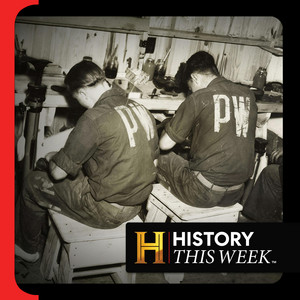
And now they're in enemy hands, on their way to the United States, where they'll join the ranks of what will total to almost 400 ,000 prisoners of war, all housed on American soil during World War II.
Today, Nazi prisoners of war come to the United States.
How did Americans make neighbors out of their most feared enemy?
And what does justice for an enemy look like in the middle of a war?
It's 1943, and the Allies have a problem.
Well, a new problem.
World War II has been raging for nearly four years, and they're starting to rack up some wins against the Nazis.
Great. But that means capturing prisoners.
And in May 1943, after the total defeat of Germany's Afrika Korps, suddenly the Allies need somewhere to put over 170 ,000 German POWs.
At this point, author William Giroux says, everyone turns to the U .S. and says, your turn.
Canada took about 36 ,000.
Britain as tiny island nation was already holding a half million of them but they didn't have the space they didn't have the food they didn't have the people to guard them but the United States had all of those things in abundance so it really was the only logical place to put them but we didn't really want them.
It's not hard to understand why.
These These soldiers take on mythic proportions in the American psyche.
In their minds, these are diehard superhuman soldiers in an evil army that has already killed tens of thousands of Americans.
They were very concerned that if we brought a large number of these guys over here, they'd have mass escapes.
They'd be raping and robbing and sabotaging their way across the country.
Taking in thousands of enemy prisoners doesn't just mean housing them and feeding them.
It also means enforcing your country's laws on them.
Once they're on American soil, they're subject to the American legal system.
It's a challenge the United States has never faced before, not at this scale.
But there's someone who really wants to try.
And that is Leon Jaworski.
Leon Jaworski grew up in Texas, the child of German -speaking immigrants.
Jaworski's Austrian -born mother died not long after his birth.
His father was a Presbyterian minister who instilled in him ambition, appreciation for a good sermon, and a deep faith in God's love and laws.
As a kid in Waco, Jaworski witnessed anti -immigrant bigotry during World War I, and he saw how members of the Ku Klux Klan used violence to skirt the law and terrorize immigrants.
All this led Jaworski towards the legal profession.
Before World War II, he was an up -and -coming, very aggressive, ambitious lawyer.
He was really good at what he did.
He was great at reading people, reading juries, reading witnesses.
He was making lots of money, getting increasingly big cases.
But he stunned everybody that knew him in 1943 by announcing that he decided to join the Army.
Because at 36 years old, Jaworski is exempt from the draft. He doesn't have to serve in the military.
Plus, he's got a wife and three children.
But Jaworski is motivated by a very specific goal.
He wanted to join particularly the JAG Corps, the Judge Advocate General's Office, the legal arm.
He wanted to be an Army prosecutor.
He said it was just that he felt like he owed the country a debt.
In the summer of 1943, just after the Africa Corps' mass surrender, Jaworski is assigned to the JAG office of the Eighth Service Command in Texas.
He believed that World War II was a clash of good and evil.
And that evil was about to arrive at his doorstep.
It's a steaming hot July day in Concordia, Kansas.
Everyone has shown up to watch the train roll in.
It's like the circus is coming to town.
They were calling out and yelling and jostling each other for a glimpse of these guys.
They were expecting these mighty, ferocious -looking characters.
This first trainload of German prisoners arrives in Kansas just two weeks after Leon Jaworski is commissioned as a JAG captain.
And there are some ferocious -looking characters.
But for the most part, the soldiers who pour off the train look kind of tired and young.
Their average age is just 22.
They got off the train, and the people in this one town in Kansas were very unimpressed with them.
They said they smelled bad, they looked bad, they were worn out, their uniforms were battered.
They even kind of felt sorry for them, these men who they had expected to be great warriors.
But once they got there, it was like, Like, this is the master race?
These forlorn, exhausted -looking guys are Hitler's great warriors?
The prisoners are also pretty stunned because all the propaganda they've been fed made them think that thanks to their mighty German Air Force, America would be this bombed -out hellscape.
And Kansas is not that.
The most ardent Nazis on board dismiss this as American trickery.
But for some of the less dogmatic soldiers, their eyes are beginning to open.
Their arrival at Camp Concordia brings even more surprises.
Where the Nazi soldiers expected to be tortured or even killed by their captors, they find comfort, especially compared to the brutal war conditions they left behind.
So they would start out, they'd have breakfast, eggs and sausage and meat and toast and juice.
and the POWs wrote home to their parents and they were saying, we haven't eaten this well in years, you know, we're getting fat.
See, the United States and Germany, for that matter, had signed on to a little treaty called the Geneva Convention back in 1929.
It requires prisoners of war to be kept under similar living conditions to a country's own soldiers, and the United States government decides to follow the Geneva Convention to the letter.
Not every country followed the Geneva Convention as closely as we did, but we thought that if we treated our captured enemy soldiers well, that the enemy would treat American prisoners well.
During the war, some 94 ,000 American POWs would be held in the European theater.
And we were very concerned about what was going to happen to these guys, you know, how they were going to be treated.
Frankly, they were also treated better than some Americans because of the color of their skin.
One of the things that you often heard from the Americans who were dealing with the Germans is that they looked like us.
Sadly, we did not feel that way about the black Americans, including black Americans who were in uniform.
And, you know, 120 ,000 Japanese Americans uprooted from their homes on the West Coast and interned in these dusty, horrific camps.
Not nearly as nice as the German POW camps.
camps. So America's new Nazi prisoners are treated well, maybe too well?
A reporter went to a camp and was astonished to see a full -fledged production of the play Faust with a lighting system and a chorus.
It was too much really for some Americans, particularly those who had loved ones fighting the Nazis in Europe.
They just thought this was ridiculous.
They said we were basically coddling these prisoners.
And their cynical nickname for the camp system was the Fritz Ritz.
But there's another reason, beyond just the Geneva Convention, for having well -kept prisoners of war scattered across almost every state.
The treaty allows for captured soldiers to be put to work.
And by 1943, America is dealing with a major labor shortage, with many of its workers occupied with the war effort.
They were desperately needed, and they worked hard. They were, by and large, pretty cooperative.
They were in good shape.
They could get a lot done.
Even the ones that were skeptical at first, many of them came around as the Germans were, not all of them were pleasant, but many of them were.
They were glad to be out of the war.
And as the millions of Americans living around these camps begin to work alongside Nazi prisoners, they're getting more than just labor.
they're continuing to poke holes in nazi lies about the enemy they spent the whole day with them working side by side with them whether it was on the farm or picking cotton or working in a factory a lot of the germans were impressed most of them had grown up just buffeted by lies and propaganda they were taught to believe that americans had horns and forked tails and they they get over here.
The farm wives, after a day's work, are insisting that the POWs, along with the guards, join the family around the dinner table at night, you know, eating fried chicken and mashed potatoes, and they're introducing them to their kids.
So the Germans, not the hardcore Nazis, but many of the Germans were really affected by this.
They said Americans are free to think what they want, free to say what they want, to rear their children the way they want.
And this was something that a lot of the Germans had never experienced under Hitler.
These seeds of doubt about the Third Reich don't sit well with the true believers in the POW camps.
The population of Camp Concordia, like the Nazi army itself, contains a complicated mix of ideologies.
A mix that the Americans overseeing these POW camps don't seem to understand.
Some prisoners are fanatical Nazis.
Others are just reluctant conscripts.
Many who who were forced to serve after the Nazis conquered their home countries.
It doesn't occur to the Americans, many of whom don't even speak German, to segregate diehard Nazis from the less enthusiastic Nazis.
And so, as they build more than 500 of these comfortable camps for 400 ,000 prisoners of war across the US, what they're actually building are time bombs, ready to blow.
A cancer diagnosis changes everything.
At Kansas City Proton Institute, we combine expert physicians with advanced proton therapy technology.
Our cutting -edge imaging and high -intensity proton beams target cancer precisely, while minimizing damage to healthy tissue.
That means better outcomes, fewer side effects, and faster recovery.
If you have prostate, breast, head and neck, or brain cancer, proton therapy may be a better option than traditional radiation therapy.
Get a second opinion today.
day. Visit kcpi .com and take the next step toward healing with precision.
Hello, it's Lena Dunham.
I host a podcast called The C -Word with my dearest friend and historian of bad behavior, Alyssa Bennett.
What is up? It's a chat show about women whose society is called crazy.
We're going to be rediscovering the stories of women's society dismissed by calling them mad, sad, or just plain bad.
Listen to and follow The C -Word with Lena Dunham and Alyssa Bennett.
Available now wherever you get your podcasts.
At New Balance, we believe if you run, you're a runner.
However you choose to do it.
Because when you're not worried about doing things the right way, you're free to discover your way and that's what running is all about run your way at new balance dot com slash running leon jaworski starts his military legal career prosecuting pretty routine cases against american soldiers on the home front but it also fell within his purview to prosecute German POWs who were in these camps and who committed crimes within the camps against people in the camp.
So that became what he did.
Because inside prisoner -of -war camps like Camp Concordia in Kansas, the inmates have created an extrajudicial system for their own version of justice.
Hardcore Nazis who are asserting their ideologies and rooting out disobedience, sometimes violently.
October 19, 1943. A gray sky hangs over Camp Concordia this morning, and during what should otherwise be an uneventful daily prisoner headcount, one name gets called without an answer.
A German officer is missing.
The missing officer is Captain Felix Tropschuh, a 30 -year -old combat engineer.
When the guards go to check his quarters, they learn he hasn't overslept.
Felix Tropschuh is dead, found at the end of a clothesline, secured to a rafter.
Nearby is a note which reads, I voluntarily take leave of my life.
And the Americans believe it.
But something's off.
The Germans behaved very strangely.
They wouldn't let him be buried among a couple of other Germans that had died previously.
They said he had dishonored Germany, even though one of the guys that had been buried earlier had also committed suicide.
None of the thousands of Germans at the camp attended his brief funeral rites, which were required by the Geneva Convention.
But as soon as Felix Tropschu's body is in the ground, scared German informants come forward with the truth.
They're terrified that what happened to Tropschu could happen to them, as divisions between the Nazi fanatics and the others in the camp deepen.
So they tell their American guards that the highest -ranking German officer and camp spokesman, Colonel Alfred Kester, and other Nazis with authority, forced Tropschu to take his own life.
His crime? Not seeming loyal enough to Hitler's cause.
The night before his death, one of the Nazis had stolen Tropschu's diary.
And in the diary, this man had written that he thought Nazism would be the ruin of Germany, which of course it was.
Based on the diary, Kester accused Tropschu of treason.
Tropschu tried to run for the camp's main gate, but he was dragged back to the barracks and beaten.
Later that night, after all the American guards left their posts, Nazi leaders convened their own honor court.
They sentenced him to death, and they said, you either kill yourself or we will get word back to Germany for the Gestapo to kill your wife in your place.
With that, they gave Felix Tropschu a clothesline, a chair, a note to sign, and no other choice.
Just 16 days after Tropschu dies at Camp Concordia, another, even more brutal execution of Nazi justice unfolds 200 miles away.
It's nighttime, and all the American guards have left. In the mess hall of Camp Tonkua in Oklahoma, 200 Nazi prisoners of war chatter excitedly.
Their leader, German First Sergeant Walter Bayer, has gathered them for a specific purpose.
When Bayer finally speaks, the room falls silent.
He announces that he's going to reveal a traitor in their midst. Someone had given him a letter that a POW had attempted to get secretly to an American at the camp.
And this letter basically recommended bombing sites in the German port city of Hamburg.
The letter writer also identified a prisoner who had recently arrived as a hardcore Nazi, you know, watch out for this guy, and another one as somebody that the Americans could work with.
So it seemed to be somebody in the camp that was trying to ingratiate themselves to the Americans and betray the Nazi cause.
By the time Beyer finishes reading the letter out loud, the men in the mess hall are in an uproar.
Beyer calls for silence.
He has more to reveal.
The head German officer said that even though the letter wasn't signed, he had opened all their mail, which he felt entitled to do, and match the handwriting.
A young corporal named Johann Kunze is visibly uncomfortable.
Beyer calls him forward. The Nazi leader asks Kunze to compare the handwriting on the anonymous note with another letter written to a prisoner's wife.
That prisoner is Kunze.
It would be his last letter.
The prisoners immediately started beating him.
The mess hall erupts in violence.
A sergeant from Hamburg punches Kunze in the face, blood spurting from his nose.
Kunze breaks free. He was a strong guy, he fought them off, but eventually you had a mob of dozens of guys just swarming over him and hurled him against the concrete base of a building until they cracked his skull and left him lying there in a pool of blood for the guards to find the next day.
In the aftermath, blood is spattered across what seems like every corner of the mess hall.
It's showered across the walls and floors and food, on the door, the ice chest, sink and stacks of dishes.
American authorities are shocked at the brazenness of the murder.
This time, no informants come forward. The Nazis refuse to provide a German flag for Kunze's coffin.
and, like in Camp Concordia, they shun his funeral.
Some play soccer instead.
The murder of Johann Kunze at Camp Tonkawa is about to become a test case for exacting justice against the Nazis within the United States, and Washington wants Leon Jaworski to ace the test. Jaworski knows that letting Kunza's murder go unpunished will give license to these fanatical Nazis that have taken over the POW camps Kunza's killing reminds him of the way the Klansmen back in Texas never settled their bigoted differences man to man They only ganged up on helpless victims So he starts to put together a case The problem was that when you have a killing by a mob You can't just charge a bunch
of people and say, this mob killed him.
You have to attach individual people to individual acts.
Jaworski's fluency in German gets him farther than most other investigators, but the prisoners are too afraid of being killed themselves if they snitch. The instigator, Walter Beyer, coolly admits that he called the meeting and pointed at Kunze, but says he can't identify anyone who struck him.
Jaworski tries every interrogation tactic he can think of to get the prisoners to name the killers.
The only ones that Jaworski was able to prosecute were the prisoners who were either so naive or so convinced of the rightness of their cause that they didn't mind talking to him.
In the end, Jaworski only gets five prisoners to admit they played small parts in the murder of Johan Kunze.
The cook admits to throwing two cups at him.
Both missed. Another man says he pushed Kunsa into the dishes.
It was the most Jaworski could do to preserve American legality over the camps.
So he charges First Sergeant Walter Beyer and the four other confessors with rioting and premeditated murder.
Those charges carry the death penalty.
The Camp Tonkowa Five are brought before a secret military tribunal which neither Germany nor the American public knows about at the time.
Jaworski argues that even if their roles in the killing were minor, they contributed to Kunze's death, and justice needs to be served.
It only takes two hours to return a unanimous verdict.
The military tribunal convicted all five of them of murder and sentenced them all to hang.
Jaworski had done it.
he had applied American justice to Nazi inhumanity.
But the test case of the Camp Tankowa convictions marks a new beginning.
Because now that a POW has been sentenced to death, the Geneva Convention requires the US to give Germany three months notice before their execution.
And as a result, the German and American governments are about to enter an era of hostage diplomacy.
She's made up her mind to live pretty smart.
Learned to budget responsibly right from the start.
She spends a little less and puts more into savings.
Keeps her blood pressure low and credit score raises.
She's cutting debt right out of her life.
She tracks her cash flow on a spreadsheet at night.
Boring money moves make kind of lame songs, but they sound pretty sweet to your wallet.
PNC Bank. Brilliantly boring since 1865.
Nazi POW violence isn't just a problem in Kansas or Oklahoma.
Leon Jaworski is called to action when a gang of Nazis at Camp Huntsville in Texas begins hunting down fellow POWs, guards, and even a Catholic priest. At another one of Texas' 33 POW camps, a young German corporal, who says he was going to try to join the American Army, dies in a coma after being beaten in his bed with clubs and lead pipes.
Over in Arkansas, a Luftwaffe paratrooper is also beaten to death for the crime of being too helpful to the Americans.
Two weeks later, at Camp Aiken in South Carolina, a private is hanged for similar reasons.
Suffice it to say, Leon Jaworski is busy.
Which is why he isn't deployed to Camp Papago Park in Arizona when the U .S. Army crosses a line.
line. Before Werner Dreschler was captured by the Allies, he had been forced to join the German U -boat force.
His father was also imprisoned by Nazis for five years for belonging to the Social Democrat Party.
So when he arrives as a prisoner in the States, Dreschler is eager to help the Americans.
What they would do is send him into bugged rooms with newly arrived U -boat men.
He would talk a little bit about his experiences, and then start asking them questions about new strategies, maybe new technologies, trying to do it casually, just to get them to tell stuff that they would never think of telling an American interrogator.
But Dreschler wasn't great at it.
A lot of the U -boat men quickly began thinking, I don't like the way this guy is asking questions.
Word spread among the U -boat men that this guy might be a traitor.
And the Navy intelligence quit using him after about six months, and they put him in protective custody, and they stressed to the army, this guy needs to stay in protective custody.
He's a known traitor.
Those warnings were either overlooked or disregarded.
And that's why Werner Dreschler is taken to Camp Papago Park in Arizona on March 12, 1944.
Just hours after he comes through the gate, word spreads across the camp that a traitor has arrived.
Dreschler is oblivious, even trash -talking Hitler to a fellow prisoner.
That night, a group of U -boat POWs huddle together.
One of them is Rolf Wiswy, one of the 43 survivors of the U -615 submarine that went down in the Caribbean in August of 1943.
Together, the U -boat crewmen decide it's their duty to kill Dreschler.
Someone gets a clothesline, another, a dog leash.
Just six hours after arriving at Papago Park, a group of seven of them murdered him.
They beat him, strangled him, and hanged him in the shower.
Wiswe thinks the murder of Dreschler is a necessary military action.
But American investigators can't get anyone to say a word about it.
Remember, they don't have Jaworski on the case.
So 20 of the Camp Papago Park suspects are transferred to a secret interrogation center.
There, third -degree methods of physical torture begin.
The U -boat crewmen are shoved against steam pipes, blindfolded for violent car rides, and forced to wear onion -filled gas masks, leading them to believe they were being poisoned.
Wiswe and the others crack.
Their confessions are the only evidence in the case against them.
And even though this all likely meets the Geneva Convention's definition of torture, the suspects signed sworn statements saying they confessed voluntarily.
So these seven guys were sentenced to hang for this killing, the largest number of defendants in any of these killings.
After all of these POW murders, the number of German soldiers sentenced to death now totals 15.
The Geneva Convention requires the U .S. to give Germany the details of the convictions before they can execute prisoners of war.
But both the Camp Tonkoa mob murder case and the Camp Papago Park torture cases are based on weak confessions.
The details are not exactly something America wants to share.
It could endanger their POWs behind enemy lines.
We responded to that by giving them the barest information possible, you know, just a few pages saying what the charges were, the verdicts.
The Germans' first response was, wait a minute, what exactly did these guys do?
The U .S. War Department refuses to say anything else, and the Germans get angry.
The negotiations went back and forth between Berlin and Washington through the Swiss, who were the mediators on POW matters.
But the Germans kept asking again and again for more information.
And as the Americans refused these requests, requests, the Germans start to issue the kind of threats that freak out the State Department.
If you're not going to postpone this execution, not going to give us this information, we're going to start treating American prisoners the way you treat our prisoners.
And the State Department was very concerned, but the War Department was determined.
They said, you know, we've done all we need to do, we're going to execute these Nazis, and that's all there is to it.
Towards the end of 1944, the German military courts swiftly sentenced 15 American prisoners of war to death, one for each of the POWs the Americans have now condemned.
The convicted Americans are accused of minor offenses, like giving a rousing speech or tearing down a propaganda poster on a camp bulletin board. One of the POWs was actually a spy, while another may not have existed at all.
The Germans might have made him up, because at this point, they are desperate.
The Germans need bargaining chips and they need ideological wins because they're losing this war and fast. Defeat is on the horizon, so they make a proposal.
In January of 1945, they stunned the Americans with a list of five Americans that they had just tried and sentenced to death and they said, we will trade you these five Americans.
We will spare their lives if you'll spare the lives of these five convicted killers from Camp Tonkawa.
To the Americans, this trade, when it first gets proposed, is unthinkable.
Secretary of War Henry Stimson was outraged that the Germans would propose such a thing, because here you've got five Germans who had been convicted of a brutal murder, and the Americans on the list had not killed anybody.
One of them was an American spy who might have expected to be executed, but the others There's no reason to execute these guys.
Stimson is ready to retaliate.
He considers threatening to hand over 1 ,000 German POWs to Russian labor camps for every American the Germans execute.
But not everyone in military leadership is aligned on that plan.
The State Department kept saying, we need to really think about this, because what happens if the Germans execute these guys and the American public learns after the war that that we had a chance to save them and we didn't.
They're weighing the safety of the 85 ,000 American POWs still in German custody, who could all be condemned to death by an erratic and desperate enemy with a penchant for mass murder.
So the U .S. softens its stance.
On March 9th, 1945, the government officially accepts the offer to exchange prisoners of war with Germany.
We just decided we better do something.
We proposed that we would exchange all 15.
We basically exchanged 30 men, 15 Germans for 15 Americans, at two spots along the Swiss border.
And this would be done simultaneously.
And we said, let's do this.
But by the time the Americans make the deal official, it's too late.
Because Nazi Germany is collapsing by the second.
Negotiators go dark.
Communication systems fail.
Neither American POW families nor the government knows what's going on until they start to get some news.
In the meantime, the Allied troops, Americans, Canadians, British, and also our allies, the Russians, were taking German territory and overrunning some of the camps where the condemned Americans were being held.
POWs sentenced to death in Holland are freed by Canadian soldiers.
A condemned colonel at a German POW camp gets liberated by Red Army troops.
The POW spy is saved from a German forced labor camp by Patton's Third Army.
All across Europe, the Allies are liberating the prisoners and victims of the Nazis.
But even though the long war is ending and the American prisoners are safe, the U .S. still has to deal with the 15 German POWs who have been condemned to death.
Almost immediately after Germany surrendered, the army's Provost Marshal General, Archer Lurch, announced that these executions, which had been held up during the negotiations, now should proceed.
There is a debate. Should they show some leniency?
After all, the war is ending.
But particularly the guy, for example, who had thrown a couple of cups and missed them, Could we commute their sentences?
Ultimately, 14 of the 15 Germans are executed.
The Camp Tonkoa Five, none of whom dealt the fatal blows to letter writer Johan Kunze, are the first to go to the gallows.
They're followed by the Camp Aiken killers, who insist, to their deaths, that they are innocent and working under orders as soldiers.
Finally, nine days after Japan surrenders, the seven U -boat men from Camp Papago Park are hanged.
The last prisoner of war to be executed is the U -615 survivor, Rolf Wiswy, who only thanked the prison chaplain with his final words.
The war is finally in the past, and so are the punishments for these POWs.
But Bill Giroux isn't sure these death sentences stand up to scrutiny.
I think it was the fury of the war that basically tilted the justice system in some of these cases.
The war amplified the desire for revenge, the desire to bring people to justice.
Some of the German POWs that were convicted of murder had been at the heart of brutal murders, but perhaps some of the others who'd been on the periphery of these things, legally we were entitled to convict them and execute them, But would we have done it under normal circumstances for a similar crime?
No, I don't think so.
The rest of the German POWs are repatriated, though many of them, profoundly affected by their experiences with Americans, want to stay.
A few even escape and try to build new lives in the U .S. before being sent back to Germany.
Ultimately, it's estimated some 5 ,000 resettle in the U .S. For his vigorous prosecution of the POW murder cases, Leon Jaworski is rewarded with a new assignment and a bigger jurisdiction.
Soon after the five Camp Tonkawa Germans are executed, Jaworski begins prosecuting the first war crime case of World War II in Europe.
But he's tired. He misses home.
And these crimes are quite horrific to prosecute day after day.
When asked to work on the Nuremberg trials, he declines.
Jaworski goes on to have a prominent legal career, serving on the Warren Commission investigating the assassination of President John F.
Kennedy. But it wasn't until the 1970s that Jaworski was appointed to his most famous role as the special prosecutor appointed by President Richard Nixon after the firing of Archibald Cox.
And so it's Leon Jaworski, prosecutor of Nazis, who ultimately convinces the Supreme Court to force the president to release the smoking gun.
It was his dogged pursuit of the White House audiotapes that ultimately forced President Nixon to resign from the White House.
I would say only that if some of my judgments were wrong, and some were wrong, they were made in what I believed at the time to be the best interest of the nation.
The experience prosecuting Nazis left a permanent imprint on Jaworski.
He became intimately familiar with these prisoners, these soldiers, later forcing him to conclude that, quote, all Germans of ordinary intelligence knew that Hitler's course was evil and wrong.
He also warned that Germany wouldn't be the last nation to face this test, saying, don't think for a moment that what happened in Germany could not also happen in this nation.
Thanks for listening to History This Week, a Back Pocket Studios production in partnership with the History Channel.
To stay updated on all things History This Week, sign up at historythisweekpodcast .com.
And if you have any thoughts or questions, send us an email at historythisweekathistory .com.
Special thanks to our guest, William Giroux.
His book is The Fifteen, Murder, Retribution, and the Forgotten Story of Nazi POWs in America.
This episode was produced by Phoebe Lett and Ben Dickstein.
It was sound designed by Dan Rosato and hosted by me, Alana Casanova -Burgess.
For Back Pocket Studios, our executive producer is Ben Dickstein.
From the History Channel, our executive producers are Eli Lehr and Liv Fidler.
Don't forget to follow, rate and review History This Week wherever you get your podcasts.
And we'll see you next week.