Did you know that But Why is public media?
Our podcast is based out of Vermont Public, Vermont's NPR and PBS station.
That means our podcast is powered in large part by listeners like you.
Your support helps keep this show free and accessible to kids all over the globe.
Head to butwhykidsorg slash.
Donate to make a gift in any amount to support our work or become a member of the But Why?
Fan club.
Thanks, and stay curious.
This is But Why, a podcast for curious kids from Vermont Public.
I'm Jane Lindholm.
On this show, we take questions from curious kids just like you, and we find answers.
You know, it's been a big summer for volcanoes.
You might have heard that back in July, a volcano erupted in Iceland.
And then, in August, a big earthquake struck off the coast of Russia, triggering multiple volcanic eruptions in the region.
While the eruption in Iceland was related to a couple of years of ongoing volcanic activity in that region.
The one in Russia had been dormant, inactive, quiet for hundreds of years.
And as we're putting this episode out, in September of 2025, an active volcano in Japan has been spewing ash into the air.
The Smithsonian Institution's National Museum of Natural History in the United States keeps a list of all the active volcanoes and volcanic activity in the world and and says that at any given time, there are typically 40 to 50 continuing eruptions and out of those, generally around 20 will be actively erupting on any particular day.
I did not realize there was that much volcanic activity all the time.
You definitely don't want to be near a volcano while it's erupting, but if you ever get a chance to view it from a safe distance, volcanic eruptions are fascinating.
You might see bright, hot orange lava flowing down mountain slopes, making really cool patterns.
And when you look up into the sky, you could see giant plumes of smoke filling the air.
Melody Joey and I were kind of hoping to get that safe viewpoint to watch an eruption while we were in Iceland earlier this summer.
And it turns out we just missed one.
It was only a couple weeks after we left that Iceland's Sundnokur crater row erupted, right near where we had been.
If you don't live in an area with volcanoes, they can seem really mysterious.
Why do they erupt and how?
And how can we know in advance so we can make sure to stay safe?
If you live in areas that are very volcanically active, you may already know a lot about volcanoes and how to stay safe around them.
You've sent us a lot of volcano questions over the years and since Iceland has so much ongoing volcanic activity, we figured while we were there whether we could see a live eruption or not.
We should find someone who studies volcanoes in Iceland who could answer all of your questions.
My name is Freystein Sigmundsson.
I work at the University of Iceland.
We do research to better understand how our planet is working, and I study volcanoes.
Does that mean you're a volcanologist?
Yes, volcanology is a very broad field.
You can study the rocks on a volcano.
What I try to do is to study what is inside the volcanoes.
Iceland has about 30 volcanic systems, with about 130 volcanoes within those systems.
You can think of a volcanic system as a network of volcanoes.
So it's a good place to be if you're a volcanologist.
And living so close to so many volcanoes when he was young made Professor Sigmundson really curious.
When I was a young kid, there was a period of very high activity of eruptions here in Iceland.
So I saw a lot of coverage of that.
And I guess that pushed me into the study of volcanoes.
I did not see volcanoes growing up in New England, the northeastern part of the U.S.
And there's a reason for that.
Most volcanoes form at the boundaries of Earth's tectonic plates.
These large pieces of the outer shell, the lithosphere of the Earth.
Iceland sits right on top of the mid-Atlantic ridge, where the North American and Eurasian tectonic plates are slowly drifting apart.
And Iceland is a hot spot, meaning the underlying ground is warmer than the surface area above.
These factors make for a lot of volcanic activity.
But to get volcanic activity, you have to have a volcano.
And what's a volcano?
A volcano is, in essence, a crater that has erupted a magma.
And in most cases, we would expect it to have erupted more than once.
So it builds up some kind of a mountain.
The crater is at the top of the volcanic mountain.
But it'll look a little bit like somebody's taken a big scoop out, leaving a bowl-shaped round hole right at the top.
That's the crater.
Do you know what magma is?
Here's how Professor Sigmundson explains it.
What is inside?
Volcanoes.
We call it magma.
Molten rock, you can think of it as a human body.
We have blood inside our human body.
Volcanoes have magma.
This molten rock, magma, is extremely hot.
So hot that it has become liquefied.
It gets that hot because the core of the Earth is really, really hot.
An eruption happens when more and more magma accumulates under the surface, building pressure.
The magma can move upwards through cracks or weakness in the material around it, making its way up and then breaking through the top layer of the Earth's surface and boom that liquid rock plus gas and ashes come out onto the surface in an eruption.
We have basically two types of volcanic eruptions.
In one type of eruption, Magma comes out of a volcano and flows on the surface of the Earth like a liquid.
The magma changes into lava and it just solidifies as black rock on the surface.
The other type of eruption is explosive, and they are often more dangerous.
Liquid that is inside the volcanoes.
When it comes to the surface of the Earth, it explodes into tiny particles and goes up into the air and it can stop air traffic.
And there can be so much of these particles that it becomes completely dark.
My name is Fritz.
I am five years old, and I live in Fairview Park, Ohio.
What was the first ever volcano to explode and turn into magma?
I'm Luca from Pasadena.
How many years did volcanoes start existing?
Luca is wondering how many years ago did volcanoes start existing, and Fritz is wondering if we know what the first ever volcano to explode was.
The existence and evolution of our planet is all about volcanoes.
So the first volcanoes were really born when the planet was forming.
We don't have a name for the first volcano, so we cannot say what was the first volcano.
But we can ask other questions, like if you are in some specific region, we can ask when did the first volcanoes form in this region?
And often the timescale or the time for that is measured in millions of years.
Like I live in Iceland.
Iceland is an island in the middle of the ocean.
And the reason Iceland exists are volcanoes.
And Iceland started to form as an island about 20 million years ago.
That is when the first volcanoes appeared here.
And typically, a volcano here in Iceland is about half a million years.
So mankind, we are very small in comparison to the lifetime of volcanoes.
My name is Navy.
I live in Meridian.
How do volcanoes erupt?
My name is Boaz.
I'm from Israel.
I'm eight years old.
What is the pressure that makes a volcano erupt?
My name is Oliver.
I live in Wellington, Massachusetts, and I'm six years old.
How do volcanoes erupt?
My name is Zoe.
I'm seven years old, and I live in Singapore.
How do volcanoes erupt?
My name is Rose Ming.
I live in Canada.
I'm six years old.
Why do volcanoes form?
How do volcanoes form and how do they erupt?
Volcanoes form because of this heat that needs to escape from the interior of the earth.
So there is somewhere a rock is melted.
There's a liquid inside the earth.
This liquid wants to rise up to the surface because it is buoyant.
It is less dense.
It is like if you jump into a swimming pool, you float up.
The same is happening with the magma inside the Earth.
And therefore, they form because this liquid is coming towards the surface of the Earth.
And often, when there has been sort of one path for magma, it is utilized by more magma.
So there are repeated upflow of this liquid And the eruptions, when do they occur exactly?
Well, pressure is building up inside, where magma is accumulating, in a very similar manner as what happens if you have a balloon and you blow air into it and you continue to blow.
You see it gets always more and more difficult.
That's because there is more pressure inside the balloon.
Same happens with volcanoes.
The more new liquid that flows into a volcano, the pressure increases.
But if you continue very hard to blow into your balloon, it may explode.
That is the same thing that happens for a volcano.
The eruptions start when the pressure is too much inside the balloon that is collecting magma inside the volcano.
And there we go, we have an eruption.
My name is Theodore.
How does the volcano rise up inside the sea?
Can you talk a little bit about volcanoes that form underwater?
Yes.
We have super many volcanoes in the oceans underwater.
Lots of submarine volcanoes underwater.
What happens is inside the volcano, the process is very similar, but the eruptions are different.
Often we form both lava similar as on the surface, but the lava will be of a little different types.
If the eruptions happen in shallow water or water depth of a few hundred meters, it becomes explosive.
So what happens then is that the lava, when it comes into the ocean, it can explode into fine particles, similar as in an explosive eruption.
And then it can pile up, and eruptions can create mountains.
And we have had a new island created off the coast of Iceland in an eruption that was first under ocean water and the volcano rose out of the sea.
My name is Calvin.
I'm five years old.
I live in New York City.
Which one's hotter, the sun or a volcano?
The red glow of this liquid that comes out of the volcano means it is very hot.
1,000 degrees Celsius, this is about 1,800 degrees Fahrenheit, so it is super hot.
But inside the sun, it is much hotter.
Scientists say the core of the sun is as hot as 15 million degrees Celsius.
That's 27 million degrees Fahrenheit.
So the heat from underneath the Earth is definitely hot.
But if we're comparing about 1000 degrees in a volcano to 15 million degrees in the core of the sun, the sun is much, much hotter.
Coming up, how do we know when a volcano is going to erupt?
This is But Why.
I'm Jane Lindholm and today on the show we're learning all about volcanoes with University of Iceland professor and volcanologist Freystein Sigmundsson.
So, as we just heard, when a volcano erupts, magma or hot molten rock flows onto the Earth's surface.
And at that point, we give it a new name, lava.
We've got some questions about lava and how it forms.
Hi, my name is Alana and I'm a years old and I live in Norwalk, California.
And my question is, why do volcanoes have lava in them?
And how does the lava even get in there?
My name is Landis.
I'm seven years old.
I live in San Antonio, Texas.
Where do volcanoes get their lava from?
My name is Charlie.
I live in New Zealand.
I am six years old.
What is lava made out of?
Lava is made out of rock that has becomes so hot that it melts.
And you see many of the features of the volcanoes can be explained by this heat.
So the volcanoes scatter magma initially.
That is when the lava is inside the volcano because of heat.
The rocks started to melt and form liquid.
So the liquid inside the volcano comes to the surface and then we call it lava.
So it is a hot liquid that, And many volcanoes have a lot of hot liquid inside them and that's when we have an eruption.
This liquid comes to the surface, and we have lava.
So that's the story, basically, of the lava.
It's all about the Earth trying to release heat from its interior.
My name is Drixie.
I'm four.
I live in Virginia.
My arm of volcano lava is orange.
Why is lava orange?
Similar...
Reasons the sun is yellow.
It is transmitting energy.
It is so hot that it starts to radiate energy.
The sun is radiating energy that is still hotter than the lava.
That is yellow.
The orange color is simply radiation from a different temperature.
When Melody, Joey and I were in Iceland, we didn't see an eruption.
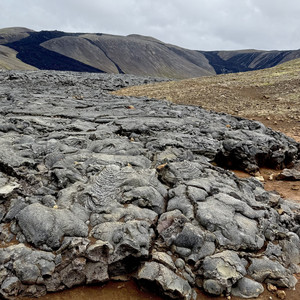
But we did visit a solidified lava field from volcanoes that had already erupted just a few years ago.
The lava there was no longer bright orange because it had cooled and hardened back into rock.
But I could see the different textures and patterns of the lava as it had flowed across the surface.
And I was really surprised to see that there was still smoke coming out of the solidified lava field even though it had been more than a year since the last eruption.
We even saw signs warning people not to walk on it because it might still be very hot underneath.
So I asked Professor Sigmundson, how long can it be hot underneath that hard surface?
And how long can a lava field be dangerous after an eruption?
For years, because it takes a long time to cool a lava field.
It depends, of course, how thick it is.
But if it is like a few meters thick, As tall as an adult.
Yes, or twice or three times that.
That is maybe typical for lava fields here in Iceland.
They can have really liquid magma inside them for possibly for months or years.
But there is also another danger simply related to the rocks.
You know, it is...
Liquid that is transforming into rock again on the surface of the earth.
And the structure of lava fields is very intriguing.
Many of the lava fields here in Iceland are very irregular on the surface.
So you also have the danger of just falling.
So they are dangerous.
So you need to be aware of that.
My name is Harper and I am five years old and I live in Scottsdale, Arizona.
Why can't we live on volcanoes?
Lots of people live on volcanoes and lots of people live close to volcanoes.
Here in Iceland, we live quite close to volcanoes.
I mean, the capital of Iceland, Reykjavik, is not far from volcanoes.
Here in Iceland, there are two villages that are practically on a volcano.
But worldwide, there are many people that live on volcanoes.
And the reason people live on volcanoes, like in Indonesia, is because the soil on a volcano can be very fertile and you can grow crops there.
Professor Sigmundson says living close to volcanoes can come with other great benefits.
In Iceland, for example, geothermal energy powers about 70% of the country.
We have cold winters, but we heat most of the houses in Iceland by water that comes from the volcanoes hot water and it just goes away into a radiator directly from a volcano and heats our houses.
We have very hot houses here in Iceland even if the winters are cold.
And many volcanoes stay dormant, which means they're inactive, kind of asleep, for hundreds or even thousands of years.
So it's entirely possible for someone to live close to an inactive volcano their whole life and not experience an eruption.
The tricky thing, though, is that volcanoes don't always stay asleep.
If we can talk about volcanoes as a living creature in their lifetime, most of the time they are sleeping.
So they only wake up occasionally.
Some of the work I do is try to understand what happens when a volcano is trying to wake up.
And yeah, it is difficult to forecast.
For example, if you're sick, if you do not feel very well in your stomach, you may need to throw up occasionally.
And forecasting when you will throw up if you have a stomach disease may be difficult.
You almost throw up, but then suddenly it comes and maybe we are not prepared.
The same is with volcanoes.
It is difficult to forecast when they throw up.
I like that way of thinking about it.
And yes, in my experience, sometimes you think, oh, I don't feel good.
Oh my gosh, now I'm throwing up.
It can be a very surprising thing.
Same for volcanoes.
What volcanologists are trying to do.
Some of our work is to forecast the activity and better prepare society.
That you're listening to this podcast is very good, because we need more people that understand what volcanoes are doing.
What you know about volcanoes is that they are very irregular.
They can erupt any time of the year.
Volcanoes are not like clock.
My name is Juniper and seven years old.
I'm from Ohio.
How can volcanoes just know a volcano is going to erupt?
That is my job, partly my job, to understand what happens before this, yeah.
So we need to measure their activity.
And we can measure what is happening inside the volcano with different techniques, mainly three techniques.
We can study earthquakes how the ground is shaking in a volcano, because the waves from earthquakes come to the surface and we can measure the waves and then figure out what is happening inside.
Or we can measure how the ground of a volcano is moving and thereby maybe try to understand, or the pressure is building up like in a balloon.
Or we can measure what we call volcanic gas.
That is like if you smell something is burning in your stove, then something serious may happen.
Stop the process.
It's basically the same thing.
We can try to sense or sniff, in a sense, what the gas that is coming out of a volcano is.
When something is burning in your stove, that's a very familiar smell.
I can picture the smell of burning toast.
The smell of a volcano that is getting active, what is that smell?
Is that a sulfuric smell, which sometimes people describe as kind of like rotten eggs?
It can be increasing that.
It can also be increase in gas types that has no smell, that we need special instrument to measure.
So we need some technology.
Normally, we cannot use our nose for it.
Are there things that you can look at?
If I was looking at a volcano and say oh, something is happening.
Or do you need special tools and special, maybe even computer models to be able to understand what's happening?
Sometimes we can see it with our eyes.
For example, a signal if there is new hot liquid coming into a volcano, the heat of the rock around it can increase.
We can start to have more geothermal activity or basically steaming from a volcano.
So we can get visual steam from a volcano, basically meaning it is hotter.
But we typically need equipment.
We need to study the earthquakes, we need to see how the ground is moving or we need to measure the gases that come out.
And typically to understand how volcanoes behave both in this time period before an eruption and during eruption.
We need this monitoring data and we take it all together and try to understand what is happening inside the volcano or during an eruption.
And often we need a computer model for that.
So even if I'm a volcanologist, most of the time I'm in front of a computer.
Scientists have been studying volcanic activity for a long time, but there's still a lot we don't know about how they work.
For Professor Sigmundsson.
He says his goals are to keep learning more about what's inside volcanoes and how that might help him understand better the warning signs volcanoes are giving.
That way people could be informed before a volcano erupts.
That's especially important for people who live close by, of course.
Volcanic eruptions are a forceful release of extreme heat and energy.
They can destroy homes, they can make nearby towns unsafe, require residents to evacuate or leave.
Sometimes all the ash from an eruption gets high up into the atmosphere and causes problems like planes needing to find new routes or not being able to fly at all.
And remember our recent episode about smoke traveling from forest fires?
Ash from volcanoes can, of course, also get into the atmosphere and go very, very far from where the volcano has originally erupted.
Given all of that, it makes sense that we often think of volcanoes as something kind of scary and unpredictable and dangerous and bad.
But Professor Sigmundson says it's important to be respectful of the power and destruction of volcanic activity but to also recognize the beauty.
If you look at some photographs or videos of volcanoes, it's a beautiful thing to see a small eruption.
You saw some nice red magma being thrown up into the air and flowing.
So I was a young kid that had the opportunity to see eruptions and hear about them.
They caught my interest.
They're beautiful spectacular, and if you stare at them for a long time stare into the red glow you can be charmed.
And volcanoes are also very important.
Not only did they shape the landscape we know today on Earth, but they continue to do that.
New islands and new terrain is constantly being formed by volcanic eruptions.
Plus, volcanoes are important for things like geothermal energy, how we can heat and cool our homes and buildings.
And they can create very fertile soils, meaning it's easier to grow things like fruits and vegetables.
So volcanoes are all of those things at once.
A little bit mysterious, maybe scary, sometimes occasionally dangerous, but also beautiful, interesting and important.
Thanks to Professor Freystein Sigmundsson at the University of Iceland for speaking with us about volcanoes and answering your questions.
As always, if you have a question about anything, have an adult record you asking it on a smartphone.
You can use an app like Voice Memos or Recorder.
Then have your adult email the file to questions at butwhykids.org.
But Why is?
Produced by Melody Beaudet, Sarah Baik and me, Jane Lindholm at Vermont Public and distributed by PRX?
Our video producer is Joey Palumbo and our theme music is by Luke Reynolds.
If you like our show, please have your adults help you.
Give us a thumbs up or a review on whatever podcast platform you use.
It helps other kids and families find us.
We'll be back in two weeks with an all new episode.
Until then, stay curious.
From PRX.