Quick warning there is some profanity in this episode.
This is planet money from npr.
Are CEOs paid too much?
A question you will hear often.
And let's just look at some random numbers here from a Harvard list of top paid CEOs.
We've got David Zaslav here of Warner Brothers Discovery.
It looks like he made $52 million in compensation last year.
We've got another David here, David Gitlin of Carrier Global, the heating and air conditioning company.
He made $66 million last year.
Patrick Smith of Axon Enterprises.
That's a company that makes tasers.
He made 165 million last year.
It was not always like this.
And so how did we get to this point where CEOs are making this much money?
Well, Jacob Goldstein and Stacey Vanek-Smith did a show about this back in 2016, about this one particular moment when all of a sudden CEOs did start getting paid a lot more.
So we're going to play that one for you now.
And then at the end, we've got an update on what has changed in the decades since.
So here's Jacob and Stacey.
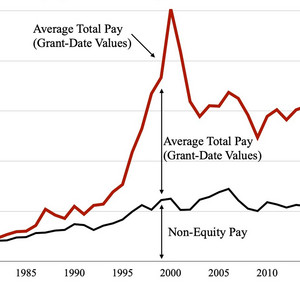
Stacey, the other day, I was looking at this chart.
I've brought it into the studio.
The chart is average pay for CEOs at big U.S. corporations over the past several decades.
And I saw something really surprising.
I'd always assumed you know that CEO pay just goes up and up and up in kind of a steady way, year after year.
But what this chart clearly shows is, in fact, there is this one moment.
I can put my finger on it here.
It's right in the mid-1990s where CEO pay goes bananas, right?
Before then, it's kind of inching along.
And then just all of a sudden, mid-90s, boom, straight up.
And you know, when I say it goes bananas I don't even mean that in like a value judgment kind of way.
I just mean.
Whatever you think about CEO pay, anybody would look at this chart, point to this moment in history and say what happened right here?
Hello and welcome to Planet Money.
I'm Stacey Vanek-Smith.
And I'm Jacob Goldstein.
Today on the show, that's our show.
What happened with CEO pay right here?
Hello.
This message comes from NPR sponsor U.S.
Bank.
With U.S.
Bank Business Essentials, you get more than just a bank.
You get a dedicated partner that provides you a powerful combo of checking and card payment processing with quick access to the money you've earned, proving that there is nothing as powerful as the power of us.
Visit usbank.com today to learn more.
Member FDIC.
Copyright 2025 U.S.
Bank.
This message comes from ServiceNow.
People should do the creative work they actually want to do, not boring busy work.
Now, with AI agents built into the ServiceNow platform, you can automate millions of repetitive tasks in every corner of your business IT, HR and more.
So your people can focus on the work that they want to do.
That's putting AI agents to work for people.
It's your turn.
Get started at servicenow.com slash AI dash agents.
The story of this moment when CEO pay started going up really fast.
Among other things, it's like a story of unintended consequences.
And it starts or at least we're going to start it a few years before things go bananas.
We're going to start it around 1990.
There was this economist named Kevin Murphy and he was looking at this and he wasn't so much concerned with how much CEOs were getting paid as he was with how they were getting paid.
He thought a lot of CEOs were getting paid a lot of money basically to just sit around.
The biggest sole determinant of your compensation was how big of a company you were running.
And it turned out to be just a lousy way to do business.
If a CEO had a great year, they got paid.
CEO had a terrible year, also got paid.
Didn't really matter.
So as a result, Murphy says, there was this tendency for CEOs to just kind of be on autopilot.
You know, go to work, take home a nice big paycheck.
So Murphy co-wrote this really influential paper where he basically argued that the way CEOs were being paid was wrong.
CEO pay, he said, should be based on performance.
If the company does well, the CEO should get more.
If the company doesn't do so well, CEOs should get less.
It's a really logical idea.
And he wrote the paper at just the right time for it to get a lot of attention.
The US was going through a recession, not a major recession, but a recession where executives were getting rich.
At the same time, they were laying off their employees.
And, of course, that's a minefield.
It's a minefield if you're a CEO making millions of dollars a year.
But if you are, say, a young governor running for president, this is a gift.
If companies want to overpay their executives, they shouldn't get any special treatment from Uncle Sam.
Oh, I know that voice young Bill Clinton, and listen here, because this is not just one more sort of abstract campaign rant about CEO pay.
Clinton here is making an actual policy proposal.
There are millions of good people in business in this country today, making the free enterprise system go.
But our tax system does not reward them.
Instead, it rewards unlimited executive compensation.
And I tell you, we need a new responsibility ethic in our tax system.
No incentives for executive compensation that's excessive are moving our plants overseas.
Bill Clinton spoiler alert wins the election and in 1993 decides he's going to make good on that campaign promise and change the tax code.
Here is how the tax code works.
If you're a company, to figure out how much income you have to pay taxes on, you need to take all the money you make and then subtract your expenses.
If you rent office space, you can subtract that.
If you buy a bunch of computers, you can subtract that.
And all of the money you pay your employees, including the CEO, you can subtract that too.
It's an expense like anything else.
And with the help of Congress, Clinton made a little change to the tax code.
He put a limit on how much CEO pay companies could subtract.
He limited how much they could deduct.
That limit?
$1 million.
So if you pay your CEO a million dollars, you can deduct that as an expense.
But if you pay them $2 million or $5 million or $10 million, you can only deduct the first million.
It was a nudge from the federal government to pay CEOs less.
There was also a second nudge in this new part of the tax code.
And this one was tied to the idea that that economist, Kevin Murphy, had been pushing.
The idea that CEOs should be paid for performance.
That made it into the tax code, too.
Specifically, it is in subparagraph 4C.
Perhaps the most important subparagraph in the history of taxes?
Sure.
Let's say CEO pay.
Okay, CEO pay.
And that subparagraph says this million-dollar cap does not apply to pay that is tied to performance.
So the government here is like hey, you want to keep paying those multi-million dollar salaries for CEOs just showing up and collecting a paycheck.
You're going to pay a tax penalty for that.
But you want to try out this new idea, this pay for performance thing?
We like that.
As long as the pay is clearly tied to performance, there is no limit.
No matter how much you pay, you can deduct it all.
Bill White remembers when the tax law changed.
White at the time was the CEO of a company called Bell & Howell and served on various boards of directors.
The law that created this rule, was that a big deal?
You know, at the time, it probably didn't look like it, but in retrospect, it was huge.
Huge!
Huge!
Well, it was huge because it changed the way that, you know, we compensate our top executives.
Bill says compensation committees the part of the board that sets the pay for the CEO looked at this new tax code and said OK, let's die.
Our CEOs pay to performance.
The compensation committees where I served immediately started thinking about how we will change the pay system for our top executive, for our CEO.
And the obvious way to move was to was to move to stock options.
Because of that law.
Correct.
Stock options.
A stock option gives you, as the name suggests, the option to buy a share of stock.
So little quasi real world example.
Stacey, let's say you get promoted to be CEO of Planet Money Worldwide Enterprises.
Oh, I'm your boss.
You're my boss.
Don't throw it in my face.
So our stock right now is trading at, say, $10 a share, okay?
As part of your pay, I'm going to give you one stock option, just one.
And this gives you the right to buy one share of Planet Money stock for 10 at some point in the future.
Oh, okay.
So now, let's say you're doing your job, you're doing great.
Stock in Planet Money Enterprises goes up.
It goes up from $10 a share to $15 a share.
Ooh, I want to cash out.
How do I cash out?
You can.
So what you do is you use your option, you exercise your right to buy a share of Planet Money stock for 10, and then you turn around and sell it for the market price.
Sell it for $15.
You get to pocket $5.
Which in midtown Manhattan will buy me… Half a sandwich.
Half a sandwich.
Okay.
I want a raise.
Okay.
So that is the good case scenario.
That's if things go well, right?
Say you do a terrible job as CEO of Planet Money.
Not that you would, but say you do.
Say you launch a 10-part series on the history of the penny.
Our stock goes down to $8 a share.
Now, that stock option at 10, it is not going to do anything for you.
We've effectively tied your pay to the performance of Planet Money Enterprises.
I like this penny idea.
All right.
Anyways, this pay for performance idea, it seems sensible enough.
And Kevin Murphy, the economist who had been pushing the idea.
His hope was companies would pay CEOs more with options and less through base pay.
And after that law passed, companies did pay more with options.
But that other part, the cutting the base pay part?
No, that's not going to happen in the real world.
Why not?
This is Bill White, the former CEO and board member.
It's a very nice concept.
But if you're a CEO, you're not going to want that to happen.
And if you're on the board of directors and you have a good CEO, the last thing you're going to do is go to them and say you know we're going to take away some of your base comp.
Now the rise in payments through options.
This was not like just happening at one company here and another there.
It was happening at lots and lots of companies.
Don Delves was a compensation consultant at the time.
And before, options payments to CEOs had been growing at a couple percent a year.
After Bill Clinton signed that tax law, they exploded.
He remembers looking at this one survey in the mid-90s.
We looked at the survey and said, oh my gosh, stock options have gone up by 40 percent.
And we were kind of floored.
And we said, this must be wrong.
So you're saying you actually looked at this number and you thought no, this must be a typo or somebody must have made a math error.
Right.
Right.
Yeah.
This must be a mistake.
It wasn't a mistake.
Between 1992 and 1996, average pay for CEOs at 500 of the biggest US corporations roughly doubled from 4 million to 8 million.
This is that moment on the chart where CEO pay takes off or when it starts to take off.
Yeah, after this, it just keeps going up and up and up.
And that happens for a few reasons.
The first one is kind of surprising.
A lot of companies are giving their CEOs a set number of options as part of their pay every year.
So, say a company gives a CEO 100 options as part of their pay in, say, 1996.
In 1997, there's a good chance that that company is going to give the CEO another 100 options as part of their pay package for that year, which you know seems reasonable on its face.
But the stock market at the time was going up a lot.
And the higher the market got, the more those options were worth.
It meant that the value of the pay packages of a lot of CEOs was essentially automatically increasing every year.
But there's a second reason that CEO pay took off around this time, way more interesting.
I learned it essentially doing the reporting for the story.
I asked everybody, you know, why around this time were companies giving out so many options?
And they all mentioned this thing that really seems to come down to five words.
We thought they were free.
We thought they were free.
Five words.
This is Barbara Franklin.
She has served on corporate boards for decades.
She went to Harvard Business School.
She's also a former Secretary of Commerce for the United States of America.
And she told me what a lot of people told me.
Back in the 90s, almost everybody thought options were free.
We thought they were free.
That was the bottom line.
And did you really think they were free?
Well, sure.
I think we did.
The idea that options were free had nothing to do with that tax law passed under Bill Clinton.
It has to do with an accounting rule that had been in place for decades.
Under that accounting rule, when companies issued their financial statements, they didn't have to account for stock options the way they had to account for other kinds of pay.
Yeah, under that accounting rule, options kind of were free.
And you can sort of see why.
Like, think about it like this.
If you're a company and you pay someone a salary, you write them a check.
You are giving them money.
That is obviously not free.
But a stock option?
I mean a stock option.
I don't have to take any money out of the company bank account to give it to you.
And if you decide to use it in the future to buy that share of stock, I can just create a new stock for you out of thin air.
That also doesn't cost us anything.
Of course, the truth is that does cost something.
Stock options are not free.
Someone ends up paying.
Specifically, every other person who owns stock in the company.
Every time a new share is created, all of the existing shares of stock are worth a little less.
So if say, you have a retirement fund, some of your retirement fund is in stock, this extra pay for the CEO, these options, they are coming from you.
Don Delves, the compensation consultant, said he kept trying to explain this to people at the time.
First of all, we built this fairly elaborate model to try to show people look, this is what's happening.
You're hurting your shareholders.
You're hurting the value of the company.
They'd look at it and they'd say, nah, we don't need that.
They're really free.
The options are really free.
He finally found one company that was willing to listen, that really wanted to understand what was going on.
We took them through it in detail.
Look, this is what your stock options are costing you.
This is what they're costing your shareholders.
And they, you know, they understood it.
They understood it.
Then we got to the end of the meeting and they said well, thank you, but we're still going to go ahead and grant the options.
They said they had to do it because everybody else was doing it.
Once options took off like this in the 90s, the group that sets the accounting rules for US companies looked at that old rule that made options feel free.
And they said, oh, obviously this is wrong.
And we're going to change the rules so that companies cannot keep pretending that options are free.
Companies went ballistic.
Here is a local news broadcast from 1994 covering a protest in San Jose.
If the marching band doesn't get your attention, maybe the signs will.
A couple of thousand Silicon Valley workers are fighting mad about losing their stock options because of the FASB or FASB.
FASB is the Financial Accounting Standards Board, that group that wants to change the rules.
And all these people are coming out to protest because stock options were not just being given out to CEOs and executives.
Especially in the tech industry, they were being given out to lots and lots of workers.
And in this new spot, you see people marching with signs that say stock options equal jobs.
You see people wearing these red buttons in the shape of stop signs that say stop FASB.
And they did stop FASB.
There were enough protests and enough political pressure that FASB backed off.
Options were still treated as free.
And CEOs kept getting more of them.
CEO pay kept going up.
Yeah, I asked Don Delves, the compensation consultant, what it was like to be doing his job at this moment.
How are you feeling at this point?
Like you're in the middle of this.
Right.
How do you feel doing your job in the late 90s?
That's a very good question, Jacob.
Let me just think about that for a second.
Uncomfortable.
Very uncomfortable.
Did you feel like because of the job you had, you were contributing to this problem?
Yes.
Absolutely.
Absolutely.
And it caused me great concern.
Kevin Murphy, the economist who had argued that CEOs should get more options, also wasn't feeling so great.
He says he felt like a doctor who recommends a glass of wine every night.
And suddenly companies are giving their CEOs and their workers a bottle of wine every night and saying drink up.
It's good for you.
I started being worried about watching in real time the largest transfer of wealth from shareholders to workers that we'd ever seen in corporate America.
Average pay for CEOs at big corporations, which had been at 4 million in 1992, hit 19 million in the year 2000.
It had almost quintupled in less than a decade.
And then it stopped going up.
What happened after the break?
Eventually, CEO pay did start to come down.
And this happened for a bunch of reasons.
The dot-com bubble popped, the whole stock market plunged and shareholders finally started noticing and caring about all those stock options companies were giving out.
They started saying, hey, that's our money you're giving away.
Suddenly, boards of directors were a lot more interested in what Don Delves, that compensation consultant, had to say.
He remembers this one call he got around, this time from a board of directors that was starting to worry about how much they'd been paying their top executives.
They came in and they said, can you just show us a little bit?
They just wanted like a five-page report.
We gave them a hundred-page report.
And we started calling it the holy s*** moment.
Because they kept flipping the pages and each one they'd go, oh, holy s***.
They'd flip the page again and go, oh, holy s***.
Meaning what?
Meaning they didn't realize how vastly overpaid their executive team was and how it had gotten out of control.
That board wound up cutting its CEO's pay in half.
And also, FASB, the accounting rules people, finally had the support for what they wanted to do.
They changed that accounting rule so companies could no longer treat stock options as free.
The most surprising thing to me in this whole story happens now, right around this time.
CEO pay goes down, which I never would have guessed.
You know, I always assumed CEO pay just goes up and up and up forever.
But no, when you look at the average pay of the CEOs of the biggest US corporations, it has actually fallen.
From $19 million in 2000 to $12 million in 2014.
All right.
So that was all back in 2016.
So it's been almost a decade now.
And we called up Don Delves, the compensation consultant, to find out what has happened since to CEO pay.
It's neither spiraling nor is it out of control, but it is high.
Don shared his updated numbers for CEO pay with us.
And so if you made a chart of things since 2016, that line would turn up and move up up up, but not exactly steadily up.
There's this big spike and drop situation around the pandemic, of course.
2020 was...
And it was horrible.
And when it comes to CEO pay, remember a lot of that.
Compensation comes in the form of stock that they get when their company meets performance goals.
In 2020, nothing went as planned.
And performance was terrible.
And you don't generally adjust goals in the middle of the year just because something bad happens.
It's sort of just considered bad form.
And so, you know, at the end of the year, payouts were not very good.
Which created this big spike up the next year because of how they thought the company might do the following year.
Things recovered faster than companies thought they were going to.
So it turned out to be a very good year relative to the goals that were set at the beginning of the year.
So it was a good year for payouts.
It comes back down, like finding a new level, and then up, up, up again since then.
And when you add up all the ways that CEOs get paid, their earnings are growing on average about 10 per year since 2014.
You can compare that to the pay for the average employee.
Their pay is going up like 3%, Don says, which brings us to the second update.
A change that kicked in around 2018 as kind of this delayed impact of the Dodd-Frank Act, one of those big financial crisis era pieces of legislation.
Publicly traded companies have been required to report how much their CEOs get paid in comparison to how much median employees get paid.
So to give a pay ratio.
So in 2017, the first fiscal year of those required disclosures, that median pay ratio was like 160 to 1.
Now it is closer to 190 to 1.
Quick data.
Note the numbers that we use in the original story for CEO pay.
They are in 2014 dollars.
They are based on CEOs of companies that were in the S&P 500.
And they come from Kevin Murphy, the economist we talked to in the story, who is now a professor at USC.
Don Delves, the compensation consultant in the story.
He is still a compensation consultant.
He works at a firm called WTW.
And data from the update comes from WTW and from Equifar Research.
As always, thank you to our Planet Money Plus supporters.
Subscribing is the best way to show that you value our work.
We would ask that you please consider joining at plusnprorg slash planet money or click the link in the show notes.
You will get to listen to these episodes with no sponsor messages.
You will also get bonus episodes from us.
This episode was originally produced by Nick Fountain with help from Sally Helm.
Our update was reported and produced by Willa Rubin, and it was edited by our executive producer, Alex Goldmark.
Thanks also to Brian Dunn, a compensation consultant, who I talked with for the story but did not make it into the show.
I'm Jacob Goldstein.
I'm Kenny Malone.
And I'm Stacey Vanek-Smith.
Thanks for listening.