This message comes from Greenlight.
Ready to start talking to your kids about financial literacy?
Meet Greenlight, the debit card and money app that teaches kids and teens how to earn, save, spend wisely, and invest. Start your risk -free trial at greenlight .com slash npr.
You're listening to Short Wave from NPR.
Hey, Short Waivers, Emily Kuang here with Cooper Katz McKim, a producer at The Indicator from Planet Money as he is...
Wait, what are you doing, Cooper?
Oh, Emily. Hi. That's just me turning on and off the lights at a facility in California where there is battery power energizing the grid.
Like literally holding energy and then releasing it onto the grid that powers all our homes.
Interesting, but in California, I'd expect energy to be coming from places like natural gas or hydro.
You're telling me batteries are in the mix?
Grid scale battery storage is surprisingly oftentimes the second largest source of energy on a given day in California.
I didn't know that battery storage could be used at that level.
I mean just a few years ago, it was unimaginable.
Grid scale storage like this was basically a dream technology for renewable companies, a what if scenario.
Right and those companies historically have been using technologies at the whim of the weather.
If the sun doesn't shine solar energy isn't so great.
If the wind doesn't blow, exactly.
And battery storage, it changes that equation.
Right, because you can store energy inside a battery somehow.
And then tap into it whenever it's needed.
Well, that dream tech is now very much mainstream.
Around 2020, 2021, battery storage capacity jumped 230 % across the US.
Wow. More and more was added in 2022, 2023, and it really took off, particularly in California.
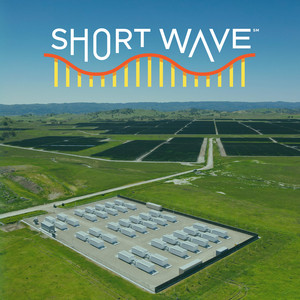
To see it for myself, I showed up to a site called CalFlats in central California.
It's this 2900 -acre plot of land just covered in solar panels.
There's like goats running around, there's little fox habitats.
The extra energy generated from all that solar flows straight into batteries right on site.
These containers you see with you know what is it six or seven doors and each one of these containers has a bunch of modules that would look like big suitcases that have the battery sells the DC battery." That's Justin Johnson, the COO of Erivon, the company that owns Cal Flats.
When we talk about battery storage, this is what people are referring to.
Rows and rows of stacked battery suitcases, basically.
In a container that's like eight feet high.
Basically a cabinet.
Oh, that's kind of small.
How much power is this site creating?
So the site has enough storage capacity to provide electricity to around 60 ,000 homes for a few hours.
Oh, that's a lot. Yeah, it's a lot.
Erivan sells that energy to Apple and PG &E, the state's largest utility.
Justin Johnson says there is no shortage of customers though.
If you have a solar plant or a battery plant or a combination, you know, a solar and battery plant anywhere in the U .S. that's ready to be built these days, you can find an off -taker.
I mean, so much more electricity is needed these days with so many electric vehicles on the road and new data centers for artificial intelligence.
Well, it's clearly a big topic and you produced a three -part series all about batteries for your podcast, The Indicator from Planet Money.
Right, but there were still a few questions that I wanted to dig into.
So Emily, today on the show, we tackle the technological reasons behind batteries taking off so fast, and what's next for them?
Let's go on a battery -powered magic carpet ride.
You're listening to Shortwave from NPR.
This message comes from Charles Schwab.
When it comes to managing your wealth, Schwab gives you more choices, like full -service wealth management and and advice when you need it.
You can also invest on your own, and trade on Thinkorswim.
Visit Schwab .com to learn more.
Support for NPR and the following message come from Edward Jones.
What does it mean to live a rich life?
It means brave first leaps, fearful goodbyes, and everything in between.
With over 100 years of experience navigating the ups and downs of the market, and of life, your Edward Jones financial advisor will be there to help you move ahead with confidence.
Because with all you've done to find your rich, they'll do all they can to help you keep enjoying it.
Edward Jones, member SIPC.
This message comes from Charles Schwab.
When it comes to managing your wealth, Schwab gives you more choices, like full -service wealth management and advice when you need it.
You can also invest on your own and trade on thinkorswim.
Visit Schwab .com to learn more.
So, grid scale battery storage has taken off the past few years, but Cooper, a lot of different technologies have their moment.
So why is this rise to the mainstream for battery tech different in some way?
Yeah. I mean, it's not like one day some company said we're going to make batteries powerful enough to support the grid.
That would have been awesome, but it kind of has to go back a ways.
The batteries I saw on Cal Flats, it arguably goes back to the 90s when Sony introduced their camcorder with a little rechargeable battery inside of it.
Dan Walter studies the rapid growth of electro tech like batteries.
In the first sector, you roll out batteries that are just good enough for that sector and they just meet the demands of the Sony camcorder.
Hmm. These batteries, I feel like I've seen a descendant of them in my digital camera.
They're the kind of boxy cube batteries that you can recharge.
Right? It's kind of satisfying to click in at that one.
We've all definitely used those batteries at some point.
That's basically at the root of what Dan calls the battery domino effect.
Because that is a growing market and that market expands, you can create more and more factories that make batteries.
And as you build more factories, it becomes cheaper and the batteries become of higher quality.
Over time, people wanted longer -lasting and cheaper batteries, so companies had an incentive to develop them.
You get a technology development that's very rapid, driven by a group of consumers that has a very high willingness to pay.
We're battery hungry in the nineties, and the aughts.
Yeah, and the whole story starts over as another sector finds use for that same battery, from camcorders to laptops, e -bikes, 3 -wheelers, cars.
because each sector is full of people who want better batteries and will pay for it.
It really has been a story of consumerism, but also clever policy of countries that have realized that there's a competitive advantage in winning batteries.
What's astonishing about this story is I was I was alive during this battery revolution and I witnessed it from childhood to now.
And I kind of just took it for granted that battery tech was like racing to keep up with our voracious need.
Then, you know, I think about electric vehicles coming along.
I mean, those must have bumped this development even more.
EVs are everywhere.
Yeah, that's a perfect transition to Dan's second point because the growth of EVs is a big part of this story.
Long before others were investing in battery storage, like back in the auts, leadership in China saw an opportunity with the technology and became a hub for manufacturing batteries.
It wasn't a big market yet, but they saw an opportunity.
Wow, okay. And as EVs got more popular, it drove the volume of larger, lighter, denser batteries way up that made batteries way cheaper.
How cheap are we talking?
Since 2010, the average cost of batteries has fallen more than 90%, which is one of the fastest cost drops of any energy technology ever.
Whoa. It's grown into new markets, new countries, and by 2021, battery storage finally reached that tipping point in the U .S., where they were literally contributing electricity to the entire grid.
Right, and you mentioned that earlier that 2021 was the year there was this big jump, that battery storage capacity increased 230%.
Right, no, exactly.
And that brings us to the situation today where batteries are all over the economy in cars and mopeds and buses and trucks to drive them around.
Ah, I have chills. I mean, this is a great time, and it's kind of cool to hear that the legacy of my iPod served a greater purpose.
Never let it go. Yep, exactly.
Now, you remember the battery I mentioned earlier?
Oh yeah, the cube battery that debuted in the 90s with the Sony camcorder?
That's the one. Yeah.
Yeah. That was a game changer for battery storage because it used lithium -ion technology, which was way more energy dense than what we had, nickel cadmium or lead -acid batteries.
Energy dense meaning?
Meaning lithium -ion batteries can hold a charge for longer.
They're lighter, it can be recharged a lot more time, it's more energy efficient.
I've always wondered this, is there anything specific to lithium that makes this possible?
Like why is it so special?
Yeah, it's a good question.
I mean, for one, they're incredibly light compared to nickel or lead.
It also gives up its electron really easily, which is important given that a battery works when electrons flow from the negative electrode to the positive one.
I've made enough lemon batteries to know this.
Yes, the negative electrode is the anode and it releases electrons and the positive electrode is the cathode, and that absorbs the electrons, and when they are recharged the electrons move back.
It's like a cycle. We should just use lemons to power our grid, what are we doing?
So you're saying lithium -ion batteries are easily allowing this electron transfer to happen?
Exactly, and as these batteries became more advanced, new types of lithium -ion batteries came about.
So there's lithium iron phosphate battery, for example, which is cheaper and less flammable than its precursors.
It's also less energy dense, but its low cost made that worthwhile.
The batteries at Cal -Flats, for example, are LFPs, this lithium iron phosphate, and they can hold like four hours of energy.
Okay, so that's where we're at today.
really. These cabinets of lithium iron phosphate batteries LFPs have become the standard for grid scale battery storage.
And it sounds like that technology is growing quickly.
Yeah. And the domino effect and an affordable powerful chemistry for batteries have allowed this technology to grow exponentially.
Is there any reason for this momentum behind battery sales to ever stop?
Like, can we forever expect batteries to keep growing at this exponential rate.
Well forever I don't know but analysts like Dan Walter definitely see the dominoes continuing to fall for the foreseeable future.
He sees battery storage advancing from cars and the grid to maybe even like freight ships even planes.
Five years ago everyone would have called us crazy for saying electric aviation can be possible.
Today I think we're seeing some really interesting first signs that you know 20 -seater electric planes that can fly most of the flights within the US, within Europe and within China.
That is wild. This plane, it's on an upward trajectory and so is battery storage.
It's really in that position to be disrupted further and likely through new chemistries.
For example, sodium -ion batteries are still a young technology, but they're projected to follow in the footsteps of LFP batteries.
Oh, why is that? Sodium -ion batteries are even cheaper than LFPs in part because they rely less on critical minerals.
But also sodium is just kind of everywhere.
It's literally a thousand times more abundant than lithium.
And these batteries don't perform as well as LFPs.
But the market could say we'll take lower performance at that cost. Right.
OK. The other benefit of sodium ion batteries, they're less taxing on the environment.
So sodium is so abundant, there's less pressure to dig deeper and deeper or in a far flung places of the world.
They also don't rely on minerals like cobalt or nickel which are both known for being super water intensive and having polluting mining processes.
That's an exciting prospect that these sodium ion batteries might be a thing.
Okay. Yeah. You mentioned earlier that most batteries used for grid scale storage have but a four hour capacity.
What about batteries that can last longer?
So there are some versions that can go for days.
decibels. And one of those is the redox flow battery, which is currently used on a much smaller scale, but it could change the story from just four hours to daily or even multi -day capacity.
That's amazing to imagine a battery that could last for days.
How would that work?
How does this redox flow battery work?
It really would redefine how batteries are made.
Inside each battery there are two electrodes that we talked about, the cathode and the anode, and in between them there's liquid.
side. Whenever electrons move from one side to the other, there's an automatic discharge, and with the redox flow battery, those two sides are completely separate so it can maintain a charge way better.
Yeah, I can see that.
So, how batteries are made, they're changing chemistries...
these are all reasons batteries have followed this upward trajectory.
Cooper, I am located in DC, are you telling me that if I turned on the lights someday, is there a chance that power could come from a battery?
It's growing fast. By 2030, some forecasts have capacity increasing by like 400 percent, and it's already high.
So all this, it's very exciting to Dan Wolter.
So we all hear about like new AI breakthroughs every day, every sort of extra billion parameters on a new AI model, everyone gets super excited about.
that. But when we talk about batteries, there are huge breakthroughs happening that are changing our energy landscape and therefore our entire economy.
And no one really seems to be paying attention to it.
Well, we are definitely paying attention to it.
shortwave and the indicator.
Thanks to you. Thanks, Emily.
Shortwave is the full battery series Cooper led for the indicator is out now.
We will link to the series in our show notes in addition to a previous episode we did on long -term term battery storage and batteries of the future.
Check them out. This episode was produced by Rachel Carlson and edited by our showrunner Rebecca Ramirez.
Tyler Jones checked the facts.
Kwesi Lee was the audio engineer.
Beth Donovan is our senior director.
And Colin Campbell is our senior vice president of podcasting strategy.
I'm Emily Kuang. Thank you for listening to Shore Wave, the science podcast from NPR.
This message comes from Greenlight.
Ready to start talking to your kids about financial literacy?
Meet Greenlight, the debit card and money app that teaches kids and teens how to earn, save, spend wisely, and invest. With Greenlight, you can send money to kids quickly, set up chores, automate allowance, and keep an eye on your kids' spending with real -time notifications.
Join millions of parents and kids building healthy financial habits together on Greenlight.
Get started risk -free at greenlight .com slash npr.
This message is from NPR sponsor Total Wine & More.
This summer season, with so many bottles to choose from, it's easy to find your favorite and more.
Find what you love and love what you find only at Total Wine and More.
Drink responsibly, B21.
This message comes from Mint Mobile.
Mint Mobile took what's wrong with wireless and made it right.
They offer premium wireless plans for less and all plans include high -speed data, unlimited talk and text and nationwide coverage.
See for yourself at mintmobile .com slash switch.