discussion keeps the world turning.
This is Roundtable.
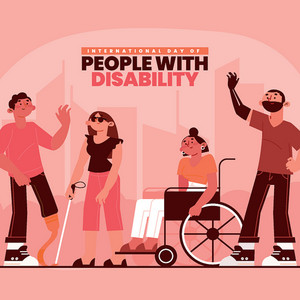
On December 3rd, we observe the International Day of Disabled Persons.
China has made significant progress in constructing accessible environments, with many provinces achieving full coverage in public spaces.
That's wonderful, but is coverage alone enough?
How do we ensure that these facilities are usable and welcoming for everyone?
We'll explore the path from building accessibility to fostering genuine inclusion for all.
We're live from our studios in Beijing.
This is Roundtable.
I'm Steve.
Thank you so much for sharing time with us today.
And for the show, I'm with Yushan and Xinyu.
First up.
December 3rd marks the International Day of Disabled Persons, and to help them and other groups of people in need, China has made strides in building more accessible environments in recent years.
For example, provinces like Henan, Anhui and Yunnan have achieved 100 coverage of accessible facilities in public buildings and city roads.
But there's a big question are they good enough?
Several recent reports highlight a troubling trend.
Public spaces with blocked or unusable accessible facilities from ramps to restrooms.
These obstacles prevent people in need from fully using the facilities and participating in public life has done a lot to bring conveniences to these groups of people.
Problems still do remain, and we have to figure out how to fix them.
This is from the UN website.
And that depends on and indeed necessitates. the inclusion of all segments of society.
And with that, we can agree.
Yushan and Xinyu, good afternoon to you both.
So where do we stand now?
I mean, when we talk about accessible facilities, what exactly are we talking about?
Accessible facilities.
They are services and facilities designed to ensure safe passing and convenient use for groups such as people with disabilities, the elderly people, pregnant women and children.
So these facilities often include features like tactile paving, ramps, and accessible elevators.
And if we look at the demand here in China, the latest data shows that, as of the end of 2024, and 85 million people with disabilities in the country and the population aged 60 and above exceeds 300 million.
And beyond that, we also have groups like pregnant women and children and also the sick and injured.
They also have a strong need for accessible facilities.
And during the past of the 14th five-year plan, the country has set a goal of supporting the renovation of 11 million homes for low-income families with members that have severe disabilities.
So that was the plan, that was part of the five-year plan, but what's been achieved so far?
Well, that's the data as of this June this year, that the renovation of a total of over 12 million homes has been already completed.
And also currently, like you mentioned earlier at the beginning, Steve provinces like central China's Henan and Anhui, and also in the South, in Yunnan Province.
They have achieved 100 accessibility in public buildings and city roads.
So that's just acknowledging the fact that these facilities are there.
Right.
It's acknowledging their existence.
Right, yes.
And they have such a coverage that right now our goal is kind of the development of such accessible environments.
It has evolved from focusing merely on whether or not they exist to focusing on how good they are and whether or not they are really helpful and functional.
So there's a law in this. goes back to 2023.
It's called China's Accessible Environment Construction Law.
It took effect on the 1st of September in that year.
And what exactly did that clarify at that time?
That's a law that clarifies the beneficiaries of accessible or barrier-free environments that are not only people with disabilities and the elderly, but also members of society who have accessibility needs, those who are in need, for example, a seat on the subway trains, where Nowadays, at least here in Beijing, you can see everyone's in the roles of C-theorists one on the edge that's labeled as Yes, specifically for elders or pregnant ladies and children.
So things like that has... become more common, like for the accessible toilets.
We are seeing them more and more commonly, especially in malls, where the room can be a bit larger, or even the put an individual room just for accessible toilets, where wheelchairs can get in without any barriers.
So that's becoming the new, It's becoming the new norm, but I think the development of these types of environments has evolved from perhaps, just whether or not Right.
Which brings us to the question and this is why we're talking about this today are they good enough?
Well, I have to be honest and say that there have been some problems that emerged and we have seen some complaints from local users.
They have complained about these facilities being blocked or poorly designed or completely unusable.
So if we look at some of the examples here, we can see that an urban square in Xianyang, northwest China's Shaanxi province.
They have been reported.
The accessible entrance to a shopping mall was blocked by a role of S-shaped steel pipes.
And also we have seen other occasions on counties like Suining.
They have been reported that some of the accessible facilities are not even established in some counties and regions.
So these are some of the problems.
And also we have encountered issues of not that user friendly or properly or poorly designed facilities, such as the stainless steel tactile paving.
Because this tactile paving was made of stainless steel and when it rains it can be really, really slippery.
And that was also talked about by one of the stand-up comedians.
He's named Hei Deng. and he is a visually impaired comedian.
And he talked on stage actually about this issue.
And right after that show, the city of Shenzhen replaced all of the stainless steel tactile paving immediately.
Awesome.
Taking on the actions.
Well, yeah, exactly.
And again, it goes back to that point of simply having the facilities in place is not good enough.
If they're not useful.
You gave the example of the S-shaped stairs, um bars on the accessibility ramp.
Well, that would make it almost impossible, if not impossible, for someone in a wheelchair to navigate their way through an s-shaped path to get up to the entrance of the building.
So there just wasn't enough thought perhaps in some of these examples put into the project when they were making them in the first place.
And also when it comes to the designs there are.
Well, I'll use an example that I encountered just last evening.
So you know, there's around that block, near our office building, there is a mall, slash training center, slash cultural hub kind of thing called Yuchen.
And there's a gym that I often go to.
But yesterday there are some sort of a it's not a blockage, but more like a chain segue that helps to put the queue, put people in natural queue when they're trying to enter.
It's like slowing down the queue and also as a barrier to prevent scooters or bikes to just ride in directly.
So people can still walk in.
But yesterday what I thought was that a baby's cart was stuck in between, with the parent trying to get his child through that little narrow S spaced segue.
There was no other space for the... carriage to go through.
There are other space, but they are very far away.
Same as the entrance where the cars get in and get out.
So that's the thing.
You want to prevent you know like close range accident happen to eliminate all high-speed scooters running in the same way as pedestrians or people walking by.
But in the meantime, what are we limiting?
Even a baby's cart, as narrow as that, couldn't pass that.
So how about people with crutches, with a cane, or how about?
There was another example of a metro station in Chongqing where there were no tactile paving indicators for those people who are visually impaired?
Those tactile paving indicators are the squares that you will see on the ground.
They're often yellow.
They're yellow, or perhaps they can be other colors, but they're bright colors so that people with low visibility can see them as well.
But those indicators signal to a person where they should turn, which direction they should be going or if there are things that they should be careful of.
And there was one Yeah, so one, the one there at that metro station.
They were leading directly to a wall right, so laid incorrectly right.
And then there was another example from a metro station in Shanghai where the elevator entrance lacked the necessary indicators and also the direction of the paving itself was laid incorrectly.
So again, back to that same point.
Putting them there is one thing, but if they're not useful or they're done incorrectly or they're made unavailable to people, then it just makes no sense to have them at all.
So why are we looking at examples like this?
Is there perhaps insight, sufficient awareness, definitely when it comes to designing the city or these facilities?
Yeah, and I've reflected on that, I think, in the past, when it comes to urban design or urban planning, there's really a lack of awareness of including everybody in the city or in this accessibility infrastructure.
But nowadays, especially in the past few years, we have a raised awareness on building a more accessible environment for people of different groups.
But now the question can be, we cannot tear down the city and rebuild the city from the scratch.
So we have to like make amendments to the existing facilities or existing infrastructure.
See the problem, fix the problem.
Yes.
And that comes to the problem that the accessibility infrastructure can be non-systematic or fragmented.
They are not holistic.
So we are seeing some of the problems that we mentioned.
So your opinion is kind of agreed by Sun Yiping, who is the secretary general.
General of the Accessibility Environment Research Committee of the Disabled Persons Development Research.
So, after spending over 20 years in the construction of accessible environments in Chinese cities, Mr Sun, He admits that some cities never really planned their infrastructure with an accessible city mindset.
That's causing problems.
Problems like, for example, if a person with disability might want to move smoothly from point A to B and then from point B to C, But then after he or she reaches point C, he find it hard to get back today.
So if the surrounding, the environment at large, isn't really planned as a whole, then even well-built, accessible facilities end up not working as intended, as we'd like it to be.
Yeah, and also A little bit fragmented in the design or the construction.
There's no system put in place like a nationwide system where you follow a certain set of steps in the construction.
So that would kind of make every project a project unto its own, not similar perhaps to anything else.
And I found it really curious that experts also pointed out that many staff members who designed these equipments in the first place they turn out to be people who rarely interact with the disabled community and are in lack of training on their mobility, on these groups' particular mobility needs.
That's why we see like very sadly examples like Some places, they even put the Braille signs upside down.
Like those Braille signs that's supposed to point up for elevators, they are placed at the down button.
That's not only kind of misleading.
So they don't know the Braille signage.
Yeah, they don't know.
They don't understand and they didn't truly try to experience it themselves when it comes to using it.
This one kind of defies logic a little bit.
I mean, it's a bit harsh to say, but if you're going to be designing something for a specific group or groups of people, why would you not ask those specific groups of people?
Yeah exactly, put them in charge of the design team themselves, because they would know the best right.
There was another bit of criticism about legal enforcement, and one of the reasons is that regulations in the accessibility environment, construction law that we mentioned before, they aren't strict enough.
And some of the provisions in the law, those are just recommendations.
They're merely recommendations.
And there aren't really any clear guidelines on how things should be done, nor do they really specify the consequences of the violations themselves.
That's from an article from Legal Daily that came out not long ago.
There might be very little consequence for blocking ramps with cars or for using accessible restrooms for general purposes, things of that nature.
Yeah, and also there are when it comes to elevating existing facilities with accessible equipment or facilities.
They are supposed to meet national standards, but in real cases, upgrading them often runs into real-world challenges like a shortage of budget or What's the local policy?
What are those policies requiring?
For example, renovating old residential communities, which are many here in China.
They may involve property and space issues or protecting cultural relics when it comes to historic buildings, buildings that also bring its own restrictions to the renovation.
So all these create customized requirements for accessibility upgrades and on top of that, construction is often limited by budget and how much money is provided for each community to do that, to do the modification.
So solutions, they require both technological and social innovation, an agreement on.
They certainly do.
And speaking of improvements, how can we make you know we've been critical so far.
We've listed some of the complaints that have come up, but how can we make the improvements, the necessary improvements to the facilities, into the environment?
Yeah, I think what is important one aspect is to raise awareness I mean society-wide and to strengthen social supervision.
Especially in recent years, we have seen public feedbacks on the setting, usage and maintenance of accessible facilities has increased.
And this also reflect a growing social awareness and public participation in barrier-free environments.
But in the future as well.
We need more the public monitoring of how these facilities are being used, or how, why or when they're blocked.
You can report these issues to some of the departments as well.
I think it's very encouraging that we're talking about it already.
In the first place, yeah.
I mean that's a step in the right direction.
For sure, you know, improvements that may seem inconsequential could be very, very important.
There was a man by the name of Mr Shang who was a visually impaired person, and he voiced his opinion.
He said that he hopes that Braille signs or audio announcements could be added to to existing sign boards in scenic areas, with a button installed at specific locations and pressing the button would trigger a speaker to read the information on the sign.
It's just a great, very simple idea that could be easily implemented.
Yeah, and the comedian that I mentioned before.
He actually shared another case that he encountered at the subway staircases.
There's a braille signage on the handrail, handrail bar but um.
The Braille signage says what's your step.
But his concern is that how can a visually impaired person, when he walks up to the stairs and he accurately touches the handrail and feels the braille?
That's one case, and another is that during that instance you can have like audio alerts that this can be more effective than just braille signage.
Yeah, and It just triggers me to think that all of these designs, they're meant for encouraging more people with disabilities to feel more confident in going out and traveling around.
To do that when things like blockage or bad design, improper design happened, there should be penalties introduced in the law which, in the first place, can help avoid these.
Yeah, I mean, you're right.
The law is there accessible environment, construction law and also the relevant regulations, but local legislation needs to be quite strict about.
That, I guess, is what you're saying.
Yeah, there's one expert on this, Lu Shiming, who is the chairman of the China Association of Volunteers for Persons with Disabilities.
So he notes that the current legislation remains largely anti advocacy-oriented, with weaker oversight and unclear responsibility among different parties.
So he recommends that strengthening accountability for violations and establishing a clearer legal basis for enforcing penalties should be there, and I think that's where we are aiming it for the next step.
Yes.
And also we have to have these people with disabilities.
They participate in the planning designing, constructing these accessible facilities, because they are the users.
So they are more aware of what they need, what they want, kind of yes, what kind of city they want to live in.
So involving these actual users in the planning, construction and also inspection is really important.
I'm reminded of I was in this is when I was in Canada and there was a parking lot to a souvenir shop on the side of the highway and the disabled parking spaces.
Now, where are those usually located? near the front entrance of the facility.
Makes sense right.
The parking spaces for the disabled spaces were next to the highway, the furthest possible place you could get away from the entrance of the building.
And I just kind of smacked my forehead and went, who designed this?
I guess the idea was, oh, they won't have to drive quite too far to get to the parking space.
They're located right next to the highway.
Or is the parking space bigger in the size?
Bigger doesn't matter.
They were the furthest away from the entrance to the building.
So the design was just the total opposite of what it needed to be.
And that just popped into my head. being really frustrated about that at the time as well.
This reminds me.
While I was pursuing my master degree in the UK, there is a door design in one of the school's halls.
So the door looks like a full two sets of door to prevent wind or rainy days.
But when you come closer, there's a sensor on the wall can send to you and we'll open it for you, depending on which side of the door you're entering or leaving.
And that timing of how the door opens follows a very slow motion that I at first doubted why it's so slow.
And then I realized one day there is one individual on a wheelchair.
And when that person approaches the door, the angle and the speed of that door's opening suits perfectly with how fast his wheelchair moved.
So I would imagine they, upon designing that door and or how to react for the sensors, they hired someone with wheelchair to move around to test how long it needs and what speed is the best.
So that's like a very interesting and curious example here.
Like, when it comes to designing these things, is these details.
They really matter.
The little tiny details make a huge difference.
And you just reminded me of another example that I also bumped into when I was in UK, while I was on a bus and there's a station and the bus stops and when the driver sees there's someone, there's a customer with a, there's a passenger with a wheelchair, he or she is sitting on a wheelchair, and then there will be a special ramp Like just rolling out from the door when the door opens.
And instead of just you have to climb the stairs.
There will be a ramp set up for these wheelchair users.
I think some Chinese buses also have that now, but perhaps not all.
And just how frequent is it used and how aware people are of the fact that there are services out there is still require more, perhaps some spreading of the good news.
Yes, and that's why it's important that we have these types of conversations on the show, for sure.
What about tech?
Let's talk about that for a sec.
Would that help to improve the usability or maybe the monitoring of accessible devices uh, facilities.
Yeah, i really like the idea that we mentioned earlier, the voice control navigation, because i think we found it more often in subways where the voice activated systems.
They could be integrated into public spaces such as subways or like in a bus or in a hallway in the public buildings to assist visually impaired individuals in navigating areas.
Like you mentioned earlier Xinyu, when it comes to specific needs, a touching or searching for the button is always more likely to replace by the convenience of just saying it out loud by yourself.
That's where tech or voice control and these sensors can really help, in my opinion.
Yeah, and I was impressed by these smart devices with GPS or Bluetooth capabilities, and they can guide users with disabilities through public spaces.
For example a smartphone app.
It can provide step-by-step navigation, accessible entrances, elevators or restrooms, et cetera.
So people with disabilities.
They can locate the nearby accessible facilities through these mobile devices, that you don't have to spend more time finding these facilities.
Yeah.
And more opportunities for user feedback I think would be a good idea.
And you could do that through applications on devices too where, if users found the experience to be a nuisance or found the facility to have real problems, giving real-time feedback from the people who are actually using those facilities, that would be incredibly useful information.
Like we said a couple of times, the fact that we're talking about it is a very good thing.
The problems do exist.
But when we recognize those problems, that means that we're on the path to creating solutions to those.
And hopefully that's the direction that we are headed.