N -P -R. This is the indicator from Planet Money.
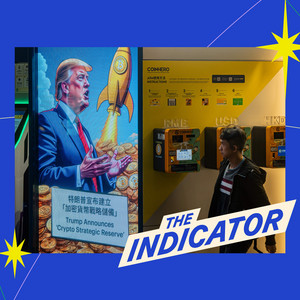
I'm Jeff Guo. And I'm Paddy Hirsch. President Trump's executive order earlier this month to create a Strategic Bitcoin Reserve and Digital Asset Stockpile made the crypto community's pulse jump.
Trump. The crypto summit that followed, however, was something of a letdown, and two weeks on, the world is wondering what was all that crypto kerfuffle all about?
Crypto evangelists had been hoping to hear that the government would be fully committed to supporting and buying crypto and that crypto gains would be exempted from taxes.
Now, on the surface, it doesn't seem like either of those things is going to happen.
Still, the creation of the reserve has raised a lot of questions.
Why did President Trump create this reserve.
Doesn't the U .S. need one?
Who benefits? Where's the money coming from?" And of course, what could possibly go wrong?
The answer to all of these questions and more, coming up after the break.
This message comes from Charles Schwab.
When it comes to managing your wealth, Schwab gives you more choices, like full -service wealth management and advice when you need it.
You You can also invest on your own and trade on thinkorswim.
Visit Schwab .com to learn more.
This message comes from NPR sponsor State Farm.
If you're a small business owner it isn't just your business, it's your life.
Whatever your business might be you want someone who understands.
That's where State Farm Small Business Insurance comes in.
State Farm agents are small business owners too and know what it takes to help you personalize your policies for your small business needs.
Like a good neighbor State Farm is there.
Talk to your local agent today.
This message comes from the John Dee and Catherine T.
MacArthur Foundation, recognizing extraordinarily creative individuals with a track record of excellence.
More information on this year's MacArthur Fellows is at macfound .org.
This message comes from NPR sponsor State Farm.
If you're a small business owner, it's your life.
State Farm agents are small business owners too, so they can help you choose personalized policies.
Like a good neighbor, State Farm is there.
talk to your local agent today.
Earlier this month, President Trump announced the executive order to create the strategic Bitcoin reserve and digital -as -it stockpile.
Here he is signing it.
To make America the world capital and crypto under your leadership.
Which is really going up, right?
Absolutely. And by creating this reserve, Trump's making good on a campaign promise when he pledged to hold on to all of the Bitcoin that the US holds or requires in the future.
Yeah, this is like the US government turning into a Bitcoin bro.
The US government is a Bitcoin bro big time.
James Brohl is a senior fellow with the Virginia Institute for Public Policy.
The government possesses a lot of Bitcoin in particular, and some other crypto currencies as having through law enforcement efforts basically confiscated, maybe even billions of dollars of cryptocurrency.
And so right now the plan is not actually to buy crypto, it's actually just to hold on to all of the crypto that apparently we have confiscated.
Yeah, we're not buying any yet.
And there's quite a lot of Bitcoin that we've confiscated, maybe as much as $17 billion worth.
It's quite a haul, right?
Netted over the years and seizures by federal law enforcement alongside the usual assets you might expect cops to net from criminal sting operations, you know?
The yacht, the Lamborghini, the Bitcoin wallet.
And it's not just Bitcoin either, the feds have seized all kinds of crypto assets.
In in the past, they've dealt with them the way that they've dealt with the yachts and the cars and all the other stuff that they see, so they just auctioned them off.
But now they're saying maybe they shouldn't do that with crypto.
Yeah, maybe not, because the government sold, for example, 500 seized Bitcoin in 2018 for about five million dollars.
But if it had held onto it, those coins would have been worth more than a 40 million at the time we recorded this, so God knows what it's worth when you're listening to it, and And you can see why Trump, who is on record saying you should never sell your Bitcoin, you can see why he might want to put a stop to that.
So he's put a working group on the case.
And so one of the tasks of this working group is to identify a number and where all this crypto is.
So if there is some kind of reserve, it could just be bringing it together in one central location, so it's housed in the same place.
Sounds reasonable. On the face of it, it sounds reasonable, but it's very unclear.
I mean, there's obviously a lot of risks with something like this.
Risks, yeah. We should talk about these risks.
Yeah, well, of course the first risk is with the currencies themselves.
Take Bitcoin, for example.
Everything depends on whether the price rises.
This is Ishwar Prasad.
He's a professor at Cornell University and the author of The Future of Money.
He says one of the unique things about Bitcoin is that only a certain number of coins can ever be made.
The supply of Bitcoin, it turns out, is limited.
There are going to be ultimately only 21 million bitcoins of which about 19 million plus have been created already.
And this is one of the big selling points of Bitcoin, and Eastwhere says you know, we've pretty much made all that already.
Yeah, and he says this ceiling on the supply of Bitcoin means that if the government becomes a big holder of it, even if the price goes up, it becomes very difficult for it to sell, and that's not the case for small holders.
They of course can sell it, because they'd be selling relatively small quantities which won't affect the price.
But if the U .S. government were to actually try to sell any of its crypto holdings, that would cause market turmoil.
In other words, there's a risk that we would be building a substantial reserve of a highly valued asset that we might not be able to monetize.
But Ishwar says there are also more profound risks.
He points out that the active involvement of a huge player, like the U .S. government, wouldn't just legitimize crypto assets in the eyes of the public.
It could also move markets.
In fact, it already has.
James Brole says it's not a good book.
There's a risk of conflicts of interest. There's a potential just appearance of corruption.
When you have people like David Sacks is the main crypto advisor to the president, and he's got close connections to the crypto industry.
You don't want to create the impression that they're benefiting or getting rich off some of these market movements.
Yeah, Trump himself could be at risk here.
He issued a meme coin ahead of his inauguration and he's named five currencies that would be included in this reserve.
Bitcoin and ether are the ones that most people have heard of, but he also named three others that are less well known XRP, ADA and Solana.
Eshwar Prasad says this illustrates the problem perfectly.
Solana is the blockchain on which Trump decided to issue the Trump meme coin.
So, increasing the value of the native token of that blockchain would potentially either directly or indirectly benefit Trump and his inner circle.
So there are rampant conflicts of interest here." And the final risk that Ishwar identifies is to the taxpayer, because right now the government apparently is not planning to buy up a lot of crypto.
But if you read the order closely, as I did, you'll see that the language does leave the were open and we could see the government buying crypto assets in the future.
That would certainly require taxpayer money, which in principle would also require congressional authorization.
In the present climate, though, it's hard to see the president being denied very much of what he wants by this U .S. Congress.
So it will certainly involve some taxpayer money being put at risk.
The argument that President Trump is making is that we should harness the power of digital assets.
But what does that actually mean?
And what does a reserve of crypto actually do for us?
There are reserves of oil where there is actually a strategic purpose because one wants to make sure that the US economy is not derailed because of limited supply of oil and the spike in prices.
I guess another type of reserve that we have in the US is gold.
Gold is a long standing safe haven as it is seen as something that is going to keep its price and could potentially serve as a hedge against inflation and so on.
So one might say, if you're going to have a gold reserve in Fort Knox, why not have a Bitcoin reserve as well?
There were notions that perhaps Bitcoin could serve a similar role.
But what we've seen is that Bitcoin is just behaving like risky asset, like equities, except it is much riskier and therefore much more volatile in price.
Right. And the question right now is, is crypto one of those things that we need and Eshwar, he doesn't think so.
It's not obvious that such a strategic reserve really has a strategic purpose to it rather than a purpose of basically boosting crypto and enriching the holders and promoters of crypto.
Now, all of this said, Eshwar and James aren't totally against the idea of leveraging an asset that the US government has managed to require without spending a single dime?
There is potentially a lot of money for the government to make, especially if they're holding onto these tokens anyway.
And if you squint, this crypto reserve kind of starts to look like one of Trump's other ideas, the US sovereign wealth fund.
Now, we spoke to James Brole about that concept a few months ago.
We'll link to that show in the show notes.
And here's what he thinks about where crypto might fit into that idea.
There's potentially billions of dollars worth of value here.
And if that were sufficiently independent from the President, and if it was set up in a more independent fashion like the Federal Reserve is a good example, then I think that you're moving more in the direction of what a reasonable sovereign wealth fund structure might look like.
In the direction, right, but true sovereign wealth fund would invest in assets that benefit Americans, for the benefit of Americans, James says, and the way that it looks right now, this reserve is entirely based on crypto.
It's not clear exactly what it is or frankly what its function is supposed to be.
This episode was produced by Lily Kirose with engineering by Jimmy Keely.
It's fact -checked by Sarah Juarez.
Kate Concannon is our show's editor and The Indicator is a production of NPR.
This message comes from InSparity.
Providing HR services and technology, from payroll, benefits, and HR compliance to talent development.
Learn more at InSparity .com slash HR Matters.