At Sierra, discover great deals on top-brand workout gear like high-quality walking shoes, which might lead to another discovery.
40,000 steps, baby!
Who's on top now, Karen?
You've taken the office step challenge a step too far.
Don't worry, though.
Sierra also has yoga gear.
It might be a good place to find your zen.
Discover top brands at unexpectedly low prices.
Sierra, let's get moving.
For Scientific American Science Quickly, I'm Rachel Feltman.
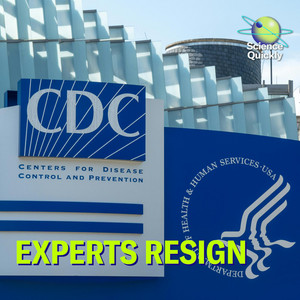
In recent weeks, several prominent public health experts have resigned from the Centers for Disease Control and Prevention, citing concerns about the agency's shift away from science-based decision-making.
Among them was Dimitri Daskalakis, who until recently directed the CDC's National Center for Immunization and Respiratory Diseases.
He's here today to tell us more about what's going on at the CDC and what concerned experts are doing to try to keep America healthy.
Thanks so much for joining us today.
Thanks for having me.
So to start, could you tell me a bit about your former role at the CDC and what you did there?
I actually, in my five years at CDC, had seven separate roles.
So I will just focus on the last two years where I was the center director for the National Center for Immunization and Respiratory Diseases.
So CDC is made out of centers.
That's what Centers for Disease Control and Prevention mean.
And So the National Center for Immunization Respiratory Diseases, which we'll call NCIRD for short, is the center that is responsible for a lot of vaccine policy and vaccine preventable diseases for the country, as well as the jurisdictional immunization programs and the very important Vaccines for Children program.
And how have things been changing there over the last year or so?
I mean, not for the good.
I think that with the installation of vaccines, the new Secretary of Health, Robert F Kennedy Jr, I was seeing a pretty significant shift away from sort of science-based work more toward this ideologic, almost authoritarian-style leadership coming from the Health and Human Services Secretary that didn't really value or listen to any expert information or advice.
You recently resigned, as did several other prominent experts at the CDC.
And the feeling in a lot of your resignation statements was that you felt that the CDC had become something so different from what it was supposed to be that you could do more work from the outside.
What do you think that's going to look like?
Unfortunately, I think my resignation letter was a little bit prophetic because literally right after I resigned, CDC put up a political manifesto as their mission statement.
That really again was all ideology and very light on science or public health.
And then we've seen the Advisory Committee for Immunization Practices, where the firewall between science and ideology and politics completely broke down.
And I feel like I'm sort of in a unique position.
I really understand what is supposed to happen and what the normal process is.
And so I feel like one of my main roles is outside of CDC is going to be to sort of identify when there are glitches in the matrix and when there are things happening that are atypical and things that aren't sort of going through a process that values science, before sweeping statements and policies are made.
And so I will have that utility.
For as long as I sort of have the awareness I can point at the chaos.
Yeah.
And what do you think some of the solutions look like for public health organizations outside of the CDC to keep America actually healthy?
Yeah, I think that this is like the key moment where, as someone who's working governmental public health for over a decade and in health care for two decades plus, it hurts me to say that I don't trust what's coming out of the CDC.
And as an infectious disease doctor, when I see patients and I have a question, that's where I go.
And so unfortunately, I think that we're seeing the decay of the quality of information.
And it's not like a random decay.
It is a specifically targeted decay to create an ideology propaganda machine that's Orwellian as opposed to a trusted health source.
So I think that the first is that this won't last forever, but it's what has to happen for now because of the way leadership is at HHS.
So I think that really a lot of the onus and responsibility now falls on.
I'm going to call them para public health, para governmental organizations that are actually using process and data to sort of generate sort of recommendations and, you know, in effect, replacement policies to make sure that the health machine of the United States continues to function, even as people are trying to destroy it.
I think that the answer is that those organizations are going to have to carry the water for a lot of this.
They're going to need to be the trusted voices for the folks at the front line, whether they're public health practitioners or medical providers.
And what I hope is that they are forming deeper and stronger alliances so that they are going, These states that are putting together coalitions, they're doing the right thing right.
Let's just be clear.
But it's going to create a tapestry across the U.S. that is about have and have nots.
So your California-Hawaii axis and your Northeast axis, they're doing great.
The question is going to be is there going to be something for the South and parts of the Midwest that may not have that political will that's necessary to lift up work, to make sure that folks are protected?
And if government funding which could be taken away at any minute and they have really created some levers where they're going to be able to potentially pull funding with not a good reason from a lot of jurisdictions?
Like how is that going to play out in places that don't have a tax base to be able to cover what the federal government normally provides?
Absolutely.
So, as you've alluded to, there are a lot of things going on at the CDC that do not align with the science and that are troubling.
So it can be, I think, kind of hard for people to keep up and know what to pay attention to.
So I'm I'm worried that the sort of ongoing effort to sort of identify programs that are somehow not ideologically aligned to the administration are going to be yanked.
And that's going to mean safety nets for people in the community are going to be taken away.
But even bigger, they're dismantling what CDC does.
And CDC.
One of the most important things that it does is it pumps out 80 percent of its money to local jurisdictions.
So if that starts to falter, then that means that when CDC starts to fail, their local jurisdictions are also going to fail.
And that's going to mean people are going to suffer.
People are going to get diseases and forget about infectious diseases.
What's going to happen with overdose prevention?
Hmm.
What's going to happen with syringe availability programs?
It's not ideologically aligned.
And going back to infectious diseases, we know what happens in environments where those services go away.
Disease outbreaks happen.
There are going to be HIV outbreaks.
There are going to be hepatitis C outbreaks.
There's going to be increased overdose.
So what I'm worried about is what's years and years of progress is going to get pulled back because people just want to break stuff.
And then, on the other side, vaccines.
I think that the advisory committee for immunization practices has now become completely irrelevant.
The problem is that it is still relevant to the people who need vaccines for children through that program.
So, you know, the good news is that they tried to break stuff.
During the ACIP meeting, what they broke was scientific process.
And so you can't trust anything that they're doing.
But the output of what they did could have been way, way worse.
But it still means that they now are able to flex the muscle and say, I don't like this vaccine.
And with no data, I'm going to remove it from the childhood schedule, like they did with measles mumps rubella, varicella or chickenpox combination.
Like there was no public health problem for which they were solving and they decided to just take that off.
I think the other part is that the only person briefing the president is RFK Jr.
And I think, what we saw in the most recent press conference, where they were talking about acetaminophen and autism, since there's no data that supports the assertions that they're making.
But what we saw was, I think, a terrifying preview of what RFK Jr wants to do with the vaccine schedule.
I feel like what President Trump said was at least based on something that was briefed to him by RFK Jr.
So are we looking at spreading out a vaccine schedule in a way that doesn't protect children, based on no data or based on RFK Jr'?
's decades old ideology that has not been proven by any science?
I think we have a dark future coming.
It won't be forever, but I think it's going to be dark for now.
What advice do you have for individuals in America who are feeling really anxious and fearful for themselves, for their children and also for their neighbors and loved ones in general, in terms of keeping people healthy?
What can people do?
So first, I think one of the things that we do in public health all the time is say how important it is to practice trauma-informed care.
So we very often don't turn that light back on ourselves, and that includes the people that we serve sometimes.
And so I think, as a public health leader, I'm going to start with some trauma-informed leadership for people and say it is okay to be scared because it's scary.
There are things happening that are not good for your kids' health and not good for your health and frankly, not good for the public health security of this country.
So my advice, other than that your feelings are valid, is I know that not everybody has a health care provider.
But where you do have a health care provider, you need to connect with them because they're going to have better advice than what CDC and HHS are putting out.
So if you're pregnant and don't know what to do with acetaminophen, talk to your OBGYN.
If you don't know what to do with vaccines for your kids, talk to your pediatrician.
If you don't know what to do with vaccines for yourself, talk to your primary care doctor.
If you don't have a primary care doctor, talk to your public health department.
See what they're recommending.
If that's not something that you want to do, talk to your pharmacist.
Really think about the people who are smart and know what they're doing and approach them.
And I guess one really important thing to say, which is like for people, a red flag.
I'm a doctor.
I take care of patients.
Even through a lot of public health emergencies, I was able to still see patients.
And one of the things that I know is that the relationship between doctor and patient, or any health care provider and patient, is a sacred one.
Whenever you hear anyone trying to destabilize that relationship, as the secretary is doing, you need to say that I don't trust that person, because that relationship is really what makes public health and personal health in the United States work, even though it's an imperfect system.
Yeah.
You know, you were at the CDC through some pretty serious public health crises.
The MPOX outbreak comes to mind as one that you've been credited with handling really beautifully.
So I'm curious if you could, using that outbreak as sort of a benchmark for comparison, could you walk us through how you think the current CDC is set up to handle a serious outbreak disease threat?
I'll start by just saying that my last few weeks were pretty hard, but the last eight months at CDC were awful.
And the reason that they were awful was because people who have no idea about public health were using like a break it strategy to do what they think is sort of refashioning CDC into some kind of different organization.
Outbreak response isn't just about the infectious disease.
So my MPOX response is something that I think is a great example of why this plan at CDC isn't good.
When I started working on the Mpox response, one of the things that I did was try to weave together different pieces of the US government's work to create what I called a syndemic response.
So Mpox is a syndemic.
That means interacting epidemics that, when they touch each other, make themselves much worse.
And so Mpox is an epidemic.
HIV is an epidemic.
Homelessness is an epidemic.
Drug use is an epidemic.
So all of those things converged to actually create a really bad MPOX outbreak.
So what I was able to do in MPOX was bring together mental health providers, housing providers, HIV prevention, HIV treatment in a way that generated an effective response.
So these people who are pulling CDC and the federal government apart don't understand that.
What you're doing is taking away the limbs of a response.
So maybe the infectious disease sort of work is like the heart or the brain, but it's not the arms and legs.
The arms and legs means you need all of those things to work together.
And so, as you see CDC being torn apart, 2000 people who are no longer there, years of experience centers that are being demolished, we are sorely unprepared for the next thing, even if it's not so big.
And I'm sitting here as an expert not only in infectious diseases but in outbreak and emergency response.
I'm looking at this, saying like the people who are tearing apart your public health endeavor have no idea how to do this.
It seems as if they've never responded to anything. which is true.
All of the people who are making these decisions are not responders.
They don't know how to do it.
And so breaking it without knowing anything about it is going to mean that the next MPOCs is just not going to go as well.
Well, thank you so much for coming on to talk with us today.
This has been really enlightening.
Thank you so much.
Thanks for having me.
And we definitely need your vote.
You can find a link to go do that in our show notes.
Thanks in advance for the support.
Science Quickly is produced by me, Rachel Feltman, along with Fonda Mwangi and Jeff Dalvisio.
This episode was edited by Alex Seguiera.
Shaina Posis and Aaron Shattuck fact-check our show.
Our theme music was composed by Dominic Smith.
Subscribe to Scientific American for more up-to-date and in-depth science news.
For Scientific American, this is Rachel Feltman.
See you next time.
Thank you.
Liberty, Liberty, Liberty, Liberty.
Savings vary.
Underwritten by Liberty Mutual Insurance Company and affiliates excludes Massachusetts.