The next generation of digital assistant will be digital twin.
You know, sometimes, you know, might be a very important meeting and I joined by myself.
For some other meetings, I might assign my digital twin to join the meeting.
My digital twin, not only listening to the meeting over there, but also can help me make the decision as well.
That's the world where we are going to live.
Welcome to The Logan Bartlett Show.
On this episode.
What you're going to hear is a conversation I have with co-founder and CEO of Zoom, Eric Yuan.
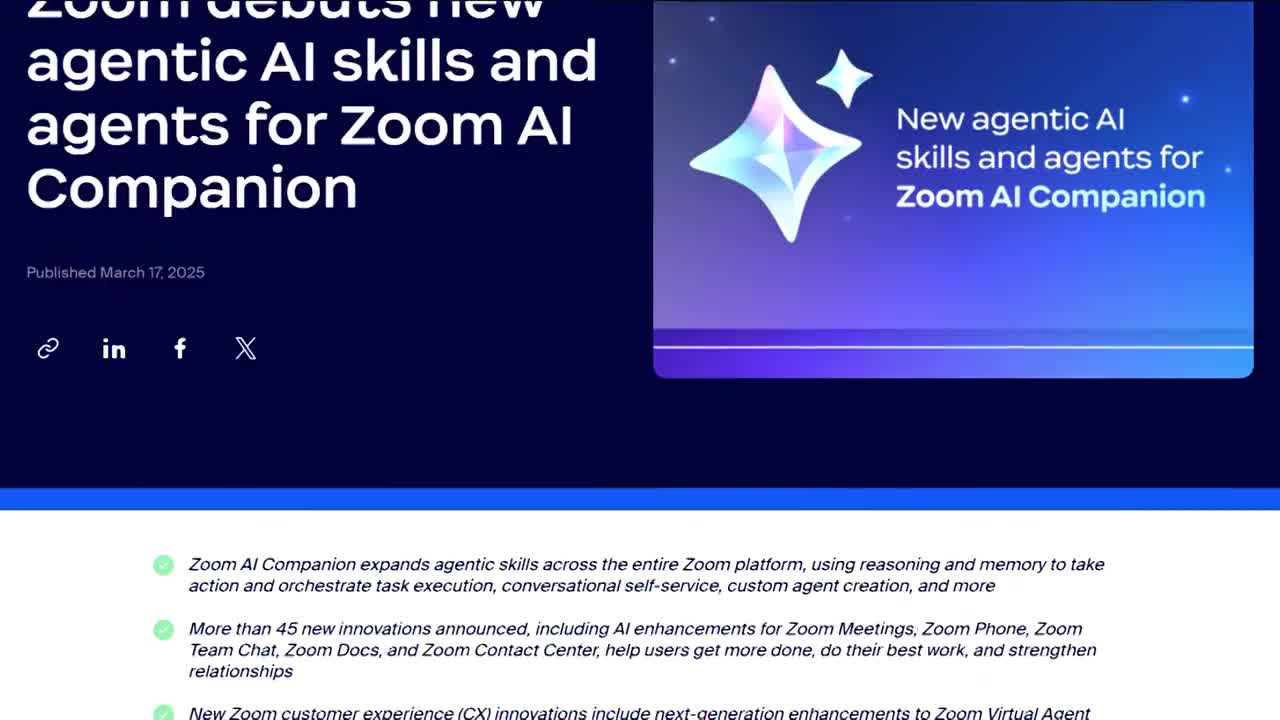
Now Eric and I talk about a number of different things related to Zoom, including the 45 different product releases that Zoom just announced this week, as well as what Eric sees as the future for Zoom in the AI world that we're moving into over the course of the next few years.
We also talk about the features that Eric thinks any person that uses Zoom should be using.
We also talk about how Eric prioritizes launching different features.
And finally, I get a question answered that I've long since wondered about the insight that Eric had in the early days of Zoom that helped lead it into the business that it is today.
A really fun conversation that I've long wanted to have with Eric that you'll hear now.
Thank you, Logan.
Awesome.
Thank you, Eric.
Great to connect.
So I guess I want to start off.
I saw the keynote today for Enterprise Connect was entirely about AI.
For people that maybe missed it, can you give just a brief overview of some of the stuff you announced?
Awesome.
Yeah.
So our Chief Product Officer Smith, she was at Enterprise Connect.
We announced a bunch of new innovations, including around 45 features, primarily in one AI company.
A year ago, we launched an AI company 10, which is, more like you know, based on the gen AI capabilities.
You know we just announced that Zoom, you know, AI company 20 with agentic skills, with agentic framework and functionalities.
You know, a lot of innovations around our Zoom AI company 2.0.
And what is, I guess, the shift?
The AI companion shifting from or evolving from a personal assistant to being truly a Gen Tech.
Can you give an example of what that means?
Yeah, so a good example, you know, take a meeting for this meeting, for example, right?
So normally, you know, after the, you know, prior to meeting, I need to prepare for agenda, right?
You know, write down the notes of the meeting.
I look at a summary, manually create a task.
That's the way it worked before.
You know, with Zoom AI, combining identical capabilities.
Essentially take this meaning, for example, after this meeting is over, you know, AI combining will automatically created some tasks.
You know, send it to you, send it to me and we'll check.
You know, after the meeting is over, right?
That's a, you know, agent is doing something, you know, on behalf of us.
Otherwise, we need manually to create the tasks based on the summary, based on the discussions.
I guess there's been a host of different AI tools that have popped up around meeting transcription and meeting summarization.
And how do you think about the role that you play as an ecosystem hub for players like that versus building your own uh solutions in in different areas that maybe relate to to zoom?
Yeah, good question.
First of all, you know we are offering our open platform.
You know third-party vendors they can build a transcription tools by themselves, right.
You know, given we have api, and at the same time, you know some of our customers, they would like a zoom to offer a seamless experience in everything from Zoom.
That's the reason why we also offer the similar capabilities.
Again, this is an open platform, you know, up to customers to make a decision.
If they want to use Zoom to build in.
You know all those.
You know AI capabilities.
You know like real-time summary or meeting summary, creating the tasks after the meeting is over.
We offer those the features.
All customers, they can go to any third party.
That's okay too, yeah.
My understanding is you all have been pretty purposeful about not charging for a number of the AI features that you guys have rolled out, which I think stands in contrast a competitor of yours Microsoft, who I think does charge for a lot of different stuff.
How do you balance the democratization of AI and the thought process around embedding some of this stuff into your core platform with maybe the potential to charge for these things because they are so valuable?
Yeah, great question.
So before we launched AI Companion, we already spent a lot of time on talking with the customers how to leverage AI to add more value for the customers.
And, you know, AI combining offers, you know, a lot of AI capability.
Those features or capabilities are core, you know, to our meeting business.
You know, and we look at everything from a customer perspective.
You know what's the total cost of ownership right?
So that's the reason why we you know we truly optimize our backend you know AI infrastructure and try to do all we can to make sure right that cost-wise very manageable.
With that, we can offer a greater service at no additional cost to our customers.
That's the reason why AI company usage is growing very well, like a quarter over quarter, 68 growth.
And because of no additional cost, because of the greater functionalities.
At the same time, some of the enterprise customers they would like to customize AI company right and deliver to our AI studio.
We can monetize on that front.
But core AI companion functionalities.
No matter how we innovate, we still want to, you know, give customers, you know, at a new additional cost.
As you think about these AI enhancements across Zoom, launching 45 of them all.
45 were announced today.
Yeah, not every 45 features are just AI companion, primarily AI companion related.
For sure.
We launched some other vertical services like Zoom, Workplace for clinicians, for frontline workers, and so on and so forth.
Is there one to two things as you started exploring AI in some of the use cases that were maybe counterintuitive to you.
Like when you set out sort of thinking about these things and the potential for Zoom to play in the world of AI, a conclusion that you reached that was maybe not totally obvious from the onset.
Yeah, one feature, we are a real-time collaboration communication company, right?
Take a Zoom call, for example.
Everything is one real-time collaboration.
And one feature like hey, what if, let's say, logging in, we are sitting together in a local Starbucks coffee, not on Zoom call.
When we meet in person, how to leverage AI.
So we launched a feature called a voice recorder.
Essentially, I just put my phone on the table. and one click launcher was recorded, right?
And we automatically recorded our conversation, generate a transcription and a meeting summary and assign a task, and so on and so forth.
That's a pretty useful feature, right?
And even in the Beyond Zoom call, that's one.
Another one are really, you know, it's my personal favorite feature, which is calendar management.
You know, like you and I want to schedule a meeting next week.
You know the way it works.
Today I need to call my EA right and talk with your assistant right to schedule a call.
You know, a lot of steps.
What if we leverage the AI company?
Hey, AI company, I want to schedule a meeting with Logan next week.
You know, it will automatically give us some options and make a decision for us.
That's very cool feature.
I assume a lot of these things are coming from the customers in some way, but how many of them do you think that more of these ideas sort of were surfaced in a bottoms up manner from individuals that sort of saw this in the field, and maybe they're an IC who had some observation that this is a way that it could work.
Or were a lot of these like top down from you or the leadership team and sort of setting the vision about where you ultimately want to go in collaboration with some of your big customers?
So great question.
You know, we are 75 hundred full-time employee company.
Top down post does not work.
I do not have enough bandwidth to do that.
Almost all the innovations are coming from bottom up.
So meaning you know, our innovation model at Zoom is always sit down with the customers, listen to their feedback or pinpoint very carefully and come up with a solution.
And then talking to customers, this solution work for you or not.
Almost all the innovations coming from that kind of a bottom-up approach.
I know you guys are very deliberate about listening to your customers and trying to hear what they're saying or maybe finding novel ways of addressing the pain points that they have.
Are there any lessons you've learned about conducting these customer interviews and trying to hear Maybe not necessarily what the pain point it is that they have, but what the problem that you can uniquely solve for them is?
Are there any techniques or styles that you've come up with in sort of conducting these case studies or these interviews?
Yeah, wonderful question.
So yeah, for sure we have a formula here.
Otherwise, this is great question.
Otherwise, you know, given the the our customers coming from, you know, online customers, smb customers, all the way to the fortune 100 companies, right?
So every day We received so many feedback or feature requests right,
If you do not have a formula, sometimes really hard, almost impossible to prioritize those features.
So our formula here is more like hey, when we talk to customers, we start from the problem statement.
You know, human nature and customers will say, hey, you should do this.
You should add that feature, right?
You should build these functionalities.
You know, more like give a solution.
And we always, we told our engineers, product managers, solution engineers when we talk to the customers, always ask what's the problem and make sure we are on the same page about a problem statement or pinpoint.
And then we work together with customers to try to understand what had happened.
What's the root cause?
And then, given we understand the problem, root cause, we work together to come up with a solution and then validate with the customers.
And then we are trying to build the product.
Otherwise, if you don't understand the problem and root cause, quite often customers say you do this way.
Yes, we are going to do as good this way.
Another customer told us, hey, you should do that way.
It's really hard to manage.
That's why here we follow the problem, root cause, and the solution in the framework.
How do you think about the areas that you have a right to solve those problems versus things that maybe are outside of your adjacency?
Like the calendaring example you gave, It's a problem we all deal with in a meaningful way.
And Zoom is the start of a lot of my, or at least one of the first things I do in the calendaring process.
And so I could say, it totally makes sense for you guys to go down that path.
I could also say there's a lot of things that are already integrated into the calendar or the email stack or whatever it is.
And maybe that's an adjacency that doesn't make as much sense for Zoom to solve.
And so how do you think about, like where your scope exists and what is inside the boundary versus outside the boundary, when you hear pain points from customers?
Yeah, again, we take Canada for example.
We look at everything from customer perspective.
Customer told us, hey, they are using Google Canada.
Yeah, we integrated Google Canada wherever.
We built a Canada client and we can talk with the Google backend.
Or we built a Canada client, can talk with Outlook as well.
At the same time, some customers say, hey, what if you offer the client a native service?
Not only client, but also server as well.
We also offer a native client service.
And some customers say, I want to stay with Google Calendar or Autoload Calendar.
We also have plug-in and to integrate it with other third-party systems as well.
Again, we know every customer is different.
We try to make sure, understand the customer pinpoint, and come up with a solution.
If a customer says I don't want to change anything, I want to stay with Google Calendar.
Okay, we have a plugin.
Where is that?
And that's the reason why our solution is very open and try to address different customers' requirements.
You know, it's really hard for us just to build one solution.
I do this way, can satisfy every customer's requirements.
That's not going to work.
That's why, you know, quite often, you know, sometimes we need to say, oh, this is our call.
This one, we can't leave it to third party.
You know, again, we want to make sure either we build up ourselves or we're part of a third party.
We always try to offer a solution for our customer.
As you guys made the shift to being not just a video conferencing platform or kind of a core application, of which video conferencing was one of the elements, to more of a AI first business.
Is there anything you did specifically in the early days of that shift that if someone else is going through something similarly or trying to think about how to internalize the opportunity of AI?
Is there anything that you feel like you guys did uniquely well, or maybe mistakes you made that you would impart to a founder?
Thinking about this,
We are way beyond a video conferencing company.
So a few years ago we already talked about how to transform our business from being a video conferencing app know to be our first you know work uh platform.
So essentially we look at the you know how customers in every day they work right.
You know open up the email, the calendar, send a china message, wire board, make a phone call, schedule a meeting and collaborate on document.
You know a lot of the tools right and the customer need to back and forth go to the different tools right to get the work done.
You know we think about how to leverage AI to give a customer you know, Zoom Workplace, the entire collaboration suite.
You know where, like this morning, I opened up Zoom Workplace.
I can live within a Zoom workplace, can get all of my work done.
There, I check my email, I send you a chat message, right?
I schedule a call, right?
I do not leave a Zoom workplace.
And also at same time, leverage AI.
You know, like used to be, I need to manually create a document.
Now I can tell AI company.
Please include a summary based on my last conversation with the partner to prepare me well for the next meeting.
My AI company, more like my assistant, will try to leverage AI to look at each service.
We are building how to improve that experience.
You know essentially you know down the road more like AI.
You know will proactively help me get most of the work done.
I just assist AI company to do that.
I know we have a lot of people that live in Zoom on a daily basis.
And so I'm curious if there's something that you've been using from an internal dogfooding standpoint.
Maybe that was a good example.
But anything that you would say hey, if you're not using this within Zoom's platform, you're just really getting a suboptimal experience.
You would encourage anyone listening to to adopt this tomorrow.
I think a lot of things right and you take a meeting, for example right, and you're 10 on air companion like i.
If i'm related to the meeting, you know.
I just you know, ping on air companion, catch me up right, it's a lot of features already available there.
You know, like in the live translation as well, a lot of the very cool features are already built in.
I sort of want to custom explore all those cool features.
At the same time, a lot of new services.
Again, take Zoom Docs, for example.
I think it's a very powerful tool.
It's not like Google Docs, not like the rest of the world.
I can create a knowledge-based wiki and create a table within Zoom Docs and track what's going on.
After the meeting is over, we automatically create a Zoom doc to track the meeting summaries and also the task and so on and so forth.
Another feature I really like, which is called Zoom Clips.
And very soon we are going to have features.
That's also we announced at Enterprise Connect, where you know I created so many videos, right?
I personally created videos.
You know it's really.
You know I would say it's costly.
You know how to leverage the AI.
I just created my avatar. and two minutes to hour.
I give it to our marketing team.
And down the road, they just use a script automatically generate a video.
For our next, you know, earning call, I'm going to do that.
With that, I do not need to pre-record anything.
And just in the marketing team, send the earning call script, we automatically create a video.
So a lot of features like that is very cool.
And we'll be on with the company's platform.
And unfortunately, you know, take some time.
Many of the customers, they did not realize.
Another example, we have a built-in chat functionality.
We call it a Zoom team chat.
You know, something like a Slack or Teams.
We had that for many, many years.
You know, a lot of, you know, bigger customers will deploy that.
It's a great built-in service and you know we created, you know here i live on the zoom team chat.
Right, i sent all the channel messages with my team, with all hands.
You know our offer all has a meeting and we also have every meeting.
After the meeting is over, we could try to proceed to the chat group.
I can continue engaging with our employees.
There's another powerful tools in a lot of our customers, they are not aware of that.
Customer education is obviously.
As your surface area increases, it obviously becomes more and more of a challenge for the salespeople, for the product team, for product marketing marketing, whoever it is.
Have you found that doing one big release, or narrowing the number of times at which you're releasing and announcing features, has led to better customer education?
Or do you guys still ship when the product's ready and work on catching up and communicating later on to the customers as needed?
Yes, great question.
So, given the size of a company, given the so many customers and the speed of innovation is still extremely important.
You know which is the reason why every time I have so many.
You know the new features because again, we are a workplace, you know, a platform.
And also we have been in the services like a Congress center.
You know, a lot of new services, new features.
The key is really not about all those innovation.
The key is how to, you know, easily, you know, have a customer discover those features.
And make sure, you know, at the right context, right?
Like take the Zoom docs, for example.
You know, customers, they are not aware of this feature.
What if we think about a use case where, after the meeting is over, we automatically created a Zoom doc where you have a meeting summary?
With that, we can expose those new services and new features.
So we got to think about it from a customer's perspective how to embrace those new features rather than we leverage marketing.
That may not work given the so complicated you know the services we built or not, because we have so many new things right.
So that's kind of for the effort we're working on.
And to, you know, take a meeting, for example, right?
After the meeting is over, and we should tell you where to find, you know, the meeting summary template, rather than before the meeting.
We should tell you oh, you should use a meeting summary template, how to customize, so on and so forth.
Right,
So that's kind of our strategy.
As you zoom out and sort of look forward, what do you think the future of meetings looks like?
Maybe in i don't know three years, five years, ten years whatever time horizon furthest out you feel comfortable projecting?
Um, are there any things that you've internalized that maybe wouldn't be obvious to just?
You know, the average person going about their day using zoom?
I think the future.
Just look at a meeting experience.
I am very excited about the potential and you know innovations.
You know like you know a few years later right,
So in how to make sure every meeting experience is very immersive.
You know, more like you and I, you know, sitting together, right?
And, you know, local Starbucks coffee, right?
And a very immersive 3D, you know, experience.
And also, you know, and if I shake your hands, if you can feel my hands shaking, that's even better, right?
That's truly immersive.
That's one thing.
Another thing is given the AI evolution.
We are building the digital assistant.
But the next generation of digital assistant will be digital twin.
Sometimes it might be a very important meeting and I join by myself.
For some other meetings, I might assign my digital twin to join a meeting.
My digital twin, not only listening to the meeting over there, but also can help me make the decision as well.
That's the world where we're going to live.
You have AI, you have AR and together we will make the meeting experience very immersive, very intelligent.
And so at a literal level, so that people understand it.
I think unpacking the concept of a digital twin would be helpful.
And so can you just go through at a very tactical like, what you mean by that?
Is it going to be avatar based?
Is it um uh, the decisioning side?
What is it trained on?
Can you just give like a little bit more granular insight into it?
Sure,
I think more like a two-step approach.
The step one is more like a digital assistant based on my digital avatar and also all the information I can access.
You know, my digital assistant can access as well.
Essentially I have a personalized LRM and also my email chat message whiteboard meeting, you know transcription, any information I can access.
The data also will be fed into my personalized, you know, LRM.
You know, it will be part of my digital assistant.
That's more like step one.
The step two a lot of knowledge.
Here you know how to make sure, let's say, I download all my knowledge from my brain, right?
Somehow to figure out a way to train my digital assistant.
Then my digital assistant would be evolved into a digital twin.
Right.
I think that's step two.
I do not think it's ready yet.
We might need some neuroscience breakthrough.
I think that's kind of two step approach.
And how do you think about resourcing against something like that, that that might feel far off to the average person and the digital twin.
How do you think about the allocation of resources or RD development to something like that versus the standard products that you're selling today?
Again, you know most of resource, you know are working so hard on addressing, you know, customers.
You know today's, you know the needs, right.
And or maybe nexus, you know a few months, few quarters, for sure we have some engineers.
You know work on work on the photo feature task right maybe, you know, may not be, you know, ready for one year, two years.
You can call that a lab, right.
So you know More like cutting-edge technology, right.
And we target it for the future.
So more like you know, and most of our engineers for sure, and they build the foundational technology, you know, add more features, you know, AI combining, so on and so forth.
We also need to think about the future as well.
I think probably 90 are working on today's features and services, 10 reserved for the future research work.
You guys obviously have access to a bunch of sensitive information and trust is such an important point of what it is that you guys do from a security standpoint, data, all of that.
There does seem to be this tension that exists with a lot of the AI products today, of a desire for the copious amounts of data that people can access, with the need to ensure user trust and confidence with either existing or potential customers.
I guess can you just speak to this and how you guys think about where the bright lines are.
That exists between the data that you wanna train on and enable versus the data that you keep totally separate and is totally sovereign to the individual customer.
Yes, great question.
First of all, Zoom is a very, very secure platform.
They take security very, very seriously.
That's the reason why today, look at almost all most of the security companies worldwide they all use Zoom because it's very secure.
But you know, take AI or data privacy, for example.
We are the first vendor who made it a commitment.
We do not want to use any of our customers content to train our AI model.
Period, right?
So we made that a commitment.
So you know, you know, we just we have we built our own large language model, but it used, you know, and we use the popular data or maybe you know, part of a third party.
We never want to use our customer data.
You know, that's kind of very, very clear.
And if customers they want to like a thing on this AI company, they wanted to get the meeting transcription.
We also very, very flexible, the policy.
Like a customer say, I do not want to have any data after the meeting is over.
I just needed the meeting summary.
We have a zero, the data retention policy right automatically, you know, deleted all the transcriptions, so on, so forth.
And some customers say i don't, i want to make sure this meeting extremely secure.
I do not have any company, it's okay.
We supported in the encryption, which is the first vendor you know who claimed the post quantum end-to-end encryption.
We also support that as well.
Again, the data privacy is extremely important.
And we look at everything from a customer perspective.
We do not want to make a decision for a customer.
Like, hey, for this meeting transcription, we should keep it for three months, six months.
No.
We give a customer choice.
Let a customer make a decision by themselves.
We touched on a little bit earlier about your obsession with the customer.
I'm curious was there an example in Zoom's history maybe of a product that became important, where customer feedback maybe directly altered a direction that you were headed from a product roadmap standpoint in an unexpected way?
Yeah, it's happening every day.
You know, I give one example, like last night at a dinner with a customer and again you know, our ai, you know a companion, is based on a federated approach, meaning we have our own large language model with llama or open eye and sopric, you know, and this is a federated approach, And some customers, especially for financial institutions, they say they want to just use a Zoom air, combine our own model.
We give them a choice.
Or you can use all the models together as a hybrid.
There's some confirmation, I just want to use Zoom iCompany, maybe with Anthopic.
I just use those two.
Do you support that?
Today, we do not support that.
It's a Zoom-owned Latin American model or federated approach.
When we get those feedback, customers say you know they want to pick up Zoom.
Our own large-language model is one of the cloud-based large-language model.
At this moment, do not support that.
But based on feedback, we are going to support it very, very soon.
You know, those kinds of feedback we receive every day.
That's the reason why you know our innovation speed.
You know truly help us stand out compared to any other competitors.
Based on the customer feedback, we can quickly innovate.
And very soon we are going to give a customer flexibility.
They can pick up whatever the last language model they want to use.
In terms of your stylistic approach to running the business.
There's been this refrain around, I think founder mode was the term of Paul Graham and I think he attributed a lot of the distillation coming from Brian Chesky.
For lack of, or for a good synthesis of, at least how I think about it, it's empowering the founders to sort of make centralized and maybe gut based or forward looking decisions that ripple through an organization, which I think stands in contrast to a lot of executive empowerment and probably elements of delegation as well.
I'm curious do you gravitate to being more hands-on and in the weeds of the individual functional areas, or do you tend to stylistically approach it more from a delegation standpoint?
Yeah, I like that conversation between Paul and the brand.
I really, you know, love that.
I think most of the founders, I think probably, in my view, is extremely hands-on and i know, from the day when i started, you know 2011 until today, you know it's still very, very hands-on.
You know, and sometimes you need a delegate.
Quite often you know it's hard to delegate right, you really as a founder right, you know you, you know, let's say, you know, when customers ask us a problem, You know, I really look at it from CASA perspective.
I could have delegated to you know, my direct report and then delegated to another, you know manager, and then talk to the engineers.
I cannot wait.
I've immediately had a Zoom call with one of the engineers, as he's trying to understand what's the problem.
When can we come up with a solution?
Can we deploy this weekend?
This is happening every week.
Like a founder, I truly care about everything.
And also the speed is very important.
That's the reason why sometimes you have to be extremely hands-on, to talk with the individual contributors and get a thing done as quickly as possible.
Because every day customer might be suffering from those issues.
That's the reason why you have to be extremely hands-on, sometimes a little bit of macro management.
But again, the goal is to make sure they deliver happiness to our customers.
As long as I have that goal, I really do not care about a delegation or not a delegation.
I just want to get the work done.
That's it.
You all have gone through different journeys over the course of the last couple of years.
I guess every business has, but you guys uniquely, Certainly we're enabling infrastructure for a lot of us just to survive with friends and family and then also do our jobs over the course of the pandemic shutter, to think of what the economy maybe looked like, absent zoom for, for all the stuff that you guys were able to enable.
And then there was sort of this zero interest rate phenomenon that we all went through, and then we've we've sort of had the hangover of all of all of that stuff that's happened since then.
I'm curious, as the as the dynamics in the market have changed, how has your culture evolved?
How have you thought about shifting the internal values or whatever are the case?
Or maybe not, maybe you've kept them consistent all the way through.
I'm curious, like in going through these different cycles, How you thought about what to iterate on versus what to keep consistent from a cultural standpoint.
Yeah, Logan, that's a wonderful question.
You know, speak of a culture, that's one of the things that keep him up, you know, in the night.
The reason why.
You know, prior to the pandemic crisis, you know we were a relatively small company 2500 employees.
And I know almost all of them, right?
So and we had a great culture and every day we are working hard to truly deliver happiness to our customers.
Look at everything from a customer perspective.
You know, whenever we, we we go to any escalation, everyone wants to see it.
Can we deliver today?
Can we deliver this week?
We have that mentality.
But during the COVID crisis, given the service demand, we had to recruit so many new employees.
Essentially, within an 18-month window, we hired around 6,000 employees.
On the one hand, we had no choice but to hire many employees.
On the other hand, I made a mistake.
We hired new employees too quickly.
I can tell you the company, the culture was broken a few years ago.
You know, we are almost, you know, fixed the company culture problem, right?
The reason why is, you know, sometimes we do not look at everything from customer perspective, always from looking at it from internal perspective.
Oh, we should have added this process.
Oh, we should do this, do that.
We forgot everything we do here.
We got to make sure customer feel happy.
And we lost that.
And all this, you know, we are trying to fix that problem.
You know, users, you know, recently we just published our culture playbook.
The goal is to make sure everyone really understand why we're working so hard here.
What's the goal?
You know, our company value is just one word, which is care.
You know, care about the community, customer, company, teammates, as well as ourselves.
If we do not care about the customers?
No matter what we do, we still have innovation customers.
They do not care.
What they care is what we can deliver our services and more value to our customers.
When customers use our service, they feel very happy.
Wow, it just works, right?
That's the reason why, you know, we are working so hard.
And again, you know we are almost there.
And to fix the culture, bring our you know, previous great culture back.
We are not there yet.
Hopefully by the end of this year.
I told our team it might take us three years for us to bring the greater culture back.
This is the third year.
I know one of the values or things that you guys think about is the continuous improvement element.
And I think that's one of the things that you try to instill into the culture.
Are there ways that you actualize that at a personal level, things that you do, that you think enable you to continuously optimize and be a better CEO leader manager, whatever the case may be?
Yeah, yeah.
So here you know again, as i mentioned earlier.
Well, a culture, a playbook, which is the nine principles.
You know uh uh, one of them is in how to develop ourselves to become a better one of a self, myself included.
You know, when you know one of those uh, the culture principle is a daily self-reflection.
You know, I want to become a better CEO every day.
I want all of my.
You know the managers, engineers.
They also become better engineers, better managers as well.
You know, what's the formula?
Right here, no matter how busy we are, you know, and we always carve out like 15 or 20 minutes time every day.
You know, very likely at the end of the day, you know, think about hey, if I start over today, what I should do differently.
Do I miss anything?
Do I receive an excursion from a customer?
Do I respond to this customer or not?
So it's more like a daily self-reflection.
This is one of our core principles.
The goal is to make sure all Zoomies become better, then the company will become better.
Right, if our employees, myself included, we do not become better in a world of ourselves, there's no way for zoom to move to the next level.
You guys have moved back to more in person in office culture and day to day of work.
I'm curious.
It seems like most of our companies have landed almost back to where they started uh the pandemic that if they were remote, they're still remote.
If they were uh in person, they've kind of moved back to in person, plus or minus.
I guess one of the challenges that i see um is there's there's still elements of this hybrid work that we haven't totally figured out.
At least a lot of my companies haven't exactly figured out the best way of operating in a hybrid environment where some people are in person and other people are remote, and making everyone feel like they're on the same team, albeit maybe the meeting is a little different because there's some people in one room and some people on the Zoom screen.
I'm curious.
Are there tactics you guys have taken or anything that you've done to enable hybrid work to work better or make everyone feel like they're on the same page in a meeting?
Yeah, yeah.
So first of all, i would say every company, every business is different and the way for them embrace hybrid, hybrid work also different.
It could be five days in office, five days remote.
Right, it's it.
You know, Either way works.
In the case of Zoom, we are more like twice a week in office, three days remote work.
The reason why we embrace hybrid like that is because a lot of our customers they embrace hybrid work.
We build features and services for our customers.
If we do not eat our own dog food, how can we build a better service for our customers who leverage our service to embrace hybrid work?
I'll give you a few examples.
In the case of hybrid work, quite often some customers they told us hey, They need their employees to reserve a desk, you know, before you go to office.
And that's the reason why we built a service.
You know Zoom Rooms.
You know a desk reservation feature right,
To help a customer reserve a desk, right?
That's the kind of feature like that.
Also a lot of customers hey, we need back to office and a conference room experience is different.
You know they.
They do not like the experience where you know if you're not in the common room, you're not a, you're not a part of a competition based on that account.
You know the feedback.
You know we.
We add a lot of features and to improve our conference room experience, like intelligent director in multiple camera support and make sure every participant is sitting in the conference room.
You know, from a remote perspective aside, they see a zoom square and more like.
You know the the when they all join a meeting remotely right.
A lot of features because we support hybrid, because the customers support hybrid, because we listen to customers.
That's the reason why we can launch a lot of innovations to support hybrid work.
There's a very famous story of your founding and working at Cisco and WebEx, and all of that that, I think, has served as something of a template or an example of founders striking out from within a bigger enterprise when they have a unique insight or opportunity.
I'm curious, if we go all the way back and look at the product insight that you had at that time, if you were to distill down what, the one to two things that you saw that were unobvious to the rest of the market what, what were those things?
And i guess, how blaringly obvious were they to you?
Was it a thesis, or were you pretty convinced that those were?
It was inevitable that we were going to move in this direction, and so you were pulling your hair out, trying to convince people that this is where where we were headed.
Yes, wonderful question.
So I started 2011, right?
The year before I started Zoom, which was 2010.
At that time I spent a lot of time on talking to the customers already realized the future of the conference will be the video-centric.
It's not a screen-sharing-centric.
You know, that's very clear.
And unfortunately you know, the web as architecture is not about video, really about data collaboration.
You know, I realize there's no way you have a best video conferencing experience unless you build a formula, going up with a new architecture very, very clear.
That's the one thing.
The second thing really about the mobile experience and also meaning you know, like you know, let's say you and i that join like back then, like cisco telepresence, you know from the comp room, but some participants they should join via their phone.
At that time there was no support.
So many of the second problem, meaning it's more like no matter which device you're using, either the laptop desktop, mobile phone, the conference room you have to have a consistent, great video experience.
That's the second thing I realized.
You have to build it also from the ground up.
Those two things I realized, and there's no way to tweak WebEx.
You have to build a new solution.
That's how I started Zoom.
Did people disagree with either of those two insights or did they just or I guess was it the first insight that people disagreed with that it needed to be fundamentally re-architected, and that was sort of the resistance within the organization.
Well, I think, a good news.
All the engineers agree with me.
Yeah, everybody else it disagreed.
So what is the lesson?
And i don't want to disparage cisco uh, but i'm curious what is the lesson in that for other um companies that that maybe would be faced with a similar situation, that that that maybe isn't identical but has some rhyming elements to it?
Are there things that you've internalized about that that you want to make sure um you, you don't let ever occur within zoom because uh, you know they just it led to this outcome for cisco.
Yeah again, don't get me wrong, Cisco is a great company.
No, I know, I know.
I want to use it more as an abstract example than Cisco.
So my point today is this is a lesson I learned.
It may not work for others.
I would say sometimes, if you really listen to customers carefully, you do not ignore them, you are not going to miss a big opportunity.
That's why. don't ignore an engineer's feedback.
Meaning you also as a special founder or senior executive.
No matter how big a company is always, always keep a very close relationship with those individual contributors, like engineers also very important.
Everything going on, you know, if you do not stay close, you know, so many layers may not work.
I've long attributed something to Zoom's early days.
I was at Battery Ventures and we were investors in BlueJeans which, for people that don't know, was an early competitor of yours.
And actually, I think initially it was out in front, particularly in the enterprise market.
But one of the maybe this goes to the re-architecture point, One of the things that I always thought you guys got uniquely right, and maybe this is just me making it up in hindsight.
So I'm curious your perspective on this was that video conferencing was as much about uh audio, or maybe even more about audio than it actually was video in the early days.
Because there's an element of tolerance that people can have if your video cuts out a little bit, but if audio cuts out, it ruins the meeting altogether.
I'm curious.
I've long attributed that to an insight that you guys had in the early days, but i don't actually know if it's true or not.
Is that?
Is that actually?
Is that actually a true observation that you guys had, or have I just reverse engineered it?
Yeah.
So yeah, Boregian is the founder and the CEO.
Chris is a great friend.
I think the insight from Boregian is right on.
I completely agree.
If a voice doesn't work, nothing matters. you have the new voice first.
Again, that's very complicated.
You know voice OIP essentially in my view.
You know it's sort of a conflicts with the TCP IP that don't work.
You have to figure out a way to make a voice over IP work.
No matter what kind of bandwidth, no matter where long distance there's a very unstable internet.
How to make the voice oip work again, that's not that straightforward.
That's that's the reason why, even today, you know some of our competitors.
You know the voice quality is still not very good.
So that's another reason why you know customers really like our service.
It just works.
So voice and video and extremely important when it comes to quality.
I feel like companies often have a window of time that they could start and have the success that they did.
Do you think if Zoom were started three years earlier, would it have been too early to the market?
Or do you think it could have worked some period of time earlier?
Yeah, wonderful question.
I also thought about that question as well.
In my view, I think two or three years earlier, probably even better.
But five years earlier, for sure, I already died, I think.
And what was that?
Just like the architecture primitives of building in the cloud.
Decisions you would have made around that time had it been five years earlier, versus two or three.
Because five years earlier, at that time, let's say 2016, right?
And we started, even have normally two years, you have a solution ready.
Let's say 2017 or 18, you have a solution ready.
At that time, You know, mobile phone with a camera, none of that, you know, popular, right?
A lot of laptops don't have video camera yet, right?
When you have a solution, you do not see a demand.
You might have to, you know, sort of, you know, ask a question.
Do I build the right solution?
Why do you not see the demand?
Actually, sometimes you're ahead of a market.
It's very, very risky if you're ahead of a market.
The reason why human nature, we do not have patience, right?
Oh, we build a solution.
If you do not see the market, the demand, we might be able to do something else.
Then you might miss the market window.
That's why timing is very tricky.
For three years, I think it might be okay, so.
Yeah.
Yeah, I was.
There's Emmett Shearer, who is the CEO of Twitch.
Founder of Twitch said one time to me that the job, if you start too early, your job is to survive.
And if you start too late, you might not have the opportunities.
And so better to be early than late.
And you just need to make sure that you survive long enough to catch the wave.
I've always thought that's an interesting way of thinking about it.
Yeah, right on.
Yeah, I totally agree.
I'm curious in the early days when you were rejected a number of times, if I have this right from Avisa in trying to come over, I guess one do.
I have that right.
And two.
If so, Was there anything that you learned from that experience that you think has enabled you to be the founder that you are today?
Or is that just an unfortunate circumstance that you don't want people to have to go through?
I think looking back, seriously, that's a great practice.
So meaning, I think that God already originated everything.
When I was young, already practiced, never give up.
If I give up, you know, that's kind of why I never had a chance to build a company like Zoom.
And I tried it multiple times.
At that time I told myself You know, I will try, you know as hard as I can, you know, maybe a few years, as long as they they.
They told me I can.
I just keep trying, keep trying.
You know, once you learn and perseverance extremely important when you start a business, right.
You know, if you're the one product that don't work, try again.
When business don't work, try again.
Keep trying, keep trying.
Someday you might achieve what you want, and dream might come true.
Again, don't give up too early.
That's what I learned.
How did you maintain that confidence to keep plowing ahead, either with Zoom or with your visa process?
Because I would say there's a thin line between crazy, stubborn people who never get to where they're going, versus the people that build the iconic companies.
And um, maybe it's just the success that's the determinant of which side you fall on on that.
But i'm curious just from a psychological standpoint, the fortitude to keep going.
Was there any anything that um, you feel like uniquely enabled you to to do that?
It's a great question.
So in my view, sometimes you are stopping on the right thing.
You're lucky.
Yes.
Stopping on the wrong thing.
Oh my God, that's bad luck.
So, but how to make sure, you know, you are working on the right things.
I think you know, in my view, in multiple things you know, always look at everything from a customer perspective.
Put yourself into customer's shoes.
The second thing is you have to have a mentor or maybe someone who is smarter.
You can count on always get their insights.
That's the second thing.
The third thing you also need to talk to yourself every day like a Zoom-wide daily self-reflection.
I always ask the question, am I working on the right thing?
Am I becoming a little bit more stubborn in this right period or not?
It's kind of every day you got to talk with yourself, talk with the customers, talk with those people who are smarter than you.
Then you try to make sure you're working on the right things.
Try to make sure sometimes don't be too stubborn.
So it's a little bit tricky.
That makes sense.
I'm curious the early days were there things that were not scalable that you guys did in the early days that enabled the success that you ultimately had?
Kind of brute forcing some things initially.
Yeah, there's so many, yeah, you know, examples.
One example is early on the capital market pressure, you know, we built a voice or IP, you know, and for the PhD in service, which is a phone call right.
We did not build it by ourselves.
We were saying, ah, customer might be switching to the voice or IP.
They do not use a phone, right, to join a call anymore.
We were wrong because we're part of a third party and we did not build by ourselves.
And when we launched the service, the quality is so bad.
You know, customers, you know, they complain, we realize.
You know, don't look at it from our internal perspective.
Look at it from a customer perspective.
I think we quickly, you know, fix that problem, build our own service and fix that problem.
Let's learn, right?
So quite often you know when you think and you do not need a PhD in service.
You do not look at it from a customer perspective.
We did not validate it with many customers and we made a mistake.
In terms of hiring, you've built out a leadership team.
I know there's been different evolutions over the years as you've grown.
Are there things that you specifically look for in any person that joins the company or specific things that you uniquely try to validate in an interview process that someone has that will allow them to succeed within Zoom's culture?
Yeah.
So yeah, a little bit, we were, you know, sort of took a little bit of different approach early on.
You know the way for us to build each functional team.
You know.
You know quite often you might hire a leader first, like you know.
Let's take a marketing team, for example.
You hire CMO first and a dedicated CMO built a marketing team and so on and so forth.
We took a different approach.
We wanted to build a team first with quite a few individual contributors.
And afterwards, we hired a leader to make that department more scalable.
We took a bottom-up approach.
The reason why is, what if you hire a wrong leader?
Right?
Wrong leader hired the wrong team.
If they don't work, the entire team, you know, might be gone, right?
So that's why we take a bottom-up approach.
That's one thing.
The second thing when we try to hire the you know, the employees, we always look at it as self-learning and self-motivation.
Because startup, you know, tons of work.
Even if you do not sleep, you still cannot get work done, right?
How to make sure every employee is motivated by themselves.
They can learn everything by themselves.
That's extremely important.
When it comes to hiring senior leaders, we like those leaders who have greater potential.
They can grow themselves along with the company growth.
That's the reason why we did not hire any like VP level leaders from any other company.
It's just a medium level, you know, managers or the regular level, right?
They joined Zoom, you know, very energetic, right?
They learn a lot of things along with the Zoom growth.
That works so well.
But now we have to change.
You know, given the size of the company, you know those are the seasoned leaders, you know for sure will help us more.
That formula will not work anymore.
So meaning a different kind of company growth.
You have to look at.
You know that formula is still working now, right?
That's the reason why you know look at, we just hired a CFO for Microsoft.
You know the CTU also for Microsoft.
They're all great leaders already in the corporate VP level from other companies.
Is the insight on the VP side, in those scaling days and hiring people that maybe haven't done it before, or trying to bring in people that were higher on potential than experience?
What was the insight or the desire to gravitate towards that?
Was it so that they weren't calcified in their ways and that they could absorb Zoom's culture without being too stuck in how they historically did?
Or was it something else?
The culture of faith, for sure, always the number one.
Assuming that, you know, all the leaders are hired, there's a culture of faith, right?
The second is really about experience.
Sometimes you have a great experience, it may not help you.
If you didn't know how to learn, because every company is different, right?
The amount of leverage, the experience they gain from working with others.
They come to Zoom, you know.
Just tell us I do this, you do that, even without understanding our problem.
We do not like that.
We would like those leaders who come to Zoom in the very hands-on, really trying to understand the problem.
And then, you know, based on their experience and come up with a solution.
And that's the learning, a self-learning mentality, extremely important.
I think even more important than their experience.
If they learn quickly, they can gain tons of experience at a startup.
So that's why we prioritize self-learning and self-motivation.
I'm curious if you could go back in time and tell your 2011 self something that you now know, 14 years into the journey.
Is there one thing that stands out that you wish you could press that time machine and go back and impart upon yourself way back when?
Great question.
That's too many things.
I made tons of mistakes and I would like to tell the younger version of myself.
And yeah, it's so many things.
Maybe one thing I'll tell you actually, you know, we got a great support from VCs.
We raised it in total 145.5 million.
And when we go public, the day we become a public company, the money we had in the bank more than what we raised from VC.
I think looking back, that's a huge mistake, a huge mistake.
You know, we should be more aggressive and build a lot of new services, right?
The reason why you get a money from VC.
You have to be smart.
How to use that you know and build a new services, new features, you know and new stuff.
And I was too conservative and always try to achieve cashflow positive.
Looking back, that's a big mistake.
That's a great commercial for my business.
I appreciate that.
We need founders to continue to take our money.
And some of these businesses are growing so fast these days.
Yeah, it's a good lesson.
I guess in picking those areas, do you think that, like in using that capital and being more aggressive in going into different areas, were there?
Were there certain things that you ended up just doing later that you would have pulled forward?
Or do you think it would have been a different set of problems that you would have gone after had you done it in 2015?
16, 17 versus 2020?
Yeah, because early on again I spent a lot of time talking to customers who already know what they need.
They want to have a full, you know, UC solution, right?
And the meeting is the first one and the chat and the phone and a lot of things.
They already told us.
I knew that.
At that time, maybe when I started the company, I was age 41.
Age might play a role.
I was too conservative.
I want to build a step-by-step.
Looking back, it's absolutely wrong.
The reason why when customers say, I really need a phone service.
We do not have that.
It took us almost two years.
Three years ago, we launched a contact center.
That should have been launched maybe five years ago.
Meaning, if you understand the customer's requirements, why not build it now?
Why you take a step-by-step approach.
Know, that's the reason why, you know, today we look at a lot of new services, are working so hard in the pipeline.
You know we should have started a few years ago.
Right, can we have, we have a capital.
But just, i just made a mistake, you just made a wrong decision.
So Are there things that you spend more time on now as a founder CEO that you wish you had focused in on earlier in the journey?
I often find sometimes People don't lean into enterprise sales or they maybe delegate in some ways and end up stepping into other functional areas.
Are there things in your day to day that you spend more time on now that you wish you had done a few months or years earlier?
Yeah, I think one thing is really about think about.
It used to be.
We only look at it like you know.
We only build like a one-year plan.
At most, one and a half years.
We do not think of what, you know, what's the Zoom look like in five years, 10 years.
You know prior to becoming a public company, if you have that more like a long-term planning or five years planning, today is a much better company.
That's the reason why I learned hard of it, right?
That's why I always think about, hey, in three years, five years, what do we want to achieve?
And, as in you know, based on what we have today, we've got to just start working on those kind of stuff.
More of the long-term planning is becoming more important, more and more important, you know, given the size, given our public company.
And we did not do well before.
It's always, you know, short-term focus.
And that's something, you know, I think I learned.
You've been fortunate enough to pick investors in the private markets as well as the public markets.
Anything that you've learned about picking who to who to work with, that you would impart upon a CEO or someone that's thinking about how to pick who are going to be the partners on the cap table yeah, so yeah, early on, i had a philosophy.
I today is still very very, you know.
I think about it.
You know, to me is the two things first of all, i want to pick someone i can work together with.
Some, you know forever, You know more like you know startups.
You know it's a long journey, right.
Could be 10 years or maybe 20 years.
You pick up a partner, you know, you can become your great friend.
You can work together, you know, even not for business, but must have something else, you know, forever right.
It's kind of a, you know, lifetime friend.
That's really important.
That's the number one thing.
Number two thing I really like, in particular for investors.
They not only bet on our business, they also want to bet on me.
You know, trust me.
Because, you know, as a founder, right, sometimes you have to pivot quickly.
If they really invest in your business, what if your business does not do well?
You want to pivot.
They may not want to support you anymore.
But this is why I like those investors or partners who truly trust me, and better on me, in addition to better on our business.
That's the second thing.
I think as long as I find anyone I can be a lifetime friend and there's a bet on me.
I think, yeah, why not become a partner?
As we wrap here, are there any things that you think about in our industry that that you project forward in the coming decade, or just a belief that you have in a unique way about anything in the industry that you think is going to radically change over the course of the next decade, particularly as people think about how AI is going to permeate our day-to-days?
In my view, AI is already flexing porn as we all know, right?
And nobody knows what's the future look like in 10 years.
I think this is the AI.
It's this crazy innovation pace on AI front.
You know, today there's so many engineers work on the product.
I guess for sure we all know that.
You know so many AI engineers you know will deliver much more than human engineers delivered over the past.
You know 200 years.
So I do not know which industry will be extremely different and truly stand out compared to other peer industries.
But I would say healthcare could be something extremely interesting.
The new drug discovery process, the way to take care of our body and the way to level the AI make the lives better.
And I think this could be revolutionary.
And that's kind of my two cents.
Well, Eric, thanks for doing this.
It was fun to have you on and talking through all this stuff and look forward to hopefully doing it again at some point in the future.