Hey, I'm Robert Vinlow and I'm from New York Times Games and I'm here talking to people about W hurdle in the wordle archive Do you all play world?
Oh, I play it every day.
All right. I have something exciting to show you.
It's the wordle archive So now you can play every wordle that has ever existed there's like a thousand puzzles Wordle archive Now you could do yesterdays wordle if she missed it New York Times game subscribers can now access the entire wordle archive Find out more at NY times calm Subscribe by May 11th to get a special offer.
From the New York Times, I'm Michael Bobaro.
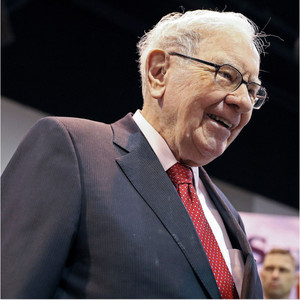
This is The Daily. A few days ago, the most successful investor in history, Warren Buffett, said he would retire as CEO of Berkshire Hathaway, the conglomerate that he built into a $1 trillion trust Colossus, today, my colleague, Andrew Ross Sorkin, on his front row view of the man who both personified and critiqued American capitalism.
It's Wednesday, May 7th.
OK, shall we? I'm going to be old and take my glasses off.
Mine we're already on, I guess I'm old.
Andrew, thank you for being here.
Thanks for having me.
You were actually in the room when Warren Buffett broke the news to the world that he was going to be retiring.
Can you set that scene for us?
It was a remarkable moment, really just the end of an era in the world of capitalism, but let me just take a full step back, if I could, to explain.
Everyone will please take their seats.
We're at the annual meeting of Berkshire Hathaway, which is really known as Woodstock for capitalists.
Every year, 40 -something thousand people descend on Omaha, making a pilgrimage there.
And these are people from all over the world, all walks of life.
My name is Revi Panida, I was born in communist Albania.
My name is Jackie Han, I'm from China.
My name is Benjamin Graham Sanderson from Pasadena, California.
Warren, thank you for all you've taught us over the years.
And you get people from California and New York, you get people from China.
I'm Dorcas Tang, I'm 14 years old.
My father brought me here for two consecutive years.
You get people bringing their kids so they can see it.
You see business school students and you see grandparents.
It is across the board. My question is for all of us, but it's probably especially for the younger people in the room, the importance of.
They literally sit for hours as Warren Buffett takes questions from the audience.
There is no other corporate annual meeting in the world where this happens.
And what advice do you have for young investors who are looking to develop their investment philosophy?
They may be everything from how he invested.
Last year you mentioned Coca -Cola and American Express being Berkshires.
Some little detail about a unit inside of Berkshire.
Do you know and believe in Jesus Christ and have a personal relationship with him?
No I'm an agnostic.
And to whether he believes in God.
One of the big questions repeatedly is, Does all that mean you are semi -retired, or if not, please explain.
When are you going to retire?
I've been semi -retired for decades.
And of course, he would never say when.
But we all were waiting and waiting.
And so this year, I got there on that Saturday morning, and something felt different.
Hm. And then we get to about 1254 in the afternoon and he says that I should say that I'm getting a section that says five minute warning exclamation point five minute warning exclamation point so I'm getting a message that we have a five -minute warning and the second he said that I knew tomorrow we're having a a board meeting of Berkshire and I'm looking in the front section all of a sudden everybody's sort of looking at each other and literally without any almost notice he says the time has arrived where Greg should become the chief executive officer of the company at year end it's about time
that his successor succeeds him and then he steps away at the end of the year.
Yeah, what was the reaction?
I mean people are tearing up and everybody starts to stand and clap.
And the standing ovation could have gone on for I don't know how long.
OK, break your cloak and calm down.
And it really felt like the end of an era.
So, there are going to be listeners who hear you describing this reaction.
And think it's crazy.
And think it's a little bit out there.
So I think we need to talk about how it is that a CEO could inspire the kind of decades -long devotion and, in this moment, emotion that occurred.
It's totally singular.
It's reserved for, you know, popes and musicians—the occasional actor.
And I want to know what you make of it and also kind of how you wrap your head around it.
He is, without question, the most successful investor in America.
He has made more money and has a better track record than just about anybody.
And just to put this in context, if you had invested $100 with this man in 1965 when Buffett bought control of Berkshire, that would be worth $2 .8 million today.
Yeah, that's unfathomable.
$100 to $2 .8 million.
And so many of the people in that room went on that ride with him or wished they could.
Or hoped that someday they will.
Right. That's the obvious reason that so many people look to Warren Buffett in this very unique and special way.
But the truth is, I've been grappling with his role for a long time, and specifically on Saturday.
Actually, after the news broke, I got a call from an editor who said, Hey, would you think about writing about Buffett?
Maybe you can try to capture this idea that he is the avatar of American capitalism.
And I sort of sat there thinking to myself, I don't know if that's totally right.
I don't know if he is the avatar of capitalism as we know it today.
Because in so many ways he actually sits outside of it.
He sits apart from the system that we know, the corporations that we know.
the ideas around wealth that we know.
And in many ways, as I contemplated it, I think Warren Buffett really is today the conscience of capitalism.
And let me just say, I don't mean to suggest for a moment that he doesn't believe in capitalism.
He would tell you that he has a card carrying capitalists and I think he may even have a business card in his wallet that says that.
Lest there be any doubt.
What I mean is that he has a moral code, and he has approached his business in a particular way that has engendered a unique level of trust, not just among his investors, but among the public, among policymakers in a way that is so very different from the way most people think about business today.
I want to dissect that phrase, conscience of capitalism.
It's a pretty loaded phrase and I want to have us talk about the two elements of it.
The first, conscience clearly, suggests a kind of corrective influence over capitalism.
The other, capitalism, suggests, as you just got at, a pretty open embrace of free markets.
So, let's start with the easier of those two, which is the capitalism.
Few people clearly have practiced capitalism as wildly successfully as Buffett.
So just remind us how he does that, the model of capitalism that gives us this company Berkshire Hathaway.
The fascinating thing about Buffett is he comes out of school and decides to be what's he's called a value investor, which means he's looking for companies that are undervalued.
And his initial approach is this idea that he's going to buy what he used to call cigar butts.
This idea that he was going to buy cheap, almost failed companies that had one more puff in them.
And he had a business partner named Charlie Munger who told him, this is not the way.
the way you're gonna make real money long -term is to buy good businesses, hold them, own them and grow them.
Cigars with many puffs in them.
Exactly, and that's what he did, and he did it remarkably, and over the years, he has assembled this collection of assets that he owns.
Everything from Burlington Northern, the train company, to Fruit of the Loom to Duracell, the battery company, to See's Candies.
He owns hundreds of these type of businesses, and then, on top of that, he owns stakes in some of the biggest iconic companies, Coca Cola, American Express, and he is the largest owner of Apple.
wow! And this one -time textile business, Berkshire Hathaway, becomes one of the largest companies in the world.
And not only that, one of the largest companies in the world with the biggest cash balance sheets in the world.
Well, what does that mean, really?
So, if Burlington Northern is super profitable, he can take the cash that's coming off of that and maybe he decides, I want to invest even more money in seized candies.
Mm -hmm. And so, he's constantly able to sort of move the profits from one business to another.
And he would tell you that his greatest talent is what he would call capital allocation.
This idea that he is better at moving money and identifying where the next big opportunity is than just about anybody else.
Right, and my sense from my reading about Buffett through the years is that This ecosystem he has allows him to do what his business partner Charlie Munger said was so essential, which is hold companies for a long time, nurture them.
And that's what having lots of money from one business and putting it in another allows him to do.
100%. And the other thing is because his public thesis is that he's gonna hold these businesses for a very long time, there are a lot of people who'd been willing to sell him businesses at probably lower values than they would sell to somebody else, because they know that he's genuinely trying to take care of these businesses and he wants them to last as humanly possible.
And he will hold onto these businesses, even businesses that are struggling far longer than just about anybody else.
And it's that longterm thinking that makes him so admired, but also the way he approaches And, you know, you could write it off as sort of a folksy charm.
But this is a guy who's worth something on the order now of $160 plus billion with a B, who is living in the same house that he bought in 1958 for $31 ,000.
And up until just a couple of years ago, he would drive his own car to work and he would Go to McDonald's and go through the drive -through like everybody else." And so in an era of billionaires and yachts and homes and cars and planes and this and that, Warren Buffett has never been that.
At one point, he actually did buy a private plane.
What did he name his plane?
What did he name it?
The Indefensible. Because it's indefensible to own a private plane.
Exactly. And so it's that I think it's that ethos that trust that really allowed him to critique the system and to say things publicly aloud about the business world that often go unsaid and to identify where the charlatans really are in business.
And that's really one of things beyond being a great investor that's made him the conscious of capitalism.
We'll be right back.
Hi there. I'm Chris Wood, audio engineer on The Daily.
That means that I put the finishing touches on the show, make everything sound a little bit better and hit publish on my computer.
That sends the day's episode out into the world so it's ready before most of our listeners wake up.
So The Daily Team makes a show every weekday, that can mean late nights and that's when they pass it off to me.
Part of the reason that I'm able to do the work with a clear head is that it's not the middle of the night for me.
You might have already guessed from my accent I live in London and we're five hours ahead of New York.
The Daily is only possible because it involves people all over the world.
And that includes the whole fleet of New York Times journalists who give us their expert analysis and in depth reporting five days a week.
So if you're a loyal listener and want to support what we do, as well as explore everything that the New York Times has to offer, you can subscribe at nytimes .com.
Slash subscribe. Cheers.
So Andrew talk about Warren Buffett's critiques of capitalism and the things he said that most CEOs leave unsaid and why those things ultimately mattered.
Look, he's really highlighted and pointed the finger at what he thinks of as the ills of the system.
So he has spoken critically of Wall Street and Wall Street banks and bankers and this idea, for example, that the advice that they're offering you is necessarily good advice.
You do not want to ask an investment banker what he thinks the earnings are going to be in five years or something he's trying to sell.
He often says, You know, it's the old story, don't ask the barber whether you need a hair cut.
You would never go to a barber and ask them whether you need a hair cut.
Because of course they're going to tell you you need a hair cut.
Just like every banker is going to tell you, of course you need to either go do this merger or buy this thing or do whatever.
Can you peel back the layers of that a little bit?
I mean, what exactly is it about bankers?
Sometimes they're probably right, right?
I mean, bankers get it right?
Sometimes bankers get it right.
They get paid an enormous fortune, typically, for what they do.
And I think that one of the things he's just tried to point out to people is that the bankers might not really always have your best interests at heart.
I would say that people that are now investing in hedge funds in aggregate are going to be disappointed.
And he's also been a critic of hedge funds.
And believe me, people don't become a genius because you walk into some office and it says hedge funds on the door, I mean...
These are the biggest investors in the world these days who've made the most money.
And he would tell you, don't invest your money with a hedge fund.
Why not? He would tell you that your returns long -term will be better literally buying an index fund like the S &P 500.
and he would say accurately that the S &P has outperformed most hedge funds after fees.
So one of the things he also talks about is just how so many of these firms are all just trying to extract fees from the people who are giving them the money and it's that kind of advice and that willingness to sort of talk about what the fine print really says that I think has ingratiated him with large swathes of the public.
Can I just ask you a question.
Is his critique of the bankers, the hedge funds, is it a moral one, like, what they're doing is fundamentally not right in his mind, or is it that there are just better ways to make money than to do things the way that those folks do things?
Or is it both? I think he thinks it's a better way, it's a safer way, and maybe ultimately it's a more moral way.
He's not a shortcut taker.
He's a long -term investor.
And he really did try to teach the American investor not to think about owning a share of stock for a month or two, or 10 days or a year, but to think, okay, if I buy it now, what's this business gonna be like five years from now?
What's it gonna be like 10 years from now?
And not your little share, but what's the whole company gonna be worth, as if you really are an owner?" You know, as an example of just how long -term a thinker he is, what's called the class A stock of Berkshire now trades, if you can believe this, at $800 ,000 a share, a share.
So, most shares... You can spend your whole life trying to buy one share and not afford it.
And you might say to yourself, well, what is going on here?
Because most companies try to keep their shares sometimes $10 a share, 20, 30, 40, $100 a share, maybe $200, and that's part of the thing.
He's created this stock at this price which effectively means that if you are in it, you are in it.
And you're in it for a very long time.
By design. By design.
The other thing, Andrew, I think of when I think of Buffett's outspokenness and his criticism of our system is what he said about what you're supposed to do with money once you've made it.
And here I'm thinking about what he said about taxes and about philanthropy.
So just talk to us a little bit about that.
He is famous for wanting higher taxes on the wealthy, including himself.
And he has said it over and over again, that his secretary is taxed at a higher rate than he is and it's not right.
During the Obama years, there was actually a tax provision that was named after Warren Buffett to raise the taxes on capital gains.
I'm guessing it didn't go through.
It did not go through.
There's very few people in the business world who are screaming from the rooftops, tax me and tax me more.
Warren Buffett actually was one of those people.
And on philanthropy, he's pledged to give all of his money away.
And he's been very outspoken about it, actually created what's called the giving pledge with Bill Gates and Melinda Gates many years ago to really try to incentivize and frankly pressure billionaires to start giving away a lot more of their fortune.
But he's now actually come out quite publicly lamenting the idea that he's actually made so much money.
That he can't give it all away.
That he can't give it all away fast enough.
And he's actually worried about who is going to give it away.
Wow. Andrew, when we're thinking about all these critiques, I think a very natural, fair, and important question here is, how much did Warren Buffett actually live by the code he laid out?
You know, I don't want to suggest to you that Warren Buffett is perfect.
He is not, and he oftentimes says as much. And there are things that he does and says that a critic from the outside could easily say feels like hypocrisy.
What are examples of where people do point the finger?
Well, look. He's long talked about taxes and how he would like to be taxed at a higher rate.
Berkshire, the company, the way it's structured effectively is to avoid taxes.
It's not illegal. It's not even that clever.
But the way he's put it together, he's able to take those profits and rather than have the profits annually taxed, he's able to keep those profits inside the company.
You know, he bought Goldman Sachs during the financial crisis.
This was a firm that was widely critiqued at the time.
Now he would say it was a great value investment and he was doing it effectively to save, or at least to help save the system, if you will, at the time.
He extracted extraordinary fees for Berkshire Hathaway shareholders as a result.
But he effectively was investing in businesses is that he has critiqued in many ways.
So there are certain things that he's talked about, and I believe he genuinely believes them in the whole.
But there have also been times where he has done or said something that's been contravened by his decisions.
He has talked about a lot of important social issues in the country, but he was never an advocate, for example, of DEI.
And I would ask him about that on the stage and say your office is not particularly diverse He would say that's almost too politically correct an idea to to address that he only wanted what he called the most talented people and he was not interested in Necessarily trying to find somebody who didn't look like him for that job for that reason.
Mm -hmm Well, what do you say to the fact that?
He operates as a critic of capitalism, but I can't think of anyone who did more to exploit the possibilities of capitalism to make so so so so much money.
I mean, so much money that a certain point you're sort of like, why are you even making even more money?
So let me, this is a big nuance in this actually with Warren Buffett, which is he is not a critic of capitalism, the concept, he is its champion.
What he is a critic of is the ills of capitalism and the charlatans that are engaged in capitalism and those that are taking advantage of the weak in capitalism.
That's the role that I think he's played as a quote -unquote conscience of capitalism.
I don't think he's here saying, capitalism doesn't work or it's a problem or anything else.
I think he'll tell you over and over again, there's no better way to do it.
Do you think that in the end, Buffett made capitalism any better?
You know, if you're asking me, did he fundamentally change policy, change regulations, for example, around business, the way businesses behave on any given day, it's very hard to point to a long list. But I do think it's very fair to say that he made investors, he made the public smarter.
And ultimately, if he actually did that, at least on the margins, he made the system better.
Just explain that. Why does that make the system better?
I think Buffett ultimately made the world a little smarter about how the system really works.
And I think by the public understanding how the system really works, understanding that his secretary is paying a higher tax rate by understanding that the hedge funds are trying to extract fees from you, by explaining that when you hear that there's an independent director on a board, who's a professor, you might want to question how independent they really are because they probably need the money.
I mean, there are these little things that he knows about, that he understands about the world of business, and by educating the public about those things, you like to think that improves the system because there are fewer people to cheat.
I guess I want to end with the question, Andrew, that I think you're well situated to answer after spending all these years covering Buffett, which is ultimately what do you think motivated him through all this time?
I mean, he does not live large.
He wants to give all his money away.
I have a much better understanding, in my mind, of what motivated Jeff Bezos, right?
he wanted to build the everything store, or Elon Musk, who wants to save humanity and wants to get to Mars and wants to slash government down to size.
I'm much less clear in my head about what animates Buffett, and I wonder if you've gotten a lot closer in your understanding.
I think I understand Buffett in this way, which is, you're right.
I don't think that there's a grand vision necessarily to influence the world in the kinds of ways that an Elon Musk may want to influence the world.
I don't think there's an effort to want to impact politics necessarily the way some people with wealth do.
And the money for him I think is a scorecard. I think that's all it is.
I think it's a contest of wits for him, and what he wants more than anything I think is actually to be this teacher about the system.
Think of anything he wants to be a successful role model of how a business could work on a long -term basis.
And I guess how capitalism could work.
How capitalism can work when it's done in the best of faith.
Andrew, thank you very much. Thanks for having me.
We'll be right back.
Here's what else you need to know today.
India has conducted strikes inside of Pakistan in a major escalation in the long -running tensions between the two nuclear -armed neighbors.
The strikes were retaliation for a massacre by armed militants that killed more than two dozen Indian civilians in the disputed territory of Kashmir.
Indian officials said they had struck multiple camps used by terrorists and took pains to say that no Pakistani military facilities had been targeted.
But Pakistan claimed that the strikes had killed civilians, and that they would not go unanswered.
In a statement, the Pakistani government said, quote, the temporary pleasure of India will be replaced by enduring grief.
Today's episode was produced by Sidney Harper and Caitlin O 'Keefe, with help from It was edited by Mark George, Chris Haxel and Paige Cowlitt, contains original music by Marion Lozano, Dan Powell and Diane Wong and was engineered by Alyssa Moxley.
Our theme music is by Jim Brunberg and Ben Landsberg of Wonderland.
That's it for the daily, I'm Michael Bobaro, see you tomorrow.