This message comes from Whole Foods Market.
Save on spring brunch with great everyday prices on bacon, organic salads and more look for the yellow low price signs and the 365 by Whole Foods Market logo.
You're listening to LifeKit from NPR.
Hey, everybody. It's Marielle.
I don't know about y 'all, but when I'm really tired, all I want to do besides sleep lie around and eat carbs, pasta, bread, cake, cookies.
And that's something researchers have identified that our sleep quality can influence our dietary choices.
But it turns out, the reverse is also true.
What we eat day to day affects our sleep.
What we have been finding is that what you eat in terms of various nutrients like types of fats and sugar and fiber, can all play a role on sleep quality at night.
That's Marie -Pierre Saint -Ange, a nutrition scientist and researcher at Columbia University who studies the connection between sleeping and eating.
Marie -Pierre decided to team up with Kat Craddick, CEO and editor -in -chief of the food and travel magazine, Cerver, to write a cookbook that will help people sleep better.
In it, they explain the science, talk about what to eat more of and less of and then give a whole bunch of recipes that incorporate the nutrients you need to sleep well.
On this episode of Life Kit, I talked to Maripia about the book.
So if you've ever had trouble sleeping, this one's for you.
This message comes from Capital One with the Capital One Saver card. Earn unlimited 3 % cash back on dining and entertainment.
Capital One, what's in your wallet?
Terms apply, details at CapitalOne .com.
This message comes from Amazon.
Have you ever been so sick that even the thought of standing up to go to the doctor made you even more sick?
Amazon One Medical has 24 .7 virtual care so you can get help while horizontal.
And with Amazon Pharmacy, you can get medicine delivered fast right to your door, you just have to make it to your door.
Thanks to Amazon, healthcare just got less painful.
This message comes from NPR sponsor Disney+.
Season 1 of Andor had critics calling it the best Star Wars series yet.
Season 2 of the Emmy -nominated series is now streaming on Disney+.
Follow Cassian Andor as he embarks on a path from a rebel to a hero.
Starring Diego Luna, and from creator Tony Gilroy, writer of Michael Clayton and The Bourne Identity, season two of Andor is now streaming only on Disney+.
Support for NPR and the following message come from LinkedIn ads.
One of the hardest parts about B2B marketing is reaching the right audience.
When you want to reach the right professionals, use the LinkedIn ads.
LinkedIn has grown to a network of over one billion professionals.
Target buyers by job title, industry, company, role, seniority, skills, company revenue.
All the professionals you need to reach in one place.
Get a $100 credit on your next campaign.
Just go to LinkedIn .com slash LifeKit.
Terms and conditions apply only on LinkedIn ads.
There was barberheimer summer then brat summer.
What will this season bring?
Maybe it's the season of actual good superhero movies.
The Fantastic Four and Superman.
For a guide to the movies and TV we're most excited about this summer listen to the Pop Culture Happy Hour podcast from NPR.
Maripia, you talk in the book about the chemicals in our bodies that play an important role in sleep.
One of them is melatonin.
What is it, and why do we need it to sleep?
So melatonin is a hormone that regulates your sleep -wake cycle, so that's important for helping one fall asleep or remain asleep throughout the night.
And so this is a hormone that's quite important, especially when we're talking about diet and its impact on sleep.
Because it is produced in the body from an amino acid, and amino acids are the building blocks of proteins.
But you must have heard about this one specific amino acid called tryptophan.
And the importance of tryptophan is that it's considered an essential amino acid.
and essential amino acids are those that we cannot produce ourselves, we must obtain from outside sources, which means in our case foods.
So this amino acid when it's consumed becomes converted to melatonin through various processes in the body that require other types of nutrients like zinc, magnesium, and B vitamins.
so essential micronutrients that we also get from foods to produce melatonin.
Okay. And then there's serotonin, right?
What is that and what role does it play in sleep?
Serotonin is basically a messenger that relays information across the brain throughout the body.
It's also relevant for sleep because serotonin is considered to be a feel -good type of neurotransmitter, it makes people feel happy, and it's also related and important for sleep -wake cycle.
All right, takeaway one, if you want to sleep better, eat foods that contain tryptophan.
Tryptophan is an amino acid that we have to get from food because our bodies don't produce it, and it's converted to serotonin and melatonin in the body.
Well, let's talk about tryptophan.
People always talk about it around Thanksgiving because they say, oh, turkey has a lot of it and it makes you sleepy.
I know that that's a misconception because you say tryptophan is not a sedative, right?
It's not a thing you're supposed to eat just before bed to help you sleep.
Yes. So the story really to turkey and feeling sleepy, it's not that far fetched in a sense that yes, turkey is a good source of tryptophan.
But what we need to realize is that when you do eat foods, the nutrients that you get from the foods do not instantaneously make it to the brain to start up the production of melatonin in that short period of time that people would consider falling asleep on the sofa a few hours after eating a turkey rich meal.
So what I suggest is to have the right nutrients available when time comes to produce and secrete melatonin for a good sleep onset.
So a way to do that, as you say in the book, is to eat tryptophan -rich foods throughout the day.
What foods actually contain tryptophan besides turkey?
So there are some also non -animal products that contain tryptophans.
we can think about tofu is a good source of tryptophan, various legumes like lentils will have tryptophan, other meat sources are beef, chicken, lamb is a good source and pork are good sources of tryptophan.
And from seafood, we could think about salmon, tuna, and then some dairy products, yogurts have tryptophan as well.
Madi Pierre says it's also helpful to eat foods that contain serotonin and melatonin and to eat foods that contain certain micronutrients.
Magnesium, zinc, vitamin B6, and folate.
That's our takeaway too.
Well you have your top 20 in here, you say my top 20 powerhouse ingredients to stock your sleep supporting kitchen.
Why did you choose the 20 on this list?
There are so many that I wanted to add in there, but we thought we'd get started with 20.
Many of those have studies that support their benefit for sleep.
I'm thinking the cherries have some research, pineapples, tomatoes, walnuts, dairy products, but also there are good sources for multiple of those sleep -supporting nutrients, like you know, barley, that's a good source for tryptophan, but also fiber, melatonin, magnesium, vitamin B6 and zinc.
Pumpkin seeds also having, you know, a good blend of multiple of those nutrients, individuals could start to incorporate some of these foods into their own diet, and maybe, you know, replacing some of the cooking oil that they use, for example, with extra -virgin olive oil or adding, spinach to various stews and soups or stir -fries, and that can help them get started on a healthy track.
Yeah. What are some other simple swaps that people can make in their recipes to start eating more sleep -promoting foods?
To me, the easy thing for all recipes is to add vegetables.
So you don't have to take away anything.
Just add to it, add more vegetables.
You can sprinkle some nuts and seeds on top at the end as a finishing touch that can just add a little bit more unsaturated fats and fiber, various complex carbohydrates and tryptophan, maybe doing some simple snack swaps for a more processed, refined food product with a piece of fruit like a banana, a bunch of cherries or oranges and pineapples.
And then incorporating more nuts and seeds and plant -based proteins, and eventually that will then start to take the place of more refined carbohydrates, for example, or higher saturated fat, animal proteins.
Well, tell me some of your favorite recipes from the book.
I'm a breakfast person.
I love, love, love breakfast. I love the granolas quite a bit, both of them, but specifically the cherry, ginger granola with coco nibs, I find is very different from what we're used to.
And the ginger that's in there gives it a really nice tang.
Sesame seeds too, right?
Yeah, sesame seeds in there as well.
And in my house, I always make a double batch And it goes in a week every, you know, my kids, my husband.
I, we have them, we have that granola anytime of the day just pass by.
It's a big bowl, grab a spoonful, grab a handful, and just, you know, have it as a snack too.
But I also, really like the overnight oats, the buckwheat porridge, I enjoy quite a bit.
It has a slivered almonds on top that gives it a nice crunch. the buckwheat grouts are also really chewy and really nice.
The muffin tin quiche I like quite a bit.
I think it's great when you're hosting a brunch and also then it gives you a little bit of portable type of breakfast or even you can dress it up for lunch with leftovers if you'd like, with a side salad and things like that.
Some other recipes from the book, soy braised butternut squash with miso butter and black sesame, whole grain chicken porridge with scallions and sesame cashew crunch, a turkey and black bean burrito bowl with salsa verde and avocado, and a banana chamomile shortcake which also includes Greek yogurt and sliced almonds.
Well, let's pivot here for a moment to what kind of foods disrupt our sleep.
We've done quite a bit of research related to carbohydrates.
And so there's a study that we conducted where we showed that women who had more refined carbohydrates in their diet and more added sugars in their diet had higher risk of insomnia.
We often talk about and think about liquids when we're thinking about different foods and beverages that can have an influence on sleep.
So for example, having caffeine too late in the day, that's often a culprit, we know caffeine is a stimulant, but what people don't necessarily realize is that our body's ability to metabolize or process caffeine slows down with age.
And so it takes the body longer to process caffeine and clear it out from your system as you get older.
And so I always tell people, it's good to reevaluate the timing of your last caffeine providing beverage in relation to your bedtime.
And then we also talk about alcohol intake because contrary to caffeine, alcohol is a sedative.
It can lead to more disrupted sleep in the second half of the night, and then you wake up not feeling as refreshed as you would if you hadn't had too much to drink the night before.
Alright, takeaway three, consider limiting your intake of refined carbohydrates, added sugars, and alcohol.
Also, if you're having trouble sleeping and you drink caffeine, try skipping that cup of coffee in the afternoon or swapping it out for something uncaffeinated?
Let's talk about some specific situations that make it hard for people to sleep and if there are any dietary tips that could help.
So one is if you're traveling and you have jet lag.
One thing that I'd like to tell people is to try to adopt the eating schedule of your your new time zone very quickly.
So eating meals when they're supposed to be eaten at the clock time of the place where you landed.
So that will help to restore your circadian rhythms. So what about if you're someone who works the night shift. Right, so for night shift workers it becomes a little more complicated in terms of the timing of eating because they're awake during the night when their body is not in a state where it's primed to receive nutrients.
So ideally it would be to not eat too much at night, to not eat at all in the middle of the night if possible, and try to eat during daytime hours.
So try to eat the bulk of your food during the daytime hours, even if you're sleeping during the daytime hours?
Yes. So for some people, it may mean having a meal when they arrive home before going to bed for their main sleep episode and then eating a larger meal when they wake up from that.
And then maybe a smaller meal or a snack late in the evening, depending on when their shift is.
If you could make one recommendation for how folks should change their diet to get better sleep, what would that be?
Increase in takes of fruits and vegetables.
That would be the first thing to do.
We often think about, you know, what should you not eat?
But I think a better message is eat more of this, eat more of that and maybe having more of this and that will help you push out some of the things that are not as helpful.
Okay. Time for a recap.
Takeaway one is to eat foods that contain tryptophan.
Tryptophan is an amino acid that we get from food, and it's converted to serotonin and melatonin in the brain.
Both of those play an important role in our sleep -wake cycle.
Takeaway two, eat foods that contain serotonin and melatonin, and foods that are rich in the micronutrients magnesium, zinc, vitamin B6, and folate.
We talked about that top 20 list of powerhouse ingredients to stock your sleep supporting kitchen.
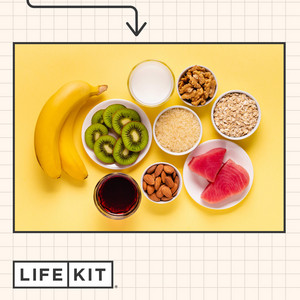
Here it is. Almonds, bananas, barley, brown rice, cherries, chia seeds, extra virgin olive oil, ginger, lentils, oats, pineapple, pumpkin seeds, salmon, spinach, tofu, tomatoes, turkey, walnuts, white beans, yogurt.
Takeaway three, consider limiting your intake of refined carbohydrates, added sugars, alcohol, and of course, caffeine.
For more LifeKit, check out our other episodes.
We have one about how to recover after a bad night's sleep and another where we bust common sleep myths.
You can find those at npr .org slash LifeKit.
And if you love LifeKit and sleep and want more, subscribe to our special newsletter.
It's a guide to better sleep.
You can sign up at npr .org slash sleepweek.
This episode of Life Kit was produced by Sam Yellowhorse Kessler.
Our visuals editor is Bec Harlan, and our digital editor is Malika Gareeb.
Meghan Cain is our supervising editor, and Beth Donovan is our executive producer.
Our production team also includes Andy Tagle, Claire -Marie Schneider, Margaret Sereno, and Sylvie Douglas.
Engineering support comes from Gilly Moon and Zou Vangenhoven.
Fact -checking help from Aida Purasad.
I'm Mary, El Segara.
Thanks for listening.
Thank you. When Malcolm Gladwell presented NPR's Through Line podcast with a Peabody award, he praised it for its historical and moral clarity.
On Through Line, we take you back in time to the origins of what's in the news, like presidential power, aging and evangelicalism.
Time travel with us every week on the Through Line podcast from NPR.
At NPR's Pop Culture Happy Hour, we sort through a lot of television and we've found some recent TV comedies we really like that you don't want to miss, and we'll tell you where to watch them in one handy guide.
Listen to the Pop Culture Happy Hour podcast from NPR.