The holidays mean more travel, more shopping, more time online and more personal info in more places that could expose you more to identity theft.
But LifeLock monitors millions of data points per second.
If your identity is stolen, our US-based restoration specialists will fix it.
Guaranteed or your money back.
Don't face drained accounts, fraudulent loans, or financial losses alone.
Get more holiday fun and less holiday worry with LifeLock.
Save up to 40% your first year.
Visit LifeLock.com slash podcast.
Terms apply.
Kay Jewelers early Black Friday sale is happening now.
Get up to 50% off Black Friday deals and up to 40% off everything else.
Don't miss this sale.
Start your season with savings only at Kay.
Exclusions apply.
See Kay.com slash exclusions for details.
Welcome to the History Extra podcast fascinating historical conversations from the makers of BBC History magazine.
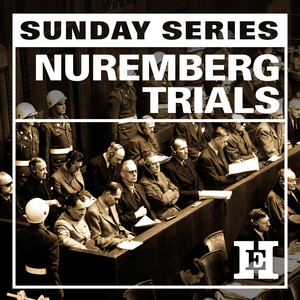
Hello and welcome to this four-part History Extra podcast series, all about the Nuremberg Trials of 1945 to 1946.
My name is Dave Musgrove and I am delighted to be joined by Philippe Sands, a writer and specialist in international law, whose books include East West Street and The Rat Line, 38 Londra Street and The Last Colony.
In this first episode, we'll be exploring how, following the carnage of the Second World War, the stage was set for the largest war crimes trial in history.
Philippe, welcome to the podcast.
Thank you for joining us.
How are you?
Terrific to be with you.
Not only a largest war crimes trial, but the first war crimes trial for a historic moment was Nuremberg in many ways, as we'll discuss.
Absolutely, yes.
And we will tackle that as we go along.
So kicking things off.
VE Day was the 8th of May 1945, and the Nuremberg war trial started in November 1945.
So hardly any time between those two events.
How did we get from the end of the war to the prosecution of the trial?
It seems almost incredible such an enterprise as the famous Nuremberg trial was put together in so short a period of time.
Actually, the preparation started Much earlier.
Already in 1942, efforts were underway, with governments in exile in particular, committing to the prosecution of Nazi criminals for crimes committed on their occupied territories.
And things were then slowly taken forward.
Britain participated, the US participated, the Soviets participated.
And at the famous Yalta conference in February 1945 Churchill, Roosevelt and Stalin met and agreed that there would be a trial.
Churchill had to be brought in kicking and screaming.
His desired option was just to line them up and shoot them.
But there was a strange alliance between them.
Stalin and Roosevelt, who for different reasons wanted a trial.
So that was how it got going.
Okay, that's brilliant.
We'll maybe come back to Churchill in a minute because I've got a question down the line that might consider that.
So you've mentioned there that people were thinking about this obviously and this is something you talk about at length in your brilliant East West book about sort of the people who were thinking about how international crimes might be tried.
So can you tell us a little bit about what people were doing in advance?
What sort of people were involved and what were they thinking about?
So I think I mean there were many issues when you're setting up the world's first ever international criminal trial.
There's quite a lot of work, but there's two really big issues.
The first one is, who do you go for?
And an early decision was taken to go for leaders.
They didn't want to go for what today is called the sort of low hanging fruit perpetrated on the ground.
They wanted people who had planned, who'd been in government positions or who were serious industrialists.
And that was how they decided. target individuals.
And in the end, they chose 24 top political and financial leaders in Germany.
But the second issue, and this was even more complicated, was what are the crimes?
Because, as of February 1945, there was only one international crime, and that was war crimes, which is targeting civilians in times of conflict, in times of war.
So one of the first things they had to do in negotiating what would be called the Nuremberg Statute was to identify other crimes.
And they essentially invented new crimes, crimes against humanity, what they then called crimes against peace, which was waging an illegal war.
Today, it's called the crime of aggression.
And then as a subhead of war crimes, genocide, which makes its way in through the back door.
And how much consideration was given to the very specific language around those crimes there?
Oh, I mean the Nuremberg statute, which is the document that basically sets out the powers of the tribunal.
Who are the judges?
Where does it sit?
What are the laws they apply?
What are the rules of procedure?
What are the rules of evidence?
All the things you have to put in place.
That was largely negotiated in London by four countries Britain France, the United States and the Union of Soviet Socialist Republics.
And they sat around a sort of negotiating table in the centre of London in Westminster.
And in just a few weeks, they filled out what became known as the Nuremberg So it's a negotiation.
Different countries want different things.
And so not everyone gets everything they want.
By this point, there are chief negotiators.
And one of the names that will be coming back time and time again is the identity of the chief prosecutor.
It's an American prosecutor.
He is a justice of the Supreme Court.
His name is Robert Jackson, and he will become, in effect, the chief negotiator.
So he is charged with bringing together a text that will be the basis for the trial.
OK, just go back to war crimes.
So you said that was kind of the only thing that was on the statute book or available to them before the conversation started.
So there were the Hague Conventions at the turn of the 20th century where people sort of define that.
Is that where people started thinking about war crimes?
Well, a little bit earlier, not a lot earlier.
But I mean, there's a sort of St.
Petersburg Declaration of 1861.
You can't use exploding bullets on people.
And then bit by bit in the late 19th century, new rules were added.
And then in the 20th century, there was a sort of rush on war crimes.
But there was a gap.
Until the Nuremberg Statute there was no rule of international law that said it was illegal to use force in your international relations.
There was no general rule applicable outside of armed conflict in terms of protecting civilians and individuals who won't combatants in a wartime scenario.
So they had to fill a lot of gaps and they wanted to make sure that they had a broad enough set of crimes to cover all of the individuals concerned.
So I'm just wondering, in terms of the conduct of the Second World War, how far were people on either side sort of aware of the possibility of committing war crimes, and how would they have understood the concept of a war crime?
When the war began on the 1st of September 1939, I mean, there'd been things going on beforehand in terms of Sudetenland, German occupation of Austria, but the war in terms of armed conflict, in terms of pan-European activity.
The starting date is 1 September 1939.
This becomes very important later on, because one of the questions the judges have to decide is what is the temporal extent of their jurisdiction?
Does their jurisdiction to try the 24 people in front of them start on the 1st of September 1939, when the war began?
Or does it go back to earlier days when the Nazis took control of Germany from 1933?
Does it include the occupation of Austria?
Does it include the occupation of Czechoslovakia?
And eventually, as we will see, the judges say no, we only have jurisdictions from the start of the war.
And that's because of their interpretation of the particular language of the statute.
So the details are very, very significant.
And what that meant in practice was that anything that happened before the 1st of September 1939, when Germany attacked Poland, is outside the jurisdiction of the statute and of the tribunal and won't be tried.
So there were some very, very clear parameters set.
Am I right in thinking that there was some sort of disputed punctuation that kind of led to that conversation?
You are right.
I share this story with my students.
There is a part of Article 6 of the Statute in which a semicolon appears.
In the English text, I think it is, but not in the French and Russian texts, in which only a comma appears.
And the difference between a semicolon and a comma is probably too difficult to explain in.
Even the time we've got available will determine whether the jurisdiction goes back to 1933 or only 1 September 1939.
And in the end the statute was amended to make it consistent and the amendment that took place was confirmed by the judges to limit the jurisdiction to only things that happened after 1 September 1939.
So all of the Nazi race laws, the Nuremberg race laws and, as I said, the occupation of Austria, the Anschluss, the occupation of Czechoslovakia, all of that was outside the jurisdiction of the tribunal.
Was this all decided before the trials happened, as to exactly what they were going to be able to look at?
Well, the statute is adopted in August 1945.
Okay.
And the next thing that happens they having identified the defendants is you have to issue an indictment.
What are each of the defendants going to be charged with?
And that is issued. in October 1945, so just a month before the trial begins.
But between the adoption of the statute, June 45, and the finalization of the indictment, October 45, there are significant changes.
I'll give you one example.
When the statute was adopted in June.
Raphael Lemkin, the man I write about in East West Street, who has invented the concept of genocide, mass murder of groups, is devastated that the statute doesn't include genocide as a crime.
So he flies to London, gets involved in the negotiations on the indictment and manages to get the word genocide into the indictment.
The first time it's ever in an international legal instrument, which means that when the trial opens on the 20th of November 1945, some of the prosecutors refer to the word genocide.
If Lemkin hadn't made that change, it wouldn't have happened.
The bottom line of the whole thing is you've got a very complex negotiation.
You're starting from what we lawyers with Latin language call a tabula rasa.
It's just a clean slate.
Imagine you and I sitting at this table, piece of paper on it.
You've got to draft the first international criminal statute in human history.
It's a blank slate.
What do you do?
You take texts that you've got in the domestic legal order, in the laws of England France, United States, Russia.
But there you hit the first problem.
They've all got different laws.
They've all got different ways of dealing with substantive laws, with evidence, with rules of procedure, with preliminary motions, with injunctions, with all this kind of stuff.
So for the first time in human history, four countries are getting together drafting an international criminal statute.
And that will become very important later on because subsequently all roads lead to Nuremberg.
So 50 years will pass before we get the next international tribunals after Nuremberg and Tokyo, and that's Rwanda and Yugoslavia in the 1990s.
What do the negotiators of the draft statutes do then?
They go back to what was agreed at Nuremberg and they take the Nuremberg statute and model.
What happened then to this task ahead in the 1990s?
So it's an absolutely crucial moment.
And it's sort of miraculous that they managed it in just literally a few weeks.
Yeah, we'll come back to Rwanda and later stuff in the Legacy episode.
So listen up for that.
In the unlikely scenario that we were asked to draft some laws together, I would probably leave it to you and I'd go and make a cup of coffee, I think, because I think you've got rather more expertise.
Well, I'd be in a good position than that because of these folks in these folks in Newham.
But to give you an example of how it actually worked, they couldn't agree on what to call a particular crime.
So Robert Jackson, at the end of July 1945, drives himself up to Cambridge to meet with the professor of international law at Cambridge University.
His name is Hirsch Lauterpacht.
And he actually comes from the city of Lviv, today in the Ukraine, but has moved to Britain in the 1920s LSE, Cambridge University.
And he becomes very involved in the drafting of the statute.
Robert Jackson consults with him.
We've got a difference between the French and the Russians and the British and the Americans.
They can't agree on what to call a particular crime.
And it's Lauterpacht who comes up with the idea of crimes against humanity crossing a line and harming individuals in ways that are so terrible that it's got to be criminalized at the international level.
And it's Lauterpacht who proposes for Article 6 Paragraph C, as it will become crimes against humanity.
And so, for the first time in human history, the concept of crimes against humanity is put into international law.
That was sort of accidental.
Jackson happened to know Lauterpacht because Lauterpacht, during the war, had taken his family to America and they were introduced by another Supreme Court justice.
And when Jackson had a technical problem of international law he went to people he knew he trusted Lauterpacht and it was Lauterpacht who came up with that.
I suppose the point that I'm making here is that individuals play a really crucial role in all of this.
And you and I could sit down and draft a statute and you'd have your ideas and I'd have my ideas and we'd thrash it out.
That's what happened in 1945.
And Larson Parks and Lemkin.
They're key figures in East West Street.
You know, in the book that you've written,
So if people want to know more about them, Their stories are told very clearly.
And what had happened is, I think you know is in 2010 I get this invitation to go and give a lecture on the cases that I do that are part of the Nuremberg legacy cases about crimes against humanity genocide, war crimes, the crime of aggression.
And I end up in Lviv because it's where my grandfather happened to have been born.
And I have discovered by then that the men who put the concepts of genocide and crimes against humanity into international law both came from the city of Lviv.
So the people at the university in Lviv were completely thrilled, obviously.
But the key point is and it's my own experience involved in these international cases is that individuals make a big difference.
Prosecutors, lawyers, judges, defendants, they make a huge difference.
But just in terms of the pace here, the time period we're talking about here, as you've said, it does sound incredibly fast.
And particularly when you're talking about detailed legalistics.
I mean, you are an international lawyer.
You know how complicated it must be.
And, you know, when you're quibbling over commas and semicolons, you've got to get it right.
So it must have been incredibly stressful for all these people.
And just utterly remarkable actually, that they were able to to move from the end of the war to trial in such a short period of time.
Does it strike you as almost fantastical, stunning?
It's absolutely stunning, i mean, when you look back with the way in which international laws are made today and, if you know, there's a decision to create a new international tribunal for example, the crime of aggression in Ukraine following the Russian attempts to occupy Ukraine.
That effort started in March 2022, after I had written an article in the Financial Times proposing the creation of a new tribunal on aggression, the first one since Nuremberg.
It took three years. finally adopted in May 2025.
And that's a single tribunal dealing with a single crime.
40, 50 countries were involved in negotiating that.
It took three years.
They gave birth to international criminal law in a matter of weeks, acting in the centre of London.
It is a stunning achievement.
And if it hadn't happened, We wouldn't have the international criminal law that we have today.
Was there something specifically driving that pace?
Did they have a hard deadline?
Did they really want to get it done very quickly?
What was the reason?
Speed was undoubtedly of the essence.
How do we know that?
I have come to know the family, the descendants of the British judge at Nuremberg, Sir Geoffrey Lawrence, and his grandson Patrick, very kindly gave me access to part of his grandmother and grandfather's archive.
Marjorie Lawrence, the wife of Sir Geoffrey Lawrence, who was the president of the Nuremberg Tribunal, kept a daily scrapbook.
And in the scrapbook, I find a letter to Sir Geoffrey Lawrence.
I can't remember if it was from Churchill or the Foreign Minister of Foreign Affairs, or from the US president.
But I do remember that the letter said don't worry, it won't last more than six months the entire trial.
You'll be back doing your day job. in English courts within six months.
Everyone wanted this done and dusted within months.
And of course, today, it seems extraordinary when trials go on for years.
It is a stunning achievement.
This episode is brought to you by Progressive Insurance.
Do you ever think about switching insurance companies just to see if you could save some cash?
Well, Progressive makes it easy.
Just drop in some details about yourself and see if you're eligible to save money when you bundle your home and auto policies.
The process only takes minutes and it could mean hundreds more in your pocket.
Visit Progressive.com after this episode to see if you could save.
Progressive casualty insurance company and affiliates.
Potential savings will vary.
Not available in all states.
You mentioned that Nuremberg was the first war crimes trial.
Had there been anything like this before?
The closest we got was in 1919.
The Treaty of Versailles, which brought an end to the First World War, had a provision allowing a tribunal to be set up to try the German Kaiser Wilhelm for warmongering, waging illegal war.
He fled to the Netherlands.
He took refuge there.
And in the end, no tribunal was ever created.
But when they were gathering in the early 1940s to work out what to do with the Nazi leaders, a lot of people went back to this moment in 1919 and said well, there's a model.
Let's action it now.
And that often is how the international legal order works.
You have a sort of tiny idea that emerges in a text in one year and then 30 years later, something else happens and people go back.
We lawyers like precedent.
We build things incrementally.
But no, there'd been nothing like Nuremberg.
I mean, obviously there were a lot of horrors perpetrated in the First World War.
You know, all manner of terrible things occurred.
I suppose...
There were worse horrors committed in the Second World War in terms of Holocaust.
How far was the kind of the scale of the horror which was enacted on people, driving the need for a trial or need for justice?
I think the driving force came... very often and very largely from the governments in exile.
What had happened was for many of the countries that had been occupied by the Nazis Poland Belgium, Holland people fled.
Leaders fled.
They gathered often in London and they set up a government in exile, and they would get news reports about what was happening, about atrocities being perpetrated against civilians, atrocities being perpetrated against Roma, gypsy populations, atrocities perpetrated against Jews or nationals of the country that was being occupied.
And that generated, I think, a sense of outrage for the governments in exile.
And it was their lawyers and their leaders who said, this is outrageous.
We commit and this was as early as 1942, 1943 that once we've won this war, once it's over, we will punish the perpetrators of the crimes.
And I think the initial feeling was it would be their national courts because, in parallel with Nuremberg, national courts in Poland, in Russia, in Holland, in Belgium, in France exercise jurisdiction over some criminals.
But they wanted to send a signal that some of the crimes that were perpetrated were so terrible that they needed to create an international criminal tribunal.
And that was what Nuremberg was.
So just nipping back to the First World War again, briefly then.
So you said if there was going to be a trial, it would have been against the figure of one man.
And then we've broadened out to a completely different sort of paradigm in the Second World.
Yeah, it's a broader set of crimes.
It's a broader set of individuals.
And obviously, the geography is even more extensive.
So it's very significant.
But let us not forget, it is lopsided justice, because the only defendants would be German defendants or Austrian defendants.
There are a few Austrian defendants or collaborators with the Nazis.
And there was no trials at Nuremberg against crimes that were perpetrated by the Allied powers.
So, for example, many people in Germany would say, what about the bombing of Dresden?
Many people in Japan would say what about the dropping of the atomic bomb on Hiroshima and Nagasaki?
And that was all excluded.
So it was justice going in one direction only.
And that has always led to the charge which is not without its justifications that this was a form of victor's justice.
I'd like to come back to that in one of the later episodes, actually.
So let's just hold that there for a second.
And I should say actually, if you're interested in the outcome of the First World War, Head to History.
Actually, we've got loads of stuff on the Treaty of Versailles and all the things that happened around the end of the First World War.
I'm just wondering, we talked a little bit about the nature of the crimes that were decided.
And we talked very briefly about the people who were chosen to be tried.
Can you tell me a little bit more about that?
How did they decide who they were going to put in the dock?
So basically there was an organization called the United Nations War Crimes Commission, which was the sort of allied organization started operating in 42, I think it was.
And they started gathering lists of names of people.
I mean, it started off with dozens, and then it was hundreds, and then it was thousands, and then it was tens of thousands.
And so there was a huge amount of sifting that had to be done.
And they wanted to find people who were senior, who were alive, who had been caught.
There was no trials of people who had been killed or who had committed suicide.
Obviously, one of the people they would have loved to put on trial was Adolf Hitler, but he had committed suicide at the end of April 1945 and there was no question of putting him on trial.
So the next best thing in relation to Hitler was his successor, Karl Dönitz, who became Reichsfuhrer upon the death of Adolf Hitler, but just for a few days.
He had been a military man, so he was charged for the crimes he had committed earlier.
And then for the others, they just really wanted to go for top flight Nazis.
So Hermann Goering was probably the most significant and senior person.
But there were many other ministers.
There were three financiers.
And there were people like Hans Frank, who I've written about in East West Street, who had been Adolf Hitler's personal lawyer from 1928 to 1933, before Hitler came to power dealing with all his cases.
And he later became Minister of Justice in Bavaria.
He drafted the Nuremberg Race Laws, and he was then appointed Governor General of Nazi-occupied Poland, on the territory of which more than 4 million people were rounded up and murdered.
So they're pretty senior figures who made it on the list.
But there are others who didn't make it I was going to ask, who should have been there?
Well, I mean, one of the names that I keep coming back to is Hans Frank's deputy, Otto Wester, who is the subject of the sequel to East West Street called The Rat Line.
And Otto Wester was governor his first job.
After the Anschluss in Austria in March 1938 was to remove all Jews from public office, and that caused many of them to perish.
He was then appointed governor of Krakow, and he's the one who set up the famous Krakow ghetto.
And then in 1941, he's appointed governor of District Galicia, based in Lviv.
He is effectively Hans Frank's deputy.
He, with Hans Frank, is involved in the murder of hundreds of thousands or more of individuals.
He is on the list and he is indicted.
But he doesn't make it onto the Nuremberg list.
He wasn't seen to be senior enough, although, frankly, I think he could have been.
His son takes refuge in that fact.
His son takes refuge in the fact that his father was never apprehended, never tried.
And then, in accordance with our basic principles, dies a man never convicted of a crime and is therefore innocent.
On the view of Horst Wächter.
And there are hundreds of people like Otto Wächter, who escaped, who fled or who died in mysterious circumstances, who could have been at Nuremberg.
But with all these international criminal trials, and that's the same for today, they sort of have a symbolic function.
You can't put on trial tens of thousands of people.
It's just too time consuming, and so they focused on what one might call the top 24, and they became the focal point.
Just as a brief pause, you mentioned Horst Wächter's son.
For people who aren't familiar with your work.
You've met him, you know him very well, Horst Wächter, and you've kind of got a relationship with him.
And so that's why you mentioned him specifically.
Well, I mean, there's two sons of top Nazis that I've come to know very well.
One of them is Nicholas Frank, who is the son of Hans Frank.
And one day when I was in conversation with Nicholas, Nicholas has become a very good friend.
Nikki said well, you're interested in Lviv and Ukraine Philippe, where your grandfather's family perished and Lauterpacht's family perished and Lemkin's family perished.
Would you like to meet the son of the governor of District Militia in Nazi-occupied Poland stroke, Ukraine.
I said yes, I don't know why he'd want to meet me, but we did and we've come to know each other very well and we're still in touch.
I mean, these two characters are now in their very late 80s.
I'm closer to Nick than to Horst, but Horst and I have a good relationship and Horst was incredibly generous in giving me access The personal papers and archives of his mum and dad.
Unless you think this is, you know, half a dozen old envelopes, it's not.
It was 10,000 pages of documents that he keeps in his dilapidated schloss in northern Austria.
And it gives a real insight into life at the top nazi table.
Remarkable documents and actually both remarkable individuals, nicholas and horst.
Yeah, and that's the story told in the rat line.
That's the story that is told in the rat line, i mean for your listeners.
These stories go on and on and on.
If i may be permitted to give a curious anecdote, absolutely nicholas's father, hans frank, Adolf Hitler's personal lawyer 1928 to 1933, is awarded an honorary degree by the University of Modena in Italy for his services to the rule of law.
That's 1936, okay, 89 years ago.
When East West Street came out in 2016, the members of the law faculty of the University of Medina realized with horror that they were continuing by their honorary degree to celebrate this man, who will come to his story later, responsible for the murder of more than 4 million people.
They explained to me At the time that under Italian law, you can't rescind an honorary doctorate that has already been given.
And the university regulations in Modena in Italy have the same rules.
So they've spent the last nine years trying to change Italian law and the regulations of the University of Modena in Italy, and a month ago I got a letter from the dean of the university telling me that they'd finally managed to change all of the laws.
And the commemoration event to rescind the honorary degree granted to Hans Frank in 1936 would be held on the 31st of October.
Would I like to come and give the keynote along with Nicholas Frank?
And so you think that these stories and legacies come to an end, but they don't.
They continue to work their magic 89 years later.
Okay, so back to the story.
So they've picked these 24 figures.
Are they all sort of incarcerated before the trial?
Are they all sort of captured, or do they have to try?
And Yes, they're all rounded up, not in Germany at that point, all held in one place.
And there are some curious accounts of hundreds of senior Nazis being held.
The 24 are then siphoned off and two of them, I think, have not been caught yet.
And one, Robert Lay, will commit suicide once he arrives in Nuremberg.
And they are incarcerated in the jail of the Nuremberg courtroom, the Palace of Justice as it's called in Nuremberg.
If you're interested in seeing what the Palace of Justice looks like and what the cells look like, i went there with nicholas frank when we filmed a bbc documentary.
Storyville called my nazi legacy what our fathers did, and i interviewed nicholas frank in a jail cell at nuremberg which was one of the ones used during the trial.
It's a very tiny and rather forbidding rim, but one of the wings still exists.
And that was where they went.
There's quite a good lot of film footage.
If you go on YouTube and stuff, you'll find footage of the defendants being led to and from their jail cells.
And we have some incredible accounts of life in the jail cell.
In particular, the memoir by the main psychologist who looked after the defendants in Nuremberg.
And Dr. Gustav Gilbert is his name.
And if you want to read an incredible diary. read Gilbert's diary.
It's still in print.
And he kept a notebook.
And so he describes his conversations with all the Nazi defendants during the Nuremberg trial.
And I derived a lot of source material from those conversations.
That sounds fascinating.
I shall have a look at that.
You have little points of detail.
It used to be they would all have lunch together.
But then the prosecutors worked out that because they gathered every day to have lunch and dinner together, they would plot what they would say in a sort of coordinated fashion.
And that would emerge in the court proceedings.
So they were very soon prohibited from eating together and they'd be kept separate.
What about Nuremberg itself?
I presume that was chosen because of its importance in the development of the Nazi regime, or was there another, more practical reason?
Nuremberg was chosen for symbolic reasons.
Nuremberg was where the race laws had been adopted.
Nuremberg was the rallying ground of the Nazis.
You've got The famous films that have been shown and made of the rally grounds.
Many of your viewers will be familiar with that footage.
And unbelievably, amidst all of the carnage, it's a city that was very largely destroyed.
The Palace of Justice was intact.
And so there was a place in a city that was symbolically significant.
Did it have to be in Germany?
Was there a reason?
No, I think the reason they chose Germany was that they wanted German reporters from the news media to be there.
I mean, it had a propaganda element to it.
Nicholas Frank would tell me every night There'd be a news broadcast on occupied forces German radio and he and his siblings and his mom would listen to the radio to hear what was going on in the trial.
And a large part of the trial was intended to convince the German people of the crimes of the regime, as well as to show that there was a solidarity amongst the Allies.
Before we wrap up this episode you mentioned earlier that Churchill was more interested in summary justice.
I wonder how much of a conversation was there?
Because clearly it would have been quicker for the Allies to just dispense summary justice.
How far was that discussed?
There is documentary material.
You find it in the archives of, for example, President Truman, following the death of Roosevelt, who was the new American president.
And you find written material which makes it clear that Winston Churchill wanted them lined up and shot, which is much more efficient, much quicker, much cheaper, but for different reasons.
Roosevelt and Stalin wanted a trial to show that we were different from the Nazis.
That was symbolically very significant.
And they prevailed pretty quickly once the two of them had joined forces on that and Churchill then accepted.
And well, in fact, this coincides with a general election in Britain, and the Conservative Party lost and Labour came into power.
There's a new Prime Minister, Clement Attlee.
And this is one of the things that was interesting.
It was the Conservatives and the Labour Party worked very closely together on the prosecutions.
And the chief British prosecutor, a man called Sir Hartley Shawcross, worked very closely with his deputy, who was a sort of Labour appointee, David Maxwell Fyfe.
And they worked together.
So by May, June 1945, the British were fully on board for a trial.
So let's finish up and the next episode, we'll look at the trial itself.
But just in terms of what's happening logistically in October, November 45, in Nuremberg Presumably a mad rush lawyers running around all over the place, people trying to work out how to actually deliver the trial.
Is a lot going on?
It's the practicalities.
You've got to start by building a courtroom.
Because there was a space in the Palace of Justice, courtroom 600.
Is it as it was known, as it's still known, a very famous place?
It's a museum.
You can go and visit it today.
It's an amazing place to go.
They get 100,000 visitors a year.
But you needed to produce a courtroom which was configured differently, because you were going to have four principal judges and four alternates.
So you needed a bigger bench for the judges.
You were going to have a dock of 24 defendants, only 21 actually present.
And, most significantly, instead of having one prosecution team, you had four prosecution teams, each seated at their own tables.
The photograph's quite well known.
And so you had to configure a courtroom.
You needed to develop offices.
You needed to find secretarial support.
You needed a very simple thing, it seems, but it had never been done before simultaneous interpretation, because you're dealing with many defendants who don't speak.
English, German is their language.
You've got prosecutors speaking in English and French and in Russian.
You've got judges who don't speak all of those languages.
And so the logistics of putting together a trial occupied a lot of the period.
June, July 1945 until the 20th of November 1945, which was the opening day of the trial.
Huge amount of work had to be done to get that prepared.
Even more incredible when you think that this was all being done in the aftermath of a massive global war and all the consequences that accrued from that.
I mean, just extraordinary.
By now, the judges have been appointed, and the French judge had chosen his nephew to be his legal assistant.
And so I know a little bit about the conditions that prevailed then in the post-war years.
The assistant's name was Yves Begbeder.
He only died last year, and so I have a long-standing relationship with him.
He told me how his uncle had called him up.
He had just graduated.
He was 21 years old, 1945.
He'd graduated from the Sorbonne University of Paris Law Faculty.
And his uncle says to him, well, I've been appointed the French judge at Nuremberg.
I need a legal assistant.
Would you like the position?
And yes.
The nephew says, no, actually, I'm pretty happy in Paris.
Why would I want to go and hang out in Germany and in Nuremberg?
And then the judge's wife, Madame Dornige de Vabre, gets in touch with her nephew and says well, you know, one of the things is, it's Nuremberg.
The Americans are in control.
There's oranges and chocolate.
And that's what caused him to take the job.
Episode two, we will come back and we will look at the trial itself.
But for now, if you enjoyed today's episode and want to know more about this period of history, head over to the History Extra app to go beyond the podcast.
I've curated a collection of content there that will expand what we talk about in today's episode, including that stuff about the Treaty of Versailles that I mentioned in the episode.
Download the app via the link in the show notes.
So thank you very much for listening so far.
And more than 900 healthy and delicious good food recipes.
Download NutriCheck today and enjoy a free 7-day trial.
Rated Excellent on Trustpilot.