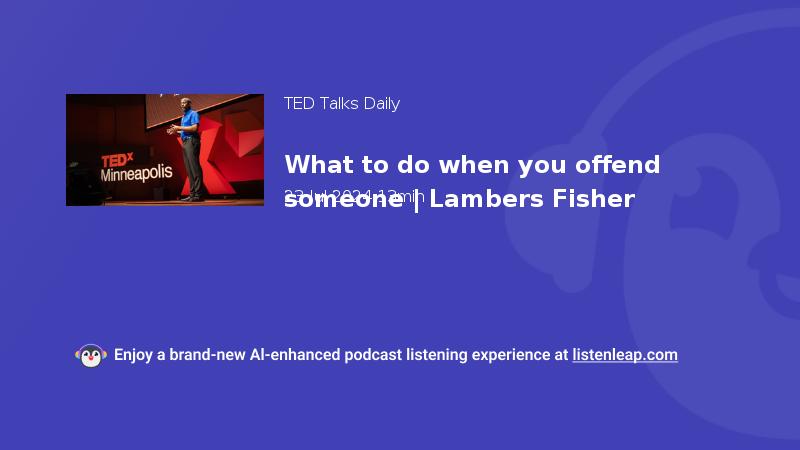
Ted Audio Collective You're listening to Ted Talks Daily where we bring you new ideas to spark your curiosity every day.
I'm your host, Elise Hugh.
I know it feels fraught to have difficult conversations.
I never want to offend anyone, and we come to the table with so many different perspectives and sensitivities.
Our relationship strategist Lambert Fisher says we should expect that we might hurt each other in our relationships.
These instances can often strengthen us and our connections.
He explains after the break.
And now our Ted Talk of the Day.
They say the road to hell is paved with good intentions.
But let's be honest, do we really want to live in a world where we no longer maintain good intentions?
Despite how negative and polarized in the world may seem at times, many of us are still doing our best to maintain good intentions and positive interactions with each other.
And yet, it can be frustrating sometimes to discover that something that we've said or done was still experienced by someone else as being offensive.
In response to this, it's easy to get stuck in unhealthy, extreme reactions such as strongly defending our character from perceived attacks, only to realize that we've invalidated someone else's feelings as a result.
Or maybe we walk on eggshells or jump through every hoop possible to avoid affending anyone only to shame ourselves for making any mistakes or blame others for being too sensitive.
Or maybe we just give up all together, concluding that you just can't make anybody happy these days.
So why even try? I don't know about you, but that makes me scared.
Because I don't know how we can maintain good intentions and positive interactions with each other if we are still going around living in fear of even unintentional offenses.
However, I believe there's another way.
With your help, I believe that we can maintain good intentions, avoid the shame and blame game and even strengthen interactions with those who we encounter on a regular basis.
And that's of interest to you.
And I invite you to join me in learning to accept the inevitability of offense.
Let me explain. During my 20 plus years as a marriage and family therapist, I've considered it an honor to be welcomed into the emotionally vulnerable spaces of new and seasoned couples through a variety of life circumstances and challenges.
During that time, I've gained a great appreciation for four relationships strengthening principles that have helped not only the couples who I serve, but also individual, personal and professional relationships in all walks of life.
This first relationship strengthening principle comes to life for me doing one of my greatest professional joys, which is when premarital engaged couples come into my office with a big smile on their face, expressing how confident that they are that they have found the one who they are to spend the rest of their life with, primarily because they never disagree or argue with each other.
That's when I get a big smile on my face.
And I say, that is awesome.
You guys are in the right place because I can help you fix that.
They get confused just like that.
And they say, wait, what?
You want us to argue and fight with each other?
I reassuringly say, no, no.
But I do want you to know that you can disagree with each other and still love each other.
You can misunderstand each other and not conclude that maybe we aren't meant to be or in the relationship prematurely due to seemingly irreconcilable offenses.
You see, no matter how hard you try, you will.
We will all offend someone at some point in time in our lives.
You know how I know? Because there's no absolute list of what's offensive and what's not.
What's offensive changes over time?
What's offensive to one person is perfectly fine to the next.
After all, you can't tell someone what they should be offended by and what they shouldn't.
Not only that, but what's offensive is not always about an absolute list of right wrongs, but more often something that was said or done that reminds someone of a past hurt and makes them fear their future harm is on the way.
As a result, if you find out that you've unintentionally offended someone, I encourage you to resist the temptation to get stuck in the shock of the existence of the offense, instead accept the inevitability of offense.
Take the time to learn what made that offensive to the person in front of you and then make every reasonable effort to reduce the likelihood of repeating that offense moving forward.
The second relationship strengthening principle that comes to life for me often does so when I see couples believing that if you don't know me by now, you will never, never know me.
As if to convey that if you don't instantly understand and know everything about me, then you must not truly love me.
But in reality, I found that some of the best and long-lasting couple relationships are the ones that embrace not knowing everything that there is to know about a person instantly, but actually appreciate the opportunity to keep the relationship fresh by learning new things about each other for years to come.
Similarly, in your personal and professional relationships, I encourage you to acknowledge that you can't know everything there is to know about everyone all the time.
Or put more simply, I encourage you to accept the inevitability of ignorance.
Now, I don't know about you, but I grew up with ignorance as an insult, synonymous with lack of intelligence.
But in reality, ignorance is merely the lack of knowledge.
And if we're honest, we all lack knowledge, a variety of different life circumstances, including the things that many people find offensive.
However, I do fair warning.
If you are informed that you unintentionally offended someone and the first thing out of your mouth is a justification for how you didn't know that it was offensive, it is emotionally reasonable for someone else to respond to frustration.
How could you not know? Everybody knows that that's offensive, except there's nothing that everyone knows.
Not only that, but how does it not know that it was offensive?
Maybe you would never talk by someone important to you that it was offensive.
Maybe you never personally experienced the hurt that would have taught you that it was offensive.
Maybe you would never surrounded by people who experienced the hurt that would have taught you by witnessing that it was offensive.
How could you not know? Well, how could you also know?
What makes this not just another insensitive defense of excuse is that we can learn to accept the inevitability of ignorance as a temporary state, turning that accusation into an opportunity to reduce our ignorance by increasing our knowledge and using that knowledge to reduce the likelihood of the next offense moving forward.
And now back to the episode.
The third relationship strengthening principle comes to life when I see a couple of stuck in the reasonable yet futile search for perfect communication.
For while healthy communication is essential to your relationship, it's also perfectly reasonable for partners to use the same words but mean completely different things based on the family of origin and life experiences even before meeting each other.
This often results in partners getting stuck in a defensive battle, protecting themselves from perceived threats that were never really attacks in the first place.
But unhealthily expressed, please for understanding, support and empathy.
Similarly, in your personal and professional relationships, I encourage you to learn to accept the inevitability of misunderstanding.
For even our reasonable intentions can result in unintentionally negative impact, leading others to feel the need to protect themselves from us as a perceived threat.
But wait a minute, why would you be a perceived threat if all you have is good intentions?
Well, consider this for a moment.
Consider the possibility that before they encounter with you, they experienced nine times of someone else saying the exact same thing or doing the exact same thing that you did.
But after each of those times, it was followed by a hurtful experience.
Then you come along, the tenth person to do or say that exact thing.
Despite your reasonable intentions, it's also reasonable for them to see the pattern and to fear similar harm from you.
It's because of this that if you find out that you've unintentionally offended someone, I encourage you to resist the temptation of getting stuck in the shock of the existence of the offense.
And instead ask yourself, am I really being attacked?
Or have I simply reminded them of a past hurt and made them fear that future harm is on the way?
If that's even a remote possibility in your life, I encourage you to accept the inevitability of misunderstanding and channel your efforts into the fourth relationship strengthening strategy, which is to learn to reassure the hurt person that you are not the threats that they fear that you are.
You see, when my couples get stuck in a defensive battle, protecting themselves from perceived threats and misrepresentations, what turns things around is not more explanations and justifications.
It's instead when one or both partners can get to the point of saying, I see better than I did before you are past hurts.
I see the impact that they've had on your current unmet needs and I want to come alongside of you to help make your future better than your hurtful past.
Similarly, in your personal and professional relationships, I encourage you to look for opportunities to reassure a hurt person that you are not the threat that they fear that you are.
How can you do this? Well, it can start with a verbal acknowledgement of the limitations of your intentions, recognizing that your intentions does not always determine your impact.
But some of you even hear may actually resent intentions.
But I find that many people don't actually resent intentions because they actually have a problem with good intentions.
But more often because people have received the gift of good intentions being offered instead of what they really need, changed behavior.
You can separate yourself from these experiences by making sure that your verbal acknowledgement of reassurance is always followed by meaningful behavioral change.
Showing that your commitment is more than just words, but actually showing to make their future better than their hurtful past.
Now, I'm not really here to tell you one more thing that you should already be doing but might not be doing.
No, I'm here to tell you what the next person who you unintentionally offend needs you to do.
They need you to accept the inevitability of offense.
Getting stuck in the shock of the existence of the offense does less to help that person than your efforts to reduce the likelihood of the next offense.
They need you to accept the inevitability of ignorance.
You don't need to know everything about everyone all the time, but you can accept what you don't know.
Value what you do know and learn more when experience at a time.
They need you to accept the inevitability of misunderstanding.
A knowledge in that your intent does not always determine your impact.
And they need you to reassure hurt persons that you are not the threat that they fear that you are.
You can do this with flexibility and openness to change, but not change out of correction for being a bad person, but change out of consideration for the well-being of someone else.
You never know. You might be the one in your environment to reduce the likelihood of the next misunderstanding influenced divorce, friendship break up, job resignation, or even cultural cancellation all often influenced by unintentional offenses.
And just like my couples, I want you to know that you don't have to live in a fear of even unintentional offenses.
Instead, you can accept the inevitability of offense.
With every reasonable effort to reduce the frequency of those offenses and move forward, repairing, and strengthening every relationship you encounter.
Thank you. That was Lambert's Fisher at TEDx Miniapolis in 2023.
If you're curious about TED's curation, find out more at TED.com slash curation guidelines.
And that's it for today.
TED Talks Daily is part of the TED Audio Collective.
This episode was produced and edited by our team, Martha Estefanos, Oliver Friedman, Brian Green, Autumn Thompson, and Alejandro Salazar.
It was mixed by Christopher Faisy-Bogan, additional support from Emma Taumner, Daniela Balorezo, and Will Hennessey.
I'm Elise Hugh. I'll be back tomorrow with a fresh idea for your feed.
Thanks for listening.