Is this Frida Kahlo?
Or is this?
Maybe this is the real Frida.
Or this.
Actually, maybe this is she.
This is definitely not she.
Neither is this.
Nor this.
Or even this, although it's brilliant.
While the artist passed away in 1954, when she was still with us, Frida Kahlo propagated her own image in numerous ways, through her distinctive style and commanding presence in front of the camera and, of course, through her artwork, which includes a significant number of self-portraits.
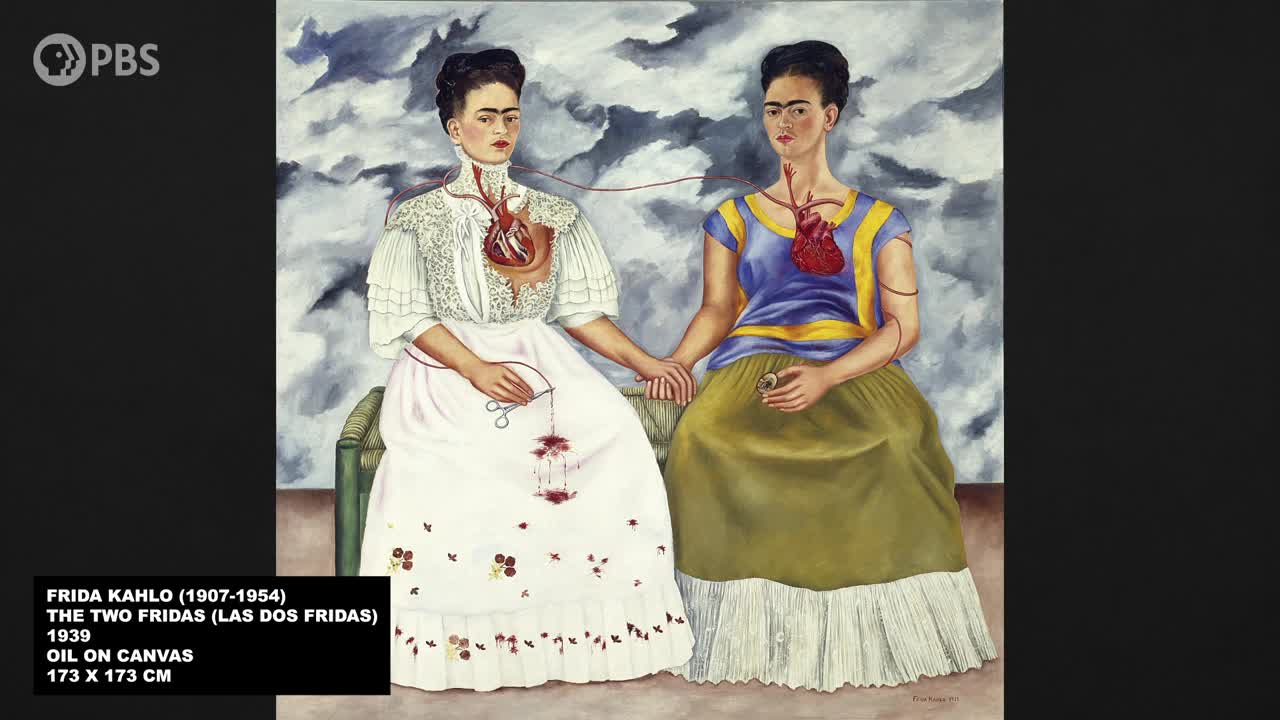
This one she titled Las Dos Fridas, or The Two Fridas.
It's one of her largest and best-known works, and it gives us a revealing glimpse into the inner life of Frida.
The person or persons.
But we're talking about it because it allows us to see beyond the compelling presence of Frida, the icon, the persona, the legend, and begin to appreciate the singularity, power and magic of the actual art she left behind.
Let's better know Las Dos Fridas.
The painting depicts two Fridas sitting side by side.
The Frida on the left wears a Victorian-style lace wedding dress and the Frida on the right wears a tehuana ensemble, the traditional dress of Zapotec women in the Oaxaca area of Mexico.
The artist herself had begun to wear clothing in the style of indigenous peoples of Mexico on her wedding day in 1929 to famed muralist Diego Rivera.
She borrowed from a maid a skirt, blouse and rebozo shawl to wear for their ceremony at City Hall in Coyoacán, the borough of Mexico City where she lived.
Diego preferred this style of dress, but it also served to express her Mexican identity both at home and when travelling abroad.
It also demonstrated her political endorsement of post-revolutionary Mexico during a time of widespread effort to cultivate a sense of national identity following the country's hard-fought independence.
Government-commissioned murals by Rivera and others were part of that, literally painting the contributions of Mexico's indigenous peoples back into its history and its present.
Before her marriage to Rivera at the age of 22, Carlo wore a variety of styles of dress including, upon occasion, a men's suit.
Her father was Jewish and born in Germany, her mother Catholic and born in Mexico.
Carlo's childhood was marked by illness.
She contracted polio at the age of six and emerged with a right leg shorter than her left and a limp.
At 18, she was riding a bus when it collided with the tram and left her severely injured.
She spent over a year convalescing and it was during this time that she began to paint.
Her mother had an easel made that attached to her bed and a mirror was installed on the underside of the canopy, allowing her to see herself as she painted.
The artist would be physically impaired, undergo numerous surgeries and suffer great pain for the remainder of her life.
Carlos' sartorial choices not only expressed her identity and ideals, but also accommodated her disabilities, covering the braces and plaster casts she often had to wear and distracted from them.
Our right-hand Frida, holds a small portrait of Rivera as a child, an amulet she had in real life that was among her belongings when she died.
An artery flows from the photograph and entwines around her arm, connecting to her exposed heart and extending across the canvas towards the even more exposed heart of our left-handed Frida.
This, Frida is trying to stem the flow of blood from the artery with a pair of surgical forceps, but isn't entirely successful.
The blood loss continues and forms stains that mimic the embroidered red flowers that decorate her skirt.
Carley made the painting in 1939, following her divorce from Rivera, which he had asked for.
About the work.
She explained that the one of Frida is the one Rivera loved and the wedding dress Frida, the one he no longer loved.
The two would remarry the following year, But their relationship was extremely volatile for its duration.
He had numerous affairs with other women, including Carlo's sister Christine.
And she, in turn, had extramarital relationships of her own, with men as well as women.
Carlo's paintings chart the ups and downs of their relationship, whether depicting she and Rivera, or gory stories of murder drawn from the news, or self-portraits exploring her inner life as well as outer life.
Still, Carlo and Rivera both maintained that they were the loves of each other's lives.
She shared in a 1939 interview.
The two Fridas are otherwise very much alike, one with slightly paler skin but with identical braided hairstyles, similar expressions and the close-knit eyebrows that Rivera once described as seeming like the wings of a blackbird, their black arches framing two extraordinary brown eyes.
The Fridas gaze out at us as they sit on a simple woven bench in a spare desert-like space.
A dramatic stormy sky takes up most of the space behind them, contributing to a sense of doom and unease, much like the skies of famed painter El Greco.
Carlo's work fuses elements of many artistic styles from different times and disparate parts of the world.
When she was young, she admired the 16th century portraits of Italian artist Bronzino, made in the Mannerist style with clearly delineated, elongated forms.
Some of her early paintings bear traces of this style, along with aspects of the work of more recent European painters like Modigliani.
Carlo's Catholic upbringing surrounded her with the iconography of the church, and that imagery suffuses her work.
She and Rivera actively collected Mexican art from a variety of traditions, pre-Columbian objects, folk art and a large number of retablos, small devotional paintings on wood or metal that venerate Catholic saints.
These were inexpensive paintings used in home altars that were very much part of life in 19th and 20th century Mexico.
Rivera once referred to Carlo's paintings as unconventional retablos imbued with a monumental realism.
But it was surrealism that Carlo was frequently associated with a label given by the movement's French leader, André Breton.
While she never saw herself as a surrealist, He viewed her as one, championing her work in Paris and New York and famously referring to her as a ribbon around a bomb.
The Surrealists were influenced by the work of Sigmund Freud and sought ways to free themselves from the strictures of the conscious mind.
They experimented with ways to tap their dreams and access subconscious thoughts.
But this came naturally for Carlo.
It was never something she set out to do.
In her work there is never a clear line between interior and exterior, conscious and subconscious, real and imagined.
She once explained, The surrealist did love the technique of doubling though a way to destabilize the self and present identity as something fractured and in flux.
We see double portraits in a number of moments in art history, a tactic used towards a variety of ends.
We also see it in other works by Carlo, like in this double self-portrait titled Tree of Hope, painted after she underwent spinal fusion surgery in 1946.
But for this work.
The artist described the two Fridas as being nothing but the representation of my loneliness.
What I mean to say is, I resorted to myself.
I sought my own help.
The two figures are holding hands, after all.
Loved and unloved Frida are distinct entities, but united.
The cultures of Europe and Mexico, as expressed through each Frida's clothing, are separate but conjoined.
While for art historian Hayden Herrera, the doubling in this portrait deepens the chill of loneliness, another reading sees these two Fridas as suffering and fractured, but self-supporting and despite it all intact.
Their bared hearts relate to the loss of Viego, to be sure, but they are also a symbol found often in the art and culture of the Aztec peoples who referred to themselves as Mexica.
In Mexica mythology, the capital city of Tenochtitlan was founded on the buried heart of Copil, which was thrown into the middle of Lake Texcoco and from which grew a prickly pear cactus with an eagle perched on top.
We also know that the Mexica did actually extract the hearts of captive warriors taken in battle and give them as offerings to their gods.
So there's that, too.
But in Mexica, art and culture, the heart represented the life center or, as archaeologist and ethnologist Loretta Jornet put it, the place of union where the luminous consciousness is made.
But you don't need to know all of this history for the work to be intelligible.
After her death at the age of 47, following years of declining health, Kahlo remained a popular and influential figure in Mexico.
But she only rose to international fame and to the fever-pitched freedomania that exists today after her work was reconsidered and resurrected by feminist scholars in the late 1970s.
While Kahlo's work explored the artist's own highly individual and specific life, Lots of the issues she represented speak to the concerns of many.
With unrelenting honesty, her work records and reveals experiences of pain, both physical and psychological, experiences of fractured identity and the negotiation of nationality, of miscarriage of love, of betrayal, of loneliness.
We are fascinated by Karlo for good reason.
It's impossible to separate her remarkable and tragic life from her work, and she didn't want us to.
Her beauty and resilience can make it hard to fully recognize the complexity and importance of the artwork that communicates it.
But Carlo stares straight at us and shows us again and again her persistence and resolve.
The scenes around her shift, but there she remains serious steadfast confrontational fragile, but also strong.
Of course we love her.
Karlo created her own myth, her own persona.
She made herself into a sacred figure to be venerated, an icon fixed in time, not vain aware, alive to her transience and multiplicity.
She looks at us and we at her.
We acknowledge her, bear witness to her suffering and affirmed that for a time she was indeed here on Earth.
The real Frida Kahlo may be gone, but the two Fridas, and the many Fridas, are still here.
And we are with her.
Thanks to all of our patrons for supporting The Art Assignment, especially our Grandmasters of the Arts Tyler Calvert-Thompson, Divide by Zero Collection, David Golden and Ernest Wolfe.