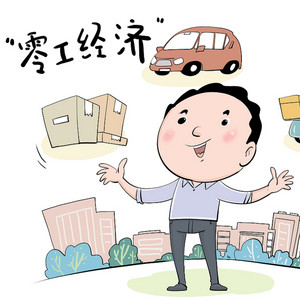
The global gig economy is experiencing significant growth driven by factors such as technological advancements and increased demand for flexible work arrangements.
However, the growth of the gig economy also presents challenges, including concerns about workers' rights, income stability, and the lack of social safety nets for gig workers.
Here in China, the Supreme People's Court has stepped in with examples to follow on gig workers' rights.
We'll find out what those are today.
After that, I'm not sure if you're a food label reader or not, but if you are, then I'm sure you know that they're kind of a pain because of the big words and the small print.
But now, many countries around the world are using what's called a Nutrient Profiling System to keep shoppers better informed.
What exactly is that and how will it affect the way we choose our foods?
We are live from Beijing.
This is Roundtable.
Thank you so much for being with us today.
My name is Steve and I'm joined by Fei Fei and Lai Ming.
First on today's show, the gig economy offers significant flexibility, allowing individuals to set their own hours and work schedules, which can be highly beneficial for those with other commitments like, I don't know, childcare or studies.
It provides a platform for entrepreneurship and it also allows individuals to leverage their skills and passions to generate income, potentially leading to greater job satisfaction and a sense of autonomy.
And in China, the gig economy, oh, it's booming, but workers are often left wondering, am I really an employee at this company?
With millions of delivery drivers, ride -hailing chauffeurs and more working in the industry, it can be tough to know who holds the power.
As a result, China's Supreme People's Court has stepped in to shine a light on gig worker rides.
Fei Fei and Lai Ming, good afternoon to you.
Good afternoon. Very nice to be on the show.
About the gig economy, I think in China's context, the definition and people's reaction to it might be different from people in a different country.
I'm saying that maybe perhaps more than four decades ago before the reform and opening up, we were basically running the state -owned enterprises and that was almost every job you could look for.
But now, since the reform and opening up, we try to diversify the forms of economy and businesses and so that has somehow changed people's perception about what is satisfying and ideal jobs and what are not.
And also, the other thing that I'd like to highlight is where China might be similar to other countries in the world, that is the impact of technological advancements that you mentioned earlier, the diversification of the economy and the advent of the Internet and also AI.
This new trend has also generated new gig jobs and new thinking about gig jobs.
In that sense then, we're almost in unprecedented times because, as you mentioned, until things opened up, maybe the gig economy didn't ...
Is that fair to say that in China before things opened up, the gig economy didn't even really exist at all?
I'm not sure it existed on a large scale.
There wasn't the economic or the private sector running, we were just helping each other, that kind of thing.
I also think it depends on how you define gig economy because what's the difference between part time jobs, for instance, and with freelancers?
And I think the gig economy in particular right now that we are referring to are part time jobs that are working in a very short term tasks.
They're not involved in a very long term task and often the case is that they don't need to sign the contract because maybe their work is daily basis, can be finished within a day or two days or within a week.
That's why the gig economy is very different from, for example, the part time jobs that we used to refer to here in China even before they're opening up.
We do have a very small amount of part time workers, but they still need to sign some sort of a contract and their work can span to several years long.
Or even it can also be a lifelong job, it's just different types of contract that they're signing.
So right now what we're talking about is people working on, they're looking for to have their paycheck by the end of the day or by the end of the week, which is very, very new here in China and also very appealing to a lot of the young people because of the flexibility that they offer.
Very appealing, yet it leads to that sense of confusion that we're going to get into in a moment or two about what rights do we have here as gig economy employees.
So, I mean, let's get into it.
What's the current situation on gig workers in China?
Well, according to data released by the National Bureau of Statistics, by the end of 2021, the number of flexible workers in China had already surpassed 200 million, and according to this accounted for about one -seventh of the total population, which is quite impressive.
And according to a 2022 report on China's gig economy from Six Sigma Research Institute, this number expected to double to about 400 million by 2036.
So this is expected, it's already huge, over 200 million people, but almost doubled within another decade or so, that's the expectation.
This is way bigger than the number you can find in Europe, which is about in the tens and then twenties.
I think the number is 28 million people working through digital platforms in the European Union, according to the European Commission.
This is not just city level, this is county level as well?
Sure, yeah. A survey led by 58 .com and in Tsinghua University show that 52 .27 % of people in county level markets earn income from gig work, and of these, around 35 % of gig jobs in counties are related to the internet, and is what we talk about online shopping, e -commerce, ride hailing, food delivery,
and that sort of thing.
And among all types of gig work, internet plus gig jobs rank the highest.
And additionally, production based labor such as construction, renovation, and moving as well as basic jobs in sales, catering, and handicrafts also attract a large number of workers in counties.
And I guess that's what you were referencing before?
The traditional and the new.
Yeah, exactly. So the internet plus gig jobs, those would be relatively new in the country, but things like construction and renovation, moving house, assistance with that, that might have been around for a long time.
Feifei, what do you think is a good list of examples just to provide a context maybe for some of the gig economy jobs that are popular here in China?
Well, definitely on the top of the list would be food delivery, guys.
We can't live without that.
Yes, right. I admire that.
And also the ride hailing drivers.
And then also I think a quite phenomenal, quite popular online in the recent months among young people is that they are looking for a gig job to supplement their full time jobs during the nights.
For example, some young people would decide to work at distribution centers for, for example, grocery store online shopping platforms.
Yes, because, you know, working in the day in the office, they suffer from like, sore necks and lack of exercises.
But then at night, they work at these distribution centers and requires a lot of labor work.
And that is sort of exercises in their eyes and also earned supplement their income in a way.
Two birds with one stone there.
They might be disappointed because a lot of the distribution centers, they're being highly automated.
So I doubt they have the opportunity to really flex their muscles.
But I'm sure some of them are working hard.
Online tutoring popular here in China.
Those services are available.
Food delivery, as you mentioned, ride hailing, as you mentioned, e -commerce logistics probably as well because there's such a boom in online shopping.
There are a number of platforms here in China that do that.
Livestreaming as well is extremely popular.
Yes, right. Yes. It was huge several years back.
I mean, it's like all we talk about on Roundtable with regard to Internet was Livestreaming.
The word of the day, you know, what new history are they making, that kind of thing.
So it is it is very influential.
It is still pretty much influential.
And the superstars, they go and sell stuff like cosmetic stuff, cosmetics.
I don't really have the vocabulary to name the stuff they're trying to sell in terms of cosmetics.
But I know at some point the second most influential, in fact, the most influential female Livestream host promoted satellites in one of her streams.
She was selling satellites.
Satellites, yeah. Wow.
Yeah, you can get almost anything purchase through a Livestream here in China.
Cosmetics is liming, you mentioned fashion, food, groceries, luxury goods, satellites.
That's I didn't expect that to be on the list.
But even cars and houses, which I think is a cool thing, you know, they'll do a Livestream where the agent will walk you around the house and show you the different rooms.
And it's just it's a really, really popular way for sellers to get their information out there.
Why then do you think is there such a high demand for gig workers, maybe not just here in China, I suppose, but worldwide?
We mentioned the number from the European Union, more currently more than 28 million people working through digital platforms.
And data from Japan's cabinet office shows that in 2022, the number of temporary workers in Japan had exceeded 21 million.
There are no match to China's size in terms of population, but still quite significant.
The reasons why gig economy is on the rise is one of the reasons being businesses who would like to manage the cost.
If small businesses were talking about like a foreman or delivery or a moving company, or even people like us, we don't necessarily have the fund to hire everybody we want.
And as such, we outsource certain jobs out there.
For instance, the latest example being the job of using AI to make still pictures move, turn them into videos, short videos, so we can edit them together to form longer form videos.
And so this particular demand generates two more of this particular job, generates demand for two types of jobs.
One is to generate the moving pictures, and the other is to edit.
We covered that on Roundtable.
The computing power rental economy, which is amazing, right?
If you need a lot of computing power for just one day, you can rent that power for just one day.
It's kind of the same when we're talking about cost control for businesses, because from the business point of view, when you employ gig workers, then if you have a busier season or a peak season, then you can hire gig workers during that time as needed, and as for as long or a short amount of time
as you need. But then there are other advantages from a business point of view as well.
Health insurance, probably not included for gig employees.
Then you have reduced overhead costs associated with full -time employment, like office space and equipment and things like training.
You can easily scale up your workforce or scale it down at any time you want.
So from a business point of view, there are some obvious advantages here.
And these are cost -related.
But there are other reasons people would like to hire an outsource.
For instance, we don't necessarily have the people who understand the latest AI technologies, whereas there are very competitive people out there, which we can't...
Again, funny, we go back to cost again, which we couldn't afford to hire, but we are essentially hiring them to use their talent.
Yeah, so you have an increase in the talent pool as well, a wider array of available people.
And then, Fei -Fei, what do you think from the employee's point of view, what are some of the advantages you can think of?
Well, I think flexibility is definitely number one.
Not only flexible in time, but also flexible in locations.
And I think we talked about the digital nomads a few years ago, that a lot of young people, they can work online so that they can travel around the world while also maintaining their income.
And then also at the same time, the technology, like different digital platform, as we mentioned before, the food delivery platform, or the internet, mobile apps, are building this dialogue and communication platform.
So that employer and employees have the opportunity to match their needs and demands.
Yeah, it just makes it a lot more convenient, right?
Because you can connect now, whereas in the past, perhaps you needed to visit a community center to check the board inside the main lobby to see what gig jobs were available.
All right, Leiming, let's get into it then, the meat of this issue, if we could.
Mm -hmm. What challenges are we talking about?
What challenges do gig workers face when it comes to protecting their rights?
Well, there are, when it comes to gig workers, if you look at the job market from the employee's perspective, in fact, in very strict terms, there are not necessarily employees that are temporary employees, but even in their perspective, they are a biased market and a sales market.
There are those who are competitive in the job market, the AI technicians that I mentioned earlier, they are certainly very competitive and they can use the flexibility to do whatever jobs they find fit that would promote their own development.
I mean, they are free to choose from job to job, but there are also those who set areas where the workers are experiencing a biased market, where the employers are free to decide the terms on which they are employed.
So, the flexibility certainly is a blessing, but on the other hand, it also leaves workers without basic protection like social insurance, companies or employers avoid formal obligations by denying gig workers a formal employment status under labor law.
Right. And then, so when you say formal employment status under labor law, that comes with a very long list of...
Obligations. ...the benefits and obligations, right?
It's a formal contract and that's not to say that gig workers won't have a contract, but they'll have a very simplified contract perhaps with job expectations, job duties and pay and perhaps the duration and that's about it.
So, the courts here have been dealing with civil...
In fact, a lot of civil cases.
Yeah, 80 ,000 civil cases from January to November 2023.
Chinese courts handled around that number of civil cases involving gig jobs or what we call new employment forms.
Basically, jobs are not fully signing a formal employment contract as we used to define it.
And another issue with that is some workers, for example, there is an example shared by the courts that a worker who worked as a live streaming host and did not receive their salary because they didn't sign a formal contract with the company.
And so, they experienced issues like being required to pay upfront fees, having money deducted without explanation or even without receiving any payment as promised.
So, then in these cases, they need to go to a course and solve these disputes.
And also, there are also workers who saw a gig offering for poster design and she joined the group and she was told she needed to pay 3 ,000 yuan for a course before she could take on these assignments.
And then eventually after completing the course and submitting her work, the client just simply disappeared and leaving her unpaid.
So, there are issues like this and also checked with one of my friends who also work on gig jobs.
And she said sometimes when the gig job is not that big and is really short time, they won't sign a contract.
It just seems really, it just seems pointless to sign a contract for, say, a one day event.
Yeah, because I mean, who's enforcing this contract?
Yeah, exactly. So, they just go to the event venue and get the work done and then receive the payment after the day wraps up.
But this could lead to many issues and even disputes.
I mean, we say they don't receive pay at the end of the six months or one year.
What are they to do?
Yeah, what's the recourse they can take?
Right now, they are asking for a down payment, sort of 10, 20 % in advance.
And then often the case is the client would sometimes pay the rest after they finish their job.
And that's like the common practice right now, on the market.
So then, how did the courts get involved?
And by the way, let's clarify because the China Supreme People's Court, Laiming, this is not a law making entity.
It's not the legislature.
China's legislature is the National People's Congress.
But the Supreme People's Court, they do give rulings on significant cases, high profile cases.
And some of the cases can be used as reference for lower courts.
Okay, so when the Supreme People's Court got involved here, they were not introducing new laws to be followed.
What they're introducing here is guidelines, is that correct?
They showed examples of how they interpret the laws that the lawmakers made.
So on December 23, 2024, the Supreme People's Court of China issued his first set of guiding cases on labor disputes related to new forms of employment.
And this responded to concerns about the determination of labor relationships for workers in emerging job categories, such as delivery riders, online streamers, and ride hailing drivers.
I have to say, a lot of the issues we've talked about on Roundtable, and it seems that they've landed on a very, very important turn that we previously didn't think about.
And that is the deciding, the term control, or say, or decision.
I mean, if for instance, in the case of delivery riders, they don't have the freedom to decide the kind of payment they get.
I mean, a lot of them are based on algorithm or maybe a contract, but there are search fees.
So in many cases, the tech companies or the service provider has a wider range of say, in deciding how the business is conducted.
And the individual drivers, they don't necessarily have the ability to collect and accumulate their own customers.
Yeah, right. Comparatively speaking, they're in a less...
What's the term looking for?
Entrepreneurial role, I guess.
Well, they can't really bargain with the platforms or the companies, right?
In that case, then that is where the company has more control over the situation than the gig worker does.
I think we see this almost, if not very similar, then exactly the same in other country.
In Australia, workers fall into two different categories, employees or independent contractors, and employees receive comprehensive legal protections and minimum wage and maximum working hours.
And we talked about that on Roundtable, the right to disconnect.
In Australia, you can't contact your employee after a certain hour in the day.
Australian courts, they use a multi -factorial approach to determine whether a worker is an employee or an independent contractor.
No single factor is a deciding factor.
They look at the overall relationship to make the assessment.
In Canada, workers are generally categorized as employees or independent contractors.
Exactly the same, right?
Based on the degree of control an organization has over them and their dependence on the organization.
For example, an Uber driver.
For example, a food delivery worker, just like we just talked about here in China, where you can't create your own customer base, you're reliant on the company for that.
You're not building your own business.
Yeah, exactly. So then recognizing employment status globally is a real challenge, isn't it?
Yes, and I think right now countries are realizing that when trying to define or decide what kind of employment status these workers are getting involved with, contracts are not the deciding factor.
I think it's here recognized here in China and also in Australia and Canada, as Steve just mentioned, that they have to look at different factors involved in the control that you have or the level of oversight you receive or the rules you have to obey or follow and how you can alter the terms of your
employment. Contracts now are not that strong of a factor in determining whether you are employed by this company or not.
And I think another example shared by the Supreme People's Court here in China is that a very interesting one is about a very big online streamer with his or her agency, is that the court decide that the streamer have enough power to bargain with that agency so that they are not really in an employment
relationship, but more of a collaboration type of deal.
So then in this case, you can't really, when they are going to court, you can't rule this case by the status of employment, but maybe in other clauses of the law.
I guess that's what makes this so challenging is that because there are so many different types of gig work, it's hard to put one theory or one rule of enforcement over everything, and it really is a case by case scenario.
Yes. And also because I think it's because of the current legal framework is quite outdated, because before in every country, basically, you need to sign a contract.
We know that you need to sign a contract to get employed.
But now with digital and internet platform, the landscape's changing, and I think laws need to be revised as well.
Yeah, and to address the challenges, perhaps clear legal framework could be looked at, maybe universal worker protections, improved contract transparency, regulation of outsourcing workplace injury, right, for people who work gig work in construction and things like that.
All of these things need to be put into place.
And maybe in the future, we'll see some sort of hybrid employment categories and substance over labels and maybe some collective bargaining agreements as well.
There's no doubt that the gig economy is booming around the world and booming, booming bigger here in China.
We do need to put some framework in place to protect people and their rights.